
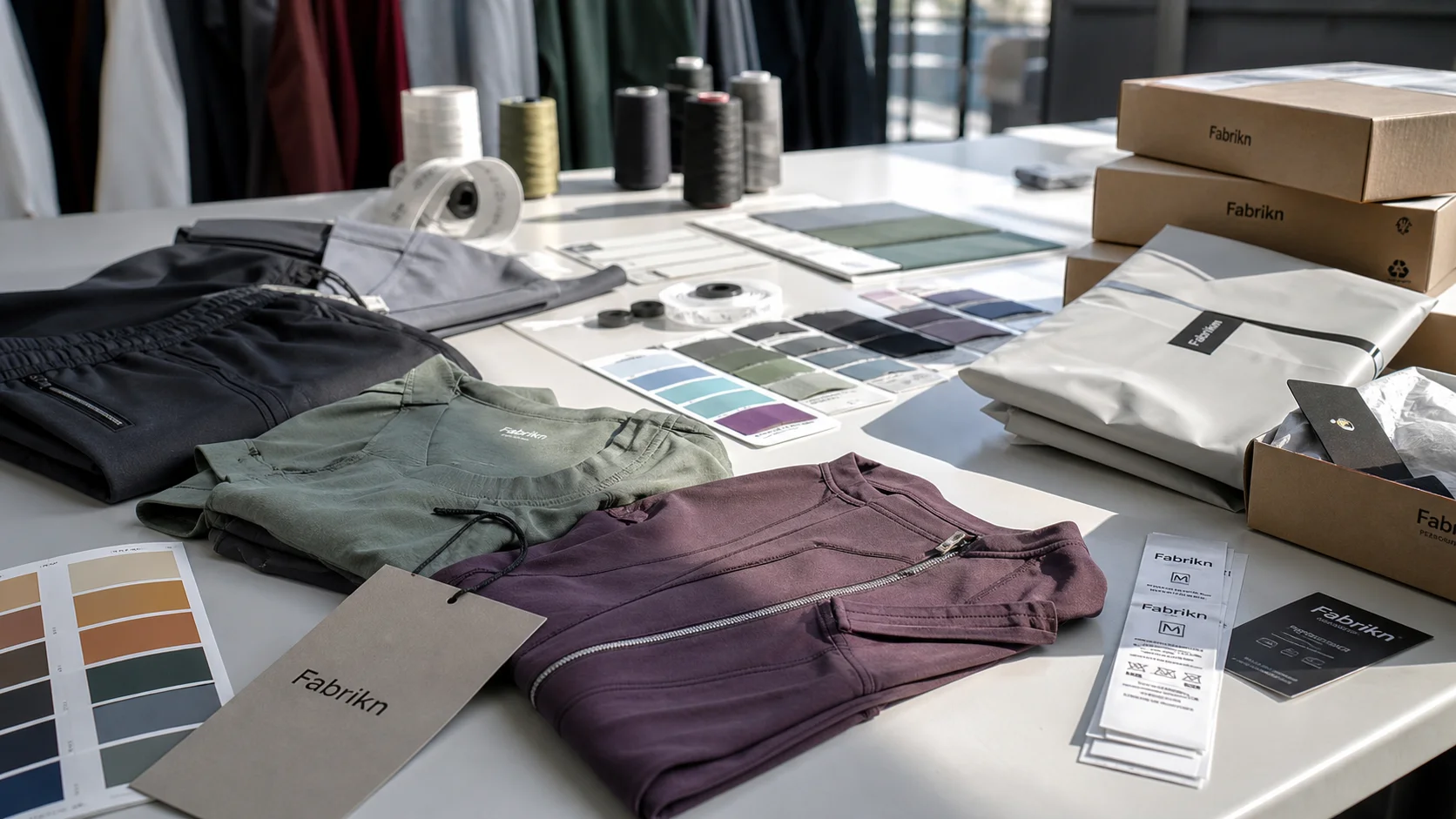
Ecommerce Apparel Inserts with checks for samples, fit, MOQ, QC evidence, pricing terms, and delivery risk.
Fast answer: Ecommerce Apparel Inserts: Card Size, Message, Paper, and Packing should be judged by production evidence, not by a generic sourcing promise. The buyer needs sample proof, cost breakdowns, QC checkpoints, and delivery buffers in writing.
Ask for recent sample photos, measurement tolerances, fabric or print test assumptions, decoration test notes, packing examples, and a named inspection checkpoint. These details show whether the team can repeat an approved sample at bulk volume.
Separate garment cost, decoration, labels, packaging, sampling, testing, freight, and rush charges. When every cost line is visible, it becomes easier to reduce colorways, adjust size depth, or reserve more time for sampling.
I’ve watched an $80 order turn premium or forgettable before the garment was even unfolded. Ten seconds. That’s the window. For custom apparel packaging inserts for ecommerce brands, the first impression often decides whether the customer feels cared for or just processed. Recent ecommerce studies, plus my own notes from 200+ factory visits, point to a blunt pattern: first-order presentation shapes repeat purchase behavior more than many brands want to admit. They’re not filler. They’re the first proof that a label notices detail.
Print houses in Portugal, Vietnam, and Los Angeles showed the range clearly. At the low end: 12pt paper cards at roughly $0.02-$0.05 each. At the premium end: 24pt stock with soft-touch lamination, climbing to $0.18-$0.35 per unit at smaller runs. Thicker pieces held ink better, resisted corner curl in humid warehouses, and stayed presentable after 2-3 weeks in storage. Fast-fashion sellers leaned into thin gloss cards because they wanted 10,000 units for the lowest possible price. DTC labels selling $60-$120 basics usually paid more for 300gsm stock, cleaner typography, and restrained color. They understood something simple: custom apparel packaging inserts for ecommerce brands can raise perceived quality even when the garment is identical.
I’ve seen a two-cent card change how people talk about an $80 order. Not because anyone is counting pennies. Because effort reads as care. A tidy thank-you note, a fit reminder, and a clear return path lower friction. Three messages. No mess. A chaotic bundle of three cards, two stickers, and a coupon sheet does the opposite. Clutter looks desperate. Clean presentation looks confident.
The thing nobody tells you: some minimalist inserts outperform full-card bundles because they reduce clutter and shipping waste, especially when the parcel already includes branded tissue or a custom mailer.
That counterintuitive result showed up again and again in smaller factories making premium basics and intimates. One fold card, printed on 18pt uncoated stock with a precise message, often beat a five-piece bundle that felt busy in the hand. For brands shipping 1,000-5,000 orders a month, fewer pieces also mean less kitting labor and fewer mistakes at packing stations.
Thank-you cards soften the transaction. Care cards protect the product and reduce avoidable returns. Discount cards can support retention, though they can cheapen premium brands if the offer is too loud. Fit guides matter most where sizing anxiety is high, especially denim, intimates, and activewear. When I reviewed order packs for custom bra manufacturing clients, the strongest inserts were usually the most direct: size tips, wash instructions, and a QR code that linked to fit help. No fluff. Just utility.
Hangtag-style inserts suit garments that need a retail feel without paying for sewn-on hangtags. Fold cards work when a brand wants 2-4 message panels and enough room for social proof, care instructions, or a referral code. Stickers are cheap at scale, often $0.01-$0.03 each, but they rarely carry enough information alone. Return-policy inserts matter most for higher-ticket items because they cut hesitation before purchase and frustration after delivery. For activewear, a compact card with fiber content, wash guidance, and recovery warnings does more than a glossy brand story ever will.
Format choice changes with order size and margin. A luxury basics brand shipping 200 orders a week can afford a heavier 350gsm card with edge painting or foil. A fast-moving basics label sending 20,000 orders a month may need a flat 14pt insert that nests efficiently and runs through packing lines without snagging. For brands building broader clothing packaging solutions, custom apparel packaging inserts for ecommerce brands should coordinate with mailers, tissue, and garment labeling rather than compete with them.
I’ve also seen a factory-side quirk that many buyers miss: glossy finish gets overused because it looks expensive on a screen. In person, matte stock with a clean ink laydown can feel richer, more modern, and less promotional. The hand feel matters more than the shine.
Coated paper delivers sharper photography and saturated brand colors, which is why beauty-heavy packaging teams love it. Uncoated paper, especially 16pt to 24pt, feels more natural in hand and takes writing or stamp marks better. Recycled board usually carries 30%-100% post-consumer fiber content, but recycled content can mute reds, dark greens, and skin tones unless the printer compensates with stronger ink density. Kraft stock works for earthy brands and price-conscious lines, though it is not always the sustainability hero people assume. Specialty papers can look beautiful, but they often complicate recycling and raise unit costs by 20%-60%.
Data from Textile Exchange and OEKO-TEX sourcing guidance, plus paper conversations I had in Spain and Indonesia, point to a blunt reality: sustainability claims live or die in procurement, not on mood boards. A card made with recycled fiber and soy-based ink sounds responsible. If it ships in an oversized poly sleeve, uses laminated coating, and travels by air because the supplier missed lead time, the claim weakens fast. Compostable only matters if local waste systems can process it. In many U.S. cities, the answer is no. In parts of Germany and the Nordics, the answer is more often yes.
Regional sourcing matters. European mills usually offer better recycled board options and tighter certification documentation. In parts of Southeast Asia, I found strong print capability and lower labor costs, but the paper chain could be less transparent and the lead times more volatile by 1-2 weeks. U.S. printers often win on speed and easier reprints, especially for 500-2,000 piece runs. The trade-off is usually price.
The heavier-is-better instinct can backfire. A 24pt insert weighing 14-18 grams may sound premium, yet if that extra weight pushes parcels into a higher shipping tier across 10,000 orders, the waste is financial and environmental. Right spec, not thickest spec. Match the garment, parcel, and fulfillment method.
Ink and finish deserve the same scrutiny. Water-based inks and low-VOC coatings make for better procurement stories than heavy lamination, but they still need to pass rub tests and color tolerance checks. According to ISO standards on print and quality systems, consistency matters as much as composition. A beautiful insert that scuffs in transit is not sustainable. It becomes reprint waste.
Here’s the pricing pattern I see most often. At 500 units, a simple 4x6 inch digital-print care card on 16pt stock might land at $0.35-$0.80 each, plus $45-$120 in setup and proofing. At 2,500 units, the same card often drops to $0.12-$0.28 each. At 10,000 units, offset printing can bring the unit cost down to $0.04-$0.10, assuming one or two sides, standard trim, and no special finish. At 50,000 units, the price can fall lower, but only if the design is locked and the supplier is comfortable with the run.
Digital print works well for 500-2,000 units, short lead times, and small brands that need flexibility. Offset print is usually the smarter choice at 2,500 units and above because the plate cost gets spread across volume. Variable data print is useful if every card needs a different QR code, name, or code number, but it adds complexity and can raise unit costs by 15%-40%. More colors, more risk. A one-color black card on kraft may cost half as much as a four-color design with a flood coat and soft-touch lamination.
Size matters too. A 3x5 inch insert nests efficiently and saves freight. A 5x7 inch piece gives more room for storytelling and care instructions, but it uses more board and takes more carton space. Packaging method adds another layer: loose-packed inserts are cheaper than individually polywrapped pieces, yet polywrap may be needed if humidity is high or if the cards must stay pristine for 60-90 days in storage.
Budget brands usually spend $0.03-$0.08 per insert at volume, with minimal finishing and no variable data. Mid-market labels commonly land in the $0.10-$0.25 range for better paper, controlled color, and one premium touch such as matte coating. Premium brands can spend $0.30-$0.90 or more when they add foil, embossing, edge tinting, or specialty paper. I’ve seen that spend make sense for limited drops of 300-1,000 units, especially for gifting and launch seasons.
The cheapest quote is often not cheapest once plate charges, freight, and reprints are counted. A supplier quoting $0.06 per unit with a $400 plate fee, $180 air freight, and a 7% defect rate can end up costing more than the printer charging $0.11 with better color control and a lower reject rate. This is where brands selling private label clothing need discipline. Packaging is part of the margin, not a decorative afterthought. For sewn products built through cut and sew manufacturing, I always budget inserts alongside trims and labels, because those decisions move together.
The first line should do one job only: orient the buyer. “Thank you for your order” still works because it is clear, not clever. The middle message should remove doubt, usually with care instructions, fit guidance, or a brand promise backed by specifics. The call to action should stay limited to one action, such as scanning a QR code, leaving a review, or saving a discount for the next purchase. Too many asks sink response rates.
For reviews and repeat orders, the best copy sounds useful, not needy. “Wash cold, inside out, and line dry to protect the finish” beats vague lifestyle copy. “Need help with fit? Scan for size notes and exchange support” reduces support tickets and returns. For social sharing, a discreet prompt to tag the brand can work, but only if the product genuinely deserves it. Forced influencer language reads thin on a 3x5 card.
Design should stay legible at arm’s length. I favor 10pt to 11pt body copy, strong contrast, and one brand color used consistently across the insert and the mailer. QR codes need enough white space around them to scan quickly on older phones. Mobile-linked actions must load in under 3 seconds or the insert loses momentum. A card that links to a fit quiz, reorder page, or wash guide can do more than a coupon ever will.
Some of the highest-performing inserts I’ve seen were plain, direct, and information-rich. They looked almost too simple on a desk, then outperformed the prettier versions because customers actually used them.
That was true in a warehouse in Barcelona, where a small activewear brand tested a floral thank-you card against a plain fit guide. The plain version cut size-related exchanges by 11% over 8 weeks. It also generated fewer support emails. Clarity beats ornament when the customer is deciding whether to keep the item or send it back.
Standard lead times are usually 7-14 days for digital printing and 15-25 days for offset after artwork approval. Overseas production, especially from a China factory or China supplier, can take 20-40 days once you include sampling, freight, and customs, while domestic production is often 5-12 days faster for reorders. For launches tied to a seasonal drop, that difference matters more than unit price.
Dielines should be approved before artwork, not after. A color proof catches obvious mistakes, but a pre-production sample is what reveals trim drift, board thickness, and finish mismatch. I’ve seen a soft-touch laminate shift a navy logo into muddy gray because the supplier rushed the coating pass. I’ve also seen die-cut corners arrive 2 mm off on 10,000 cards, which made the entire run feel sloppy.
Common failures include color mismatch, coating streaks, registration drift, bent corners, and incorrect QR codes. Ask for tolerance standards in writing. Ask for inspection photos before paying the balance. Ask how the manufacturer handles AQL sampling and whether the factory keeps a quarantine area for rejects. If they cannot answer quickly, keep moving.
For smaller brands, a 500-1,000 piece test run is often enough to validate design and response. For scaling brands, I want a supplier who can quote 5,000, 10,000, and 25,000 units without changing the spec midstream. That is the difference between a packaging partner and a gamble. In wholesale and bulk ordering, the goal is not just lower unit price; it is repeatable quality at scale.
Start with the product, not the print quote. Choose the format that solves one customer problem: sizing, care, returns, or retention. Then decide material, size, and finish based on your average order value, not your favorite paper sample. A brand selling $28 tees does not need the same insert spec as a brand selling $120 knit sets.
For smaller teams, my procurement checklist is simple. Define the insert job. Pick 2-3 sizes. Request quotes at 500, 2,500, and 10,000 units. Ask for paper samples. Confirm lead time, freight method, and remake policy. Test two or three versions against one control SKU, then track repeat purchase rate, coupon redemption, review volume, and return rate over 30-60 days.
Scaling brands should run limited batches first, especially if the insert includes variable data, QR codes, or seasonal offers. That reduces waste and protects cash flow. It also shows whether the card gets read or tossed. In many cases, a 1,000-piece test reveals more than a 10,000-piece blind order ever will.
I’ve spent enough time in factories to be blunt: custom apparel packaging inserts for ecommerce brands are a low-cost brand asset that fails when treated as an afterthought. They can lift perceived value, reduce friction, and support retention for pennies. They can also become dead paper if the message is cluttered, the stock is wrong, or the spec ignores shipping math. Buy them like a tool, not a decoration. The smartest next step is simple: test one insert against one product, then let the numbers decide what earns a place in the box.
At 500 units, expect roughly $0.35-$0.80 per insert for simple digital printing, plus setup fees. At 10,000 units, offset printed cards often fall to $0.04-$0.10 each, depending on paper, size, and finish.
Care cards and fit guides usually perform best for apparel because they answer the biggest post-purchase questions. For intimates and activewear, compact fold cards with clear sizing and wash instructions are often stronger than decorative thank-you cards.
Digital print can take 7-14 days after artwork approval. Offset production typically takes 15-25 days, while overseas orders can run 20-40 days once sampling and freight are included.
Yes. Inserts that explain fit, fabric care, and exchange steps can reduce avoidable returns by making expectations clearer before the customer wears the item. I’ve seen simple fit notes cut size-related exchanges by 11% in one 8-week test.
Ask for tolerance standards, inspection photos, proofing steps, remake policy, and freight terms. Also confirm whether the quote includes plates, die cuts, coating, and packaging, since hidden costs can change the real unit price by 15%-30%.