
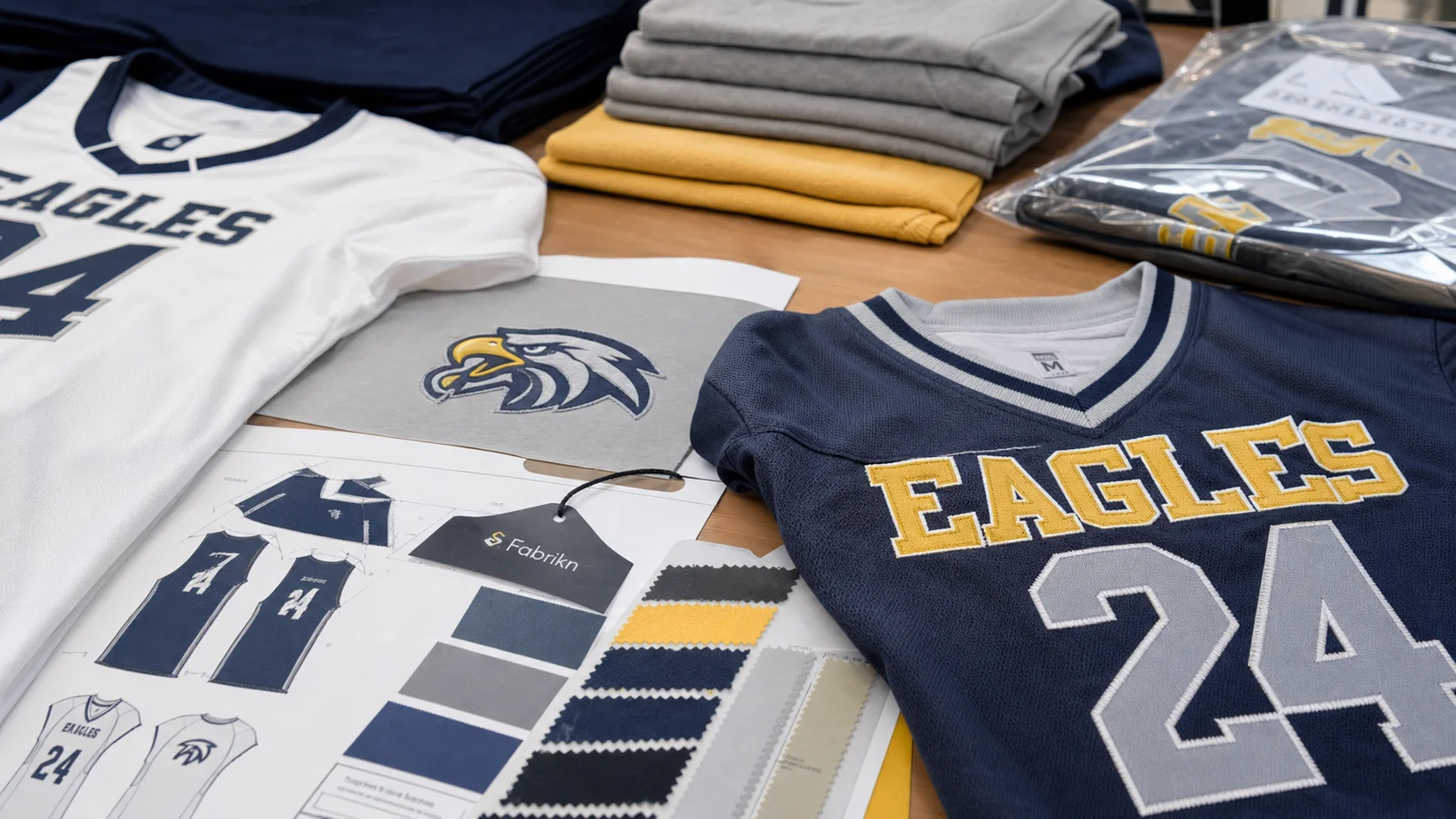
Should Go on A Clothing Hang Tag compared by sample evidence, fabric or trim specs, MOQ, AQL terms, cost lines, delivery timing, and rework responsibility.
Fast answer: Should Go on A Clothing Hang Tag: Material, Print, MOQ, and QC Terms should be judged by production evidence, not by a generic sourcing promise. The buyer needs sample proof, cost breakdowns, QC checkpoints, and delivery buffers in writing.
Ask for recent sample photos, measurement tolerances, fabric or print test assumptions, decoration test notes, packing examples, and a named inspection checkpoint. These details show whether the team can repeat an approved sample at bulk volume.
Separate garment cost, decoration, labels, packaging, sampling, testing, freight, and rush charges. Clear cost lines make it easier to reduce colorways, adjust size depth, or reserve more time for sampling.
What should go on a clothing hang tag is the question that decides whether a shopper pauses or passes. In the aisle, you rarely get more than a few seconds, so the hang tag does the first talking. Brand identity, product facts, price, proof points—yeah, all of that—but without letting the card turn into a miniature brochure. During factory visits across Asia, Europe, and Latin America, the same pattern kept showing up on more than 200 production lines. I have seen factories where the hang tag crew is the only team still awake at midnight, rewriting copy because the merch people swapped palettes (yep, that was real, and yes, the espresso machine did its part). Palettes swapped. Coffee machine humming.
In Guangzhou, a finishing partner running a Heidelberg Speedmaster CX 75 for the four-color run, inline Corona treatment, and Bobst die-cutters can still deliver 350 GSM recycled stock with a spot UV element, soft-touch lamination, and string attachment for about $2.50-4.00 per unit at a 500 MOQ. Lead time from die approval to export pallets leaving the dock is 18-22 business days, and yes, that includes the 3M 467MP adhesive dot for the braided loop. In Dhaka, Komori Lithrone presses pump out high-contrast copy for value tiers, while Ho Chi Minh City specialists add laser-cut cords and Istanbul letterpress houses handle foil-block and embossing for capsule drops. Your location ends up dictating the mix of finishes you can swing without leaving compliance behind.
The tags that sold best were not the fanciest. They were the easiest to read at arm’s length. Honestly, shoppers just want the facts, not a tiny novella (the rack is not a literary magazine, promise). Less clutter. More clarity.
At a knitwear factory in Portugal, I was shown two tag specs for nearly identical sweaters. One used thick 450 GSM card, foil, embossing, and three pages of copy. The other kept things plain: 350 GSM FSC-certified stock, brand mark on the front, size, price, one fabric line. Sales told the story. The simpler version pulled a 12% higher sell-through in a six-week test. Floor staff were not shocked. The brand team was. Once a brand admits the hang tag is a sales tool, the conversation gets a lot shorter (and I stop wishing for a remote control to mute the "add glitter" brigade).
What should go on a clothing hang tag changes with price point, but the core formula holds. Premium labels can justify heavier stock, 400-500 GSM, soft-touch coating, and restrained copy. Mid-market brands usually do better with 300-350 GSM recycled stock, one or two ink colors, and a tighter hierarchy. Value brands need the fastest read possible: logo, size, price, barcode, one factual product line. Decoration slows the decision. Honestly, the only thing worse than a crowded tag is a manifesto disguised as a hang tag (seriously, do we need a bibliography to choose a tee?).
I have seen factory samples where teams spent more on finishes than on the actual garment trim. That is a backward move. A hang tag is not a poster. It is a sales tool, a compliance tool, and a packaging cue. If the price takes more than two seconds to find, or the size takes more than one, the tag is failing. Once you accept that, the urge to overdesign finally fades.
The thing nobody tells you: in store aisles, the least crowded tag often wins. On a rack of 40 items, a clear 60 mm x 90 mm tag with 20-30 words can beat a dense tag with 80 words and multiple callouts because the eye reads hierarchy faster than embellishment. The clean tag tends to get the nod (and I have seen floor staff thank us for saving their eyeballs).
Start with the basics: size, product name, style code, fiber content, country of origin, care instructions, barcode. Those are the lines buyers actually use. I've seen retailers reject cartons because of one missing style code, even though the garments were flawless. One missing line turns into a three-day delay. Three days can kill a floor set. Nothing frustrates a merch planner faster than an innocent-looking hang tag omission.
In many markets, size and style code belong on the hang tag because they support merchandising and replenishment. Fiber content and care instructions often live on sewn-in labels, while the hang tag carries a short summary or a care icon set. Polybag inserts help when extra detail is needed, but they should never be the only place a critical fact appears (because remove the bag in transit and the information vanishes).
Compliance rules vary by market and category. The United States, the EU, and the UK all use different formatting conventions, and children’s wear, swimwear, or sleepwear can trigger extra requirements. Before print release, verify local rules. A tag that clears one market may fail in another.
For omnichannel retail, barcode placement matters more than most teams admit. A UPC or EAN on the hang tag supports store intake, warehouse scanning, and returns. QR codes can add size charts, fit notes, or care videos, but only when they sit near the product code and leave the face of the tag uncluttered. ISO publishes barcode and data-structure standards to reduce ambiguity across supply chains, not to decorate packaging.
Private label apparel follows the same logic, whether the item is a cap, hoodie, or baby onesie. Each category needs its own legal check, but the information hierarchy stays tight. If you work with custom baby clothing manufacturing, the compliance bar gets even higher because fiber, safety, and care details are checked early and often.
Sales copy should read like a product brief, not a brand manifesto. I like a simple order: brand mark, collection name, key benefit, fabric story, care, price. That sequence mirrors how shoppers scan. First they identify the label. Then they confirm the product type. Then they hunt for one reason to trust the garment enough to try it on. The more you mimic that scanning order, the less the shopper has to hunt (and trust me, they are not in the mood to hunt).
Feature hierarchy matters. If a T-shirt is made from 220 GSM combed cotton, say that. If a sweatshirt uses French terry 320 GSM with a garment wash, say that. If a blazer is cut in a wool blend with a 3-4 week production cycle and structured shoulders, that belongs on the tag. “Premium feel” and “made to last” are just fog.
Last year, I worked with a brand that cut a women’s trouser tag from 92 words to 34. Conversion in a 14-store test rose by 9%, while print cost fell 11% because the tag shrank from 90 mm x 140 mm to 70 mm x 100 mm. Fewer words. Stronger typography. Better result. Readability improved at one meter, and that matters on a crowded rack.
For sustainability claims, specificity wins. “30% recycled polyester from post-consumer bottles” beats “eco-friendly fabric.” “Dyed with low-water reactive dye process” is more useful than “responsibly dyed.” On a $25 basics tag, keep it short: size, fabric, one benefit, price. On a $250 outerwear tag, there is room for weatherproofing, fill power, lining, and origin. The price point tells you how much storytelling the customer expects.
Factory visits keep teaching me the same thing. Fast-selling brands are not the ones with the longest copy. They are the ones with the clearest promise. One sharp claim, one fabric fact, one trust signal — that is the formula. If the brand also sells headwear, the same discipline works in custom hat manufacturing: clean copy, tight hierarchy, no clutter.
Material changes perception before a
A strong brief makes the supplier's job narrower and the quote more reliable. For what should go on clothing hang tag, include the target customer, sales channel, expected order quantity, size range, decoration needs, packaging requirements, and delivery market. Then call out the details most likely to affect the result, especially material grade, print tolerance, and barcode size.
The brief should also explain what cannot change. Some brands care most about hand feel, some about price, some about launch timing, and some about retail compliance. When those priorities are not written down, suppliers tend to optimize for whatever is easiest to quote. Clear priorities help the factory make better tradeoffs before the first sample is cut or printed.
Ask the supplier to respond with assumptions, not just a price. A useful reply states MOQ, sample route, production capacity, inspection plan, packing method, and freight handoff. If the answer is vague, the project may still work, but it needs a tighter pre-production stage before money and calendar pressure build up.
The best time to catch problems is before the pre-production sample is approved. Check measurements, color, placement, material behavior, shrinkage, construction, labels, and packaging in the same review instead of approving each item in isolation. Many bulk issues are not caused by one dramatic mistake; they come from several small unchecked assumptions.
For what should go on clothing hang tag, pay special attention to folding method, pack-out sequence, and retail compliance. These details often look minor in an email but become expensive once cutting, printing, sewing, packing, or shipping begins. A simple checklist with owner, due date, and approval status keeps the brand team and factory aligned.
Bulk production should not start until the supplier can explain how the approved sample becomes a repeatable production standard. That means reference sample storage, line instructions, inline checks, final inspection, and defect handling. A factory that can describe this process clearly is usually safer than one that only promises speed.
Price differences are useful only when the quotes cover the same work. Compare sample cost, material source, trims, decoration, packaging, testing, inspection, and freight assumptions. A low unit price can become expensive if it excludes items the brand needs before launch.
Timeline promises deserve the same scrutiny. Ask what happens if the first sample needs revision, whether materials are in stock, when the production slot is reserved, and how export packing is handled. The most reliable supplier is often the one that gives a realistic calendar instead of the fastest optimistic answer.
Before making the final decision, write down the specification, approval owner, delivery expectation, and the one or two risks that would cause the most trouble if missed. For what should go on clothing hang tag, this usually means checking material grade, print tolerance, barcode size, and the support process after the order is placed.
This last review does not need to be complicated. It simply makes the decision easier to repeat, easier to explain, and easier to verify when the finished product or jewelry arrives.
One useful way to pressure-test the decision is to ask what would happen if the order had to be repeated in six months. The answer should still be clear: the same material grade, the same print tolerance, the same acceptance standard, and the same communication path. If a second order would depend on memory or guesswork, the first order is not documented well enough yet.
Another useful check is to separate preference from requirement. Preference is the look, wording, or finish the brand likes. Requirement is the measurement, tolerance, certificate, material, or delivery condition that cannot fail. Good buying decisions keep both visible, so the final choice is not pushed around by the last email, the cheapest quote, or the prettiest sample photo.
Finally, ask who owns each approval. A project with one accountable owner for sample review, one owner for final content or artwork, and one owner for delivery sign-off usually moves faster than a project where every decision is shared loosely across a team. Clear ownership reduces delays and makes the finished result easier to judge.