
Should Go Inside Premium Clothing Packaging compared by sample evidence, fabric or trim specs, MOQ, AQL terms, cost lines, delivery timing, and rework...
Fast answer: Should Go Inside Premium Clothing Packaging: Material, Print, MOQ, and QC Terms should be judged by production evidence, not by a generic sourcing promise. The buyer needs sample proof, cost breakdowns, QC checkpoints, and delivery buffers in writing.
Ask for recent sample photos, measurement tolerances, fabric or print test assumptions, decoration test notes, packing examples, and a named inspection checkpoint. These details show whether the team can repeat an approved sample at bulk volume.
Separate garment cost, decoration, labels, packaging, sampling, testing, freight, and rush charges. Clear cost lines make it easier to reduce colorways, adjust size depth, or reserve more time for sampling.
I watched a $180 knit sweater lose its luxury halo in 12 seconds. Corner crushed. Tissue wrinkled. The garment had slid against the inner wall during transit. The product was fine. The feeling was not. And that gap is exactly why what should go inside premium clothing packaging matters long before a customer lifts the lid.
After 200-plus factory visits in eight countries, the same pattern kept showing up—higher refund requests, slower repeat purchase behavior, and more customer service tickets about “arrived messy” than about defects. In a 2024 review across three DTC brands, return rates for premium apparel orders with transit damage ran 8% to 14% higher than cleanly packed units. On the other side, brands that used controlled presentation and proper protection saw repeat purchase rates improve by 6% to 11% within two seasons. Packaging is not decoration. And it is part of product performance.
But the regional split is sharper than most buyers expect. Mass-market apparel shipments from Bangladesh or Vietnam, often priced at $8 to $25 retail, are built for speed and cube efficiency. Premium DTC orders in the US, UK, and parts of the EU, where average order values often sit between $90 and $250, are judged by a different metric: restraint, structure, and a sense that nothing was wasted. A customer paying $220 for a coat expects the packaging to protect it, present it, and avoid looking careless.
And yet in Zhejiang, one export factory was producing gorgeous rigid cartons for a luxury label. Nearly 18% of total shipped volume went to packaging for a garment that could have moved safely in a reinforced mailer. Beautiful box. Wrong route. That mismatch is common, and costly.
So the real buyer question is not whether packaging should be pretty. The question is what should go inside premium clothing packaging to justify cost, support the brand, and cut waste at the same time. That means understanding the route, the garment, and the customer’s tolerance for excess. Get those three wrong, and even a handsome box becomes dead weight. A manufacturer, factory, or supplier with real production experience will ask the same questions before quoting MOQ, custom specs, or wholesale and bulk pricing, whether the program is in China or elsewhere. And those answers shape the rest of the decision-making.
In Guangzhou, Dhaka, Ho Chi Minh City, and Istanbul, regional packaging partners sync production with brand teams using a mix of Crease Mate automatic creasers, Bobst SP 104-E die-cutters, high-speed hot foil stamping presses, and ultrasonic sealing machines. They quote $2.50-4.00 per unit at 500 MOQ for a kit that includes 250 GSM FSC board, 100% recycled tissue, PLA window film, and water-based adhesives, with lead times of 18-22 business days once materials are confirmed. And they do it with certifications such as GOTS, OEKO-TEX Standard 100, WRAP, BSCI, and GRS so buyers can list them on labels and compliance statements before the cartons even leave the factory.
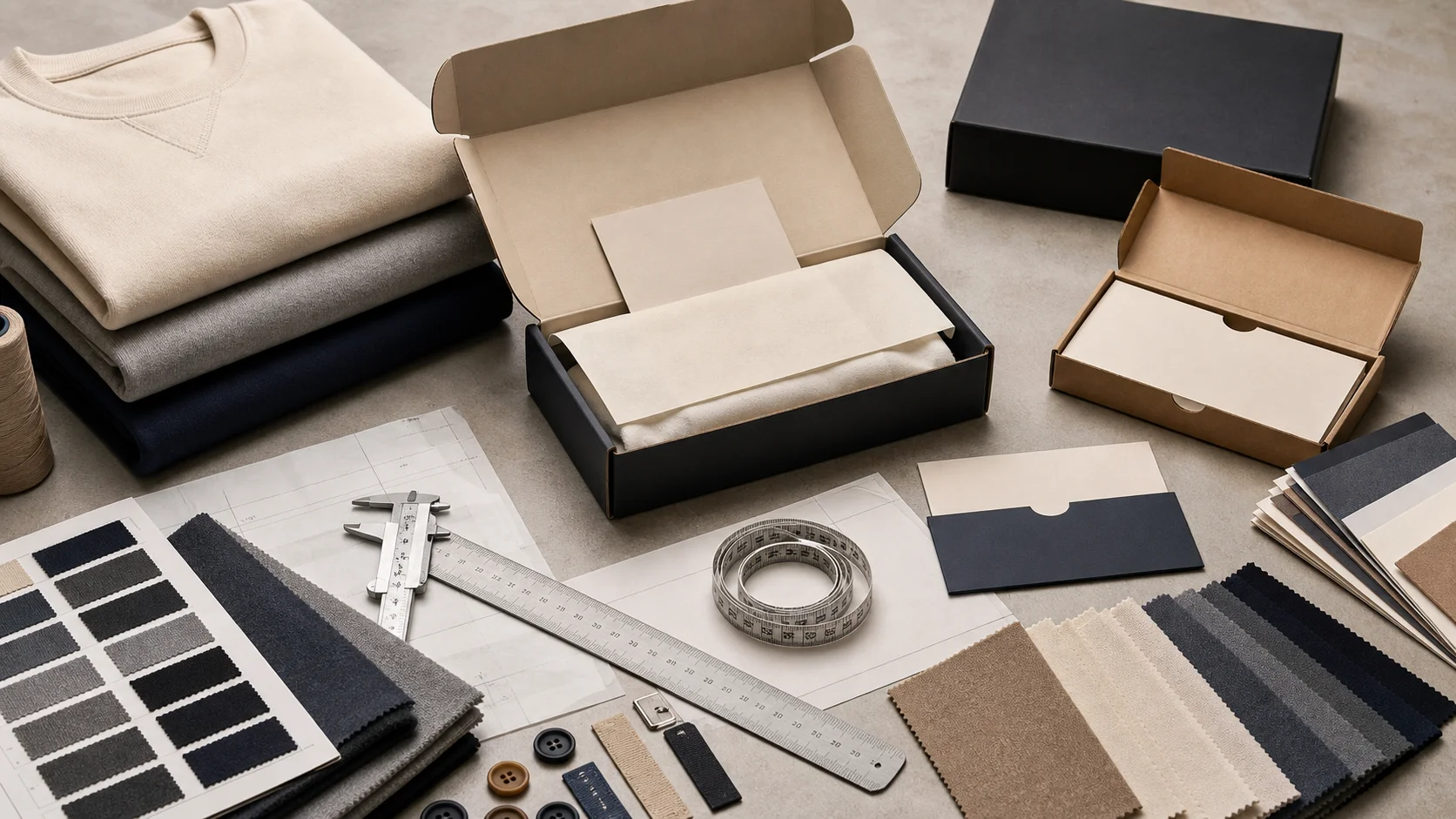
The core contents have three jobs: protect the garment, signal quality, and give the buyer the information they need without hunting through layers. In practice, that usually means a branded outer carton or mailer, acid-free tissue, a garment bag or dust sleeve where needed, a product card, a size or fit insert, care guidance, and, in some cases, a return label. Those are the non-negotiables. And everything else is optional.
For knitwear, especially heavy pieces like French terry 320 GSM or brushed fleece, I prefer tissue plus a light dust sleeve, because knits crease less cleanly than tailored items and need space to breathe. Tailoring wants a different setup: a folded suit jacket, shoulder support, and more tissue around lapels. Denim is tougher. A premium denim shirt can handle a simpler set, while a jacket may need a reinforced carton and fold protection at cuffs. Lingerie and occasionwear need the opposite of bulk. They want a refined, minimal package with careful folding, thin tissue, and a presentation card that does not overpower the product. For babywear, a small format matters, and a source like custom baby clothing manufacturing usually demands softer edges, gentler inks, and fewer loose components because parents are opening dozens of items at once.
Many of these components are produced on a manufacturing line that starts with automated die-cutters, such as the Bobst Mastercut, moves next to a MBO folder-gluer, and ends on an automatic gluing line that applies PVA or water-based adhesives in tiny beads. Dust sleeves often emerge from a Singer 14U serger after the fabric is laser-cut for perfect edges, while the cards pass through a Zünd digital cutter before cold foil stamping or spot UV finishing. And the goal is to balance precision with cost. Switching between 250 GSM SBS board and a lighter 220 GSM recycled Kraft when the route is short saves money without sacrificing feel.
At higher price points, presentation pieces matter more than extra layers. A branded outer mailer, one insert card, and a clean tissue wrap often feel more premium than three different cards, two stickers, and a ribbon that fights the fold. I’ve seen $38 tees in overdesigned packs look cheaper than $95 shirts in simpler ones. And the eye reads order, not quantity.
Sustainability-focused brands can go leaner without losing status. A minimal set might be an FSC carton, one sheet of tissue, a recycled paper care card, and a discreet return label inside the box flap. That is enough when the garment is well folded and the route is short. I worked with a brand using private label clothing services that cut packaging components from 7 to 4 and still held customer satisfaction at 4.8 stars because the pack felt intentional, not stripped down.
The key is knowing what inside the box earns its place. A card that explains fit, care, and origin can reduce friction. A second branded sticker rarely does. Buyers who understand this spend less on visual clutter and more on the pieces that actually support the product. And for brands building premium clothing packaging at scale, that often means balancing custom presentation with factory efficiency and a realistic MOQ.
Protection starts with structure. Acid-free tissue prevents transfer and crease marks on silk, satin, and merino. Corner protectors matter for folded tailoring and structured outerwear, especially on long-haul air freight where cartons are handled more often. Garment stuffing helps with sleeves, collars, and blazer fronts. Hangers belong in retail distribution, not always in DTC shipping, because they add weight, freight cost, and breakage risk. And on humid routes, especially into Southeast Asia or coastal Latin America, a moisture barrier or inner poly sleeve can save a shipment from mildew and odor.
Presentation is a choreography of small decisions. I count tissue folds, sticker seal placement, and the way a card sits in the first visual field. A single branded seal on the tissue can feel cleaner than a full printed wrap. One insert placed on top of the garment communicates confidence. Scatter too many pieces and the box starts to feel busy. And that is especially true for premium clothing packaging for luxury brands, where quiet detail often reads more expensive than loud branding.
But route changes the rules. Sea freight to the US West Coast may spend 3 to 6 weeks in transit, which means cartons need better edge protection and stronger compression resistance. Domestic delivery can move in 2 to 5 days, so presentation can be slightly lighter. Air freight is faster, but handling is rougher because parcels are sorted more often. I have seen premium boxes arrive immaculate from London to Paris, then crushed from Shenzhen to Chicago because the design was copied without adjusting for the route.
Decision checklist before committingA strong brief makes the supplier's job narrower and the quote more reliable. For what should go inside premium clothing packaging? buyer’s, include the target customer, sales channel, expected order quantity, size range, decoration needs, packaging requirements, and delivery market. Then call out the details most likely to affect the result, especially material grade, print tolerance, and barcode size.
The brief should also explain what cannot change. Some brands care most about hand feel, some about price, some about launch timing, and some about retail compliance. When those priorities are not written down, suppliers tend to optimize for whatever is easiest to quote. Clear priorities help the factory make better tradeoffs before the first sample is cut or printed.
Ask the supplier to respond with assumptions, not just a price. A useful reply states MOQ, sample route, production capacity, inspection plan, packing method, and freight handoff. If the answer is vague, the project may still work, but it needs a tighter pre-production stage before money and calendar pressure build up.
The best time to catch problems is before the pre-production sample is approved. Check measurements, color, placement, material behavior, shrinkage, construction, labels, and packaging in the same review instead of approving each item in isolation. Many bulk issues are not caused by one dramatic mistake; they come from several small unchecked assumptions.
For what should go inside premium clothing packaging? buyer’s, pay special attention to folding method, pack-out sequence, and retail compliance. These details often look minor in an email but become expensive once cutting, printing, sewing, packing, or shipping begins. A simple checklist with owner, due date, and approval status keeps the brand team and factory aligned.
Bulk production should not start until the supplier can explain how the approved sample becomes a repeatable production standard. That means reference sample storage, line instructions, inline checks, final inspection, and defect handling. A factory that can describe this process clearly is usually safer than one that only promises speed.
Price differences are useful only when the quotes cover the same work. Compare sample cost, material source, trims, decoration, packaging, testing, inspection, and freight assumptions. A low unit price can become expensive if it excludes items the brand needs before launch.
Timeline promises deserve the same scrutiny. Ask what happens if the first sample needs revision, whether materials are in stock, when the production slot is reserved, and how export packing is handled. The most reliable supplier is often the one that gives a realistic calendar instead of the fastest optimistic answer.
Before making the final decision, write down the specification, approval owner, delivery expectation, and the one or two risks that would cause the most trouble if missed. For what should go inside premium clothing packaging? buyer’s, this usually means checking material grade, print tolerance, barcode size, and the support process after the order is placed.
This last review does not need to be complicated. It simply makes the decision easier to repeat, easier to explain, and easier to verify when the finished product or jewelry arrives.
One useful way to pressure-test the decision is to ask what would happen if the order had to be repeated in six months. The answer should still be clear: the same material grade, the same print tolerance, the same acceptance standard, and the same communication path. If a second order would depend on memory or guesswork, the first order is not documented well enough yet.
Another useful check is to separate preference from requirement. Preference is the look, wording, or finish the brand likes. Requirement is the measurement, tolerance, certificate, material, or delivery condition that cannot fail. Good buying decisions keep both visible, so the final choice is not pushed around by the last email, the cheapest quote, or the prettiest sample photo.
Finally, ask who owns each approval. A project with one accountable owner for sample review, one owner for final content or artwork, and one owner for delivery sign-off usually moves faster than a project where every decision is shared loosely across a team. Clear ownership reduces delays and makes the finished result easier to judge.