
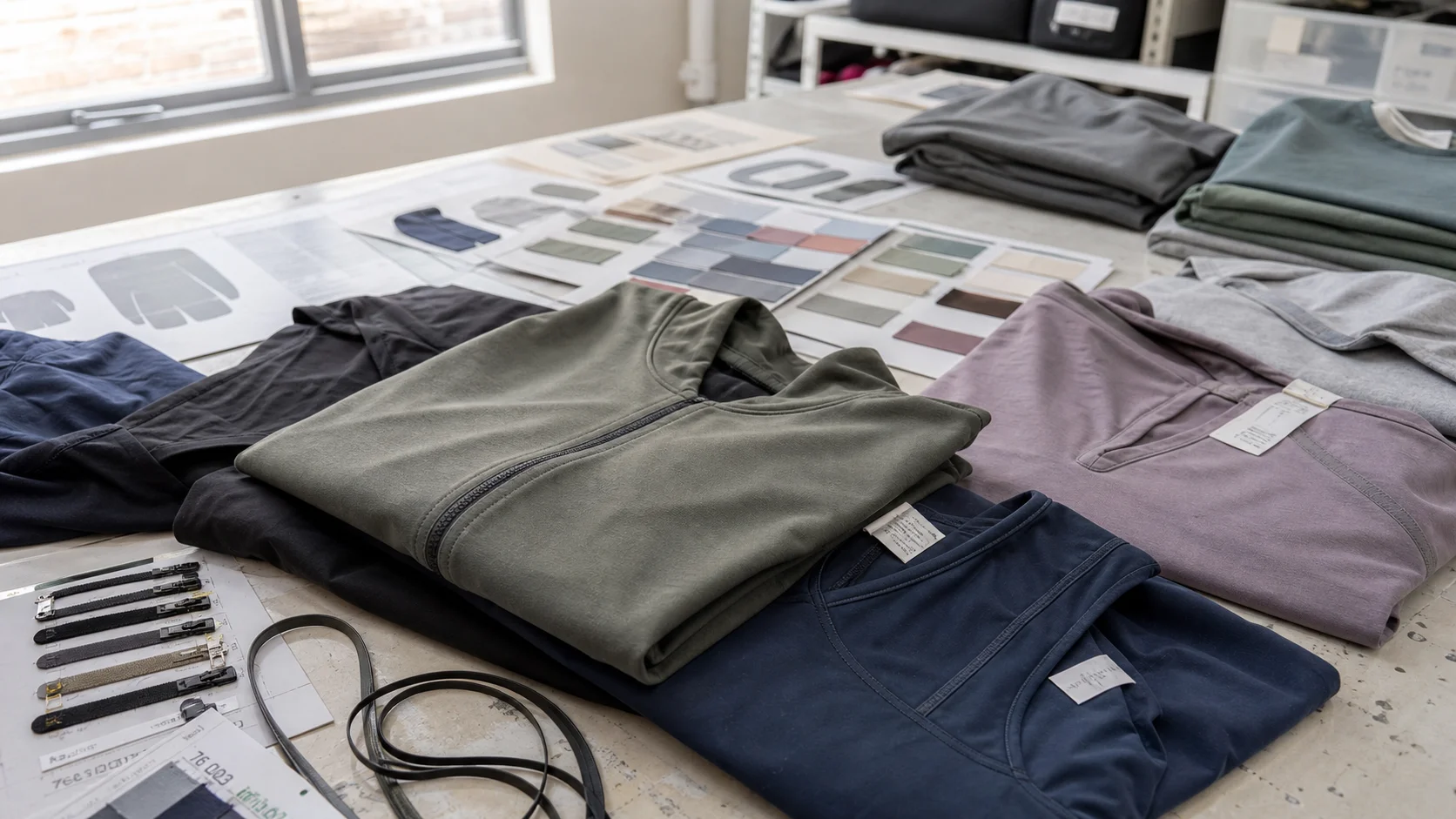
A detailed outline for retailers sourcing wholesale activewear sets that need export-ready compliance documentation, labeling, testing records, and decoration-specific production paperwork.
Wholesale Activewear Sets Export Compliance Checklist - Fabrikn production reference
Wholesale activewear sets compliance documentation for retailer export orders is not a side task. It sits at the center of whether goods can move on time, clear customs cleanly, and arrive in stores without expensive disputes over labeling, testing, or packaging. For buyers sourcing coordinated sports bras, leggings, biker shorts, crop tops, zip jackets, and matching lounge-performance sets, the documentation burden can be heavier than expected because these products combine stretch fabrics, close-fit sizing, performance finishes, and often decoration or printing details.
In practical sourcing terms, activewear sets carry two kinds of compliance risk at once. The first is product-level compliance, such as fiber content labeling, care instructions, country of origin marking, and chemical or physical safety test requirements. The second is order-level export compliance, which includes commercial paperwork, packing accuracy, carton markings, barcode requirements, and retailer-specific manuals. A supplier can be technically capable of sewing the garments and still fall short on the documentation package.
That is why experienced buyers usually treat the compliance file as a gated deliverable, not a final admin exercise after production is finished. If the seller cannot provide a clean document trail before bulk cutting starts, the real shipment risk is already visible.
For teams evaluating manufacturing capability, trim control, and decoration readiness, it helps to review supplier process depth early. Buyers comparing development support and production coordination can also review broader sourcing information through services and supplier background on about-us.
Activewear looks simple from a distance, but export compliance is rarely simple in this category. A matching set may use nylon-spandex or polyester-spandex blends, power mesh, elastic underbands, removable pads, heat transfer branding, reflective prints, zipper components, and polybag packaging. Every one of those elements can affect paperwork and approval requirements.
Retailers also tend to apply stricter controls to this category for a few reasons:
From a retailer’s point of view, the compliance file is the quickest way to measure whether the supplier understands export discipline. Missing test reports, incomplete label artwork approvals, or inconsistent carton data usually signal deeper control problems on the factory floor or with upstream fabric and trim vendors.
The most reliable purchasing approach is to ask for compliance evidence before relying on production promises. Capacity claims are easy to make. Document control is harder to fake.
A wholesale activewear sets export order usually requires a document pack that combines standard trade documents with product-specific compliance records. The exact list depends on destination market, retailer manual, fabric composition, and decoration method, but buyers should expect the following categories.
These documents sound routine, but many export delays come from simple mismatches. If the invoice says “women’s leggings set” while the packing list splits sports bra and legging by separate descriptions, customs questions may follow. The language used across all documents needs to be consistent.
Buyers should not assume one report covers the whole order. If the set includes different fabrics across top and bottom, or if one color uses a special finish, separate verification may be needed.
Retailers often charge back for packaging non-compliance even when the garments themselves are fine. For activewear sets, that can include wrong sticker placement, missing set-banding, mixed size pairing, or inconsistent folding methods that distort molded cups or printed surfaces.
Compliance documentation is only as strong as the technical file behind it. If the bill of materials is vague, testing and labeling accuracy become weak by default. Buyers should expect a working specification pack that includes the details below.
Claims-based finishes deserve extra caution. If the garment is promoted as quick-dry, anti-bacterial, or squat-proof, the documentation should support those claims. Unsupported marketing language creates legal and commercial risk.
Retailers often inspect activewear returns for trim failure before they question sewing quality. Weak elastic, curling waistbands, and cracked heat transfers create more claims than many buyers expect.
The practical rule is simple: if a supplier cannot show approved label artwork tied to each style, the shipment is not ready, no matter how complete production appears.
Because this category sits under Decoration & Printing, the compliance discussion must go beyond garment construction. Decorative techniques can trigger extra risk in export orders, especially on stretch activewear where graphics must remain stable under extension and repeated wash cycles.
Heat transfers look clean and cost-efficient on activewear, but they are unforgiving if fabric temperature tolerance and press settings are not controlled. Excess heat can mark shiny compression fabrics. Low heat can cause edge lifting after wash. That tradeoff makes pre-production testing essential.
Sublimation offers excellent color permanence on polyester, yet it can complicate fabric handfeel and opacity if the base fabric is too lightweight. Screen printing can be economical at scale, though heavy ink deposits may reduce stretch recovery and create handfeel complaints. There is no universally best decoration method. The right option depends on fabric blend, design size, order volume, and end-use performance.
Retailer export orders should move through a documented approval path before bulk production starts. In activewear, sample discipline is especially important because fit, fabric recovery, and decoration durability do not always show up in a sketch or digital mockup.
Sample approval should not rely on appearance alone. A sound approval record usually includes measurement report, fabric test references, decoration comments, label confirmation, and packing instructions. If any of those pieces remain open, the order is not fully controlled.
Typical sample timelines vary. A straightforward development sample may take 7 to 14 days if fabric is available. A pre-production sample using custom dyed fabric, branded elastic, and approved transfer logos can easily take 2 to 4 weeks. Buyers should build that into launch calendars rather than treating sample delay as a surprise.
MOQ and lead time planning have direct compliance implications. For wholesale activewear sets, common MOQs often start around 200 to 500 sets per colorway for basic cut-and-sew programs, while more customized orders with special knitting, custom-dyed fabric, branded trims, or complex printing can push effective MOQs to 800 to 1,500 sets per style or spread across sizes and colors. The lower the volume, the harder it can be to justify custom testing, trim development, or dedicated print setups at a commercially efficient price.
Lead times also depend on how much of the order is stock-supported versus fully custom. A practical range for bulk production is often 45 to 90 days after pre-production approval, but that range can move wider based on:
The purchasing judgment here is straightforward. If a supplier offers a very short lead time on a highly customized activewear set with multiple decoration placements and compliance testing requirements, that promise should be examined closely. Fast claims are often built on hidden shortcuts, such as overlapping bulk cutting before final approvals or assuming tests will pass without contingency.
Order Element Typical Range Compliance Impact Basic MOQ 200–500 sets per color Lower volume may limit custom trim and print efficiency Custom Program MOQ 800–1,500+ sets per style Supports dedicated material development and testing Development Sample 7–14 days Early feasibility check for fit and construction PP Sample 2–4 weeks Locks bulk materials, trims, labels, and decoration method Bulk Production 45–90 days Depends on approvals, material readiness, and testingInspection failures in activewear sets often come from a small group of repeated problems. Most are preventable if the factory and buyer align on standards early.
One of the biggest hidden risks is color continuity across separate production lots. When tops and bottoms are cut from different dye lots, the mismatch may only become obvious under store lighting or after the sets are paired in packing. Buyers sourcing matching activewear should request clear lot control and pairing rules for set components.
In this category, packing errors are not minor admin defects. A single wrong size pairing can turn a sellable set into unsellable inventory.
The checklist below is the working version most buying teams need. It is built for action rather than theory.
Buyers often focus first on price, fabric handfeel, and sample appearance. Those matter, but for export orders the better question is whether the supplier can run a disciplined compliance workflow. A capable partner should be able to explain documentation ownership, approval timing, and how changes are version-controlled from sample stage into bulk packing.
There are a few signals worth watching:
For buyers managing private label activewear, this distinction matters more than small quoted price differences. A slightly cheaper quote can become expensive very quickly if the order misses launch dates or triggers retailer chargebacks.
If your team needs to compare supplier communication quality or clarify documentation expectations before placing an order, use contact-us to start a more detailed sourcing discussion.
The best wholesale activewear sets compliance documentation for retailer export orders is complete, early, and tied directly to production reality. That means approved specs, traceable materials, verified labels, tested decoration methods, accurate packing data, and synchronized export paperwork. Buyers who wait until final inspection to ask for compliance records usually discover problems too late to solve cheaply.
In Decoration & Printing programs, the risk is even sharper because graphics, transfers, reflective details, and branded finishes add another layer of technical control. The practical buying decision is not just whether a supplier can make the garment. It is whether the supplier can prove, document, and repeat the process without creating shipment risk.
That is the real checklist value: fewer assumptions, earlier approvals, and better control from sample desk to export handover.
Get a free quote from Fabrikn — your trusted B2B clothing manufacturer with 10+ years of experience. MOQ as low as 200 pieces.
Get a Free Quote →Most orders require a commercial invoice, packing list, purchase order reference, origin details, approved labeling records, and any required product test reports. Retailer programs may also require barcode files, carton marking approvals, and packaging compliance sheets.
Decoration methods such as heat transfers, screen prints, silicone logos, and reflective graphics can fail under stretch or repeated washing if they are not properly specified and tested. That creates quality claims even when the garment body is well made.
Basic programs often start around 200 to 500 sets per colorway, while more customized programs can require 800 to 1,500 sets or more per style. The real MOQ depends on fabric development, trim customization, and print setup complexity.
Sample and approval work can add several weeks, especially when custom fabric dyeing, branded trims, or print strike-offs are involved. A realistic production calendar often includes 7 to 14 days for development sampling, 2 to 4 weeks for pre-production approval, and 45 to 90 days for bulk production after approvals are locked.
Common issues include incorrect label content, top and bottom shade mismatch, print cracking or peeling, measurement failures, wrong size pairing inside sets, and inaccurate carton markings. Most of these can be reduced with tighter pre-production approval and in-line inspection controls.