
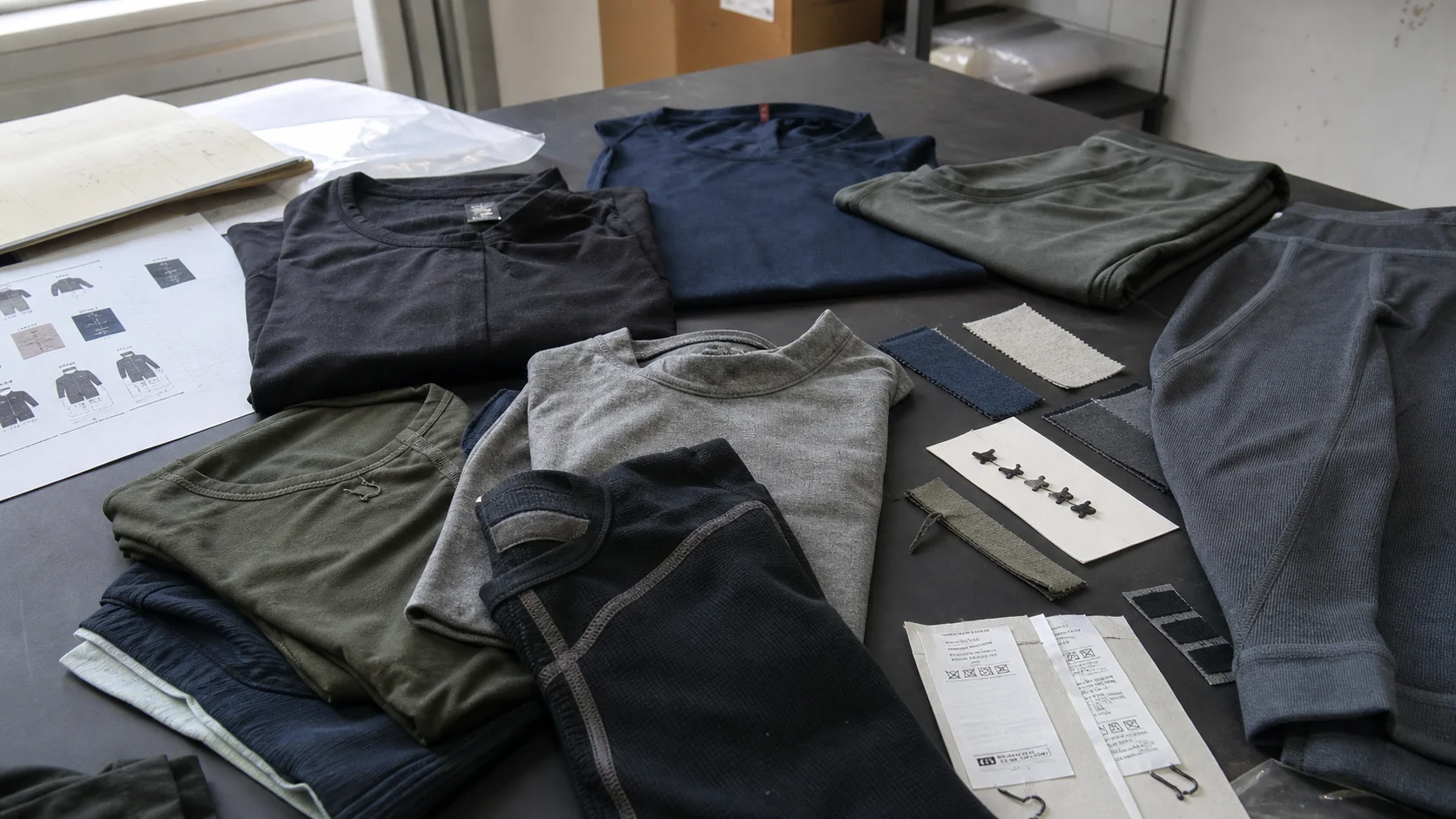
A practical SEO outline for repair chain buyers auditing wholesale base layer set colorfastness, including lab tests, wash protocols, shade control, defect...
Base Layer Set Colorfastness Audit for Buyers - Quality & Inspection manufacturing guide
Base layer sets look simple on a purchase order: long-sleeve top, bottom, thermal or moisture-wicking fabric, assorted sizes, private label packaging, and repeatable colors. The inspection reality is less simple. For repair chain buyers, colorfastness is not a cosmetic side issue. It affects customer complaints, exchange rates, brand confidence, and the perceived durability of the garment after the first wash.
A wholesale base layer set colorfastness audit for repair chain buyers should be built around the way the product is actually used. Base layers sit close to skin. They are exposed to sweat, body heat, friction, repeated washing, tumble drying, and sometimes contact with workwear, uniforms, jackets, or tool belts. Dark navy, black, charcoal, burgundy, forest green, and high-visibility contrast trims can all create staining or shade-change risks if the fabric and trims are not controlled properly.
Repair chain buyers often need dependable replenishment rather than one-off fashion drops. Their base layer sets may be sold as winter essentials, service technician apparel, roadside assistance gear, workshop uniforms, or customer-facing branded merchandise. In these channels, a poor colorfastness result can affect more than one SKU. It can damage a whole seasonal program.
Purchasing judgment: if the base layer set is worn under light uniforms or company shirts, color transfer risk matters more than a slightly lower fabric cost. A cheap dark fabric that bleeds can become expensive after returns, replacements, and buyer-side sorting.
The buyer’s job is not to demand every possible test at maximum severity. That often creates cost and delay without improving the commercial result. The better approach is to define the likely risks, set measurable pass criteria, approve the correct pre-production samples, and inspect bulk goods against agreed standards before shipment.
A colorfastness audit is not just a lab report. It should connect fabric sourcing, dyeing control, trim selection, wash testing, shade consistency, packing, and final inspection. Buyers who treat it only as a final lab test may find problems too late, after bulk fabric has already been cut and sewn.
For wholesale base layer sets, the audit should cover at least these areas:
A repair chain buyer should also consider the after-service environment. If technicians or customers wear base layers while handling grease, cleaning chemicals, antifreeze, solvents, or industrial detergents, the buyer should not assume standard domestic wash tests cover every use case. A practical audit can include additional buyer-specific wash trials, but those trials should be written clearly and agreed before production.
Useful support can come from a sourcing and quality partner that understands both garment manufacturing and inspection planning. Buyers can review service options through Fabrikn services when setting up supplier coordination, sampling, and quality control workflows.
Base layer sets carry several colorfastness risks that are not always obvious during showroom review. A salesman sample may look clean under office lighting, while bulk production may fail after washing or rubbing because the dyeing process, fabric lot, or finishing recipe changed.
Dark solid colors are common in repair chains because they hide stains and coordinate with workwear. Black, navy, graphite, and deep olive are commercially safe choices, but they often have higher dye loading. Higher dye loading can increase the chance of bleeding, crocking, or staining adjacent garments if fixation and washing-off are weak.
For dark polyester-spandex base layers, rubbing fastness and wash staining should be checked carefully. For cotton-rich thermal sets, perspiration and wash color change deserve attention. For nylon-spandex, acid dye behavior and migration can be a concern if process control is poor.
Repair chain programs may use branded contrast colors: red stitching, orange piping, blue waistbands, or reflective-looking details. These accents can create a higher complaint risk than the main fabric. An elastic waistband, for example, may be stretched repeatedly and exposed to sweat. If the elastic tape or printed logo has poor fastness, staining can appear inside the garment or on skin.
Base layers often use heat-transfer neck labels for comfort. Some buyers also request chest logos, size marks, or safety messages. Heat pressing can create shade change, gloss marks, dye migration, or print staining if the fabric is not suitable for the print process. Polyester fabrics are especially sensitive to dye migration under heat.
Brushed thermal fabric feels warmer and sells well in winter assortments. The brushed surface can increase rubbing and lint transfer. Poorly washed-off dye may transfer more easily from the raised fibers. Shade variation can also become more visible after brushing, especially between garment panels cut from different fabric rolls.
A base layer set has two garments sold together. Buyers must control shade matching between the top and bottom. A slight variation that might pass on a single item can look unacceptable when the shirt and pant are packed in one polybag. The audit should define whether top and bottom must be cut from the same dye lot, same fabric roll, or approved shade band.
Many colorfastness disputes begin with weak specifications. A purchase order that says “black thermal set, 180 gsm, polyester spandex” is not enough. The factory may source from different mills, accept different shade bands, or use trims that pass visually but fail in wash testing.
Buyers should lock the technical specification before sample approval and bulk booking. The specification does not need to be overcomplicated, but it must be measurable.
Specification Area What to Define Buyer Judgment Fiber content Example: 92% polyester / 8% spandex, 60% cotton / 40% polyester, or 100% merino wool Fiber changes can affect dye selection, shrinkage, handfeel, and test results. Fabric weight Typical range: 160-260 gsm depending on season and warmth target Heavier fabric may improve perceived value but can extend drying and finishing time. Fabric construction Single jersey, interlock, rib, waffle knit, brushed back, fleece back Brushed fabrics need stronger rubbing and lint checks. Color standard Pantone, physical swatch, lab dip, or approved standard sample Physical standards reduce disputes better than screen references. Shade tolerance Commercial tolerance, gray scale rating, or defined shade band Set products need tighter matching than loose separates. Elastic and trims Color, width, stretch recovery, logo method, dye/print fastness Trim fastness is often missed until wash claims appear. Care label Wash temperature, bleach warning, tumble dry setting, ironing instruction Care claims must match tested performance, not marketing preference.For base layer sets, fabric performance and colorfastness must be connected. A moisture-wicking finish may affect dye behavior. Anti-odor treatments, softeners, brushing, resin finishes, or silicone handfeel agents can influence color change and staining. The buyer should ask the supplier whether any finishing chemistry will be used and whether it is included in the submitted test sample.
Trim specifications deserve the same discipline. Elastic waistbands should be tested in the final color and logo method. Drawcords, binding, and contrast coverstitch threads should not be approved only by appearance. If thread dye bleeds or the waistband stains the shell fabric after washing, the finished set will still be considered defective by the customer.
A practical testing plan should reflect product use, market requirements, and order value. It is rarely necessary to test every color, every size, and every trim in full laboratory scope. It is risky to test only one light color and assume dark shades behave the same.
For a wholesale base layer set colorfastness audit for repair chain buyers, the following test areas are usually worth considering:
Common pass targets often use gray scale ratings, such as grade 4 or above for color change and staining, with some buyers accepting grade 3-4 for difficult dark colors in lower-risk areas. The exact requirement should be agreed in writing. A buyer selling to professional repair chains should be cautious about accepting weak wet rubbing results on dark base layers, because sweat and friction are normal use conditions.
Testing standards may vary by buyer market. ISO, AATCC, or other recognized methods can be used depending on destination and customer requirements. The important point is consistency. A lab dip tested under one method and bulk fabric tested under another can create confusion. The purchase agreement should state the test method, sample type, wash temperature, detergent type where relevant, and pass criteria.
Purchasing judgment: do not rely on supplier verbal assurance that “dark colors always have this result.” If the product is skin-contact and sold in volume, require documented test results for the highest-risk colorways before bulk approval.
For budget control, buyers can prioritize worst-case colors. Dark black, navy, red, burgundy, deep green, and any high-saturation brand color should be tested first. White, light gray, and beige may be lower risk for bleeding but still need staining and shade-change review if packed with dark trims.
For a multi-color program, one sensible approach is to test the darkest shade, the brightest shade, and one representative neutral. If all fabrics come from different mills or different dyeing methods, more testing is needed. Shared color names do not guarantee shared performance.
Lab dips are useful for shade and early fastness screening, but they are not enough for final approval. Buyers should test production-intent fabric and trims. A garment-wash trial on a pre-production set can reveal problems that fabric swatches do not show, such as waistband bleeding, seam thread staining, print migration, and top-bottom mismatch after laundering.
Sample approval should be treated as a gate system. Each gate reduces a specific risk. Skipping gates may save days early in the schedule but can cost weeks if bulk fabric fails later.
Sample Stage Purpose Colorfastness Focus Lab dip or color swatch Approve shade direction before fabric booking Check color match, initial wash/rub risk for dark shades. Fabric quality sample Confirm handfeel, weight, stretch, recovery, and construction Confirm the sample represents bulk-intent dyeing and finishing. Fit sample Approve pattern, size grading direction, and comfort Note seam placement and friction zones but do not use it as final color approval unless fabric is correct. Pre-production sample Approve final fabric, trims, labels, stitching, print, and packaging Wash the full set and compare top, bottom, trims, and labels. Size set sample Confirm graded sizes before bulk cutting Check shade consistency across sizes if cutting spans multiple fabric rolls. Shipment sample Confirm bulk output before dispatch Compare against approved standard and lab-tested sample.The pre-production sample is the most important approval point for colorfastness. It should include the actual bulk fabric or a clearly identified production-intent fabric, actual elastic, actual label method, actual sewing thread, actual print, and proposed packaging. If a factory submits a pre-production sample with substitute trims, the buyer should not approve bulk production for colorfastness-sensitive items.
A simple wash review can be added to the sample approval process. Wash one full set according to the proposed care label, dry it as instructed, then compare shade, staining, print appearance, and garment shape against the unwashed approved sample. This buyer-side check does not replace laboratory testing, but it is useful because it mirrors customer experience.
Approval records should be specific. Instead of writing “sample approved,” record “approved for fit only,” “approved for shade only,” or “approved for bulk production subject to passing colorfastness test.” This prevents factories from treating partial approval as full release.
Colorfastness starts before sewing. By the time garments reach final inspection, many failures are already locked in. Buyers should ask how the supplier controls dye lots, fabric washing-off, finishing, roll numbering, and cutting allocation.
Every fabric roll should be identified by dye lot and roll number. For set products, the factory should avoid mixing significantly different shade lots within one set. If the shirt and bottom are made from different lots, the chance of visible mismatch increases after washing.
For larger orders, shade banding is often needed. The factory groups fabric rolls by shade and cuts garments so that matching panels and set components stay within acceptable shade tolerance. This is especially important for black, navy, and gray, where minor undertone differences can be obvious under retail lighting.
Poor washing-off after dyeing is a common cause of staining and bleeding. The fabric may look correct when dry but release unfixed dye during washing or wet rubbing. Buyers should not manage the dyehouse directly in most wholesale programs, but they can require documented bulk fabric test results and reject fabric lots that fall below agreed ratings.
For cotton-rich fabrics, reactive dye fixation and after-washing are important. For polyester fabrics, disperse dye selection, reduction clearing where applicable, and heat setting can affect migration. For nylon blends, dye selection and pH control matter. The supplier should be able to explain the basic process in commercial terms, even if the buyer does not need the full dye recipe.
Spandex base layers usually need controlled heat setting. Excessive heat can affect stretch recovery, handfeel, and dye migration. Heat-transfer labels and prints introduce another heat process. Buyers should confirm that lab-tested samples include the same heat exposure as bulk garments.
Thread is easy to overlook. Color-matched sewing thread may be polyester, nylon, or cotton-wrapped. It can behave differently from the shell fabric. Contrast stitching increases visibility of any staining or fading. Seam areas also create friction during wear, so rubbing fastness should be considered around underarms, waistband, crotch gusset, neck opening, and cuffs.
For repair chain use, comfort and durability matter together. A base layer that passes shade tests but has rough seams, unstable stretch, or weak waistband recovery will still generate complaints. The colorfastness audit should sit inside a broader quality inspection plan, not replace it.
Final inspection cannot replace fabric testing, but it can catch many commercial defects before shipment. The inspection should be designed for set products and color-sensitive garments.
Key inspection risks include:
AQL inspection should include visual color checks under consistent lighting. Inspectors should compare garments against the approved shade standard, not only against each other. If the approved standard is not available at the inspection site, the inspection loses value. Photos can support reporting, but color decisions based only on phone images are risky because lighting and camera settings distort shade.
For base layer sets, the inspector should open packed sets and compare the top and bottom together. It is not enough to inspect tops in one pile and bottoms in another. The customer buys a set. The inspection must assess the set.
Several practical checks can be done during inspection, even when full lab testing is not available. A dry white cloth rub on dark fabric may reveal obvious crocking. A damp cloth rub can flag high-risk wet transfer. A quick soaking check may show severe bleeding. These checks are not substitutes for official test methods, but they help identify shipments that should be held for further review.
Inspectors can also check for shade stability after light stretching. Some spandex fabrics show grin-through or color lightening when stretched. A base layer naturally stretches on the body, so the color under tension matters. If the fabric looks acceptable flat but turns pale or uneven when stretched, the buyer should assess whether it meets the intended market positioning.
Base layer sets are often packed tightly to reduce carton volume. Compression can increase contact between dark garments, printed inserts, elastic logos, and labels. If the product ships in humid conditions or is stored in warm warehouses, poor fastness may lead to staining inside the polybag.
Buyers should review whether tissue, belly bands, hangtags, paperboard inserts, or printed polybags contact the garment surface. A dark garment packed against a white cardboard insert may stain the insert. A printed insert may stain the garment. Both situations can look like poor quality at store level.
Colorfastness control affects MOQ, lead time, and price. Buyers should understand the commercial tradeoffs before negotiating aggressively. Very low MOQs can force factories to use available fabric or small-lot dyeing, which may increase shade variation. Larger MOQs may allow better mill planning, lab dip control, and dedicated dye lots, but they increase inventory risk.
Order Type Typical MOQ Range Colorfastness Consideration Stock fabric base layer sets 300-800 sets per color Faster and cheaper, but buyer has less control over dye history and shade continuity. Custom dyed fabric 800-2,000 sets per color Better color control, but lab dip and bulk fabric testing add time. Private label with custom trims 1,000-3,000 sets per color Elastic, labels, and print methods must be tested with the shell fabric. Performance fabric or merino blend 1,000-5,000 sets per style Higher material cost makes early testing more important before bulk commitment.These ranges are typical commercial references, not fixed rules. Actual MOQ depends on fabric mill requirements, dyeing minimums, trim suppliers, size range, packaging, and whether the factory already runs similar base layer programs. Repair chain buyers ordering repeat seasonal stock may negotiate better MOQs after the first production run because the supplier understands the product and can plan raw materials earlier.
Lead time also depends on testing decisions. A straightforward stock fabric order may ship in 25-45 days after sample approval if materials are available. Custom dyed and private label orders often need 45-75 days, sometimes longer during peak winter production. Lab dips may take 5-10 days per round. Fabric testing can take roughly 5-12 working days depending on lab availability and test scope. Failed tests can add one to three weeks if re-dyeing, additional washing-off, or trim replacement is required.
Purchasing judgment: the cheapest timeline is often the least flexible. If the buyer needs guaranteed colorfastness, build testing and re-approval time into the calendar before committing retail launch dates.
Cost tradeoffs should be discussed openly. Better dye fixation, additional washing-off, stricter shade sorting, and more robust trims may raise unit cost. These increases are usually easier to justify on base layer sets sold as durable workwear or professional apparel. For promotional or low-price programs, the buyer may accept simpler specifications, but skin-contact color transfer should still not be ignored.
Buyers setting up new supplier relationships can use Fabrikn contact support to discuss inspection planning, sourcing coordination, and quality expectations before committing to bulk orders.
A good audit checklist keeps the buying team, supplier, merchandiser, and inspector aligned. It should be short enough to use but detailed enough to prevent expensive assumptions.
Colorfastness audits work best when buyers make decisions early rather than leaving them to the factory. The first decision is risk tolerance. A repair chain selling budget thermal sets may not need premium outdoor-brand specifications, but it still needs safe, stable color performance under normal wear and washing.
The second decision is who pays for testing and failed-test corrections. Many buyers expect suppliers to cover tests after quotation. Suppliers may include that cost in the price or resist repeat testing after changes. A balanced approach is to state testing responsibility in the purchase terms. If the supplier changes fabric, dye lot, or trims without approval, the supplier should bear the retesting cost. If the buyer changes color or artwork after approval, the buyer may need to absorb some delay or cost.
The third decision is whether to approve conditional shipment. For example, a dark navy set may pass washing and perspiration but show wet rubbing at grade 3-4 instead of grade 4. Is that acceptable? The answer depends on customer expectation, care instructions, garment use, and order urgency. Conditional acceptance should be documented, not handled casually through email remarks.
The fourth decision is shade continuity for repeat orders. Repair chain buyers often reorder the same black, gray, or navy base layer set year after year. If shade continuity matters, keep a sealed master standard and update it only when the buyer intentionally changes the color. Each new production run should be compared against the master and the previous bulk shipment sample.
Companies evaluating supplier capabilities, inspection workflows, or long-term apparel sourcing support can learn more about the business background through Fabrikn about us.
Some supplier responses should prompt closer review. A factory that says colorfastness testing is unnecessary for base layers may be underestimating the product risk. A supplier that refuses to identify fabric composition or dye lot structure may not have enough control over its material chain. A factory that offers a much lower price but cannot provide production-intent samples may be quoting with unstable material assumptions.
Other red flags include vague claims such as “all colors pass,” “our fabric is standard,” or “the previous customer accepted it.” These statements are not evidence. Buyers should request test reports linked to the actual fabric quality, color, and production period. Old reports from unrelated colors or previous seasons have limited value.
A practical buyer does not reject every supplier with weak paperwork immediately. Some capable manufacturers are not strong at documentation until the buyer sets clear expectations. The real concern is whether the supplier can follow a controlled process once the requirements are explained. If the supplier remains vague after receiving a clear test and approval plan, the order risk is high.
The final audit report should be clear enough for purchasing, quality, merchandising, and supplier teams to act on. A long report with unclear pass/fail decisions is less useful than a concise report with evidence, photos, test references, and recommended actions.
A strong report should include:
The report should separate critical, major, and minor defects. Severe bleeding, obvious staining, wrong care labels, or top-bottom shade mismatch across a large portion of the order should be treated more seriously than a small shade variation within agreed tolerance. Buyers should avoid making every issue “critical,” because that weakens decision-making. Clear classification helps the supplier focus on what must be corrected before shipment.
A wholesale base layer set colorfastness audit for repair chain buyers should protect the commercial program, not create paperwork for its own sake. The best audits are practical. They identify high-risk colors, test the right materials, approve production-intent samples, control shade matching, and inspect packed sets before shipment.
Buyers should invest more control where the risk is highest: dark shades, skin-contact fabrics, elastic waistbands, heat-transfer labels, brushed surfaces, and repeat programs where shade continuity matters. They can be more flexible with low-risk light colors or stock fabric orders, but only if the product still meets basic washing and rubbing expectations.
The main tradeoff is time versus certainty. Fast orders using available fabric can work when the buyer accepts limited customization and verifies stock material early. Custom programs need more discipline. Lab dips, test reports, pre-production samples, and final inspection all take time, but they reduce the chance of costly returns and brand damage.
For repair chain buyers, the right question is not “Can the supplier make base layer sets?” Many can. The sharper question is “Can the supplier make the same color, with the same performance, across the whole shipment and the next reorder?” A structured colorfastness audit is the most reliable way to answer that before the cartons leave the factory.
Get a free quote from Fabrikn — your trusted B2B clothing manufacturer with 10+ years of experience. MOQ as low as 200 pieces.
Get a Free Quote →A base layer set colorfastness audit checks whether the fabric, trims, labels, prints, and finished garments can resist color change, bleeding, rubbing transfer, and staining during normal wear, washing, perspiration, and packing. For set products, it also checks whether the top and bottom match in shade.
Colorfastness to washing, dry and wet rubbing, perspiration, and water are usually the most important. If the garment uses heat-transfer labels, printed logos, or polyester fabrics, heat-related dye migration or sublimation risk should also be reviewed.
Typical MOQs range from about 300-800 sets per color for stock fabric, 800-2,000 sets per color for custom dyed fabric, and 1,000-3,000 sets per color for private label programs with custom trims. Exact MOQs depend on mill minimums, trim requirements, size range, and supplier capacity.
Lab dips may add 5-10 days per round, while fabric or garment colorfastness testing often takes around 5-12 working days depending on the laboratory and test scope. Failed results can add one to three weeks if fabric needs reprocessing, replacement, or retesting.
No. Final inspection can catch visible shade mismatch, staining, packaging issues, and obvious rubbing problems, but it cannot fully replace laboratory testing. Colorfastness control should begin with fabric selection, dyeing control, sample approval, and bulk material testing.
Testing every color is safest but may not be cost-effective. A practical approach is to test the highest-risk colors first, such as black, navy, red, burgundy, deep green, and any bright brand color. If fabrics come from different mills or dye processes, more colors should be tested.
Wet rubbing and wash staining are common risks in dark base layer sets, especially when fabrics have high dye loading, brushed surfaces, or poor washing-off after dyeing. Elastic waistbands and contrast trims can also create staining if they are not tested with the final garment.
Buyers should first confirm the test method, sample identity, and pass criteria. If the failure is valid, the supplier may need to improve washing-off, change dyeing process, replace trims, remake fabric, or downgrade the product only with written buyer approval. Shipment should not proceed if the failure creates likely customer complaints or skin-contact staining risk.