
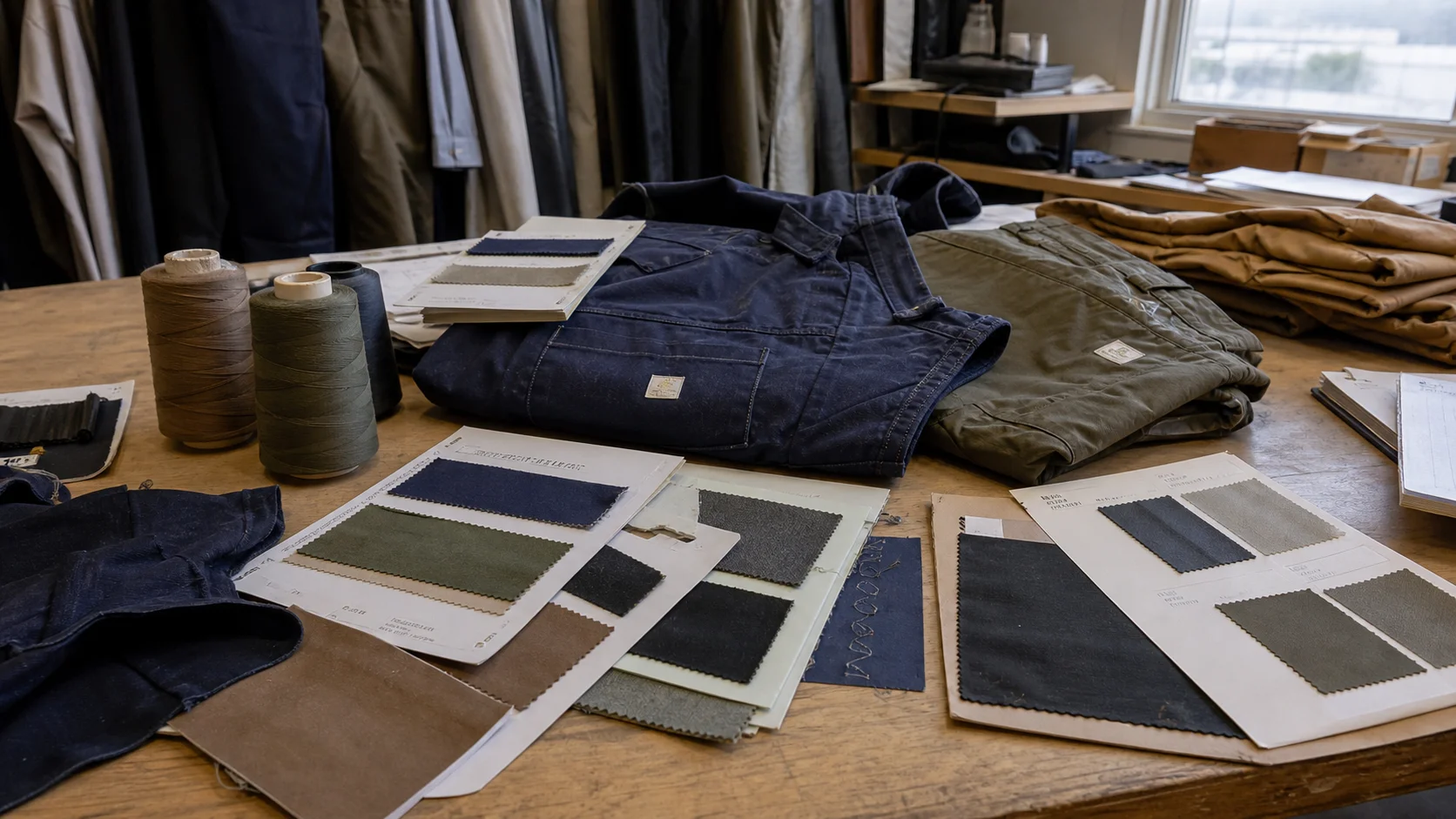
A focused outline for buyers ordering wholesale chef coats at culinary institute scale, covering size grading, fit standards, roster planning, decoration placement, and production details that affect accurate bulk ordering.
Wholesale Chef Coat Size Grading for Orders - Fabrikn production reference
Wholesale chef coat size grading is one of the least glamorous parts of an apparel order, yet it has a direct effect on budget control, student satisfaction, and reorder accuracy. For culinary institute orders, the issue is even more important because uniforms are worn in training kitchens, classrooms, labs, demonstrations, and often public-facing events. A coat that pulls across the chest, restricts arm movement, or hangs too long at the sleeve quickly becomes a daily complaint.
Institutions buying in volume usually focus first on fabric durability, embroidery placement, and price per piece. Those matter, but poor size grading creates downstream costs that are harder to recover. Exchanges, emergency top-up orders, and inconsistent fit between intake periods can erase the savings from a low initial quote. In practical sourcing terms, the cheapest unit price is rarely the best buying decision if the size curve is not built for the actual wearer group.
Chef coats also carry specific fit demands. Students bend, lift, reach, lean over prep stations, and work in hot environments. That means grading cannot be approached like a standard office uniform. Ease allowances, shoulder mobility, sleeve volume, and body length all need to work together. A coat can be technically “to spec” and still perform badly if the grading increments are too aggressive or too tight between sizes.
For schools placing annual or semester-based uniform orders, a disciplined grading plan supports consistent replenishment. It also helps when adding decoration services such as embroidery, screen printing, heat transfer names, or department identifiers. Buyers comparing suppliers should look beyond the size label and ask how the base pattern was graded, what measurement tolerances apply, and whether the supplier can support a rational size breakdown for mixed cohorts.
Institutes that need support with product development, decoration planning, or bulk manufacturing workflows often start by reviewing a supplier’s production capabilities and service scope. A useful reference point is the broader service overview at /services/, especially when an order includes both garment manufacturing and branded finishing.
Size grading is the process of scaling a base size pattern up and down into a full run of sizes while maintaining proportion, function, and fit intent. In chef coats, this usually starts with an approved sample size such as medium or large, then expands into the full size set required for bulk production.
That sounds straightforward. In practice, it is where many institutional orders go off track.
Grading is not only about adding width to the chest. It affects shoulder width, back width, armhole depth, sleeve circumference, sleeve length, body length, neck opening, cuff placement, and the location of functional components such as pockets, pen slots, concealed plackets, snaps, or knot buttons. If these points do not scale properly, the garment may look balanced on paper but wear poorly in use.
For wholesale chef coats, buyers typically encounter three grading situations:
Stock grading is usually the fastest and cheapest route. It suits basic chef coat programs when the wearer group is broad and the institution accepts standard unisex fit. The tradeoff is reduced control over body balance, sleeve proportion, and wearer comfort across different demographic groups.
Customized grading offers a middle ground. It often works well for institutes that need modest changes, such as shorter body length, less chest ease, or a better sleeve opening. This is a practical option when the order volume justifies a pattern adjustment but not a full bespoke development process.
Fully developed grading makes the most sense when branding is important, repeat orders are expected, and the institution wants long-term consistency. It costs more upfront because pattern work, fit approvals, and measurement control take time. Still, for recurring orders over multiple intakes, that investment usually pays off.
Culinary institute buyers will usually choose between unisex grading, men’s and women’s split grading, or alpha sizes paired with body measurement charts. Each framework has advantages and limitations.
Unisex sizing remains common in culinary education because it simplifies ordering and reduces SKU complexity. A typical run might be XS to 3XL or XS to 5XL, depending on program size and supplier capacity. For basic entry-level uniforms, this can be sufficient.
The limitation is fit precision. Unisex blocks often rely on added ease to cover a broader wearer range, which can create excess volume in some sizes and tightness in others. For back-of-house uniforms, many buyers accept that compromise. For presentation kitchens, front-facing programs, or premium branded academies, it often feels too blunt an instrument.
Separate grading blocks provide better fit control across chest, waist, hip, shoulder, and body length. This option is generally more accurate, especially when the order includes fitted or semi-fitted chef coats.
The tradeoff is complexity. More SKUs, more sample approvals, and more risk of ordering errors if students self-select sizes without proper measurement guidance. Institutes using split blocks should plan a clear size allocation process, not just a size form with generic labels.
Some suppliers work with numeric sizes, while others use alpha sizes such as S, M, L, and XL. Numeric systems can provide better nuance in grading steps, especially for structured garments. Alpha sizes are easier for administrative teams to manage. There is no universal best method. What matters is whether the underlying measurement chart is consistent and transparent.
Buyers should ask for a full point-of-measure spec rather than relying on label names. A medium from one supplier can fit like a small from another. The only reliable comparison is the measurement chart tied to the approved production pattern.
For wholesale chef coats size grading for culinary institute orders, the size curve is where purchasing judgment really matters. A size curve is the quantity distribution across sizes in a bulk order. It should be built from likely wearer data, not guesswork or last year’s habit.
A practical starting point is to gather one or more of the following:
Try-on sessions usually produce the most reliable curve. Self-reported sizes are fast but often inaccurate, particularly when students choose based on casualwear habits instead of garment measurements. Chef coats need enough ease for movement and layering, but too much oversizing becomes a safety and presentation issue.
A common wholesale size curve for a mixed student body might center heavily around S, M, L, and XL, with lower quantities at XS, 2XL, and above. That sounds obvious, yet many orders still underbuy edge sizes and overbuy mid-sizes because purchasing teams rely on rough estimates. The cost of getting this wrong can be high when customization is involved and decorated goods cannot easily be reassigned.
For first-time programs, it is sensible to build a modest contingency into the curve. That may mean a small overage in core sizes or an undecorated reserve stock, depending on branding requirements. The right strategy depends on whether coats are embroidered with individual names, department names, or generic school logos only.
This is only a working example, not a universal formula. Institutes should treat it as a planning aid, not a final buy ratio.
Not every culinary institute needs the same chef coat grading profile. The end use affects the right fit strategy.
For basic training programs, durability and ease of movement usually take priority over tailored appearance. A standard unisex block with moderate ease can work well if the fabric is stable and the sleeve pattern is not restrictive. This is often the most cost-efficient choice for large annual intakes.
Higher-level programs often want a sharper silhouette for public events, assessments, or media use. In these cases, a better-controlled grading system is worth the extra setup cost. Students spend long hours in uniform, and visible fit problems tend to attract complaints quickly.
Pastry environments sometimes favor lighter-weight coats or alternative closures, which can influence fit preference. If the garment is less layered underneath, the coat may not need the same ease as a heavy-duty hot-line kitchen coat. Buyers should confirm use conditions before approving grading changes.
When uniforms double as a branding asset, oversized unisex fits can undermine presentation. This is where separate fit blocks or a cleaner semi-fitted unisex block may be justified. The extra pattern discipline tends to show up clearly in photos, open days, and institutional marketing materials.
Chef coat grading cannot be evaluated in isolation from materials and finishing. Fabric composition, shrinkage behavior, trim weight, and decoration methods all affect perceived fit.
Common wholesale chef coat fabrics include 65/35 poly-cotton twill, 60/40 blends, 100% cotton, and lighter-weight poly-cotton sheeting for budget programs. Twill is popular because it balances durability, appearance, and care performance. A typical weight range is around 180 to 245 gsm, though lighter and heavier options exist.
Heavier fabrics can feel more structured and may reduce drape, which changes how ease is perceived. Cotton-rich fabrics may shrink more if pre-treatment and wash controls are not managed properly. That means the approved garment measurement must account for expected residual shrinkage. A buyer who ignores shrinkage allowances may think the grading is wrong when the real issue is fabric behavior after laundering.
Snap fronts, knot buttons, hidden plackets, cuff tabs, thermometer pockets, and apron loops all influence wear comfort. A stiff front construction can make a coat feel tighter through the chest even when garment measurements are technically correct. Sleeve cuff design can also affect whether students perceive a coat as too short or too narrow.
Since this topic sits within Decoration & Printing, it is worth stating plainly: decoration can change wear feel, garment balance, and reorder flexibility. Embroidery on the chest is common for culinary institutes, but dense embroidery can stiffen the fabric panel slightly. Large back prints, name applications, or heat-transfer badges can also affect drape in lighter-weight fabrics.
Screen printing is less common on traditional chef coats than embroidery, but it is still used for training events, short courses, or branded promotional outerwear. Heat transfers and direct-to-film applications can be useful for variable data such as names, though buyers should verify heat resistance and wash durability against the chosen fabric finish.
The sourcing judgment here is simple: if the order includes personalized decoration, grading accuracy matters more because reassignment options shrink. A generic logo coat can sometimes be reissued to a different student. A named coat usually cannot.
Institutes comparing decoration methods alongside manufacturing options can review available support channels and project discussions through /about-us/ and the company contact page at /contact-us/.
The safest way to manage size grading risk is to control the approval process. Too many bulk chef coat orders move from tech pack to production after a single visual sample review. That is rarely enough for institutional uniforms.
A more reliable approval flow looks like this:
For higher-volume orders, a size set sample can be a worthwhile expense. Not every institution needs a full size set, but approving only one sample size creates blind spots. Problems with sleeve grading or body length increments often appear only when you compare several sizes side by side.
Wear testing also matters. A coat that passes a mannequin check may fail in a kitchen classroom. Ask sample wearers to reach forward, lift arms, bend, and work through realistic motions. Look for back strain, gaping at the front overlap, sleeve drag, and collar discomfort. These are common failure points in chef coat development.
MOQ and lead time planning for wholesale chef coats depend on whether the product is stock-supported, semi-custom, or fully custom.
Typical MOQ ranges often look like this:
These are broad market ranges, not fixed rules. The real MOQ shifts with fabric availability, size spread, decoration complexity, and whether the supplier is consolidating production with other runs.
Lead time is equally variable. A decorated stock program may move in a few weeks if inventory is ready and approvals are fast. A custom production order can take 60 to 120 days or longer when fabric booking, pattern adjustment, sampling, and peak-season capacity are involved. Freight mode also changes the schedule significantly.
Buyers should pay close attention to these lead-time dependencies:
Institutes often underestimate approval delays on their own side. Internal sign-off between procurement, program heads, branding teams, and administration can take longer than factory sampling. A good sourcing plan builds time for that reality instead of assuming immediate decisions.
Inspection risk in chef coat orders is not limited to obvious sewing defects. Size grading errors can pass through production if the inspection checklist is too narrow.
Common risks include:
A serious buyer should request point-of-measure checks by size during pre-production and final inspection, especially for core sizes and edge sizes. Tolerances should be stated clearly. In many uniform categories, a tolerance around plus or minus 0.5 inch on selected measurements is common, though acceptable ranges vary by garment area and construction method. Tighter control may be needed on collar, chest, and sleeve points for structured chef coats.
There is also a practical tradeoff between tolerance control and production cost. Extremely tight tolerances on a budget-volume program can drive rejection rates and price. The right move is not to demand perfection everywhere. It is to tighten control on measurements that materially affect wear and loosen it where appearance or comfort is less sensitive.
For procurement teams ordering wholesale chef coats size grading for culinary institute orders, the best buying process is disciplined rather than complicated.
The central sourcing judgment is straightforward. If the institution expects repeat orders and cares about professional presentation, it is usually worth spending more effort on size grading upfront. If the program is price-led and basic, a stock size run may be acceptable, but only after checking the actual measurement spec. In both cases, the cost of unclear grading is usually higher than it looks at quote stage.
Wholesale chef coats are a uniform item, but they are still a fitted product with performance requirements. Culinary institutes that treat size grading as a strategic purchasing decision tend to achieve better wearability, fewer exchanges, and cleaner reordering over time.
Get a free quote from Fabrikn — your trusted B2B clothing manufacturer with 10+ years of experience. MOQ as low as 200 pieces.
Get a Free Quote →Size grading is the process of scaling a base chef coat pattern into a full range of sizes while keeping proportions, function, and fit intent consistent. It affects chest, shoulder, sleeve, body length, neck, and pocket positioning.
They can be, especially for basic student programs with tight budgets. The tradeoff is less precise fit across different body types. Institutes that prioritize presentation, comfort, or recurring uniform consistency often benefit from adjusted or separate fit blocks.
Many wholesale programs start around 100 to 300 pieces for decorated stock garments, while custom-manufactured chef coats often begin around 300 to 1000 pieces per style. Exact MOQ depends on fabric, trims, size range, and personalization requirements.
Try-on sessions are the most reliable method. A detailed size chart, body measurement guide, and approval of multiple graded samples also reduce sizing errors. Self-selected casualwear sizes are less dependable for chef coats.
Embroidery does not usually change core measurements, but dense embroidery can stiffen the fabric panel and alter how the garment feels in wear, especially on lighter fabrics. Placement consistency across sizes should also be checked carefully.
Lead times vary widely. Decorated stock programs may be completed in a few weeks, while custom chef coat production can take 60 to 120 days or more depending on sampling, approvals, fabric sourcing, and shipping method.
Chest width, shoulder width, sleeve length, sleeve opening, body length, armhole depth, and neck opening are the most important points. In active kitchen use, sleeve and shoulder balance often matter just as much as chest size.