
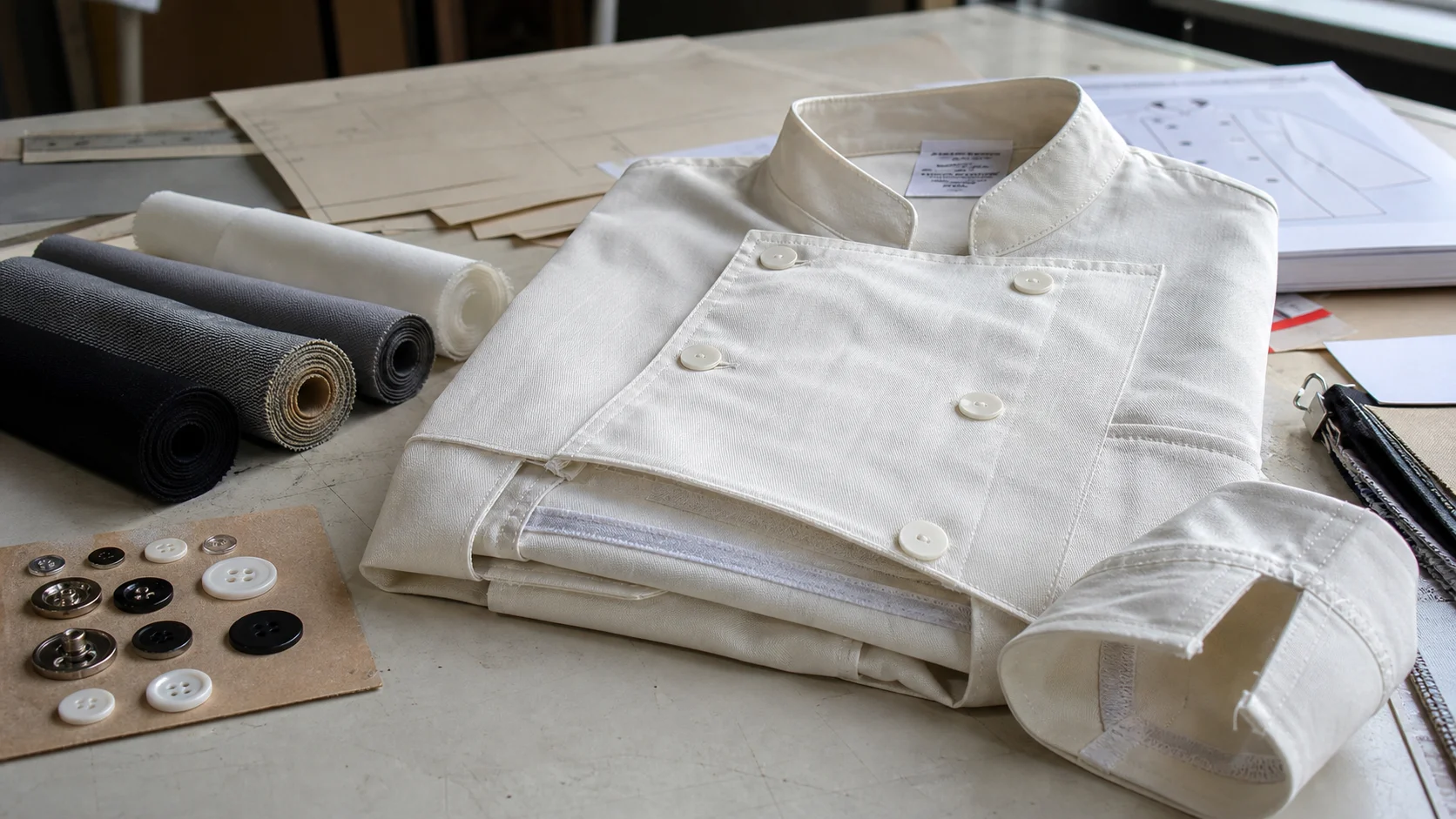
A product-specific audit outline for sourcing wholesale chef coats, helping field service teams verify fabric, construction, decoration readiness, MOQ...
Chef Coat Vendor Audit Brief for Buyers - MOQ, Cost & Sourcing manufacturing guide
Buying wholesale chef coats is not just a price comparison exercise. For field service teams, catering groups, hotel operators, restaurant chains, culinary schools, and uniform distributors, chef coats are high-visibility workwear with daily laundering, heat exposure, stain risk, and repeat-order pressure. A weak vendor can create inconsistent sizing, late deliveries, poor fabric recovery, and rework costs that are not visible in the first quotation.
This audit brief is built for buyers and field service teams evaluating wholesale chef coat vendors before issuing a purchase order. It covers supplier qualification, MOQ logic, cost drivers, sampling, fabric and trim specifications, production controls, inspection risks, and replenishment planning. Use it as a practical sourcing checklist when comparing vendors for embroidered chef coats, blank chef jackets, executive chef coats, kitchen uniforms, and private-label hospitality apparel.
A chef coat looks simple until the order reaches production. The buyer may specify white poly-cotton, double-breasted front, plastic buttons, left chest pocket, thermometer sleeve pocket, and logo embroidery. The vendor may quote quickly. The risk begins when the buyer assumes that all chef coats are made to the same standard.
In real procurement, small differences create large service issues. A 160 gsm fabric may feel too light for an executive kitchen. A 245 gsm twill may hold structure but feel warm in fast-service environments. Plastic buttons can crack during industrial laundering if the quality is low. Sleeve length can vary between production lots if the vendor does not control shrinkage or pattern grading. White garments expose every contamination issue in cutting, sewing, pressing, and packing.
A vendor audit gives the buyer a structured way to separate low-cost quoting from dependable supply. It does not guarantee perfection, but it reduces preventable mistakes before the order is placed. For wholesale chef coat programs, the audit should focus on four commercial questions:
Buyers comparing vendors for a new uniform program can also review broader sourcing support through Fabrikn services, especially when the project includes design, development, sampling, or supplier coordination.
Field service teams often need chef coats for more than traditional kitchen staff. The garment may be used by food demonstration teams, appliance service trainers, catering supervisors, hospitality installation crews, culinary brand ambassadors, and retail food specialists. These users may travel, interact with customers, work near heat, and require clean brand presentation.
This context changes the audit brief. The buyer should not only ask whether the chef coat is suitable for a commercial kitchen. The buyer should ask whether it supports mobile staff who need comfort, durability, size consistency, and easy replacement.
The audit should match the buying scenario. A culinary school may prioritize price and minimum order flexibility. A luxury hotel group may prioritize fabric handfeel, embroidery finish, fit, and long-term replenishment consistency. A distributor may prioritize carton labeling, stock keeping units, size ratios, and private-label packaging.
Practical sourcing rule: do not audit every chef coat vendor against the most expensive specification. Audit against the job the garment must perform.
The first step is to confirm what kind of vendor is quoting. In apparel sourcing, a “vendor” may be a factory, trading company, buying office, stock wholesaler, customization shop, or integrated manufacturer. Each type can be useful, but the risk profile is different.
A stock wholesaler may be the fastest option for small quantities and urgent deployment. The tradeoff is limited control over fabric, fit, label placement, and long-term continuity. A cut-and-sew manufacturer gives more control, but MOQs and sampling time are usually higher. A trading company can simplify coordination if it has strong supplier management, yet the buyer should clarify transparency, accountability, and inspection access.
A vendor that cannot provide basic specifications before the audit may still be capable, but the buyer should treat the project as higher risk. Weak documentation often leads to disputes later: the buyer expects one thing, the production team makes another, and both sides claim the approved sample was unclear.
MOQ is one of the biggest sourcing filters in chef coat procurement. The right MOQ depends on whether the order is blank stock, customized stock, or made-to-order production. Buyers should avoid treating MOQ as a single number. It usually varies by fabric, color, size range, label requirements, trim customization, and decoration.
These ranges are typical market references, not guarantees. Some vendors will accept lower MOQs at a higher unit cost, especially if the buyer uses available fabric and standard trims. Others will require higher MOQs because their cutting table, fabric purchase, or production line setup is not economical for small orders.
For field service teams, size distribution is often more important than total quantity. A 500-piece MOQ is not useful if the vendor requires unrealistic minimums by size. Buyers should provide an estimated size curve early and ask the vendor to confirm production feasibility.
A chef coat quotation should be specific enough to audit. A vague unit price creates later disputes about fabric weight, buttons, embroidery size, label type, carton quality, and delivery terms. The cheapest quote may be valid for a very basic garment, but not for a durable uniform program.
Good buyers compare quotes on an equal specification. If Vendor A quotes 65/35 poly-cotton at 190 gsm with standard buttons, and Vendor B quotes 240 gsm twill with branded snaps and embroidery, the unit prices cannot be judged side by side. Normalize the specification before negotiating.
When a buyer needs help organizing cost, production, and supplier communication, contacting Fabrikn can be a practical next step for structured sourcing support.
Fabric is the main performance factor in chef coats. The vendor audit should include both specification review and physical handling of fabric swatches or sample garments. A chef coat must balance appearance, comfort, wash durability, stain handling, opacity, and cost.
White chef coats need special attention. Thin fabric may show undershirts, tattoos, or inner seam shadows. Poorly controlled white shade can vary from bright optic white to cream. If the buyer is building a uniform program across several months, dye lot and fabric lot control should be part of the vendor agreement.
Chef coats fail in predictable places: front placket, underarm seams, sleeve openings, collar edge, pocket corners, button attachment, and embroidery backing. Field teams should inspect these areas carefully during sample review and production audit.
Fit is a major complaint category in uniform programs. Chef coats must allow movement across the shoulders, chest, and arms. A fitted retail silhouette may look better, but it can restrict kitchen staff and field teams who bend, reach, carry equipment, or demonstrate products.
Buyers should request a full size chart with garment measurements, not only body measurements. Key points include chest width, shoulder width, back length, sleeve length, bicep, cuff opening, neck circumference, and bottom opening. The vendor should state measurement tolerance, often around 0.5 cm to 1.5 cm depending on the point of measurement and garment size.
Extended sizing requires special attention. Scaling a medium pattern upward without proper grading can create oversized sleeves, tight hips, or poor shoulder balance. If the workforce includes broad size coverage, approve samples in core size and at least one larger size before bulk production.
A strong chef coat vendor audit must review how samples are developed, approved, and controlled. Many production issues start because the buyer approved a sample without a clear record of what was approved.
Not every order needs every stage. A small stock embroidery order may only need a blank sample and embroidery approval. A custom private-label chef coat should not skip the pre-production sample. The buyer should decide the sample path based on risk, order value, and deadline.
Approval discipline slows the process slightly but prevents expensive rework. If a chef coat will be worn by customer-facing teams, a rejected bulk order is far more costly than a properly managed sample stage.
Lead time is often misunderstood. A vendor may say “30 days,” but the clock may start only after deposit, sample approval, fabric arrival, trim confirmation, artwork approval, or final size breakdown. Buyers should define lead time in writing.
Lead time depends heavily on fabric availability. If the vendor must purchase fabric after order confirmation, the buyer should ask whether the fabric is greige, dyed stock, or made to order. Trim delays also matter. Custom buttons, woven labels, care labels, and branded packaging can hold production even when fabric is ready.
Buyers should be cautious with vendors promising very short lead times for fully custom garments. Fast delivery is possible with stock materials and open production capacity. It is less realistic when the order requires custom fabric, special trims, lab testing, embroidery approvals, and size grading.
Chef coat inspection should cover measurement, appearance, stitching, fabric defects, shade, stains, trims, decoration, labeling, and packing. Because many chef coats are white, inspection must also focus on cleanliness and contamination. Dirt from cutting tables, oil from machines, loose threads, and poor pressing marks are more visible than on dark garments.
For standard wholesale orders, final random inspection before shipment may be enough if the vendor has a proven record. For first orders, large programs, or custom chef coats, buyers should consider earlier checks.
Many buyers use AQL inspection standards for bulk apparel. The specific AQL level should be agreed before production. Critical defects may include safety issues, sharp objects, broken needles, wrong branding, or severe contamination. Major defects may include visible stains, open seams, incorrect measurements beyond tolerance, and decoration errors. Minor defects may include loose threads or small pressing marks, depending on the buyer’s tolerance.
Chef coats may need to comply with destination market labeling rules. At minimum, the buyer should confirm fiber content, country of origin, care instructions, size labeling, and brand labels. Requirements vary by market, so vendors should not guess. The buyer should provide clear label artwork and compliance requirements.
Packaging matters for field service deployment. If garments are shipped to multiple branches, poor carton organization creates extra handling cost. Buyers should specify whether garments are packed by size, by employee kit, by location, or by mixed carton ratio.
Needle control should also be addressed during the audit. Apparel factories should have procedures for broken needle records, metal detection where appropriate, and final safety checks. This is especially important for garments used in food environments, even though chef coats are not food-contact products.
A scorecard keeps the audit objective. It helps field service teams compare vendors on more than price. The scoring system does not need to be complicated. A 1 to 5 rating for each category is enough for most sourcing teams, provided the notes are specific.
Audit Category Key Checks Suggested Weight Product capability Chef coat experience, style range, size grading, construction knowledge 15% MOQ flexibility MOQ by style, color, size, reorder, and decoration 10% Cost transparency Detailed quote, clear inclusions, stable pricing assumptions 15% Fabric and trims Fabric specs, trim quality, wash durability, shade control 15% Sampling discipline Sample stages, revision control, approval documentation 10% Production control Capacity planning, subcontracting transparency, lead-time reliability 15% Quality system Inline checks, final inspection, defect handling, measurement control 15% Packaging and logistics Carton labeling, SKU control, shipment readiness, replenishment support 5%One red flag may be manageable. Several red flags usually mean the buyer should either reduce order complexity, start with a trial order, or choose a different vendor.
The right chef coat vendor depends on the buyer’s commercial priority. There is no single best option for every order. A practical sourcing decision weighs price, MOQ, quality, lead time, customization, and replenishment risk.
Stock chef coats are suitable when timing is tight, quantities are low, or the buyer is testing demand. They work well for small field teams, temporary events, or early-stage uniform trials. The buyer can often add embroidery without committing to a full custom program.
The downside is limited differentiation. Stock garments may change without notice if the wholesaler switches suppliers. Size charts may not match future replenishment exactly. Fabric shade and button style may vary between batches. For a long-term branded program, stock is convenient but not always stable.
Private-label chef coats are better when the buyer needs brand consistency, custom labels, predictable sizing, and repeat production. This route is suitable for distributors, hotel groups, culinary institutions, and field service programs with ongoing demand.
The tradeoff is higher MOQ and longer development time. Buyers must manage sampling, approvals, and production planning. The cost per piece may be better at scale, but the upfront work is heavier.
Custom fabric, stretch panels, cooling mesh, stain-release finishes, branded trims, or special silhouettes may be justified for premium programs. These features can improve comfort and brand value, especially for customer-facing field teams.
The risk is complexity. Every special feature adds an approval point and potential failure mode. A breathable mesh panel may improve comfort but create color variation or seam durability issues. Stain-release finishing may add cost and require wash testing. Branded buttons look polished but create trim MOQ and replacement risk.
Purchasing judgment: pay for features the wearer will notice and the business can maintain. Avoid custom details that look good in a presentation but complicate every reorder.
For a new vendor, a trial order can be a smart step. The trial should be large enough to test production behavior but small enough to limit exposure. For stock orders, this may be 50 to 100 pieces. For made-to-order production, it may be the vendor’s minimum viable production quantity, often 300 to 500 pieces depending on the style and fabric.
The trial order should include the real size range, real decoration, real labels, and real packaging. Testing only medium-size blank coats does not reveal the risks of extended sizes, embroidery placement, or warehouse handling.
Before approving a wholesale chef coat vendor, buyers should complete a concise but disciplined checklist. The goal is not to create paperwork for its own sake. The goal is to prevent avoidable defects, delivery gaps, and cost surprises.
Buyers building a long-term apparel sourcing program can learn more about company background and sourcing approach on the Fabrikn about page.
A wholesale chef coat vendor audit should be practical, specific, and tied to the buying scenario. Field service teams need uniforms that look clean, fit consistently, survive laundering, and arrive on schedule. Those outcomes depend on more than a low unit price.
The strongest vendors can explain their MOQ logic, quote against a clear specification, control fabric and trims, manage samples properly, and inspect production before shipment. The weakest vendors avoid details until problems appear.
For buyers in the MOQ, cost, and sourcing stage, the best approach is to compare vendors against the same chef coat brief. Define the fabric, construction, fit, decoration, packaging, inspection, and replenishment needs before negotiating final price. A disciplined audit will not remove every risk, but it will make the buying decision clearer and reduce the chance of expensive surprises.
Get a free quote from Fabrikn — your trusted B2B clothing manufacturer with 10+ years of experience. MOQ as low as 200 pieces.
Get a Free Quote →Typical MOQs range from 24 to 100 pieces for blank stock chef coats, 24 to 200 pieces for stock coats with embroidery, and 300 to 800 pieces for private-label production using available fabric. Fully custom fabric or special trims can push MOQ to 800 to 2,000 pieces or more.
Start with vendor capability, fabric specification, MOQ rules, sample process, and quotation detail. If the vendor cannot define fabric composition, garment measurements, trim quality, and what is included in the price, the sourcing risk is higher.
Blank stock orders may ship within 3 to 10 business days if inventory is available. Stock coats with embroidery often need 7 to 21 business days. Private-label production commonly takes 30 to 60 days after approvals, while custom fabric programs may require 60 to 100 days or longer.
There is no single best fabric. A 65/35 polyester-cotton twill is common because it balances durability, cost, and wash performance. Cotton-rich fabrics can feel more natural but may wrinkle and shrink more. Lightweight blends improve comfort but may look less structured or become transparent in white.
For low-risk stock orders, photos may be acceptable for basic confirmation. For custom chef coats, embroidery, private labels, or new vendors, physical samples are safer. Fit, fabric handfeel, opacity, stitch quality, and embroidery puckering are difficult to judge accurately from photos.
Common defects include uneven collars, twisting plackets, loose buttons, open seams, inconsistent pocket placement, incorrect measurements, embroidery puckering, stains on white fabric, wrong labels, and carton packing errors.
Compare quotes only after normalizing the specification. Confirm fabric composition and weight, trims, labels, decoration, packaging, inspection, MOQ, payment terms, and delivery terms. A lower price may simply reflect lighter fabric, cheaper trims, or excluded services.
Private-label production is worth considering when the buyer needs consistent branding, sizing, labels, packaging, and repeat supply. For small teams or one-time events, stock chef coats with embroidery may be more practical and lower risk.