
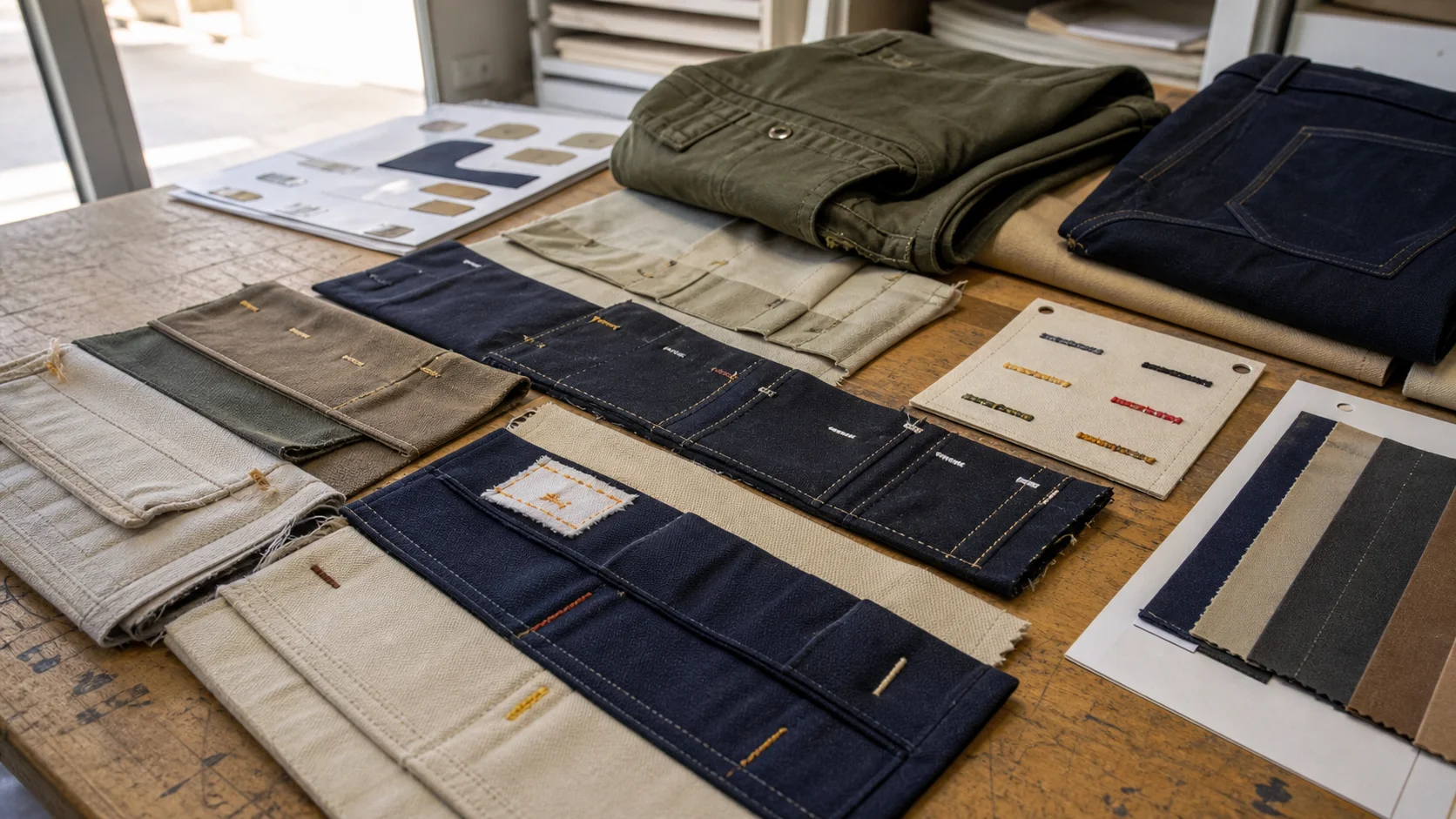
A production-focused outline for restaurant group buyers evaluating wholesale contrast bartack maps, fabric durability, stitch visibility, wash...
Contrast Bartack Map Testing Guide for Buyers - Decoration & Printing manufacturing guide
Restaurant groups buy uniforms differently from fashion brands. A chef coat, apron, server shirt, or utility overshirt is not just a garment; it is part of a daily operating system. It gets washed hard, worn under heat and moisture, exposed to food stains, and judged by guests at close range. When contrast bartacks are used as a visible decoration detail, the risk profile changes. Buyers need to test both the strength of the bartack and the visual consistency of the contrast thread placement.
This guide explains how to build a practical contrast bartack map fabric testing process for wholesale restaurant uniforms. It is written for sourcing teams, procurement managers, uniform program owners, and brand operators who need repeatable quality across multiple locations, not just an attractive sample in a showroom.
A bartack is a dense reinforcement stitch used at stress points. On restaurant uniforms, it often appears at pocket corners, apron tie points, side vents, sleeve tabs, placket ends, belt loops, and tool loops. A contrast bartack uses thread that is intentionally different from the garment fabric or main stitching color. That small detail can support brand identity, improve visibility of reinforced zones, and add a more deliberate finished look.
A contrast bartack map is the placement guide that tells the factory exactly where each bartack should sit, what size it should be, what thread color should be used, and how it should perform. It is usually part of the tech pack or uniform specification sheet. Without a map, production teams may place bartacks inconsistently across sizes, styles, or reorder batches.
Testing the contrast bartack map means checking three things at the same time:
For wholesale restaurant groups, this matters because a uniform order is rarely a single small batch. A group may need aprons for front-of-house teams, chef coats for kitchens, shirts for managers, and replenishment stock for new hires. If contrast bartacks shift from one lot to the next, the uniforms can look mismatched even when the base fabric is correct.
Contrast bartacks are a small decoration choice with practical value. They are not as bold as embroidery, screen printing, or woven patches, but they can create a quiet brand signature. For restaurant groups that want durability without heavy decoration, contrast bartacks are often a sensible option.
Common reasons buyers specify contrast bartacks include:
The purchasing judgment is straightforward: contrast bartacks are a good choice when the buyer wants a durable, repeatable, low-profile brand detail. They are not the right choice if the uniform needs strong logo visibility from a distance. In that case, embroidery, heat transfer, woven labels, or printed elements may still be needed. Buyers comparing decoration methods can review broader production options through Fabrikn services before locking the final uniform decoration plan.
The risk with contrast bartacks is that they look simple. They are small, fast, and familiar to most sewing lines. That often leads buyers to under-specify them. In wholesale restaurant orders, that can become expensive.
Key risks include:
For buyers, the tradeoff is between detail control and production speed. A detailed bartack map adds work during sampling and inspection, but it reduces argument during bulk production. A vague request such as “red bartacks on pocket corners” leaves too much room for interpretation.
Practical sourcing rule: if the contrast bartack is visible to guests or repeated across multiple uniform styles, treat it as a decoration specification, not just a sewing reinforcement.
A good bartack map starts with function. Decoration should not override garment performance. On restaurant apparel, the best bartack locations are usually the points that already need reinforcement.
Aprons are the most common uniform item for contrast bartacks. Stress points include pocket openings, waist tie attachments, neck strap joints, towel loops, pen pockets, and side tabs. Contrast bartacks work well here because aprons are often simple garments with large visible fabric surfaces.
For bib aprons, buyers should pay close attention to the upper chest pocket and waist tie connection points. For waist aprons, the pocket corners and tie insert points are the main failure areas. Dense bartacks on very light apron fabrics can cause puckering, so sample testing should include laundering and flatness review.
Chef coats need reinforcement around sleeve vents, side vents, pocket corners, and placket stress points. Contrast bartacks can look sharp on black, navy, charcoal, white, or natural cotton-rich fabrics. They can also become too decorative if overused.
For back-of-house uniforms, buyers should prioritize wash durability and heat comfort. Bartacks near the underarm, cuff, or neck can create irritation if they are too stiff. Testing should include wear simulation or at least a fit review on the approved size set.
Server shirts often need a cleaner appearance than kitchen apparel. Contrast bartacks should be used selectively: pocket corners, side vents, sleeve tabs, or back yoke stress points. A map with too many visible bartacks may make the garment look more like workwear than hospitality apparel.
The right choice depends on brand positioning. Casual restaurant groups can use bold contrast colors. Premium dining groups usually need more restrained tones, such as tonal contrast, muted metallic shades, or one signature placement.
Restaurant utility pants, cargo trousers, and chef pants may use bartacks at pocket openings, belt loops, fly ends, and side seams. Contrast bartacks can be effective, but buyers should be cautious with bright thread on lower-body garments. Soil exposure, abrasion, and laundering can make thread wear more obvious.
Fabric selection determines whether the bartack sits cleanly or causes problems. Buyers should specify fabric weight, construction, composition, finish, and shrinkage tolerance before approving a contrast bartack map.
Fabric Type Typical Use Bartack Consideration Buyer Judgment Cotton twill, 180-260 gsm Aprons, chef coats, work shirts Handles bartacks well but may shrink; thread color must be wash-tested. Good choice for natural look and durable casual uniforms. Poly-cotton twill, 160-240 gsm Aprons, shirts, chef apparel Stable in laundering; contrast thread usually sits cleanly. Often the most practical option for multi-location restaurant groups. Canvas, 240-360 gsm Heavy aprons, utility uniforms Needs correct needle size and machine setting; heavy seams can become bulky. Best for rugged concepts, not for lightweight service uniforms. Chambray or poplin, 110-160 gsm Server shirts, casual uniforms Can pucker under dense bartacks; lower density may be needed. Use sparingly and test after wash. Stretch woven fabric Modern shirts, pants, active uniforms Bartack may restrict stretch and create stress concentration. Requires careful placement and stretch recovery testing. Denim or dyed canvas Aprons, casual restaurant workwear Shade variation and crocking may affect contrast thread appearance. Strong visual option, but approve full wash standard before bulk.For restaurant groups, poly-cotton blends often provide the best balance of durability, cost control, and wash stability. Pure cotton can look better in some brand environments, but shrinkage and fading must be managed. Stretch fabrics add comfort but complicate reinforcement stitching.
Buyers should not approve a contrast bartack only on unwashed fabric. At minimum, the sample should be washed according to the expected care method. If the restaurant group uses commercial laundry, the testing should reflect that harsher process as closely as possible.
Thread is the decoration in a contrast bartack. It must be specified with the same discipline as embroidery thread or label color. A buyer should not rely only on a general color name such as “orange,” “gold,” or “red.” Those words mean different things to different suppliers.
Polyester thread is usually the most practical choice for restaurant uniforms because it offers good strength, abrasion resistance, and wash performance. Cotton thread can create a softer, matte look, but it may not be as durable under repeated industrial laundering. Core-spun polyester is often used where extra strength is needed.
Common thread specifications may include:
Contrast thread should be approved under the lighting conditions that matter. Restaurant interiors often use warm lighting, while factories and offices may use cool white lighting. A bright red thread on black fabric can look premium in daylight and harsh under warm light. A gold thread can shift toward yellow or brown depending on the fabric shade.
A practical approval process uses one physical thread standard and one sewn reference sample. The thread cone alone is not enough because thread looks different when densely stitched into fabric.
Buyers do not always need to dictate every machine setting, but they should define the result. The factory can then propose the right needle, stitch density, and bartack dimensions. Typical bartack lengths for uniform stress points may range from 6 mm to 18 mm, depending on the location. Apron pocket corners may use a shorter bartack, while tie points or belt loops may need longer reinforcement.
For lightweight shirts, dense bartacks can create puckering. For heavy aprons, weak density can pull out. The correct setting is a balance between strength, appearance, and fabric behavior.
A controlled sample process prevents bulk disputes. Buyers should treat contrast bartack mapping as part of the decoration approval path, especially when a restaurant group is ordering multiple styles.
The map should show each bartack location on a flat sketch or technical drawing. It should include front view, back view, sleeve view if needed, and close-up placement for pockets or straps. Each bartack should have a reference code, such as BT-01 for left chest pocket, BT-02 for apron tie point, and BT-03 for side vent.
Approving thread separately is risky. The buyer should review thread on the actual bulk fabric or approved sample fabric. If there are multiple fabric colors, the same thread should be tested on each base color. A contrast color that works on black may look too bright on khaki or too dull on navy.
For bartack testing, a full garment is useful but not always required at the earliest stage. A strike-off panel can show thread color, stitch density, puckering, and placement scale. For high-volume restaurant programs, the buyer should still approve a full garment before bulk production.
Bartacks are small, but they can affect comfort at cuffs, neck straps, waistbands, and side seams. A fit review should check whether any bartack rubs against the body, restricts stretch, or creates stiffness where staff bend, reach, or tie the garment.
The approved sample should be washed before final bulk approval. Buyers should check thread color change, fabric puckering, seam distortion, thread fray, and any dye transfer. For restaurant use, one wash is not enough for long-term confidence, but it is better than approving only a fresh sample.
The pre-production sample should use bulk fabric, bulk thread, bulk trims, and intended production machinery where possible. This is the sample that should control the production line. If the pre-production sample differs from earlier samples, the buyer should document the difference and approve or reject it in writing.
Teams preparing a full uniform program can use Fabrikn’s contact page to discuss specification development, sampling sequence, and production planning for decoration-sensitive restaurant apparel.
Testing should be practical. Not every buyer needs a full lab program for every apron, but wholesale restaurant groups should define the performance risks that matter most.
Measure bartack placement against the approved map. Tolerance should be realistic. For visible pocket bartacks, buyers may use tighter tolerance such as plus or minus 2-3 mm. For hidden reinforcement points, a wider tolerance may be acceptable if function is not affected.
Use the same measurement points each time. For example, measure from pocket edge to bartack center, from pocket top to bartack start, or from seam edge to bartack end. Vague placement comments are hard to enforce during inspection.
Stress points should withstand normal use. Apron ties, pocket corners, and belt loops are common failure zones. A formal test can be performed by a lab, but a factory-level pull check is still useful during development. The purpose is to confirm that the bartack does not pop, tear the fabric, or distort the seam under reasonable force.
If the fabric tears before the bartack fails, the reinforcement may be too dense for that material. Strong stitching is not useful if it cuts into the fabric.
Restaurant uniforms face frequent washing. Buyers should test according to the expected care method: home wash, commercial laundry, tunnel wash, or industrial process. The harsher the wash, the more important thread quality becomes.
After washing, inspect:
Dark dyed aprons, denim, and canvas can crock, meaning color rubs off onto thread or other surfaces. Contrast thread can make this more visible. A white or bright bartack on indigo fabric may become stained after rubbing or washing. Buyers should test dry and wet rubbing if the base fabric is deeply dyed.
Some restaurant environments expose uniforms to sanitizers, grease removers, chlorine, and cleaning chemicals. Not every uniform will contact these directly, but kitchen aprons and chef coats often do. If the garment will be commercially laundered with aggressive chemicals, the thread should be tested accordingly.
Shrinkage affects bartack placement. A pocket bartack may be correctly placed on the unwashed garment and look misaligned after shrinkage. Buyers should compare pre-wash and post-wash measurements, especially for cotton-rich fabrics and garments with large pockets.
Inspection should not wait until final packing. Contrast bartacks are easier to correct early in production than after thousands of garments are finished.
Before sewing starts, the factory should confirm fabric lot, thread color, thread type, and trim compatibility. Buyers should ask for confirmation photos or physical swatches when color precision is important. If the thread supplier changes after approval, the buyer should be notified.
Inline inspection should review bartack size, density, placement, thread tension, and fabric puckering. The first output from each production line should be compared against the pre-production sample. If multiple lines are producing the same uniform, each line should be checked separately.
For large orders, buyers may request a wash check on early production units. This is useful when the order involves cotton twill, denim, garment dye, or bright contrast thread. It can catch bleeding, distortion, or shrinkage before the full order is packed.
Final inspection should include visual checks and measurement checks. The inspection plan should list contrast bartack defects clearly. Otherwise, inspectors may focus on general sewing and miss the decoration issue.
Defect Risk Level Inspection Action Wrong thread color High Compare against approved physical standard under controlled light. Missing bartack High Check all mapped points on selected samples. Incorrect placement Medium to high Measure against tolerance by garment size and style. Puckering Medium Review flatness before and after wash where applicable. Loose thread ends Medium Check trimming and bartack start/end security. Thread fraying High Check abrasion zones and reject if durability is compromised.Buyers should define which defects are critical, major, or minor before inspection. A missing bartack at an apron tie point is not cosmetic; it can become a functional failure. A slightly long bartack hidden inside a vent may be minor if it does not affect appearance or use.
Contrast bartacks do not usually require high minimums by themselves, but the overall MOQ depends on fabric, garment style, dyeing, trims, and factory setup. Buyers should look at the total uniform program rather than the bartack as an isolated item.
For wholesale restaurant uniforms, typical MOQ ranges may look like this:
These are general market ranges, not fixed rules. A factory may accept lower quantities at a higher unit price, especially if stock fabric and standard thread are used. A buyer needing low initial quantities should avoid too many custom colors, uncommon trims, or complex decoration combinations.
Lead time depends on material availability and approval speed. A simple apron using stock fabric and standard contrast thread can move faster than a custom-dyed chef coat with lab dips, wash testing, and multiple decoration approvals.
Common lead-time drivers include:
For planning purposes, buyers should allow extra time for the first order. Reorders can be faster if the same fabric, thread, map, and sample standards remain valid. Any change to fabric mill, thread supplier, garment wash, or factory line should trigger at least a limited re-approval.
Contrast bartacks are usually a low-cost decoration compared with embroidery or patches, but they still add cost through setup, sewing time, inspection, and quality control. More bartack points mean more operations. Tight placement tolerances also increase inspection effort.
The buyer’s tradeoff is simple: use enough contrast bartacks to create brand value and reinforce stress points, but do not scatter them across the garment without purpose. On a server shirt, two or four visible bartacks may be enough. On a utility apron, more reinforcement points may be justified.
A clear specification is the best tool for controlling contrast bartack quality. The following template can be adapted for restaurant aprons, shirts, chef coats, and utility garments.
Specification Area Buyer Requirement Garment style Define apron, chef coat, server shirt, overshirt, pant, or other item. Fabric State composition, construction, weight, finish, color, shrinkage tolerance, and wash method. Thread State fiber content, ticket or Tex size, color reference, and approved physical standard. Bartack map Attach technical drawing with coded bartack locations and measurement references. Bartack size Define length and acceptable tolerance by location. Stitch appearance Define clean density, no skipped stitches, no loose ends, no visible tension imbalance. Performance testing Define wash test, pull check, rubbing check, and colorfastness requirement where needed. Inspection standard Define critical, major, and minor defects with acceptance criteria. Packaging State whether garments are packed by size, location, role, or restaurant opening schedule.Large restaurant groups should also standardize the bartack map across related styles where possible. If every garment uses a different contrast placement system, inspection becomes harder and reorders become more vulnerable to mistakes.
Contrast bartacks sit between construction and decoration. They are sewn, but they carry visual brand value. That makes them relevant to Decoration & Printing planning, especially when uniforms also include embroidery, heat transfers, woven labels, or printed neck markings.
A balanced restaurant uniform program might use:
Buyers should avoid decoration overload. Restaurant uniforms need to be washable, replaceable, and comfortable. Every decoration method adds its own test burden. A contrast bartack is efficient because it can reinforce and decorate at the same time, but it should still be specified and tested properly.
For restaurant groups sourcing wholesale uniforms, the most reliable approach is to start with the operating environment. A casual barbecue chain, a high-volume coffee group, a hotel restaurant, and a fine-dining group all need different fabric choices and decoration levels.
Use contrast bartacks when:
Avoid or limit contrast bartacks when:
The safest commercial decision is to test the most exposed garment first. For many restaurant groups, that is the apron. It has visible surfaces, high stress points, frequent washing, and direct contact with stains. If the bartack thread performs well on the apron, it is more likely to work on related uniform pieces, though each fabric still needs its own approval.
Factories need clear direction, not long paragraphs of design intent. A contrast bartack map should be visual, measurable, and linked to approved standards. Buyers should send the factory a complete pack that includes garment sketch, fabric specification, thread standard, bartack size, placement tolerances, wash method, and inspection criteria.
Good communication reduces the chance of the factory making reasonable but incorrect assumptions. If the buyer wants red bartacks only on the top two apron pocket corners, the map should say that. If the lower pocket corners must use tonal thread because they are less visible or more exposed to abrasion, that should also be stated.
For buyers evaluating suppliers or building a long-term restaurant uniform program, it is useful to understand the production partner’s capabilities, quality process, and apparel development approach. Background information about the company can be reviewed through Fabrikn’s about page.
Before approving a wholesale contrast bartack restaurant uniform order, buyers should confirm the following:
Contrast bartacks are a small detail, but in restaurant uniforms small details repeat hundreds or thousands of times. A controlled bartack map helps buyers protect brand consistency, garment durability, and reorder reliability. The best programs do not overcomplicate the detail; they define it clearly, test it early, and inspect it consistently.
Get a free quote from Fabrikn — your trusted B2B clothing manufacturer with 10+ years of experience. MOQ as low as 200 pieces.
Get a Free Quote →A contrast bartack map is a technical placement guide showing where contrast bartacks should be sewn on a garment. It normally includes location codes, measurements, thread color, bartack length, and tolerance requirements.
Restaurant groups use contrast bartacks to reinforce stress points while adding a subtle brand detail. They are common on aprons, chef coats, overshirts, and utility garments because they combine function with decoration.
Poly-cotton twill, cotton twill, canvas, and medium-weight woven fabrics usually work well. Lightweight poplin, stretch fabrics, and loosely woven materials need more testing because dense bartacks can cause puckering, restriction, or fabric tearing.
Typical MOQs may range from about 100-300 pieces for simple stock-fabric aprons to 300-1,000 pieces for custom fabric, garment dye, or more complex uniform styles. The final MOQ depends on fabric, trims, thread availability, factory setup, and total program volume.
Thread color should be approved as a sewn sample on the actual garment fabric. A thread cone or digital reference is not enough because dense stitching, fabric shade, and lighting can change the final appearance.
The most important checks are wash durability, pull strength, placement accuracy, colorfastness, rubbing resistance, and post-wash appearance. Commercial laundry conditions should be considered if the restaurant group uses outsourced or industrial washing.
Contrast bartacks can support brand identity, but they usually cannot replace a logo when strong visibility is required. They work best as a low-profile decoration detail used alongside labels, embroidery, or printing where needed.
Common defects include missing bartacks, wrong thread color, inconsistent placement, loose thread ends, skipped stitches, puckering, fraying, and fabric damage around dense stitch areas.
Yes. Restaurant uniforms are washed frequently, so post-wash review is essential. Buyers should check thread fading, bleeding, puckering, loose stitches, shrinkage effects, and any distortion around bartack locations.
Buyers can reduce risk by approving a physical pre-production sample, using bulk fabric and thread, limiting unnecessary bartack placements, defining inspection criteria, and testing the most exposed garment style before scaling the program.