
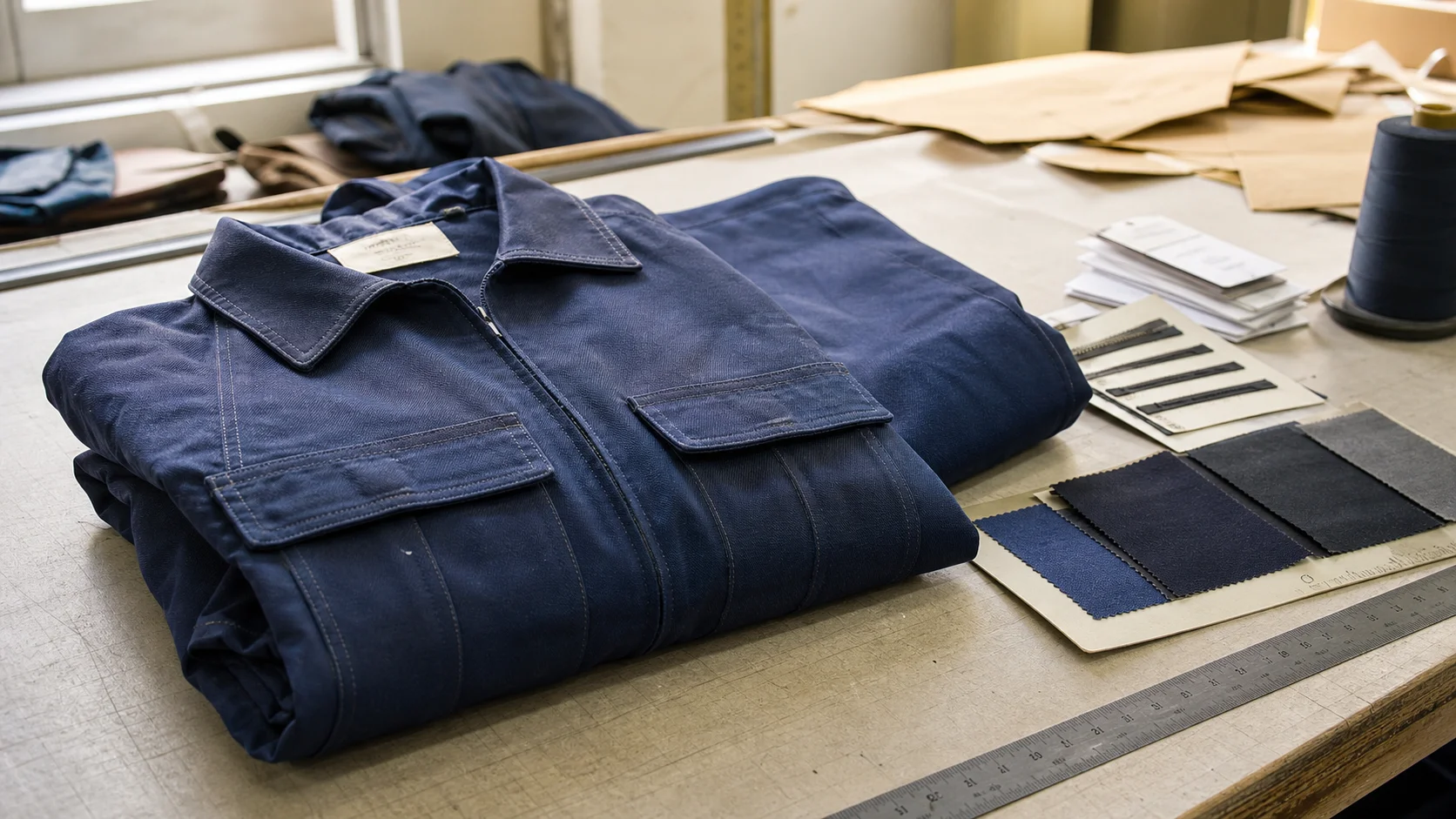
A practical landed cost outline for restaurant groups buying wholesale coveralls, including fabric, decoration, packaging, freight, duties, sizing,...
Wholesale Coveralls Landed Cost Buying Guide - MOQ, Cost & Sourcing manufacturing guide
Restaurant groups buy coveralls for practical reasons: kitchen maintenance, commissary work, sanitation teams, delivery staging, facilities crews, dish operations, food production, and occasional front-of-house support during messy setup tasks. The garment looks simple, but the landed cost is rarely just the factory unit price. A low FOB quote can become expensive once fabric selection, sizing, decoration, packaging, freight, duties, rework risk, and replenishment timing are included.
This wholesale coverall landed cost guide is written for restaurant groups comparing suppliers, building a uniform budget, or preparing a bulk order for multiple locations. The focus is practical sourcing: what affects cost, where suppliers often leave gaps in quotes, and how to judge whether a cheaper offer is actually cheaper after delivery.
Buying judgment: for restaurant groups, the best coverall program is usually not the lowest unit price. It is the option with stable sizing, washable fabric, reliable replenishment, clear packing by location, and predictable landed cost.
Landed cost is the full cost of getting finished coveralls into your hands, ready for distribution or use. It includes the garment price, decoration, labeling, packaging, export charges, freight, customs duty, brokerage, domestic delivery, warehousing, and any extra handling needed to sort by restaurant location or department.
Many buyers compare coverall quotes using only FOB or ex-factory pricing. That is risky. A supplier offering a $14.80 coverall may not be cheaper than a $17.20 coverall if the first option has higher shrinkage risk, weaker zippers, poor carton packing, expensive air freight, or inconsistent sizing that causes returns and reorders.
Restaurant groups should separate cost into three levels. First is the product cost: fabric, sewing, trims, logo, labels, and packaging. Second is the movement cost: freight, duty, customs clearance, and local trucking. Third is the operating cost: size exchanges, replacement stock, staff complaints, laundry failure, and management time spent fixing avoidable issues.
That third level is often ignored, yet it matters most for uniform programs. If a coverall fails after several industrial washes or workers reject the fit, the original savings disappear quickly.
Coveralls have more cost variables than a T-shirt or apron. They use more fabric, require more sewing time, include heavier trims, and need more size grading. A small change in fabric weight or zipper quality can shift cost noticeably across a large order.
Restaurant groups commonly consider poly-cotton twill, cotton twill, ripstop, stretch woven blends, or specialty treated fabrics. For general back-of-house and maintenance use, poly-cotton twill is often the most balanced choice because it offers reasonable durability, easier care, and better price control than all-cotton options.
Typical weights range from about 160 gsm to 260 gsm, depending on use. Lightweight coveralls breathe better but may look less structured and wear faster at knees, elbows, and seams. Heavier coveralls feel more durable but can be hot in kitchens, dish areas, and commissary environments.
Buying judgment: do not over-spec the fabric just to make the garment feel “premium.” In restaurant operations, comfort and laundering performance usually matter more than heavy weight.
A basic coverall with a straight fit costs less than a design with an action back, elastic waist, gusseted crotch, knee reinforcement, adjustable cuffs, multiple cargo pockets, or contrast panels. These details may be worth paying for when staff move constantly, bend frequently, or carry tools.
Fit is a landed cost issue because poor grading leads to size exchanges. If the supplier’s medium fits like a small, your group may need to reorder larger sizes or carry deeper backup stock. For restaurant groups with diverse teams, a practical size range may include XS to 5XL, depending on workforce needs.
Zippers, snaps, thread, elastic, pocket bags, hook-and-loop tape, and reflective tape all affect cost. A weak zipper can ruin the garment before the fabric wears out. For coveralls, specify zipper material, zipper gauge, puller type, snap finish, thread type, and reinforcement points.
Restaurant buyers should be cautious with overly cheap plastic zippers on work coveralls. They may be acceptable for light-duty, occasional-use garments, but metal or reliable molded zippers are usually better for frequent wear. Nickel-free snaps may be necessary if skin contact or compliance preferences are part of your uniform policy.
Logo application can be embroidery, woven patch, heat-transfer print, screen print, or direct print, depending on the fabric and laundry method. Embroidery is durable and professional, but it adds cost and may feel stiff on lightweight fabric. Heat transfers can look sharp but must be tested against wash temperature and abrasion.
For restaurant groups, subtle branding is often more practical than large decoration. A left chest logo, department label, or role identifier may be enough. Large back logos can increase cost, complicate placement approval, and create higher rejection risk if alignment varies.
Standard bulk polybag packing costs less than individual size-labeled bags packed by location. Yet multi-location restaurant groups often benefit from more organized packing. If 2,000 coveralls arrive in mixed cartons with unclear size ratios, the labor cost of sorting can be painful.
Ask suppliers to quote both standard packing and location-based packing. For rollouts, a practical approach is individual polybagging with size sticker, carton-level size breakdown, and packing lists by store or department. This increases unit cost slightly but can reduce operational confusion.
Minimum order quantity depends on fabric availability, color, size range, decoration, and whether the coverall is stock, private label, or fully custom. Buyers should not treat MOQ as a fixed number across all suppliers. It is a reflection of fabric minimums, cutting efficiency, dyeing requirements, and production line setup.
Coverall Type Typical MOQ Range Best Use Case Cost Tradeoff Stock blank coveralls 50-200 pieces Small teams, urgent needs, testing fit Higher unit price, limited colors and sizing Stock coveralls with logo 100-300 pieces Simple branded uniform programs Faster setup, less control over pattern Custom color or fabric 300-800 pieces Restaurant groups needing brand consistency Better control, longer lead time Fully custom construction 500-1,500 pieces Multi-location groups with defined specs Best long-term consistency, higher development effort Special treated fabric 800-2,000+ pieces Flame-resistant, water-repellent, or technical use Higher fabric MOQ and testing riskFor restaurant groups, the practical MOQ decision depends on rollout size and replenishment cadence. If you operate 10 locations and need 8 coveralls per location, a 100-piece order may cover the first need but leave little buffer. If turnover is high or roles change seasonally, you may need 15-25% extra stock in common sizes.
Size curve is another hidden MOQ issue. Suppliers may accept 500 pieces total but resist producing only 5 pieces in 5XL or XS because cutting and bundling become inefficient. Confirm whether MOQ applies by style, color, size, or decoration version.
Buying judgment: if the supplier cannot explain MOQ by fabric, color, and size, the quote may be incomplete. Restaurant groups should push for a written size-level MOQ before approving samples.
A vague coverall spec creates vague pricing. “Durable poly-cotton coverall with logo” is not enough for accurate sourcing. The supplier needs measurable details that define performance, appearance, and cost.
Restaurant environments create specific pressure on garments. Staff may work around grease, cleaning chemicals, steam, stainless steel edges, mop sinks, and wet floors. The coverall does not need to be over-engineered for every scenario, but it should survive the intended use.
For standard kitchen maintenance and commissary operations, a midweight poly-cotton twill with reinforced pocket openings and a reliable front zipper is often more sensible than a fashion-led design. For dish areas or cleaning teams, stain resistance and wash recovery may matter more than softness. For food production teams, linting, cuff control, and color coding may be more important.
Ask for test data when the order is large or the garment will face repeated laundering. Useful checks include shrinkage after wash, colorfastness to washing, colorfastness to rubbing, seam strength, pilling resistance, and dimensional stability. Not every order justifies a full lab test package, but large restaurant groups should at least require wash testing before bulk approval.
A practical internal test is also useful: wash the fit sample or pre-production sample several times under expected laundry conditions. Measure chest, inseam, sleeve, and body length before and after. If the garment twists, shrinks heavily, or loses shape, the low quote deserves skepticism.
Sampling is where restaurant groups prevent expensive mistakes. Rushing directly from quote to bulk production is risky, especially when the coverall includes custom color, logo placement, or a broad size range.
Sample Stage Purpose Buyer Checkpoint Reference sample Shows target style, fit, and construction Confirm what must match and what can change Fit sample Tests pattern, movement, and size grading Check bend, reach, squat, sleeve, torso, and inseam Fabric swatch or lab dip Approves material and color Review under kitchen, office, and daylight conditions Logo strike-off Approves branding method Check size, thread color, edge quality, and wash behavior Pre-production sample Final sample before bulk cutting Approve all specs, labels, trims, packing, and measurements Size set sample Confirms grading across sizes Review key sizes, especially XS, XL, 2XL, and 4XL+For custom coveralls, the pre-production sample should be treated as the contract standard. Keep one approved sample with the buyer and one with the supplier if possible. Photos are helpful, but physical samples are better for checking fabric handfeel, seam finish, zipper function, and logo quality.
Restaurant groups should involve operations before final approval. A uniform manager may focus on appearance, while kitchen supervisors may notice issues with reach, heat, or pocket placement. A 15-minute wear test can expose problems that are not visible on a hanger.
Buying judgment: if the garment pulls at the shoulders when reaching forward or binds at the torso when squatting, do not approve bulk production. Coveralls must be tested in motion.
Coveralls are heavier and bulkier than many restaurant uniform items. Freight can therefore become a major part of landed cost, especially if orders are shipped by air. The right freight method depends on delivery deadline, volume, storage capacity, and risk tolerance.
Lead time depends on more than sewing time. Fabric booking, dyeing, trim sourcing, sample approval, production queue, inspection, export documentation, freight sailing schedule, customs clearance, and domestic delivery all affect the calendar.
Stage Typical Time Range What Can Delay It Tech pack and quote alignment 3-10 days Unclear specs, missing size chart, logo uncertainty Fit sample 7-20 days Custom pattern, fabric not available, trim changes Lab dip or fabric approval 5-15 days Color matching, dye lot constraints Pre-production sample 7-18 days Logo revision, fit correction, label changes Bulk production 25-60 days MOQ, factory capacity, fabric arrival, inspection failure International freight 5-45 days Air versus sea, port congestion, customs review Domestic sorting and delivery 2-14 days Multi-location packing, warehouse availabilityA realistic custom coverall program may take 8-14 weeks from confirmed specs to delivery, sometimes longer if fabric is custom dyed or the order requires special testing. Stock garments with decoration can be much faster, often 2-5 weeks depending on inventory and logo workload.
Duty rates and import rules depend on country of origin, destination market, fabric composition, and product classification. Buyers should not rely on a supplier’s casual estimate for duty. Work with a customs broker or qualified import partner to confirm the HTS classification and duty exposure before placing a large order.
A clear landed cost worksheet prevents poor quote comparisons. The table below shows the categories restaurant groups should request or estimate before deciding between suppliers.
Cost Component What to Include Buyer Notes Garment unit price Cut, sew, fabric, basic trims Confirm whether price is FOB, EXW, DDP, or delivered Logo and decoration Embroidery, patch, transfer, setup, digitizing Ask if logo cost changes by size or stitch count Labels Care, size, brand, department, compliance labels Private label programs need written label specs Packaging Polybag, size sticker, carton label, store packs Location sorting may save labor after delivery Testing Wash, colorfastness, seam, safety, compliance Large orders should budget for reasonable testing Inspection Pre-shipment inspection or in-line check Inspection cost is cheaper than receiving bad goods Freight Air, sea, courier, trucking, fuel surcharges Compare by cubic volume and gross weight Duties and taxes Import duty, VAT/GST where applicable Confirm classification before final budget approval Brokerage and clearance Customs broker, documentation, entry fees Small charges add up across repeated orders Domestic delivery Warehouse delivery, store distribution, liftgate Remote locations may raise last-mile cost Contingency Shortage, replacement, exchange, rush freight Budgeting 3-8% can prevent rollout surprisesA simple landed cost formula is:
Landed cost per coverall = total product cost + decoration + packaging + testing + inspection + freight + duty + brokerage + domestic delivery, divided by total accepted units.
The phrase “accepted units” matters. If 2% of garments fail inspection or must be reworked, the cost of usable garments rises. Good buying teams track accepted units, not just shipped units.
Assume a restaurant group orders 1,000 custom poly-cotton coveralls. The quoted FOB garment price is $18.50. Embroidery adds $1.20. Individual packing and size stickers add $0.35. Inspection and testing average $0.30 per unit. Freight, duty, brokerage, and domestic delivery total $3.80 per unit. The estimated landed cost is $24.15 per coverall before internal handling.
If the same order is shipped partly by air to meet a rushed opening schedule, freight may add several dollars more per unit. If poor fit causes 100 replacements, the actual program cost rises again. That is why lead time discipline and sample approval matter as much as quote negotiation.
Coveralls should be inspected more carefully than basic uniforms because construction issues can affect both comfort and durability. A missed defect may not show until staff start working.
Set inspection tolerances before production. Common apparel measurement tolerances may range from around 0.5 inch to 1 inch depending on the point of measure and garment size, but the supplier should agree in writing. Large sizes may require slightly different tolerances because grading is broader.
Restaurant groups should also inspect packing accuracy. If cartons are marked incorrectly, distribution teams can lose hours. Ask for carton labels showing style, color, size, quantity, purchase order number, and destination if store-level packing is required.
Buying judgment: a coverall that looks acceptable on a table can still fail in use. Function checks, zipper tests, pocket reinforcement, and movement fit are not optional for bulk restaurant workwear.
Suppliers do not always quote the same scope. One may include logo, packing, and freight. Another may quote only FOB blank garment cost. Restaurant buyers need a standardized quote sheet to compare options fairly.
The right supplier for a restaurant group may not be the cheapest factory. It may be the partner that can manage specifications, sampling, logistics, and replenishment without creating administrative load for operations.
Groups that need structured uniform development can review apparel production support through Fabrikn’s services. If supplier selection, custom development, or quote comparison is unclear, early sourcing support can reduce expensive revisions later.
A quote does not need to be perfect on the first pass, but the supplier should become more specific as the buyer asks better questions. If the supplier stays vague, the risk stays with the buyer.
Coverall buying becomes more complex when a restaurant group has many locations, job functions, and start dates. The garment itself is only part of the rollout. Distribution planning can determine whether the program feels organized or chaotic.
Start with headcount by location and role. Estimate how many coveralls each worker needs. A maintenance technician may need 3-5 units for rotation, while a manager using coveralls occasionally may need only one. Commissary or production teams may need more if laundering is frequent.
Build a size curve from actual staff data when possible. If that data is not available, start with a conservative size mix and use a pilot order before committing to a large custom run. Keep extra units in the most common sizes. For many uniform programs, medium through 2XL carry the highest demand, but each workforce is different.
Replenishment is where many uniform programs fail. A custom coverall may have a 45-90 day replenishment cycle depending on fabric and factory schedule. If the group waits until stock is depleted, urgent freight becomes likely.
A sensible approach is to define reorder points by size. For example, once medium or large inventory falls below a set number, the next purchase order is triggered. Restaurant groups with seasonal hiring should place replenishment orders before peak staffing periods.
Stock coveralls are useful for speed and smaller quantities. They reduce development work and allow quicker replacement. The tradeoff is limited control over fabric, color, fit, and trim quality. If the supplier discontinues the style, consistency can suffer.
Custom coveralls make sense when the restaurant group has enough volume, wants brand consistency, or needs specific features such as color-coded departments, reinforced pockets, or special sizing. The tradeoff is longer lead time and more responsibility during sample approval.
Buying Path Advantages Risks Best Fit Stock blank Fast, low MOQ, simple replacement Limited branding and control Small teams or urgent needs Stock with logo Good balance of speed and branding Fit and fabric depend on stock supplier Regional groups and pilots Custom private label Control over fabric, fit, trims, and packaging Higher MOQ and longer setup Multi-location groups with repeat demand Managed uniform program Better coordination and replenishment Needs clear forecasting and budget discipline Large groups with ongoing hiringRestaurant groups that are still defining supplier criteria can learn more about the sourcing approach and company background through Fabrikn’s about page. For a quote review or project discussion, use the contact page with order quantity, target fabric, logo requirements, destination, and expected delivery date.
Before placing a wholesale coverall order, confirm the following points in writing. This is not paperwork for its own sake. It is the difference between a controlled landed cost and a messy receipt of goods.
If the purchase is large enough to affect multiple openings or operating departments, create a landed cost comparison for at least two supplier options. Include realistic freight and contingency numbers. A supplier that costs $1 more per unit but delivers better packing, stronger zippers, and more reliable sizing may be the better commercial choice.
For restaurant groups, wholesale coveralls should be sourced like operational equipment, not promotional apparel. The garment has to fit real workers, survive laundering, arrive sorted correctly, and be available for reorder. Landed cost is the tool that keeps the buying decision honest.
The strongest programs usually start with a clear specification, a realistic MOQ, a tested sample, and a supplier quote that separates product cost from freight, duty, and handling. Shortcuts can work for a small emergency order, but they are expensive when repeated across locations.
If speed matters most, stock coveralls with simple branding may be the right first buy. If consistency and long-term cost control matter more, custom coveralls with an approved size set and replenishment plan are usually stronger. The better decision depends on order volume, launch calendar, laundry conditions, and how much operational friction the group can tolerate.
Get a free quote from Fabrikn — your trusted B2B clothing manufacturer with 10+ years of experience. MOQ as low as 200 pieces.
Get a Free Quote →Typical MOQ ranges from 50-200 pieces for stock coveralls, 100-300 pieces for stock coveralls with logo decoration, and 500-1,500 pieces for fully custom coveralls. Custom fabric, special colors, extended sizing, and technical finishes can push MOQ higher.
Landed cost includes the garment price, logo decoration, labels, packaging, testing, inspection, freight, duty, customs brokerage, domestic delivery, and any sorting or handling needed before the coveralls reach the final user.
A realistic custom coverall timeline is often 8-14 weeks after specifications are clear, depending on sampling, fabric availability, production capacity, inspection, and freight method. Stock coveralls with logo decoration may be completed faster, often in 2-5 weeks when inventory is available.
For many restaurant operations, midweight poly-cotton twill is a practical choice because it balances durability, wash care, comfort, and cost. All-cotton, ripstop, stretch, or treated fabrics may be better for specific roles, but they should be tested against the actual work environment.
Stock coveralls are better for urgent needs, small orders, or pilot programs. Custom coveralls are better when the group needs consistent branding, controlled fit, specific trims, special colors, or repeat replenishment across many locations.
Common issues include inconsistent measurements, weak zippers, poor seam reinforcement, logo misplacement, fabric shade variation, shrinkage, mixed carton packing, and incorrect labels. These risks can be reduced through sample approval and pre-shipment inspection.
A practical buffer is often 10-25% above immediate headcount needs, depending on turnover, laundering rotation, and replacement demand. Common sizes usually need deeper backup stock than very small or very large sizes, but the best size curve should come from actual staff data when available.
Standardize fabric and color, simplify pocket design, avoid unnecessary decoration, plan sea freight instead of urgent air freight, approve samples quickly, and consolidate orders across locations. Cutting zipper quality, fabric testing, or inspection is usually a poor saving.
Send target quantity, size range, fabric preference, color, logo artwork, decoration method, delivery country, required date, packing needs, and whether the order is stock, customized, or fully private label. Better input produces a more reliable quote.