
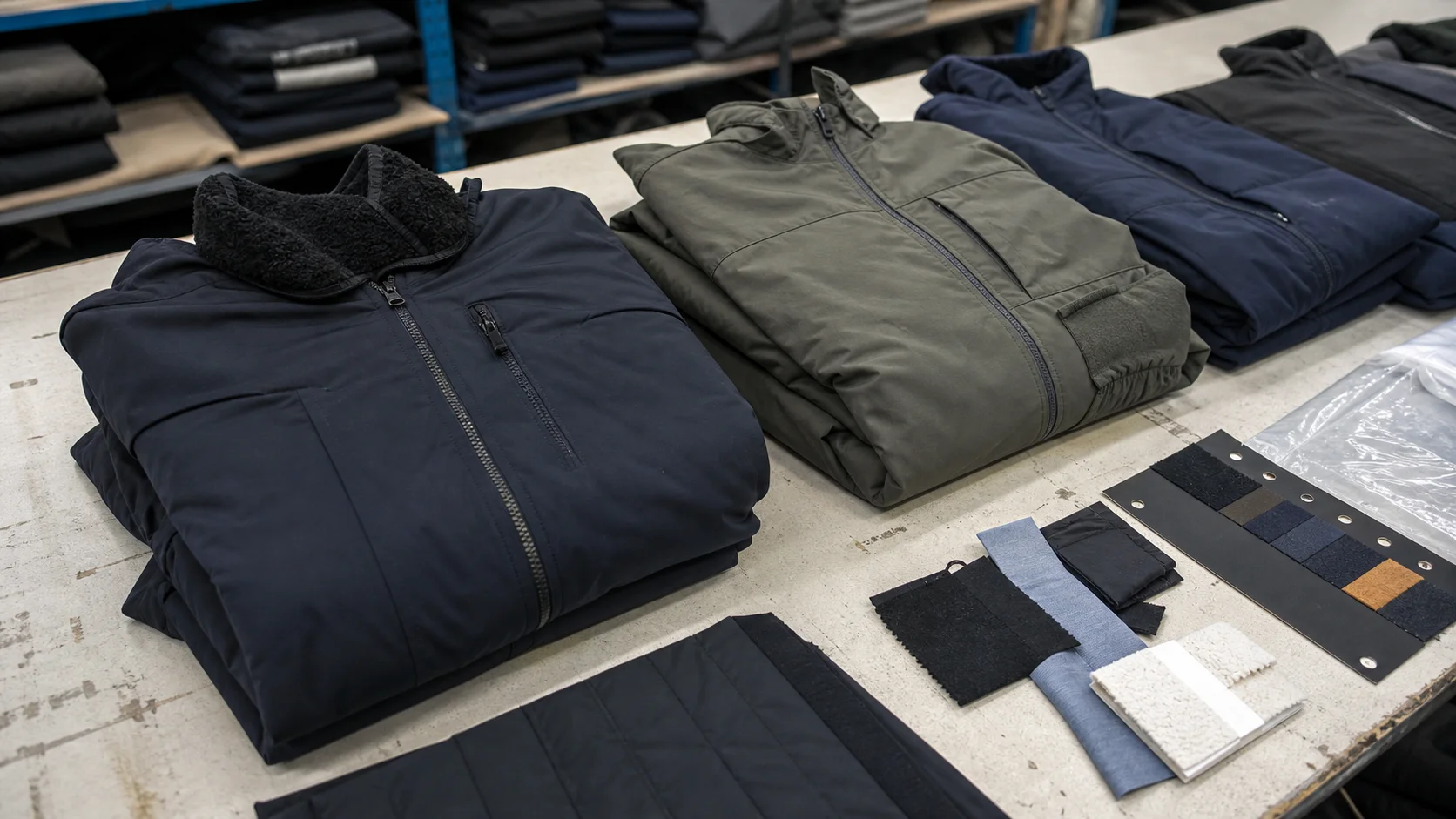
A transport-hub buyer’s review of wholesale freezer coat MOQ pricing, including insulation specs, compliance needs, decoration costs, size runs, freight...
Freezer Coat MOQ Pricing Review for Hub Buyers - Outerwear & Jackets manufacturing guide
Wholesale freezer coat MOQ pricing is not a simple jacket quote with thicker padding. For transport hub buyers, the product sits between workwear, cold-chain PPE, and operational uniform. The coat must keep staff warm during repeated exposure to cold rooms, loading docks, container yards, cross-dock platforms, and refrigerated vehicle bays. It also has to survive abrasion, bending, condensation, cleaning, branding, and fast reissue cycles.
A freezer coat order for a transport hub usually has more moving parts than a standard outerwear program. Buyers may need different sizes for warehouse crews, drivers, forklift operators, security teams, and supervisors. They may also require reflective tape, ID windows, radio loops, badge tabs, detachable hoods, longer back panels, reinforced elbows, or color coding by department. Each of those choices affects MOQ, unit price, sampling time, production risk, and inspection scope.
The practical question is not only, “What is the cheapest freezer coat?” A better sourcing question is, “At what MOQ can the supplier hold insulation performance, fit consistency, trim durability, and delivery reliability?” Cheap coats can be expensive if zippers fail in low temperatures, sleeve seams leak air, or the lining tears during the first month of use.
For hub buyers, the strongest freezer coat quotation is usually not the lowest first price. It is the quote that explains MOQ logic, fabric availability, insulation weight, trim grade, sample approval steps, and inspection tolerance clearly enough to reduce surprises before bulk production.
This review breaks down the main MOQ and pricing considerations for wholesale freezer coats used in transport hub environments. It is written for procurement teams, uniform buyers, cold-chain logistics operators, and sourcing managers comparing manufacturers or importers for repeat programs.
Transport hubs have a harsher buying profile than many retail outerwear programs. A retail jacket may be judged by appearance, seasonal merchandising, and consumer comfort. A freezer coat for a hub is judged by worker protection, cost per wear, safety compliance, and replacement control.
In a refrigerated transport hub, workers often move between different temperature zones. A coat may be used in a frozen storage room, then a semi-open loading bay, then a staff corridor. That movement creates moisture and condensation issues. Fabrics, linings, and insulation must manage not just cold but also repeated thermal change.
Hubs also have mixed wearer profiles. One order may cover permanent staff, agency labor, seasonal workers, and supervisors. This can make size distribution unpredictable. A buyer may want a low MOQ, but size fragmentation can push the supplier’s cost higher because cutting efficiency declines and packing becomes more complex.
These use cases matter because each one changes the correct specification. A coat for a stationary checker in a deep-freeze zone may need heavier insulation and a longer body. A forklift operator may need shorter length, better sleeve articulation, and less bulk around the waist. A buyer chasing one universal coat may reduce SKU complexity, but the compromise can hurt user acceptance.
For broader apparel sourcing support, buyers comparing custom outerwear programs can review Fabrikn services to understand how product development, sourcing, and production coordination can fit into a wholesale buying process.
MOQ, or minimum order quantity, is the smallest quantity a supplier is willing to produce under a certain specification and price structure. In freezer coat manufacturing, MOQ is shaped by fabric minimums, insulation purchasing, trim setup, cutting efficiency, branding method, labor planning, and factory line economics.
For simple stock-style freezer coats, MOQs can sometimes start around 100 to 300 pieces per color if the supplier already holds fabric and trims. For custom freezer coats with specific shell fabric, lining, insulation, reflective tape, logo placement, and size grading, typical MOQs often sit around 300 to 800 pieces per style and color. More complex programs, especially with custom-dyed fabric or specialized trims, may require 1,000 pieces or more.
These ranges are indicative, not universal. A supplier with available stock fabric may accept a smaller first order. A mill-dyed color can require a higher commitment. A buyer asking for eight sizes, three colors, and several logo versions should expect MOQ pressure even if the total order quantity appears reasonable.
MOQ should be reviewed with size ratio, not just total quantity. A 500-piece order spread across XS to 5XL is harder to produce efficiently than a 500-piece order concentrated across S to 2XL. Oversize garments use more fabric and insulation, and some suppliers apply surcharges for 3XL and above.
Freezer coat pricing is built from material cost, labor cost, overhead, wastage, packaging, quality control, margin, and logistics. The coat’s shell fabric and insulation usually carry the biggest cost influence, but trims and construction details can quietly add meaningful cost.
Buyers should avoid comparing freezer coat quotes only by unit price. Two coats may look similar in a spreadsheet while being different products in use. One may have 160 gsm polyester padding while another uses 240 gsm insulation with better quilting stability. One may use a standard zipper that stiffens in cold rooms, while another uses a heavier molded zipper with a storm flap. The cheaper quote may be acceptable for light chiller use but poor for freezer exposure.
A strong purchasing review separates “must-have” features from “nice-to-have” features. For example, certified high-visibility tape may be required for loading yard staff, while a detachable hood may be optional if helmets or bump caps are worn. A radio loop may be useful for supervisors but unnecessary for all workers. Buying every feature for every wearer can inflate the average unit cost without improving safety where it matters.
The freezer coat specification should be written clearly before serious price comparison. Vague descriptions such as “warm winter coat” or “heavy freezer jacket” invite inconsistent quotations. A supplier may quote a lightweight padded jacket while another quotes a heavy-duty cold-room coat. The buyer then compares prices that do not represent equal products.
Common shell fabrics include polyester oxford, polyester pongee, nylon taslon, ripstop polyester, and coated woven fabrics. Polyester oxford is common for workwear because it balances durability and cost. Nylon options can feel softer and stronger by weight, but they may cost more. Coated fabrics improve wind and water resistance but may affect breathability and hand feel.
For hub environments, abrasion resistance matters. Workers brush against pallets, racks, dock plates, vehicle doors, conveyor edges, and handheld equipment. A very soft fashion shell can look good in samples but wear poorly in daily use. A rougher workwear shell may be less stylish but more suitable for repeated operational contact.
Freezer coats typically use polyester insulation because it is cost-effective, washable, and available in different weights. Typical padding weights may range from 120 gsm to 300 gsm, depending on target temperature and garment design. A light chiller jacket may sit around 120 to 160 gsm. A deeper cold-room coat may use 200 to 300 gsm or layered insulation zones.
Higher insulation weight is not always better. Bulky coats reduce mobility and can cause overheating when workers move between temperature zones. Bulk also increases carton volume, which raises freight cost. For transport hub buyers, the best insulation choice depends on exposure time, activity level, and whether workers wear thermal mid-layers underneath.
Zippers, snaps, cuffs, drawcords, and reflective trims require careful review. Low-quality zippers are a frequent failure point in cold-use garments. Large zipper pullers are useful because workers may wear gloves. Storm flaps help block wind and cold air. Rib cuffs, adjustable cuffs, and inner storm cuffs can improve warmth but also add cost and sewing complexity.
Buyers should request a full bill of materials before approving bulk. If the supplier resists sharing trim grades or substitutes components without approval, the low price carries hidden risk.
The table below gives a cautious review of common wholesale freezer coat scenarios. Actual pricing depends on country of production, order timing, fabric availability, currency, duty, testing, freight, and compliance requirements. Use these ranges as a negotiation framework, not a fixed market quote.
Order Scenario Typical MOQ Range Indicative FOB Unit Price Range Best Fit Main Buying Risk Stock freezer coat with logo decoration 50-300 pcs Lower to mid range, depending on stock quality Small hubs, trial orders, urgent replenishment Limited control over fabric, fit, color, and trim quality Basic private-label freezer coat 300-600 pcs Moderate range Regional hub programs needing consistent branding Spec may be simplified to hit price target Heavy-duty cold-room coat with reinforced zones 500-1,000 pcs Moderate to higher range High-use warehouse and loading teams Bulkiness, sewing consistency, and higher freight volume High-visibility freezer coat with certified tape 500-1,500 pcs Higher range Yard, dock, airport, and port-adjacent operations Certification mismatch or reflective tape substitution Multi-color departmental program 800-2,500 pcs total Varies by color and fabric minimum Large hubs needing role identification Color MOQs, shade variation, and excess inventory Custom technical freezer coat with special lining 1,000+ pcs Higher range Long-term cold-chain uniform programs Long development time and component dependencyFOB price is only part of landed cost. Freezer coats are bulky, and freight can change the total cost materially. A thicker coat may look competitive at factory price but become expensive after carton volume is calculated. Hub buyers should ask for estimated carton dimensions, pieces per carton, gross weight, and net weight during quotation review.
Sampling is where freezer coat sourcing either becomes controlled or starts to drift. A buyer should not move from a sales photo directly to bulk production. At minimum, the process should include a reference sample, fit sample, pre-production sample, and approved sealed sample for inspection comparison.
For transport hub programs, fit should be checked with work movement in mind. A coat that fits while standing may pull across the back when a worker reaches forward to scan freight, steer equipment, or lift cartons. Sleeve ride-up is common in poorly graded outerwear. A longer back hem helps coverage when bending but may interfere with seated drivers or forklift operators.
Logo approval also deserves attention. Embroidery can puncture coated fabric and may reduce water resistance in that area unless handled properly. Heat transfer can work well on some shells but may peel if the surface finish is unsuitable. Woven patches are durable but add stitching and labor cost. Buyers should test decoration on the actual approved shell fabric, not on a convenient substitute.
If your team needs help structuring sample stages or comparing garment quotations, the Fabrikn contact page is a practical next step for discussing sourcing requirements and production support.
Freezer coat lead time depends on material readiness, order size, sampling complexity, factory capacity, inspection requirements, and freight method. A basic stock coat with logo can sometimes ship quickly if inventory exists. A custom freezer coat may need several weeks for sampling and several more for bulk production.
A cautious development timeline for a custom wholesale freezer coat may include 1 to 2 weeks for initial sample preparation, 1 week for buyer review and comments, 1 to 2 weeks for revised samples if needed, 2 to 4 weeks for fabric and trim procurement, and 4 to 8 weeks for bulk production. Freight, customs, and inland delivery add more time. Peak outerwear seasons can stretch these timelines.
Transport hub buyers often buy against operational deadlines: new site opening, winter season, contract start, audit window, or workforce expansion. Late garments can force emergency local purchasing at much higher prices. A realistic procurement calendar should work backward from the date workers need coats on site, not from the preferred purchase order date.
For repeat programs, buyers should reserve production capacity earlier and keep replenishment forecasts updated. A supplier may support lower replenishment MOQs after the first bulk order if fabric and trims are continued. That point should be negotiated before the initial order, not after stock runs low.
Freezer coat inspection should focus on function as well as appearance. General visual inspection is not enough. A coat can pass a basic appearance check while still failing in cold operational use. The inspection plan should cover materials, measurements, stitching, insulation distribution, zipper function, reflective placement, branding, packing, and carton labeling.
Measurement tolerance should be agreed in advance. Outerwear tolerances are usually wider than shirts, but uncontrolled variance still causes problems. A chest tolerance of around plus or minus 1 to 2 cm may be acceptable depending on garment type and buyer standard, while sleeve and body length need careful control for worker comfort. Larger sizes should be checked separately because grading errors can accumulate.
Buyers should also request inline inspection for larger programs. Waiting until final inspection can be risky when defects relate to construction sequence, padding placement, or trim attachment. An inline check can identify problems before the full order is sewn and packed.
The right freezer coat buying strategy depends on order maturity. A first-time hub program should not chase the same price as a mature annual rollout. New programs need more development time, sample review, and contingency stock planning. Repeat programs can be sharpened with better forecasting, size data, and controlled replenishment.
A higher MOQ can be sensible when the coat is a long-term uniform item, the size demand is predictable, and the supplier can lock approved materials for repeat production. Higher volume may reduce unit price, improve fabric buying efficiency, and allow better control over custom features. It can also support consistent branding across multiple sites.
The tradeoff is inventory exposure. Freezer coats are bulky and expensive to store. If staff turnover is high or size demand is uncertain, overbuying can tie up budget and warehouse space. Buyers should use issue history, headcount plans, and replacement rates before accepting a high MOQ just to lower unit cost.
Lower MOQ can be worth the premium when launching a new site, testing supplier performance, or confirming wearer acceptance. A smaller order helps reduce specification risk. It also allows buyers to collect feedback on warmth, fit, pocket use, sleeve mobility, and durability before committing to a full rollout.
The tradeoff is a higher unit price and possibly less customization. Suppliers may only offer stock colors, standard linings, or limited branding at low quantities. Buyers should decide whether the first order is a trial, emergency cover, or final uniform standard. Confusing those goals leads to poor negotiation.
A staged buying plan is often more reliable than a single aggressive order. Start with a controlled pilot if the specification is new. Confirm fit and user feedback. Then place a larger annual or seasonal order once the product is proven. Build a replenishment clause into the first negotiation so the supplier knows what future demand may look like.
For buyers evaluating manufacturing partners, company background and service structure also matter. You can review Fabrikn’s about page for context on the business before discussing outerwear and jacket sourcing requirements.
Good supplier questions reveal whether a quotation is stable or fragile. A weak quote often avoids detail. A strong quote explains what is included, what may change, and what assumptions support the price.
The supplier’s answers should be compared in a structured quote sheet. If one supplier includes certified reflective tape, heavier insulation, and individual barcode packing while another excludes those items, the higher price may be more honest. The buyer’s job is to normalize quotations before negotiating.
A clear tech pack does not need to be overcomplicated, but it should prevent avoidable interpretation. Transport hub buyers should define the following items before final price review:
This checklist also supports fair supplier comparison. Without it, buyers often receive three prices for three different garments and then spend weeks clarifying what each quote actually includes.
Freezer coat MOQ pricing should be reviewed as a full operational cost, not a standalone garment price. Transport hub buyers need warmth, mobility, durability, visibility, and predictable replenishment. A coat that fails early disrupts staff issue programs and damages trust in procurement decisions.
For most hub buyers, the best value sits in a clearly specified private-label freezer coat with controlled materials, approved samples, realistic MOQ, and documented inspection standards. Stock coats may work for urgent or small-volume needs. Fully custom coats make sense for large, repeat programs where consistent branding and performance justify higher development effort.
The strongest purchasing move is to define the product first, then negotiate. When fabric, insulation, trims, sizing, packing, and inspection expectations are clear, suppliers can quote more accurately and buyers can challenge price differences with facts. That is where freezer coat sourcing becomes manageable.
Get a free quote from Fabrikn — your trusted B2B clothing manufacturer with 10+ years of experience. MOQ as low as 200 pieces.
Get a Free Quote →Typical MOQs range from about 100 to 300 pieces for stock styles with simple logo decoration, 300 to 800 pieces for private-label freezer coats, and 1,000 pieces or more for custom fabrics, certified trims, or complex technical designs. Actual MOQ depends on fabric availability, color, size range, and trim requirements.
Freezer coats usually require heavier insulation, stronger shell fabrics, better closures, storm flaps, reinforced seams, and functional trims for cold work environments. They are also bulkier to produce, pack, and ship, which can raise both factory cost and freight cost.
Yes, low MOQ orders are possible when using stock garments or existing supplier materials. The tradeoff is reduced customization and possibly higher unit price. Low MOQ is useful for pilot programs, urgent replenishment, or small facilities, but it may not deliver the best long-term cost for a large hub network.
Buyers should confirm shell fabric, insulation weight, lining, zipper grade, hood type, pocket layout, reflective tape, logo method, size range, packing method, and inspection standard. Clear specifications help suppliers quote the same product instead of different interpretations of a freezer coat.
A stock freezer coat with logo may move quickly if inventory is available. A custom freezer coat program may require several weeks for sampling and material approval, followed by roughly 4 to 8 weeks for bulk production. Fabric dyeing, special trims, testing, peak season capacity, and freight method can extend the timeline.
Not always. Heavier insulation can improve warmth but also increases bulk, cost, sewing difficulty, and freight volume. The right insulation depends on temperature, exposure duration, worker activity level, and layering. For mixed hub environments, mobility and moisture management can be as important as maximum thickness.
Common issues include zipper failure, uneven padding, weak pocket stitching, incorrect measurements, reflective tape defects, logo placement errors, lining tears, and packing mistakes. Larger sizes and high-stress areas such as cuffs, pockets, elbows, and front closures deserve close inspection.
Normalize each quote by checking the bill of materials, insulation gsm, fabric type, trim grade, branding inclusion, packing terms, size surcharges, lead time, and inspection support. A cheaper quote is only useful if it covers the same specification and quality expectations.