
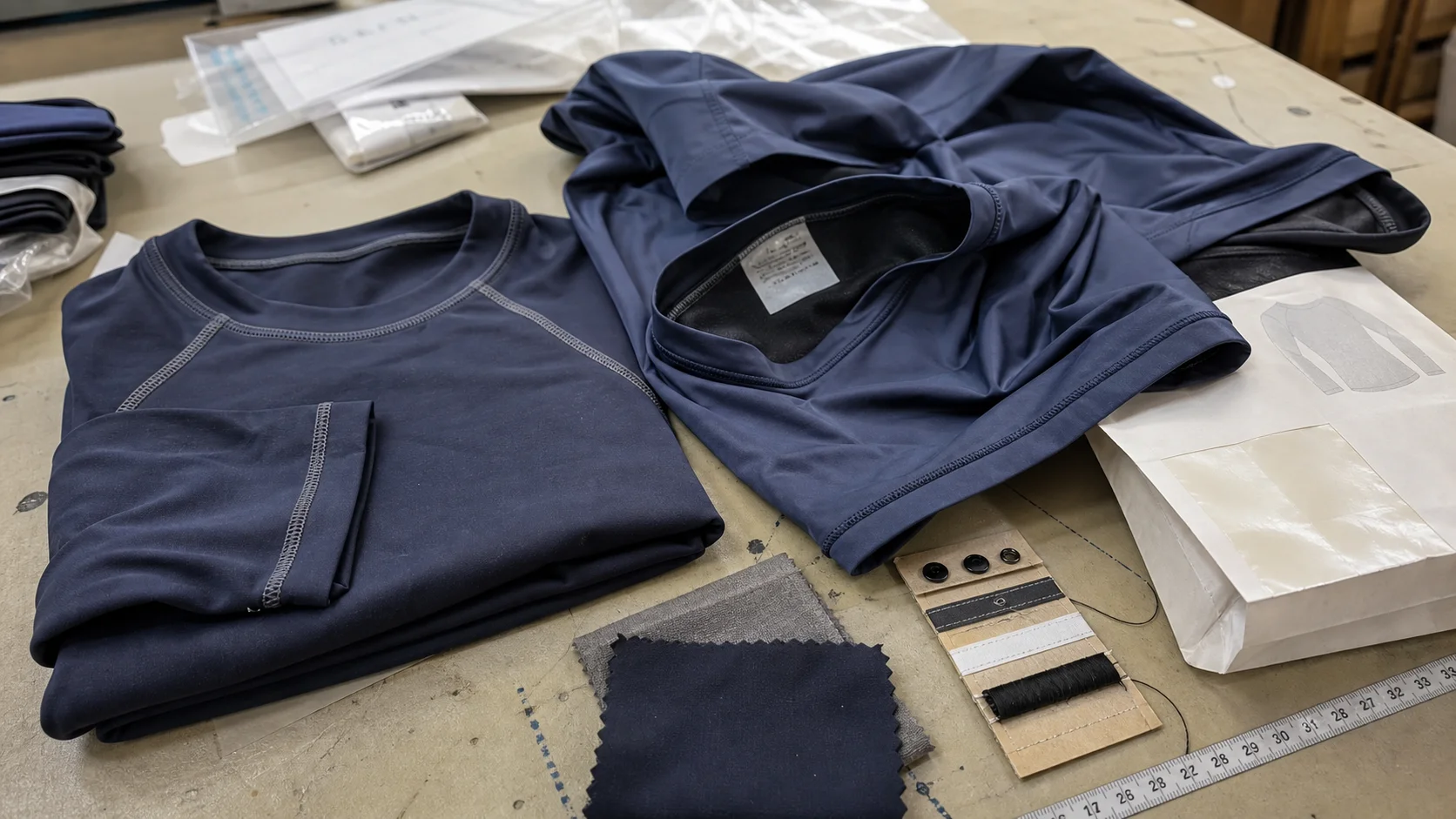
A product-specific quality control outline for outdoor school buyers sourcing wholesale rash guards, covering fabric performance, stitching, fit, labeling,...
Rash Guard QC Checklist for School Buyers - Activewear & Teamwear manufacturing guide
Outdoor school programs need rash guards that are safe, durable, comfortable, and easy to manage across many students. A rash guard for a school swimming program, surf camp, outdoor education trip, water sports club, or summer activity uniform is not the same buying decision as a retail fashion top. The garment must survive repeated wear, sun exposure, chlorine or saltwater, washing, name tagging, student handling, and mixed-size distribution.
For wholesale rash guard quality control, the buyer’s job is to reduce risk before bulk production starts. That means checking the fabric, UPF claim, fit, seam strength, print quality, color consistency, labeling, packing, and delivery documentation. It also means deciding which requirements are essential and which are nice to have. Over-specifying can inflate cost and lead time. Under-specifying can create safety, comfort, and replacement problems after delivery.
This checklist is written for outdoor school buyers, purchasing teams, activity coordinators, uniform suppliers, and teamwear brands sourcing rash guards in bulk. It focuses on practical inspection points rather than generic apparel theory. Use it when requesting quotes, reviewing samples, approving production, and inspecting finished goods.
A strong rash guard order starts with a clear technical package. A low price is not useful if the fabric stretches out, the print cracks, or the sizing does not match the student group.
School rash guards usually need to balance four buying goals: student protection, comfort, durability, and budget control. The product may be worn by children, teenagers, instructors, or mixed-age groups, so the QC checklist should be tighter than a simple promotional apparel order.
Purchasing judgment matters here. A premium recycled nylon-spandex fabric may feel better and offer stronger recovery, but it may carry higher MOQ and longer lead time. A polyester-spandex option can be more budget-friendly and suitable for school orders, especially when the program needs many sizes and a stable reorder path. The right choice depends on the use case, not only the fabric name.
The QC checklist should not be written after the factory finishes production. It should be built from the buyer’s approved specification sheet. If the order only has a product photo and a rough size list, inspection becomes subjective and disputes become harder to settle.
For school buyers, the most common QC failure is not a dramatic factory defect. It is a mismatch between what the buyer assumed and what the supplier quoted. A supplier may quote a lightweight fabric when the buyer expected better opacity. A logo may be printed too low on the chest because placement was not measured. A youth size set may run too tight because the pattern was based on athletic compression rather than school comfort. Written specifications prevent many of these issues.
Brands and institutions that need help structuring a production-ready order can review apparel development and manufacturing support through Fabrikn services.
Fabric is the foundation of rash guard quality. Outdoor school buyers should inspect more than composition. The same 82% polyester / 18% spandex blend can perform very differently depending on yarn quality, knitting, finishing, dyeing, and heat setting.
Common wholesale rash guard fabrics include polyester-spandex, nylon-spandex, and recycled versions of both. Polyester is often chosen for colorfastness, print performance, and cost control. Nylon can offer a softer hand feel and strong stretch, but it may cost more and require careful dye control. Recycled fabrics can support sustainability goals, yet buyers should confirm certification requirements and availability before committing to a launch date.
Fabric Type Typical Use Buying Tradeoff Polyester-spandex School programs, teamwear, printed rash guards Good cost control and print compatibility, but hand feel varies by mill Nylon-spandex Premium rash guards, surf and swim programs Softer feel and strong recovery, usually higher cost Recycled polyester-spandex Sustainability-focused school or outdoor programs Useful for ESG goals, but certification and MOQ must be checked early Heavier 220–250 gsm fabric Higher opacity, stronger coverage, cooler seasons More durable feel, but may feel warmer and cost more Lighter 160–190 gsm fabric Warm weather, budget programs, quick-dry use Lower cost and faster drying, but opacity and durability need careful reviewOpacity deserves special attention for school buyers. White, pale yellow, light blue, and pastel shades may look acceptable when dry but become too sheer in water. If the rash guard is intended for mixed-gender student use, wet opacity should be checked during sample approval, not after bulk shipment.
Many school buyers request UPF 50 or UPF 50+ rash guards. The claim must be handled carefully. A supplier saying “UPF fabric” is not the same as providing a verified UPF test report for the actual fabric quality and color. Darker colors often perform better than lighter colors, but assumptions are not enough for institutional purchasing.
UPF performance is not only about lab results. Garment design also matters. A loose neckline can expose the upper chest. Sleeves that ride up can expose the forearm. A cropped body length may leave skin uncovered during swimming or paddling. School buyers should review fit during movement, not only on a flat table.
For outdoor school use, a conservative design with reliable coverage is usually a better buy than a trend-driven cut with gaps at the neck, waist, or sleeve.
Rash guards can be designed as compression fit, athletic fit, or relaxed fit. School orders usually need a practical middle ground. A garment that is too tight may be difficult for younger students to put on and remove when wet. A garment that is too loose may drag in water, shift during activity, or reduce the intended sun coverage.
Measurement tolerances should be realistic. For stretch garments, many buyers use tolerances around plus or minus 1 cm for small measurements and plus or minus 1.5–2 cm for larger body measurements, depending on size and construction. Tighter tolerances may increase rejection rates and cost. Loose tolerances may create visible inconsistency across a class set.
Do not approve bulk production from one medium sample only. School buyers should request a size set sample for key sizes. For youth orders, that may include the smallest, middle, and largest sizes. For mixed student and instructor orders, include at least one adult staff size. The goal is to check grading, not only sample workmanship.
The most common sizing risk is poor grading between sizes. A youth small may fit properly, while youth large becomes too long in sleeves or too narrow across the chest. Adult unisex sizing can also create issues for female staff if the neckline, sleeve length, or body length is not reviewed. Fit testing with real measurements is better than relying on size names.
Rash guards stretch during wear, so seam construction must be stronger than a standard T-shirt. The best construction choice depends on budget, comfort expectations, and factory capability.
Flatlock seams are often preferred for rash guards because they reduce rubbing. They may cost more than basic overlock construction and require skilled machine setup. For high-use outdoor school programs, the added comfort can be worth the cost, especially if students wear the garment during swimming, kayaking, paddleboarding, or beach activities. For short-term promotional use, a clean overlock construction may be acceptable if the seam placement and softness are checked carefully.
School rash guards often carry logos, house colors, staff markings, sponsor graphics, or student identification. These details are visible to parents and administrators, so they should not be treated as minor decoration.
Common branding methods include screen printing, heat transfer, sublimation, silicone print, and woven or heat-applied labels. Sublimation can be useful for all-over graphics on polyester fabric, but it is less suitable for nylon and may not work for all design requirements. Screen printing can provide solid color branding, but stretch compatibility must be tested. Heat transfers can look sharp, yet poor-quality transfers may crack, peel, or feel stiff.
Branding Method Best For QC Risk Sublimation All-over designs on polyester Color variation, white creases, print distortion Screen print Simple logos and solid graphics Cracking on stretch fabric, poor registration Heat transfer Names, numbers, sharp logos Peeling, edge lifting, stiff hand feel Embroidery Limited premium branding Usually not ideal for wet stretch rash guards due to bulk and puckeringLabels need similar care. A scratchy neck label can cause more complaints than a small cosmetic issue on the sleeve. For school rash guards, printed neck labels or soft heat-transfer labels are often more comfortable than woven neck labels. Care labels should remain readable after washing, and required fiber content or country-of-origin information should match the destination market’s rules.
A disciplined sample process protects both the buyer and the supplier. It gives the supplier a clear target and gives the buyer physical evidence before bulk cutting begins. Rushing sampling is tempting when the school calendar is fixed, but it often creates larger delays later.
Not every order needs every stage, but outdoor school buyers should not skip the pre-production sample for a custom rash guard. If the order includes new fabric, new print artwork, youth sizing, or UPF claims, sample review becomes more important. A repeat order of an approved design may need fewer steps, provided the same fabric, pattern, supplier, and trims are used.
Approve samples in writing, and list any remaining corrections clearly. Avoid vague comments such as “make it better” or “fit should be normal.” Use measurable instructions: increase sleeve length by 2 cm, lower front logo by 1 cm, change neck label to printed label, improve collar seam tension, or approve color against a named swatch.
If the supplier cannot produce a reliable pre-production sample, bulk quality is unlikely to improve by chance. A sample issue may be acceptable if it is clearly isolated and corrected before production. A pattern issue, fabric issue, or seam strength issue should be treated as a serious warning.
Bulk inspection should compare finished goods against the approved pre-production sample, purchase order, spec sheet, and packing instructions. For larger orders, inspection may happen during production and before shipment. For smaller wholesale school orders, a final random inspection may be the main QC checkpoint.
Inspection standards often use AQL sampling for larger orders, but the buyer should define the acceptable level before production. Critical defects should have zero tolerance. These include unsafe trims, sharp zipper parts, incorrect fiber labeling, serious stains, wrong school logo, or incorrect size labels that make distribution unreliable. Major defects may include open seams, visible print cracking, wrong measurements outside tolerance, or poor color matching. Minor defects may include small loose threads or slight cosmetic issues that do not affect use.
Wholesale rash guard MOQ depends on fabric availability, color, print method, size range, and whether the buyer needs custom patterns. School buyers often need many sizes in modest quantities, which can be harder for factories than one large adult size run.
These ranges are typical, not guaranteed. A supplier may accept lower MOQ at a higher unit cost, especially if using available fabric and standard construction. Very low MOQ can work for pilot programs, but buyers should ask whether the same fabric and color will be available for reorders. A school may save money on the first order and then struggle to match replacements later.
A practical wholesale timeline may include 1–2 weeks for initial sampling if materials are available, 1–3 weeks for revisions and approvals, and 3–6 weeks for bulk production after approval. Custom fabric, lab testing, complex size sets, or seasonal capacity pressure can extend that timeline. Buyers working toward a school term, camp start date, or overseas trip should build in buffer time rather than ordering at the last possible date.
For sourcing support or production planning, buyers can contact the team through Fabrikn contact with order details, size range, fabric preferences, and delivery requirements.
Packing is a QC issue, not just a warehouse detail. A perfectly made rash guard order can still create problems if the sizes are mixed, class groups are wrong, cartons are unmarked, or individual garments are missing labels.
Individual packing increases cost and packaging waste, but it can save administrative time for school staff. Bulk packing is cheaper and may align better with sustainability goals, but it requires careful sorting after delivery. For large school programs, class packing is often the most practical compromise if the order data is accurate.
Short shipments are a common frustration for school buyers because the missing units are often needed for specific students or staff. The final inspection should include carton count, unit count, and size reconciliation. If the supplier allows overage or shortage tolerance, that tolerance should be agreed in advance. For school programs, even a small shortage in a key size can create problems.
Before issuing a purchase order, school buyers should ask direct questions that reveal whether the supplier understands rash guard production. Good answers should be specific and tied to the buyer’s requirements.
Price should be evaluated with these answers in mind. A lower quote may exclude UPF testing, use lighter fabric, apply cheaper heat transfers, or rely on basic packing. A higher quote may be justified if it includes better fabric, stronger seams, verified labeling, organized packing, and clearer inspection support. The best supplier is not always the cheapest supplier. It is the one that can deliver the required product with controlled risk.
A well-managed rash guard order gives the school a product that students can actually wear, staff can distribute easily, and buyers can reorder with confidence. The checklist does not need to be complicated, but it must be specific. The safest approach is to define the standard before sampling, approve the standard before production, and inspect against that standard before shipment.
Buyers comparing manufacturing partners can also review company background and sourcing approach through Fabrikn about us. For school programs, the most useful supplier relationship is one that supports clear specifications, practical MOQs, repeatable sizing, and honest lead-time planning.
Get a free quote from Fabrikn — your trusted B2B clothing manufacturer with 10+ years of experience. MOQ as low as 200 pieces.
Get a Free Quote →Polyester-spandex is often a practical choice for school rash guards because it balances cost, print performance, and availability. Nylon-spandex can feel softer and more premium, but it may cost more. The best choice depends on budget, UPF needs, opacity, comfort, and reorder requirements.
Typical MOQ can range from 100–300 pieces for stock fabric and simple logo orders, 300–800 pieces for custom color fabric, and 500–1,000+ pieces for more complex recycled or fully custom programs. Actual MOQ depends on fabric, color, size spread, print method, and supplier capacity.
Ask for a UPF test report that applies to the exact fabric quality, weight, and color being ordered. Buyers should also check garment coverage, neckline fit, sleeve length, and whether stretching affects protection. A general supplier statement is weaker than documented testing.
Most school programs need a comfortable athletic fit rather than strong compression. The garment should stay secure in water but not be difficult for students to put on or remove when wet. A size set sample is the best way to confirm fit across the student group.
Flatlock seams are often preferred because they reduce bulk and rubbing against the skin. Clean overlock seams can be acceptable for budget programs if they have enough stretch and comfort. Seam strength and thread tension should be checked during sample approval and bulk inspection.
The main risks are poor wet opacity, unsupported UPF claims, inconsistent sizing, weak seams, print cracking, wrong logo placement, scratchy labels, and packing errors. Size shortages can also be serious because school orders often need exact quantities for specific students.
A practical timeline may include 1–2 weeks for initial samples, 1–3 weeks for revisions and approvals, and 3–6 weeks for bulk production after approval. Custom fabric, UPF testing, complex artwork, personalization, or peak-season capacity can extend the schedule.
Sublimation can be a good choice for polyester rash guards with all-over graphics, team colors, or bold school designs. It is less suitable for nylon and may show color variation or white creases if production is not controlled. Buyers should approve a printed sample before bulk production.
A pre-production sample should use the intended bulk fabric, trims, labels, seam construction, logo method, colors, and measurements where possible. It should represent what the supplier will make in bulk. Any changes after approval should be documented in writing.
Use clear packing instructions before production starts. Packing by size, class, team, or student name can reduce sorting time. Carton labels, packing lists, size stickers, and accurate quantity checks are important parts of rash guard QC for school buyers.