
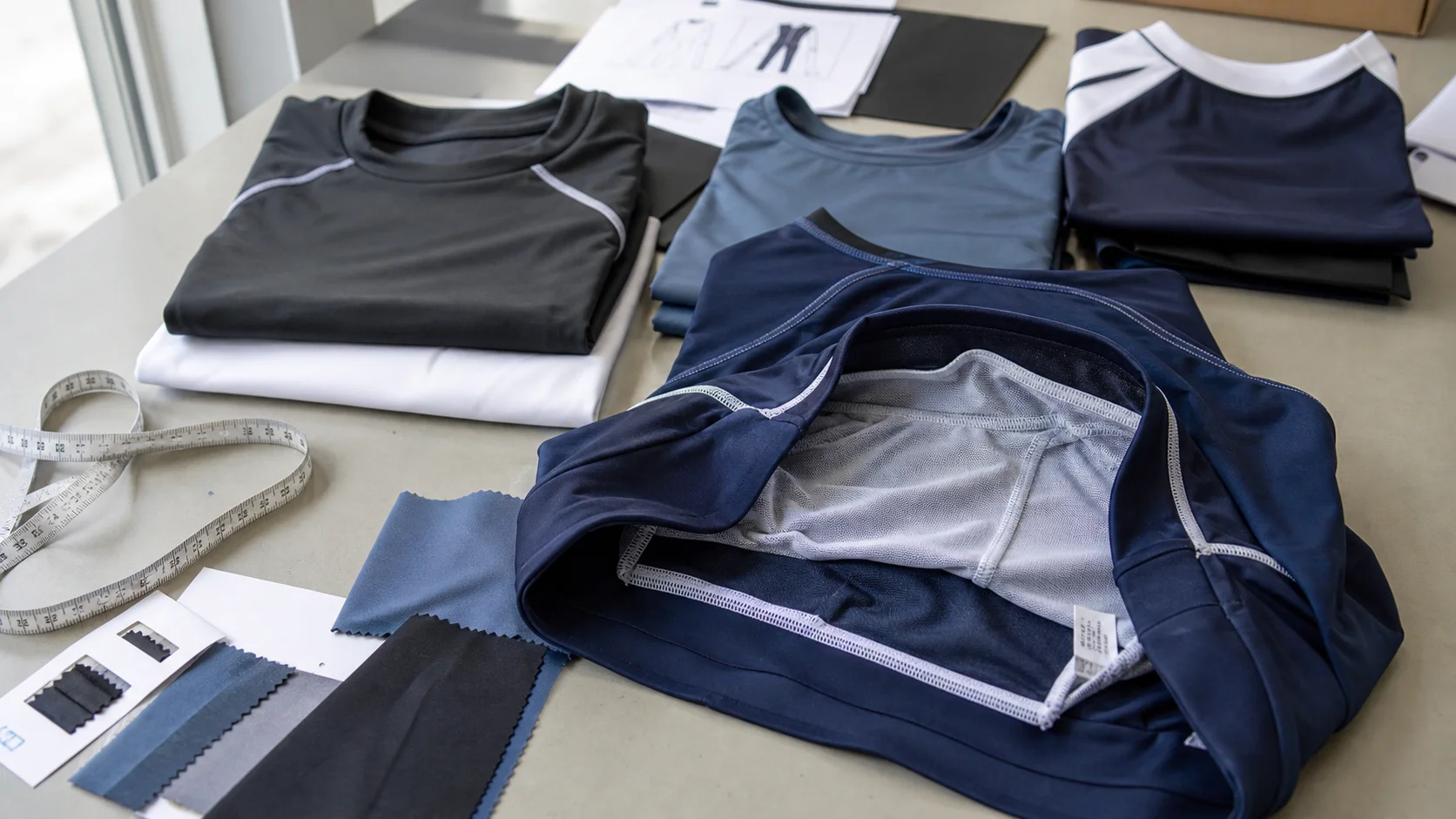
A distributor-focused quality control outline for wholesale rash guards, covering fabric performance, seam construction, print durability, sizing,...
Rash Guard QC Checklist for Distributor Buyers - Activewear & Teamwear manufacturing guide
Wholesale rash guard quality control is not just a final inspection task. For distributor buyers, it is a buying discipline that starts before the purchase order is issued and continues through sampling, bulk production, packing, and shipment release. Rash guards look simple on a line sheet, but they combine stretch fabric, tight fit requirements, print durability, saltwater exposure, sun-protection claims, and high return risk if sizing or seams fail.
A practical QC checklist helps distributors reduce avoidable claims from retailers, clubs, resorts, gyms, swim schools, surf shops, and teamwear programs. It also gives the manufacturer a clear standard to build against. The goal is not to inspect quality into a weak product at the end. The better approach is to define the product correctly, approve samples carefully, monitor the right production risks, and inspect finished goods against measurable criteria.
This guide is written for distributor buyers sourcing wholesale rash guards for resale, private label, team programs, corporate merchandise, or activewear collections. It covers fabric and trim specifications, sample approval, MOQ planning, lead-time dependencies, construction checks, print testing, size control, packing, and AQL inspection risks.
Rash guards sit between swimwear, compression activewear, and teamwear. That makes quality control more demanding than a basic T-shirt inspection. The garment is worn wet, stretched across the body, exposed to UV, rubbed against boards, sand, pool edges, backpacks, and life jackets, then washed repeatedly. Small errors in fabric recovery, seam stretch, size grading, or print curing can become visible failures very quickly.
Distributor buyers also face a commercial problem. The end customer may not know whether the issue came from the fabric mill, the sewing line, the printer, or the buyer’s own tech pack. They only know the rash guard does not fit, the logo cracked, the sleeve twisted, or the neck seam rubbed. That claim usually moves upstream to the distributor.
A wholesale rash guard quality control checklist should focus on four practical outcomes:
For distributor programs, the highest-risk orders are usually not the largest ones. They are often mixed-size, multi-color, logo-customized orders with short delivery windows. Teamwear and resort programs may include youth and adult sizes, several body types, and strong expectations around delivery dates. QC has to be built into the sourcing calendar, not treated as an afterthought.
A rash guard order should not move to bulk production until the buyer has approved fit, fabric hand feel, stretch recovery, construction, color, decoration method, size specifications, care label content, and packing presentation.
The strongest QC checklist begins with a complete product specification. A vague order such as “men’s long sleeve rash guard, polyester spandex, logo print” leaves too much room for interpretation. The supplier may choose a fabric that meets the general description but fails the buyer’s actual resale needs.
Distributor buyers should issue a tech pack or at least a structured specification sheet. If the order is part of a private label program, the spec should be controlled even more tightly. For sourcing support, production development, and garment manufacturing services, buyers can review the supplier capability information at fabrikn.com/services/.
Most rash guards use polyester/spandex, nylon/spandex, or recycled polyester/spandex blends. Typical fabric weights may range from about 160 gsm to 250 gsm depending on the intended market. Lightweight fabric can feel breathable and cost less, but it may become transparent when stretched or wet. Heavier fabric can feel premium and improve coverage, but it may dry slower and increase landed cost.
A practical fabric specification should include:
UPF claims deserve special caution. If a distributor markets a rash guard as UPF 50 or UPF 50+, the claim should be backed by appropriate testing and should match the actual fabric, color, construction, and coverage being sold. A darker approved fabric may not represent a lighter colorway. Mesh panels, perforated fabrics, or overstretched areas can affect the effective protection.
Trims on rash guards should be chosen for comfort and durability in water. A scratchy neck label can cause complaints even if the garment itself is well made. Distributors should specify whether the main label is heat transfer, printed, tear-away, woven, or tagless.
Fabric is the biggest quality variable in rash guard manufacturing. A distributor may approve a nice-looking salesman sample and still receive bulk goods with a different stretch, shade, hand feel, or recovery. This often happens when the original sample fabric is not locked properly or when the factory substitutes a close alternative to meet price or lead time.
The approved bulk fabric should feel consistent with the approved sample. Buyers should not rely only on composition because two 82/18 polyester spandex fabrics can behave very differently. Yarn type, knitting method, finishing, and dyeing all affect the final result.
Stretch is not automatically good. Too much stretch with poor recovery can make a rash guard bag out after wear. Too little stretch can make the garment hard to put on, especially in youth and compression styles. Buyers should request stretch and recovery targets during development and verify them before bulk cutting.
A simple purchasing rule is useful: compression rash guards need tighter recovery control than relaxed resort styles. If the product is for teamwear, schools, or rental programs, durability and repeatable sizing often matter more than a soft fashion hand feel.
Color issues are common in wholesale rash guard production because distributors often order multiple colors and repeat orders across seasons. Lab dip approval should be documented, and bulk fabric should be compared under consistent lighting.
Neon, bright red, royal blue, and dark contrast panels can carry higher colorfastness risk. White or light-colored rash guards may show transparency, staining, or dye transfer more easily. That does not mean these colors should be avoided, but they should be tested and priced with realistic expectations.
For distributor orders, the exact test package depends on market, claim, and buyer risk. A low-cost promotional rash guard may not need the same testing as a premium sun-protection line, but basic performance checks should not be skipped when the garment is sold for water sports.
Rash guard sewing quality depends on seam elasticity, needle control, operator skill, and pattern balance. A clean seam on the table can still fail when stretched on the body. Distributor buyers should inspect construction both flat and under gentle stretch.
Flatlock seams are widely used in rash guards because they reduce bulk and can improve comfort. Overlock seams are also common, especially on lower-cost styles or internal construction. Coverstitch may be used at hems, cuffs, necklines, and decorative seam lines. Bonded or seamless construction is less common in standard wholesale programs and usually requires higher development cost and stricter process control.
Stretch fabrics can be damaged by the wrong needle size, dull needles, or excessive sewing tension. Needle cuts may not be obvious at final inspection, but they can turn into holes after stretching and washing. This is a serious inspection risk for rash guards because customers pull the garment over shoulders, arms, and torso.
Comfort is a quality issue, not just a design preference. Rash guards are often worn directly against skin. Rough seams, bulky labels, hard zipper tape, or stiff transfers can cause irritation. For youth programs and long-wear sports, this risk is even more important.
Distributor buyers should check the inside of the garment carefully. A garment can look good on the outside while having rough internal thread ends or poorly placed labels. Heat transfer labels should be tested for edge lift and skin feel after washing.
Fit problems are among the most expensive rash guard defects because they are hard to fix after bulk production. A distributor cannot correct a tight neck, short sleeve, twisting torso, or mismatched size scale with trimming or re-packing. The pattern, grading, and fabric behavior must be controlled before cutting.
A rash guard size spec should include enough measurement points to control fit without becoming unmanageable. The most important points depend on style, but distributor buyers should usually include:
Measurement tolerance should reflect fabric stretch and garment construction. Overly tight tolerances may create avoidable inspection failures, especially on high-stretch fabrics. Loose tolerances may allow unacceptable size variation. Many buyers use tighter tolerance for critical dimensions such as chest, body length, and sleeve length, with slightly wider tolerance for curved or stretch-sensitive areas.
Grading is not just increasing every size by the same amount. Youth, women’s, men’s, and plus-size rash guards require different body assumptions. A unisex rash guard can be efficient for inventory, but it may not satisfy customers expecting a gender-specific fit.
Distributor buyers should review the full size set before bulk production when the order includes new patterns, new fabric, or new customer requirements. At minimum, request a fit sample in the base size and a size set sample for key sizes. If the program includes youth and adult sizes, do not assume the adult pattern can simply be scaled down.
Distributor buyers should be careful when approving fit only on a mannequin. Rash guards must be checked on a body or fit model because stretch, shoulder movement, and neck comfort are central to performance.
Decoration is a major defect source in wholesale rash guard orders. Logos can crack, peel, migrate, fade, distort under stretch, or sit in the wrong position. A buyer selling to clubs, resorts, or teams cannot afford a logo placement issue across hundreds or thousands of garments.
Screen printing can be cost-effective for larger runs and solid logos, but ink flexibility must suit stretch fabric. Sublimation can produce full-coverage artwork and strong wash durability on polyester, but it is not suitable for every fabric and can be limited by base color. Heat transfer is useful for names, numbers, small runs, and team personalization, but poor transfer quality or incorrect pressing can lead to cracking or peeling.
Logo placement should be specified by measurement, not just by visual mockup. A digital mockup may not account for size grading, seam position, or how the garment stretches on the body. For teamwear and corporate programs, placement consistency across sizes matters.
A common purchasing mistake is approving the artwork but not approving the artwork on the actual bulk fabric. This matters because print adhesion, color brightness, and stretch behavior depend on the fabric surface and finishing.
Labels affect resale readiness and compliance. Distributor buyers should confirm label content before bulk production, especially for private label orders. Incorrect fiber content or country-of-origin labeling can create import, retailer, or compliance problems.
Sampling is where distributors prevent most quality failures. The key is to approve samples in stages, not all at once. A supplier may produce a nice prototype but still need corrections for pattern, measurement, construction, print, or packaging. Each approval should be documented in writing.
Not every order needs every sample stage. A repeat order in the same fabric and pattern may only need lab dip, print approval, and top of production confirmation. A new private label program should use a fuller approval process.
The pre-production sample should be treated as the manufacturing reference. If the buyer approves it casually, the supplier may consider all visible features acceptable. Distributor buyers should check it against the purchase order, tech pack, and intended resale use.
A distributor should not release bulk production based only on photos when the product is new, high value, claim-heavy, or customized. Photos are useful for speed, but physical samples reveal fabric weight, stretch, hand feel, seam comfort, and print texture.
Final inspection is the buyer’s last chance to catch problems before shipment. It should be structured, measurable, and tied to the approved sample. For larger or higher-risk orders, inspection during production can catch issues earlier. Once all goods are packed, rework becomes slower and more expensive.
Before cutting, the factory should inspect fabric rolls for shade, defects, width, and relaxation needs. Stretch fabrics often need proper relaxation before cutting. If fabric is cut too soon after spreading or without relaxation, measurements may shift.
Cutting accuracy affects fit and seam balance. High-stretch fabric can move during spreading and cutting, so the cutting room needs careful handling. Poor cutting may cause twisted side seams, uneven sleeves, mismatched panels, or inconsistent measurements.
During sewing, inspectors should check seam stretch, skipped stitches, thread tension, and cleanliness. Underarm seams, necklines, cuffs, and hem openings need special attention because these points are stretched during wear.
Many distributors use AQL inspection for bulk apparel orders. AQL levels depend on buyer policy and order risk. Common apparel inspections may use general inspection levels and define critical, major, and minor defects. The buyer should agree on the inspection standard before production starts.
Critical defects are usually safety, compliance, or severe usability problems. Major defects can affect resale, function, or customer acceptance. Minor defects are small workmanship issues that do not seriously affect use but may still reduce perceived quality.
The inspection report should include the order quantity, inspected quantity, defect list, measurements, photos, packing checks, carton count, and pass/fail result. Distributor buyers should require corrective action for failed inspections before balance payment or shipment release.
MOQ and lead time are not only commercial terms. They affect quality control. A low MOQ may limit fabric options, decoration methods, color choices, and testing budget. A rushed lead time may reduce sample review, lab dip approval, fabric testing, and proper inspection.
MOQ varies by supplier, fabric availability, decoration method, and customization level. Buyers should treat these as general planning ranges, not guaranteed rules.
Distributor buyers should ask what drives the MOQ. Sometimes the cutting and sewing MOQ is flexible, but fabric MOQ is not. In other cases, trims, labels, packaging, or printing screens drive the minimum. If a supplier offers an unusually low MOQ on a fully custom rash guard, check whether they are using stock fabric, digital printing, shared trims, or simplified quality controls.
Typical lead times can range from 3 to 8 weeks for simpler custom logo orders and 6 to 12 weeks or more for fully custom development, depending on fabric, samples, testing, production queue, and shipping method. Peak season, holiday closures, fabric dyeing delays, and approval delays can extend the schedule.
The most reliable delivery schedules include buffer time for sample corrections and inspection rework. A buyer can compress the calendar by using stock fabric and an existing pattern, but that reduces differentiation. A buyer can improve product uniqueness with custom fabric, color, and trims, but the QC process becomes longer and more demanding.
Packing defects are less dramatic than seam failures, but they create real distributor problems. Wrong size stickers, mixed SKUs, missing barcodes, damp cartons, or incorrect carton marks can delay retail delivery and warehouse receiving. For teamwear and multi-SKU programs, packing accuracy is critical.
Carton packing should match the packing list. If the buyer uses a warehouse management system, carton labels and SKU counts need to be precise. Mixed-size cartons can be efficient, but they increase picking and receiving risk unless clearly labeled.
Rash guards should be fully dry before packing. Packing damp garments can cause odor, mildew, color transfer, and staining. This is especially important after washing tests, wet processing, or humid production conditions.
A checklist is useful, but sourcing judgment decides whether the checklist is realistic. Distributor buyers often have to balance price, MOQ, quality, delivery, and customization. A lower unit price may be acceptable for a short-term promotional program, but it can be a poor choice for a branded activewear line expected to reorder season after season.
Stock rash guards are practical when the buyer needs speed, low MOQ, or simple logo customization. They reduce development risk because the pattern and fabric may already be established. The tradeoff is limited control over fit, color, fabric composition, labeling, and differentiation.
Custom production is stronger for distributors building a repeatable product line or serving customers with specific fit, branding, and performance needs. The tradeoff is higher MOQ, longer sampling, and more QC responsibility.
If a distributor is comparing manufacturing options or wants to discuss a rash guard development brief, the contact page at fabrikn.com/contact-us/ is a practical next step. Buyers can also review company background information at fabrikn.com/about-us/ before starting a sourcing conversation.
The cheapest rash guard quotation usually removes cost somewhere. It may use lighter fabric, fewer inspections, simplified trims, lower print durability, looser tolerances, or faster sewing. That may be fine if the product is sold as a budget item and the buyer accepts the risk. It is not fine if the sales pitch promises premium activewear performance.
Distributor buyers should compare quotations by specification, not just by unit price. Ask whether the price includes fabric testing, lab dips, size set samples, custom labels, print strike-offs, packaging, inspection support, and rework responsibility. A slightly higher FOB price can be cheaper than a shipment of garments that cannot be sold without claims.
Some defects appear repeatedly in wholesale rash guard orders. A buyer’s checklist should highlight these risks so inspectors spend time where it matters most.
Inspection should not focus only on the front appearance. Turn garments inside out, stretch seams, compare left and right panels, check neck comfort, and confirm packing accuracy. A good rash guard inspection is hands-on.
A workable QC workflow does not need to be complicated. It should be repeatable and documented. The following sequence suits many distributor orders and can be adjusted for order size and risk level.
Define the customer, use case, target price, order quantity, size ratio, decoration needs, delivery date, and compliance requirements. Do this before requesting final quotations. A supplier cannot quote responsibly without knowing whether the product is a budget logo rash guard or a performance private label garment.
Confirm fabric, construction, measurements, labels, artwork, packaging, and testing requirements. If any requirement is optional, mark it clearly. Ambiguity becomes expensive later.
Fit, fabric, color, decoration, and packing approvals should be handled before bulk production. If the buyer changes artwork after the pre-production sample, the approval process should be updated rather than assumed.
For higher-risk orders, check bulk fabric before cutting and early garments during sewing. This catches shade, measurement, seam, and print issues while they can still be corrected.
Inspect finished goods against the approved sample, purchase order, measurement spec, artwork approval, and packing instructions. Do not release shipment based only on production completion photos for a new or customized order.
Distributors should track returns and complaints by style, size, color, defect type, and customer. Repeat orders should update the tech pack based on real selling experience. If medium sizes always run tight, or a sleeve logo rubs under life jackets, the next purchase order should correct it.
A wholesale rash guard quality control checklist protects margin, brand reputation, and delivery reliability. The most important controls are not glamorous: clear specifications, proper sample approval, fabric verification, stretch seam inspection, accurate sizing, durable decoration, and clean packing. These basic controls prevent most avoidable disputes.
Distributor buyers should be especially strict with new suppliers, new fabrics, new artwork methods, UPF claims, youth sizes, and tight delivery programs. Once a style is proven, the process can become faster, but the approved standard should never disappear. The best rash guard orders are not only delivered on time; they are consistent enough to reorder with confidence.
Get a free quote from Fabrikn — your trusted B2B clothing manufacturer with 10+ years of experience. MOQ as low as 200 pieces.
Get a Free Quote →The most important checks are fabric performance, seam stretch, fit accuracy, and print durability. Rash guards are worn under stretch and often in water, so normal flat garment inspection is not enough. Inspectors should stretch seams, check opacity, verify measurements, and test logo areas for cracking or peeling.
Polyester/spandex and nylon/spandex are common choices. Polyester is often used for sublimation and quick-dry performance, while nylon can offer a softer hand feel. The best choice depends on use, price point, decoration method, and performance claims. Buyers should specify gsm, stretch, recovery, opacity, and colorfastness instead of relying only on fiber content.
Typical MOQs may range from about 50 to 300 pieces for stock styles, 100 to 500 pieces for custom logo stock styles, 300 to 1,000 pieces for custom colors, and 500 to 2,000 pieces for fully custom private label production. Actual MOQ depends on fabric, trims, printing, size range, and supplier setup.
Simple custom logo orders may take around 3 to 8 weeks after approvals, while fully custom programs may take 6 to 12 weeks or longer. Lead time depends on tech pack readiness, fabric sourcing, lab dips, sampling, testing, production capacity, inspection, rework, and shipping method.
Physical approval is safer for new styles, new fabrics, custom fit, UPF claims, and important private label programs. Photos can support quick reviews, but they do not confirm fabric weight, stretch recovery, seam comfort, or print hand feel. For repeat orders, photo approval may be acceptable if the standard is already locked.
Common defects include skipped stitches, seam popping, tight neck openings, twisted bodies, poor sleeve symmetry, transparent fabric, shade variation, cracked logos, peeling transfers, wrong size labels, inaccurate packing, and incorrect care labels. Underarm seams, necklines, cuffs, and printed areas deserve extra attention.
UPF claims should be supported by appropriate testing for the actual fabric and color being sold. Buyers should be careful when changing fabric, color, mesh panels, or garment coverage because those changes can affect the claim. Marketing language should match the verified test result and applicable market requirements.
AQL inspection is useful, but it should not replace proper product development and sample approval. Final inspection can catch many defects, but it cannot fix a bad pattern, weak fabric, or wrong decoration method without major rework. The best approach combines clear specifications, staged sampling, production monitoring, and final inspection.