
A product-specific SEO outline for security contractors assessing reorder risks, compliance checks, and production variables when buying wholesale recycled...
Category: Sustainable Fashion
Wholesale recycled nylon jackets can be a sound choice for security contractors, but only if the reorder process is controlled. A jacket that works for one delivery can turn into a repeat headache when shade, coating, trim quality, or fit drift on the next production run. For security teams, that drift matters more than usual because uniforms need to look consistent, hold up in weather, and perform across long shifts, repeated laundering, and mixed field conditions.
This review focuses on the practical risks behind wholesale recycled nylon jacket reorder risk review for security contractors. The aim is not to sell recycled nylon as a perfect solution. The better approach is to treat it as a technical purchase with clear specifications, a defined approval path, and a conservative view of what can go wrong between the first order and the next reorder.
For sourcing support, see services, about us, and contact us.
Recycled Nylon Jacket Reorder Risk Review - Sustainable Fashion manufacturing guide
Recycled nylon is common in outerwear because it offers a useful balance of abrasion resistance, low weight, and weather performance. Security contractors usually need jackets that can be worn over layered uniforms, survive daily movement, and still present a controlled appearance. Recycled nylon fits that brief better than many cotton-heavy fabrics and often better than lower-grade polyester blends when the application involves wind, rain, and repeated wear.
The material also supports a sustainability story, which matters in procurement conversations. That said, sustainability claims should be treated carefully. The real value comes from verified recycled content, controlled fabric specifications, and consistent production. A recycled nylon jacket is only as credible as the documentation behind it and the repeatability of the mill and factory that produced it.
For security use, the material needs more than a recycled-content label. The jacket must retain shape, resist tearing at stress points, handle trims such as zippers and hook-and-loop patches, and keep a professional appearance after laundering. If the reorder is not managed tightly, a fabric that looked acceptable on the first run can shift enough on the second run to create uniform inconsistency across a contract.
Reorder risk starts with the assumption that the next production run will match the approved sample automatically. In recycled nylon outerwear, that is not a safe assumption. Fiber blend changes, dye lot variation, coating changes, and trim substitutions can all alter the final jacket. Even when the supplier is reliable, a small upstream change can show up as a visible difference on the finished garment.
The most common risk is shade drift. Recycled nylon often carries more lot-to-lot variation than commodity virgin nylon because feedstock can differ by source and processing history. A dark navy or black jacket may appear acceptable under shop lighting, then look off in daylight next to prior stock. For security uniforms, shade inconsistency is a real problem because mixed lots can make the team look uncoordinated.
Fit drift is another issue. If the pattern is not locked and graded carefully, repeated production can slowly move the jacket toward tighter sleeves, shorter body length, or a different collar balance. Security contractors often need room for radios, body-worn equipment, or layered uniforms. A fit change that seems minor on paper can create customer complaints in the field.
Trim drift deserves the same attention. Zippers, snap hardware, drawcord tips, labels, and reflective elements may look interchangeable, but they are not. A zipper from a different vendor may change hand feel, corrosion resistance, or pull strength. A lower-cost snap may work in a sample but fail after repeated use. Reorder control should include trim codes, brand approvals, and a clear rule against substitutions without sign-off.
A reorderable jacket starts with a spec sheet that is detailed enough to prevent quiet substitution. For recycled nylon outerwear, the fabric spec should include fiber content, yarn count or fabric weight, weave or knit construction, finishing process, and any coating or DWR treatment. Security contractors should also care about GSM or fabric ounces if the jacket is expected to provide a specific level of protection or hand feel.
There should be no ambiguity on color standards. A Pantone reference alone is often not enough. A practical sourcing file should include approved lab dips, bulk shade tolerances, and a rule for how much deviation is acceptable across panels, sizes, and reorders. If a jacket has contrast panels or reflective trim, those areas need separate approval points.
Pattern measurements also need to be fixed. Chest, body length, sleeve length, shoulder width, cuff opening, and hem sweep should all have a defined tolerance. A jacket used by security personnel may need a slightly more generous cut than a fashion outerwear item because movement and layering matter more than silhouette. That decision should be documented before the first bulk order, not argued during the reorder.
Labeling and packaging can also affect reorder consistency. Internal labels, size stickers, hangtags, and polybag specs should be recorded. The buyer may not think of packaging as part of the product, but packaging errors can cause size mix-ups, carton damage, or inspection disputes when a new lot arrives.
Wholesale MOQ ranges for recycled nylon jackets vary widely, but many suppliers will quote somewhere around 300 to 1,000 units per color and style for a serious production run. Smaller MOQs are possible, especially for simple constructions or stock-supported fabrics, though pricing usually rises as the order size falls. Security contractors should not focus only on the lowest minimum. A very small first order can hide production issues that become expensive during the reorder phase.
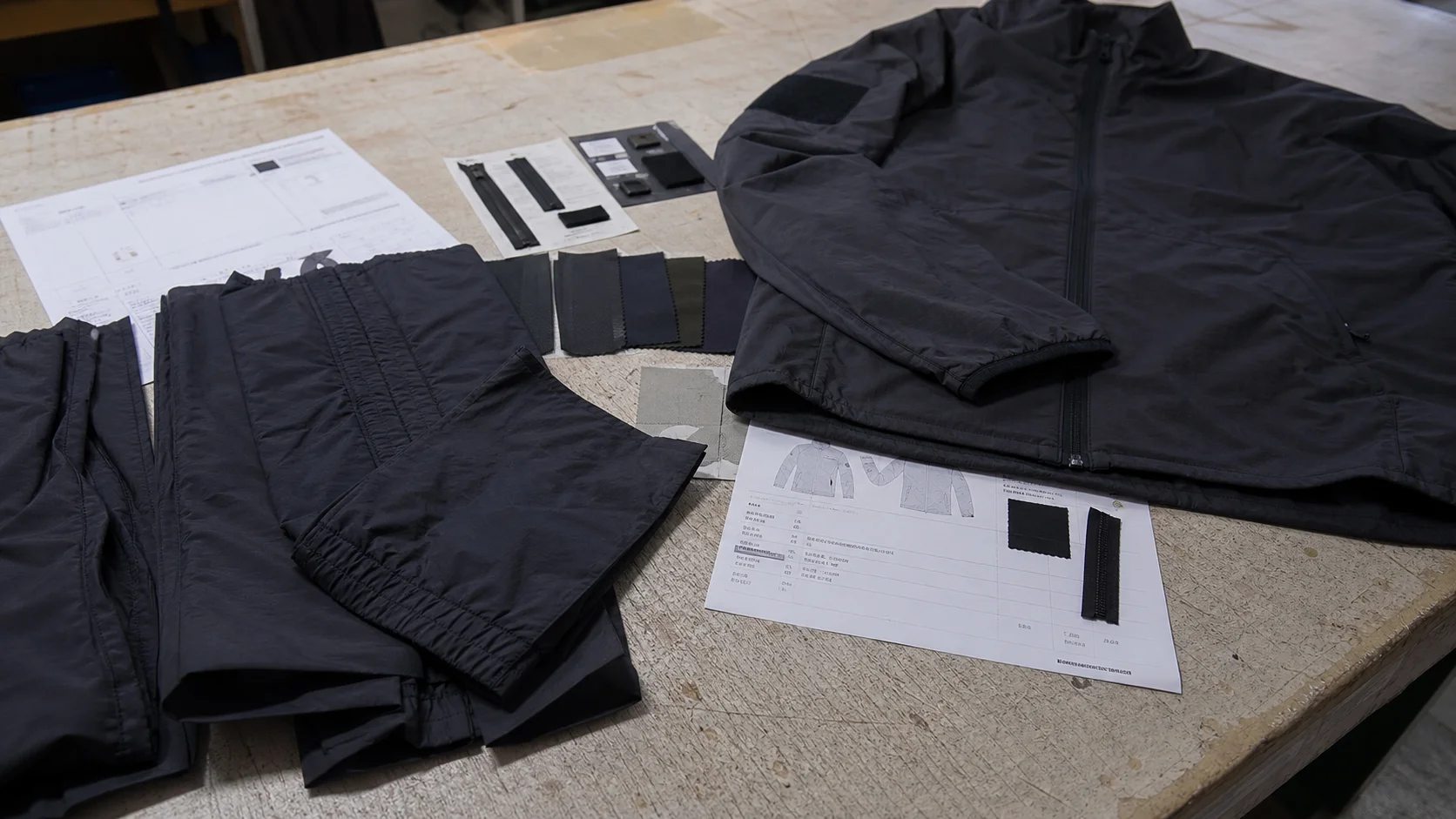
The sample approval path should be treated as a sequence, not a single step. A practical process often includes fabric swatches, lab dips or color approvals, a proto sample, a fit sample, a pre-production sample, and then bulk approval. If reflective tape, printed logos, or special pocket layouts are involved, those details should be approved before cutting bulk material. Skipping steps may save a week, but it usually creates delay later.
Lead time depends on fabric availability, dyeing, trims, factory capacity, and inspection timing. A recycled nylon jacket can move faster when the mill has greige fabric or stock-supported recycled yarn ready. Lead times can extend when the supplier must source recycled filament, book dyeing capacity, or wait on custom hardware. A realistic wholesale timeline often lands in the 45 to 90 day range after sample approval, and longer if the program includes custom packaging, complex branding, or multiple colorways.
Reorders should not rely on memory. The buyer needs a written record of approval dates, approved sample photos, and the exact version of the tech pack used for the first run. If the supplier uses a different factory line on the reorder, the buyer should ask whether the same construction methods, machine settings, and inspection points are being used. Those questions are basic, not aggressive.
Inspection should focus on the failure points that matter in field use. Recycled nylon can show pilling, abrasion wear, or uneven surface texture if the fabric quality is inconsistent. Security jackets also see stress at the shoulders, armholes, pocket openings, cuffs, and zipper tape. Those areas should be checked for seam slippage, broken stitches, skipped stitches, and reinforcement consistency.
Water resistance is another point that buyers often assume is stable when it may not be. If the jacket uses a DWR finish, the performance can vary across dye lots or across washes. A jacket that sheds light rain on the approved sample may wet out faster on the bulk run if the finishing process is changed. Buyers should ask whether the coating or finish is part of the permanent spec and whether test results can be repeated on the reorder.
Zipper quality deserves close inspection. A security contractor may wear the jacket in cold, wet, or high-motion conditions, which puts extra load on the zipper. Pull consistency, slider durability, and tape alignment should be checked. A weak zipper can turn a technically acceptable jacket into a field failure.
Inspection risk also increases when the supplier substitutes thread or lining. Thread strength, color matching, and shrink behavior can affect appearance and durability. Lining material can affect warmth, breathability, and inside snagging. Reorder agreements should require written approval for any material substitution, even if the change appears minor.
A reorder should be treated as a controlled repeat of the approved product, not as a fresh design decision. If the supplier cannot reproduce the same fabric, trim, and measurements, the buyer should expect variance and price that risk into the purchase.
Security contractors have a narrower tolerance for product drift than many apparel buyers. The jacket is part of a uniform system, so even small variation can affect professionalism, comfort, and compliance. Recycled nylon is a practical choice when the need is weather resistance and durability, but it is not automatically the best choice for every deployment.
If the contract requires high visibility, reflective compliance, or strict color matching across multiple sites, the sourcing plan should be conservative. A lightly textured recycled nylon may look sharp, but it can be less forgiving than a more structured fabric when the buyer is trying to keep every team member aligned visually. A highly technical shell fabric may also cost more than the end user expects, especially if the procurement team has not budgeted for trim control and inspection.
Warmth is another tradeoff. A lightweight recycled nylon shell may need a separate lining or insulation layer to work in cold climates. That adds cost, bulk, and assembly complexity. A more insulated jacket can improve comfort but may reduce mobility and increase MOQ risk if multiple liner weights are introduced.
Customization also creates tradeoffs. Embroidery, heat transfer, patch panels, and radio-access features improve function for security users, yet each addition increases the chance of reorder variation. Buyers should decide early whether the jacket is primarily a uniform shell, a weather layer, or a branded workwear item. Mixing all three roles in one spec often leads to avoidable compromise.
A supplier should be evaluated on repeatability, not just on the first sample. The useful question is whether the factory can produce the same jacket six months later without introducing visible or functional changes. That means checking whether they control fabric booking, trim sourcing, production records, and inspection routines in a way that supports repeat business.
Ask for evidence of how they manage approvals. A capable supplier should be able to identify which sample is the final approved version, which fabric lot was used, and how bulk production was matched to that approval. If the answer is vague, reorder risk is high.
It is also reasonable to ask how they handle exceptions. If a zipper vendor misses a delivery or the recycled nylon dye lot changes, what happens next? A supplier with a disciplined process will explain whether they pause production, request approval, or use a documented alternate. A supplier that treats substitutions casually is not a good fit for uniform programs.
Internal support matters as well. If the buyer needs help turning field requirements into a usable spec, a manufacturing partner with clear service support can reduce rework. See the company overview on about us and the available support structure on services. For active sourcing questions, the fastest path is usually contact us.
The best purchasing approach is to buy the first run as if a reorder will follow. That means preserving every approved reference: fabric swatch, trim card, sample photos, measurement sheet, and packaging spec. The buyer should expect to use those records to police the next order. If the first purchase is treated as a one-time event, the second order often becomes a reinvention of the product.
For security contractors, the safest buying decision is usually a conservative one. Choose a recycled nylon jacket construction that is straightforward to reproduce, not one that depends on hard-to-repeat decorative details. Keep the fabric spec clear, reduce trim complexity where possible, and make sure the fit supports layering and duty use. If the end customer wants premium appearance, the premium should come from disciplined execution, not from fragile design complexity.
Buyers should also think about inventory strategy. A small reserve stock can prevent emergency reorder pressure, which is where quality control often slips. If the jacket is tied to a uniform contract, it is better to hold a controlled buffer than to rush an unplanned reorder and accept substitutions. That buffer should be sized against seasonality, turnover, and lead-time volatility.
A final point is documentation. The supplier relationship is easier to manage when every decision is written down. Color approval, sample sign-off, trim approval, packing instructions, and inspection criteria should all be stored in one place. That does not eliminate risk, but it narrows the room for avoidable disagreement.
Get a free quote from Fabrikn — your trusted B2B clothing manufacturer with 10+ years of experience. MOQ as low as 200 pieces.
Get a Free Quote →The main risk is inconsistency between production runs. Shade shift, fabric lot drift, trim substitution, and fit variation are the most common causes of a reorder that no longer matches the approved sample.
Many suppliers quote roughly 300 to 1,000 units per color and style, depending on fabric availability, garment complexity, and customization. Lower MOQs are possible, but pricing and lead time usually become less favorable.
A practical sequence often includes fabric swatches, lab dips, a proto sample, a fit sample, and a pre-production sample. Complex jackets may need more than one revision before bulk approval is safe.
After sample approval, a common wholesale lead time is 45 to 90 days. That window can extend if the supplier must source recycled yarn, book dyeing, or wait on custom trims and labels.
Fabric composition, weight, color standard, pattern measurements, zipper and trim codes, stitch construction, finish type, and packaging instructions are the core items that should not change without written approval.
Yes, if the jacket is designed for durability, layering, and field movement. The fabric choice works best when the spec is controlled and the supplier can repeat the approved construction accurately on future orders.
Look closely at seam quality, zipper function, stress points, shade consistency, reflective placement if used, and any water-resistant finish. These are the areas most likely to create field complaints if they are not controlled.
For buyers managing uniforms at scale, the lesson is simple: recycled nylon is workable, but only when the reorder process is treated as a technical exercise. The supplier, the spec, and the approval trail all matter. When those are in place, the jacket can serve security teams well without turning every repeat order into a new sourcing problem.