
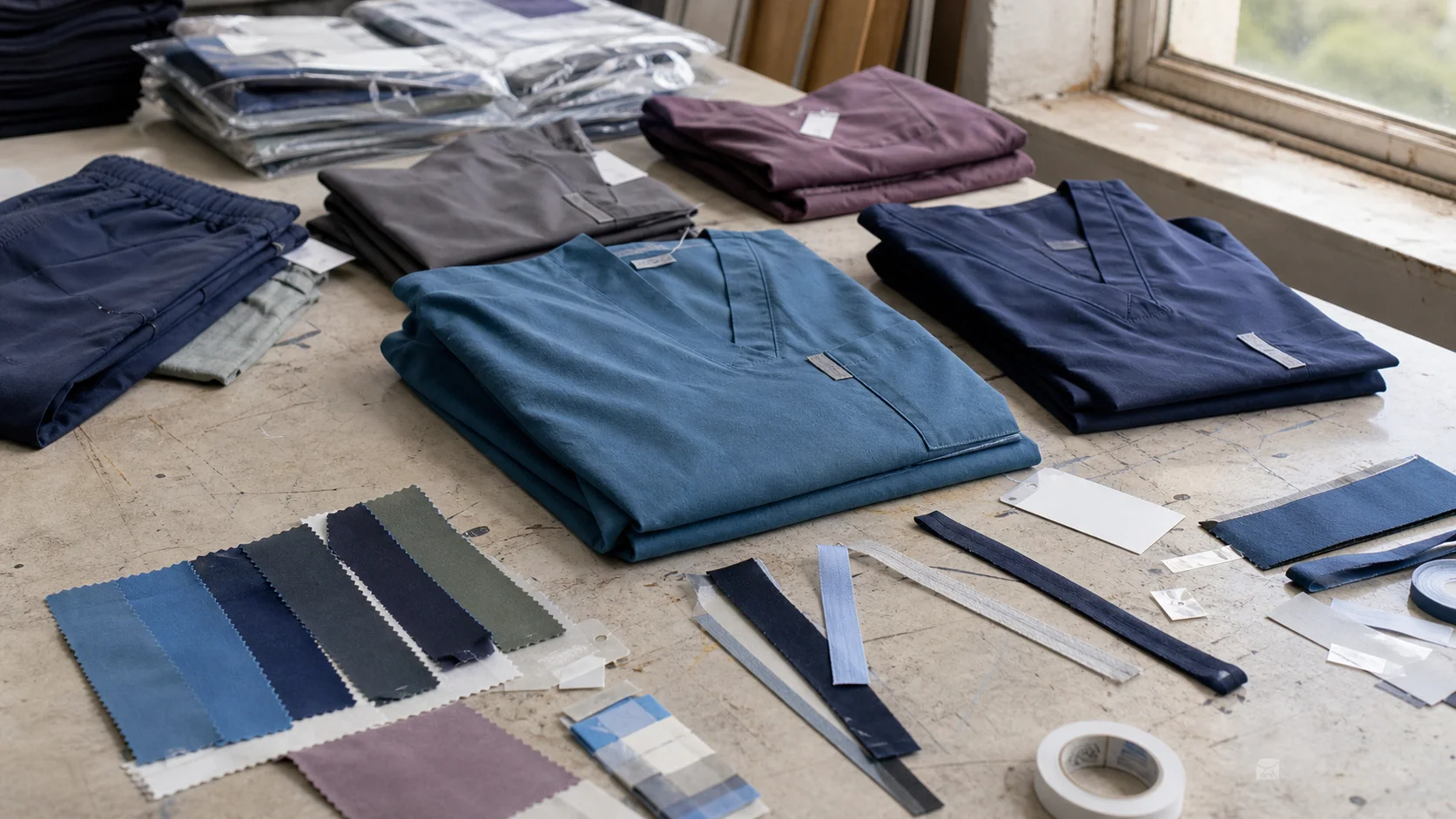
A retail operations-focused outline for evaluating wholesale scrubs reorder risks across sizing, color continuity, fabric lots, MOQ exposure, lead times,...
Wholesale Scrubs Reorder Risk Review for Buyers - MOQ, Cost & Sourcing manufacturing guide
Wholesale scrubs reorder risk review for retail operations teams is not just a purchasing checklist. It is a practical way to protect margin, shelf availability, size coverage, and customer trust after the first bulk order has already landed. Many retail teams focus heavily on the initial buy: colors, fit, fabric hand feel, packaging, and landed cost. The bigger commercial risk often appears later, when the same scrub top or pant needs to be reordered quickly, consistently, and at a quantity that matches actual store demand.
Scrubs are repeat-purchase products. Healthcare workers replace worn sets, buy extra colors for department rules, and return to styles that fit correctly. That repeat behavior is valuable only if the retailer can keep the right size and color matrix in stock. A weak reorder process turns a strong product into a stockout problem, a dead-size problem, or a margin problem.
This guide reviews reorder risk from the perspective of retail operations teams buying wholesale scrubs from manufacturers, importers, or sourcing partners. It covers MOQ pressure, lead-time dependencies, fabric and trim consistency, sample approval, costing, inspection risks, and supplier communication. The goal is to help buyers decide where to accept risk, where to push for control, and where to simplify the assortment before it becomes operationally expensive.
Wholesale scrubs look simple on a line sheet: tops, pants, joggers, jackets, maybe maternity or plus-size extensions. Operationally, they are more complex. A single style can carry multiple colors, unisex and gendered fits, inseams, alpha sizes, numeric sizes, and fabric options. Once that assortment is sold through retail channels, reorder decisions become more sensitive than the original purchase order.
The first order is often based on assumptions. The reorder is based on evidence. That evidence may show that navy medium joggers moved quickly, ceil blue small tops lagged, tall inseams sold out online, and 3XL sizes were underbought in stores serving larger hospital systems. Retail operations teams need a reorder method that reacts to sell-through without creating a new purchasing problem.
The common mistake is to treat reorders as a simple repeat of the first PO. That approach can overload slow-moving colors, miss emerging size demand, and ignore supplier-side changes. Fabric mills may switch lots. Dye houses may vary shades. Zipper pulls, drawcords, snaps, labels, polybags, and cartons may change unless the buyer locks specifications clearly.
A reorder risk review should answer one commercial question: can the retail team replenish the winning styles without losing control of cost, quality, timing, or inventory balance?
Direct purchasing judgment: a scrub program is not truly scalable until the second and third orders can be produced with the same fit, fabric, shade tolerance, packaging, and margin assumptions as the launch order.
Retail operations teams should separate reorder risk into a few practical buckets. This prevents every issue from becoming a general supplier complaint. It also helps purchasing, merchandising, logistics, and quality teams agree on the real problem before placing the next PO.
Risk Area What Can Go Wrong Buyer Control Point MOQ Supplier requires too many units per style, color, or size Negotiate matrix-based MOQ, consolidate colors, or reduce style count Cost Reorder pricing changes due to fabric, labor, freight, or currency shifts Request cost validity windows and itemized costing Lead Time Reorder misses seasonal or contract-driven demand windows Confirm fabric booking, trim readiness, and production slot availability Quality Fit, stitching, shade, or fabric hand feel differs from approved samples Use sealed samples, spec sheets, and pre-shipment inspection Inventory Fast sizes remain out of stock while slow sizes accumulate Reorder by sell-through rate, not by equal size ratiosScrubs buyers should be especially cautious with suppliers that quote attractive launch pricing but cannot explain their reorder process. A good launch order can still become a bad program if replenishment requires long delays, high MOQs, inconsistent shades, or repeated sample disputes.
Operations teams should also consider the channel mix. A uniform retailer serving clinics may reorder differently from an ecommerce retailer selling individual healthcare workers. Contract uniform programs tend to need color continuity and predictable delivery dates. Consumer-facing scrub retailers need broader size availability, faster replenishment, and tighter returns control.
MOQ is one of the biggest reorder risks in wholesale scrubs because demand is fragmented across many variables. A supplier may advertise a manageable MOQ, such as 300 pieces per style, but the real requirement may become difficult once color and size rules are applied.
Typical MOQ ranges vary by supplier type, fabric availability, customization level, and whether the scrubs are stock-supported or made to order. For basic wholesale scrub styles using available fabric, buyers may see MOQs around 100 to 300 pieces per color. For custom scrubs with private labels, special colors, proprietary fabric blends, or custom trims, MOQs often move into the 500 to 1,500 pieces per style-color range. Larger factories or mill-dyed fabric programs may require higher commitments, especially when the buyer wants exact shade continuity.
The issue is not only the headline MOQ. The risk is how the MOQ breaks down.
Retail operations teams should review reorder MOQ against actual sell-through. A scrub pant that sells 60 percent in black and navy should not be reordered in the same ratio as a launch order that included teal, pewter, wine, royal, and ceil blue for presentation. The launch assortment may be designed for market testing. The reorder assortment should be designed for cash flow and availability.
A practical approach is to classify scrub colors into core, secondary, and test groups. Core colors are usually the safest reorder candidates because they serve hospital, clinic, and school requirements. Secondary colors may need lower frequency or seasonal timing. Test colors should not be reordered unless sell-through and margin justify the MOQ.
Color Group Typical Reorder Approach Risk Level Core colors Plan recurring replenishment and reserve production capacity Lower, if shade consistency is controlled Secondary colors Reorder after sell-through review and inventory aging check Medium Trend or test colors Limit reorder unless demand is proven by channel HigherThe buying judgment is straightforward: accept higher MOQ only where demand is predictable. Do not let a supplier’s production convenience dictate a size-color matrix that your stores cannot sell.
Reorder cost risk is often underestimated because the buyer assumes the previous price still applies. In apparel manufacturing, repeat-order pricing can change for valid reasons. Fabric costs can move. Freight can shift. Dyeing costs may rise for smaller lots. Labor, packaging, compliance documentation, and currency exposure can affect the final quote.
Buyers should not treat every price increase as supplier opportunism. They should ask for a clear explanation. A supplier that can break down fabric, trims, cutting, sewing, washing, finishing, packing, testing, and freight assumptions is easier to manage than a supplier that only sends a new unit price with no detail.
For wholesale scrubs, fabric is a major cost driver. Polyester-rayon-spandex blends, polyester-cotton-spandex blends, recycled polyester blends, antimicrobial finishes, moisture-wicking finishes, and four-way stretch fabrics all carry different cost and availability profiles. Small changes in GSM, stretch recovery, yarn quality, or finishing can affect cost and product performance.
Retail teams should lock these details before comparing reorder quotes:
A lower reorder price is not always better. If the supplier reduces fabric weight, changes the spandex content, substitutes a cheaper zipper, or weakens packaging, the retailer may pay later through returns, complaints, and markdowns. Cost review should compare the same specification, not just the same style name.
Teams working with sourcing partners can use apparel sourcing and manufacturing services to structure specifications and supplier communication more tightly. The value is not only finding a factory; it is controlling the repeatability of the product once sales data begins to guide reorder decisions.
Wholesale scrubs reorder timing depends on more than sewing capacity. A factory may be able to sew quickly but still wait for fabric, dyeing, lab dips, trims, packaging, testing, or booking confirmation. Retail operations teams should separate production lead time from total calendar lead time.
For stock fabric and standard trims, repeat orders may be possible in roughly 30 to 60 days after approval and deposit, depending on supplier workload and order size. For custom-dyed fabric, private label trims, larger size ranges, or special finishes, buyers should expect longer windows, often 60 to 120 days or more. Ocean freight, customs clearance, domestic delivery, and warehouse receiving can add meaningful time beyond factory completion.
Lead-time risk becomes more serious when the retailer waits until inventory is already low. Scrubs are replenishment products, so the reorder point should be set before stockouts appear on the sales floor or website. If a style sells steadily, the reorder trigger should account for supplier lead time, internal approval time, freight time, and safety stock.
Operations teams should ask suppliers to confirm each dependency in writing:
The tradeoff is speed versus control. Fast reorders may rely on available fabric and standard trims, which can reduce delay but may limit color precision or customization. Fully controlled custom reorders may protect brand consistency but require earlier forecasting and higher commitments.
Scrubs customers notice consistency. A nurse buying a replacement navy pant expects it to match the navy top bought earlier. A clinic ordering uniforms for a team expects the next delivery to match the first. Even a small shade shift can create customer service problems when garments are worn as sets.
Color consistency is one of the most important reorder risks for scrubs. Navy, black, pewter, ceil blue, royal, wine, and hunter green are common workwear colors, but each can shift across dye lots. Fabric composition also affects dye behavior. Polyester-rich blends, rayon blends, and spandex-containing fabrics do not always respond the same way in dyeing and finishing.
Buyers should approve lab dips and bulk fabric against a controlled standard. The standard may be a Pantone reference, a physical fabric swatch, or an approved bulk lot. Physical standards are often more reliable than screen-based color references. The supplier should also state acceptable shade tolerance and whether garments from different dye lots may be mixed in the same shipment.
Trim consistency matters as much as fabric in repeat orders. A drawcord that changes from flat to round, a zipper that feels cheaper, or a label that irritates the wearer can make a reorder feel like a different product. Scrubs are worn for long shifts, washed frequently, and judged by comfort. Small changes become noticeable.
Component Reorder Risk Control Method Main fabric Shade, weight, stretch, shrinkage, pilling Approved fabric standard and bulk test report Elastic Weak recovery or uncomfortable waistband tension Specify width, stretch, recovery, and placement Drawcord Different texture, length, color, or end finish Trim card approval and measurement spec Zippers and snaps Breakage, tarnishing, rough operation Approved supplier, pull test, and corrosion check where relevant Labels Incorrect branding, care content, or size marking Artwork approval and incoming trim inspectionRetail buyers should also review laundry performance. Scrubs are washed frequently, sometimes under harsh conditions. Shrinkage, seam twisting, colorfastness to washing, colorfastness to rubbing, pilling, and seam strength are relevant quality points. Claims such as antimicrobial, fluid-resistant, wrinkle-resistant, or moisture-wicking should be supported by appropriate testing and clear labeling guidance.
A reorder should not skip sample control simply because the style has been made before. The approval process can be shorter than a new development cycle, but it should still confirm that the supplier is using the correct pattern, fabric, trims, construction, and packaging.
A practical reorder sample flow may include several steps. Not every order needs every step, but the buyer should decide deliberately rather than leaving it to the supplier.
The pre-production sample is especially important when the reorder involves a new size extension, a new color, a fabric substitution, or a different production unit. A buyer may choose to waive a full sample round for an identical reorder using the same materials, but that decision should be documented. Waiving samples saves time but increases risk if the supplier has changed inputs behind the scenes.
Buyers should keep measurement tolerances realistic. Scrubs need comfort and mobility, so fit cannot be judged only by flat measurements. Waistband stretch, hip ease, shoulder mobility, rise, sleeve opening, and knee area comfort all affect wearability. Retail returns often come from fit dissatisfaction that could have been reduced through stronger sample review.
Teams that need a tighter sourcing setup can contact Fabrikn through the contact page to discuss how specifications, sampling, and reorder controls can be organized before volume commitments are made.
Inspection risk is not limited to first production. Reordered scrubs can fail inspection because suppliers assume the buyer will be less strict after the first order. Retail operations teams should keep inspection standards consistent across repeat orders, especially for high-volume core styles.
Common inspection risks include shade variation, skipped stitches, open seams, uneven topstitching, twisted legs, incorrect labels, wrong size ratios, missing hangtags, barcode errors, poor folding, carton shortages, and mixed sizes in cartons. Scrubs also require attention to functional details: pocket depth, drawcord security, elastic recovery, zipper operation, snap strength, and seam durability.
Inspection should compare bulk production against the approved sample and tech pack. For wholesale orders, buyers commonly use AQL inspection methods, though the exact level depends on product risk, order size, and buyer policy. Critical defects should be clearly defined. For scrubs, a sharp object in a pocket, broken needle contamination, incorrect fiber content label, or severe size mislabeling should be treated differently from a minor loose thread.
Inspection Point Why It Matters Typical Risk Measurements Fit consistency drives repeat purchases Waist, hip, inseam, and rise out of tolerance Shade matching Scrub tops and pants are often worn as sets Different dye lots mixed in one shipment Seam strength Garments are worn during active shifts Open seams, weak bartacks, or skipped stitches Labeling Retail compliance and customer clarity depend on accuracy Wrong size, care label, fiber content, or barcode Packing Warehouse receiving depends on clean carton data Mixed SKUs, incorrect carton marks, or missing unitsInspection timing matters. A final random inspection after packing is useful, but it may be too late to correct systemic issues without delaying shipment. For larger scrub reorders, inline inspection can catch construction and measurement problems earlier. If the order includes a new fabric lot or new production line, inline review is worth considering.
The purchasing tradeoff is cost versus prevention. Inspection adds expense and coordination, but returns, chargebacks, markdowns, and customer complaints are usually more expensive. The higher the reorder volume, the stronger the argument for formal inspection.
A strong reorder review combines sales data with sourcing discipline. Retail operations teams should not reorder only because a product “sold well.” They should check which sizes, colors, stores, channels, and customer segments drove the demand. They should also check whether the supplier can repeat the product under the same commercial assumptions.
A useful reorder review can be built around five questions.
Review sales by style, color, size, inseam, channel, and location. Scrubs demand can vary heavily by local employer dress codes, climate, school programs, and customer body type distribution. A national ecommerce mix may not match a store-level mix.
Slow sizes and colors should be identified before placing the reorder. Reordering only the best sellers may seem obvious, but many teams still repeat the original ratio because it is administratively easier. That is usually a costly mistake.
Confirm whether MOQ applies by style, color, size, fabric lot, trim, or shipment. The best supplier is not always the lowest-cost supplier. It may be the one that supports replenishment in a quantity pattern that fits retail demand.
Ask whether the factory, fabric mill, dye lot, trims, pattern, labels, packaging, testing requirements, or shipping route changed. Any change can affect cost, quality, or lead time.
Calculate landed cost, expected sell-through, markdown risk, storage cost, and cash tied up in slow sizes. Reorder decisions should protect gross margin after returns and markdowns, not just initial markup.
Buying judgment: if the reorder requires carrying too much unwanted inventory to secure the fast-moving units, the program may need fewer colors, fewer fits, or a different supplier structure.
Retail teams should also create reorder thresholds. For example, a core scrub pant may trigger reorder when available stock plus inbound stock falls below forecasted demand for the supplier lead time plus safety stock. A trend color may only reorder after reaching a defined sell-through rate within a fixed time period.
Supplier communication should become more specific after the first order. Buyers now have performance data and should use it to negotiate better operational terms. The goal is not to pressure the supplier blindly. The goal is to align production reality with retail demand.
Buyers should be cautious with vague answers. A supplier that says “same as last time” should still confirm the actual inputs. If the previous production used a specific fabric lot, a new lot is not automatically the same. If the first order used one sewing line and the reorder uses another, measurement and construction consistency may shift.
For retailers building private label scrub programs, it is also worth reviewing supplier capability beyond one PO. The Fabrikn about page can help buyers understand the type of sourcing support and production coordination they may need when moving from trial orders to repeat wholesale programs.
Wholesale scrubs reorder planning sits at the intersection of MOQ, cost, and sourcing. Pushing for lower MOQ can increase unit cost. Pushing for lower unit cost can increase inventory exposure. Pushing for faster lead time can reduce customization options. Pushing for more colors can weaken size availability.
Retail operations teams should decide which constraint matters most for each segment of the scrub program. Core items should prioritize continuity, replenishment reliability, and fabric consistency. Fashion or seasonal colors should prioritize controlled exposure and faster exit if demand is weak. Private label hero styles may justify higher MOQ if they deliver stable margin and repeat customer demand.
The right sourcing decision may be different for each product tier. A retailer may use one model for stock-supported basics and another for custom branded scrubs. The key is to avoid mixing the economics. Stock-supported products should not be judged like fully custom products, and custom products should not be expected to behave like open-market blanks.
Program Type Best Use Main Reorder Risk Stock wholesale scrubs Fast entry, lower development work, smaller test buys Limited control over fabric, fit, and future availability Private label scrubs Brand differentiation and margin control Higher MOQ and stronger need for specification management Custom color programs Clinic, school, or retail-exclusive assortments Shade continuity and fabric MOQ exposure Full custom development Unique fit, trims, performance fabric, or design details Longer lead time and higher sampling disciplineA disciplined reorder review helps buyers avoid emotional purchasing. Strong early sales can tempt a retailer to expand colors, sizes, or styles too quickly. That may be justified, but only if the supplier can support replenishment without creating excess inventory or quality drift.
Before releasing a wholesale scrubs reorder, retail operations teams should complete a short but firm checklist. This checklist should be shared across merchandising, buying, quality, logistics, and warehouse receiving teams.
The best reorder systems are not complicated. They are consistent. They force the team to look at actual demand, supplier constraints, and quality controls before money is committed. For wholesale scrubs, that discipline can be the difference between a profitable replenishment program and a warehouse full of uneven sizes and mismatched colors.
Wholesale scrubs can be a strong retail category because the customer need is recurring, practical, and fit-driven. Reorder risk is the operational price of that opportunity. Retailers that manage reorders well can protect availability on best sellers, reduce markdowns, and build trust with healthcare customers who expect consistency.
The safest path is not always the smallest MOQ or the lowest unit cost. It is the reorder structure that matches real demand while preserving fit, fabric, color, labeling, and delivery reliability. Buyers should keep core styles narrow enough to replenish, specific enough to control, and profitable enough to justify the inventory commitment.
Retail operations teams should treat every reorder as a controlled production decision, not a clerical repeat purchase. Scrubs customers come back when the product fits, lasts, matches, and arrives when needed. The reorder process is where that promise is either protected or lost.
Get a free quote from Fabrikn — your trusted B2B clothing manufacturer with 10+ years of experience. MOQ as low as 200 pieces.
Get a Free Quote →Typical MOQ can range from about 100 to 300 pieces per color for standard wholesale or stock-supported scrub styles. Custom private label scrubs, special colors, proprietary fabrics, or custom trims often require 500 to 1,500 pieces per style-color, and sometimes more. Buyers should confirm whether MOQ applies by style, color, size, fabric lot, or trim.
Scrubs reorders are risky because demand is split across sizes, colors, fits, and inseams. A retailer may sell out of medium navy joggers while holding excess XS or 3XL units in slower colors. Reorders also carry quality risks, including shade variation, fabric changes, measurement drift, and trim substitutions.
Buyers should approve samples again when the fabric lot, trim source, pattern, production line, color, fit, or packaging changes. For identical repeat orders with the same controlled inputs, the sample process may be shortened. The decision should be documented, and approved reference samples should remain available for inspection.
Retailers can reduce shade variation by using approved physical color standards, controlling fabric lots, reviewing lab dips, and requiring bulk shade approval before cutting. Tops and pants intended to be worn as sets should be inspected carefully so different dye lots are not mixed without approval.
The most important inspection points include measurements, shade matching, seam strength, pocket placement, waistband and drawcord function, label accuracy, barcode correctness, and carton packing. Scrubs are workwear, so durability and fit consistency matter as much as appearance.
Colors should be reordered based on sell-through, margin, customer requirements, and inventory aging. Core colors such as navy, black, pewter, and ceil blue may justify recurring replenishment if demand is proven. Trend colors should be reordered only when sales data supports the MOQ and lead time.
The biggest mistake is repeating the original purchase order without reviewing actual sales data and supplier changes. Launch orders are often built for assortment testing. Reorders should be built for profitable replenishment, size availability, and controlled inventory exposure.
Sourcing partners can help define specifications, compare supplier capabilities, manage sampling, clarify MOQ structures, and coordinate inspection requirements. They can also help buyers separate realistic production constraints from avoidable supplier risk before a reorder is placed.