
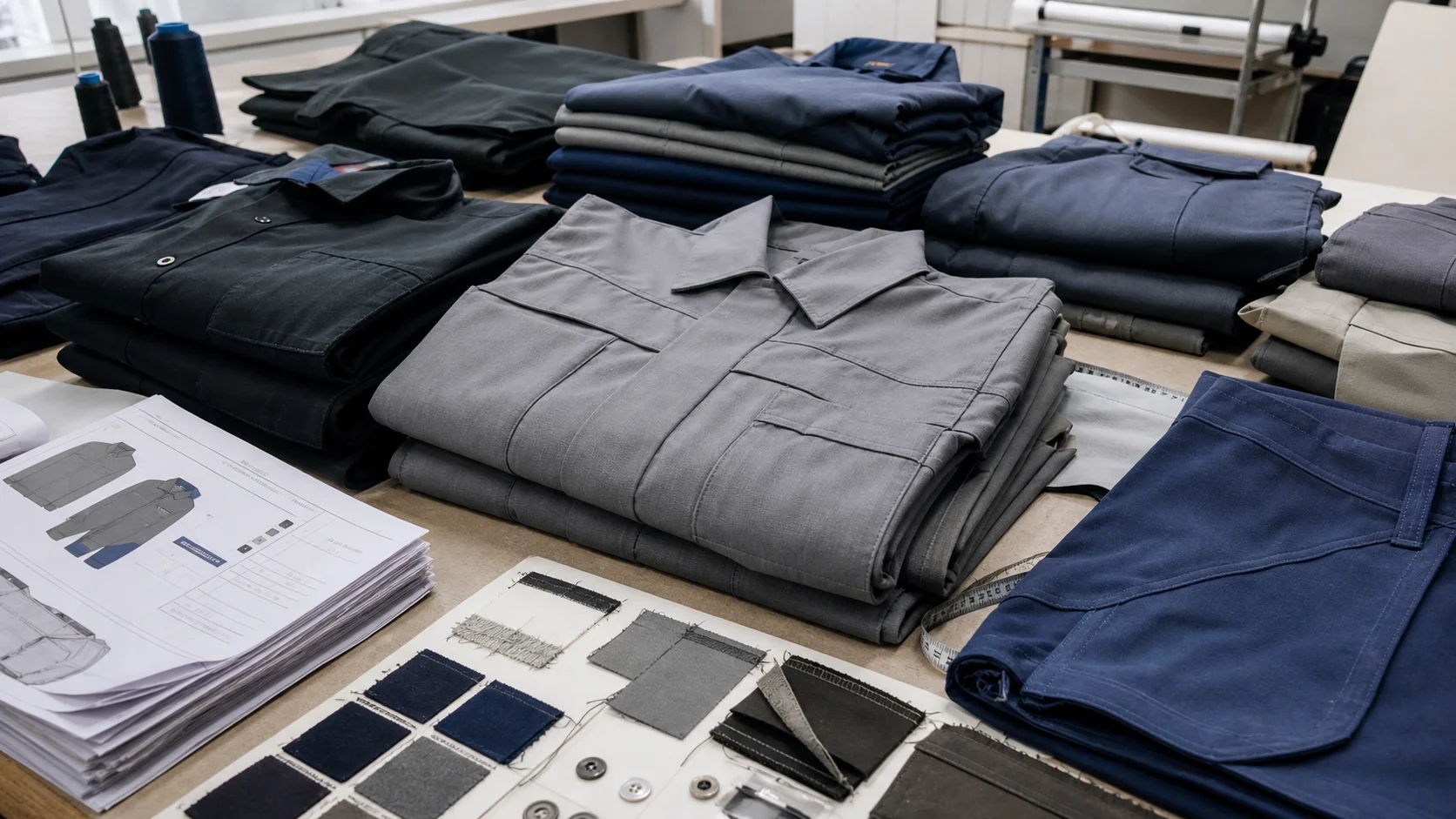
A distributor-focused outline for evaluating seam strength in wholesale service uniforms, covering stress points, test methods, inspection plans, failure...
Service Uniform Seam Strength Review for Buyers - Fabrikn production reference
Wholesale service uniform seam strength review is not a cosmetic checkpoint. For distributor buyers, it is one of the fastest ways to separate a durable workwear program from a return-prone order. Service uniforms are pulled, bent, washed, repaired, and worn for long shifts. A shirt may look acceptable on a hanger, but weak seams can fail after a few laundering cycles, during physical work, or when the wearer reaches, squats, carries, or bends.
This guide is written for distributor buyers sourcing service uniforms in bulk, especially uniforms for maintenance teams, hospitality staff, logistics crews, facility workers, automotive service, cleaning teams, food service support roles, and general commercial wear. The focus is practical: what seam strength means, where failures usually occur, what specifications to request, how to review samples, and what inspection risks should be controlled before shipment.
Service uniforms are purchased for repeat wear, brand consistency, and operational reliability. Distributor buyers are not just buying garments; they are buying replacement-cycle stability. If seams fail early, the cost is not limited to one damaged shirt or trouser. It can lead to credit claims, rushed replenishment, end-user dissatisfaction, and pressure on distributor margins.
Seam strength matters most when the uniform is exposed to movement and laundering. Service workers often reach overhead, kneel, lift boxes, bend at counters, carry tools, or sit and stand repeatedly. These movements place stress on shoulder seams, armholes, side seams, seat seams, crotch seams, pocket openings, and waistband attachments. A seam that is adequate for casual apparel may be underbuilt for daily service wear.
For distributor buyers, seam strength should be reviewed before committing to a wholesale program. It is easier to improve stitch density, thread quality, seam allowance, reinforcement, or fabric compatibility at the sample stage than after bulk goods are packed. A good review also helps buyers communicate clearly with suppliers and avoid vague instructions such as “make strong stitching,” which are difficult to inspect.
Purchasing judgment: if the uniform will be worn for physical service work and washed frequently, seam strength should be treated as a core specification, not an optional upgrade.
Not all service uniforms need the same seam construction. A front-desk woven shirt does not carry the same stress load as a maintenance coverall. A lightweight hospitality apron has different failure points than cargo work trousers. Buyers should match seam requirements to use conditions rather than applying one standard across every garment.
Service shirts are common in facilities, hospitality, automotive service, retail support, and delivery environments. Key seam points include shoulder seams, sleeve attachment, side seams, placket edges, collar attachment, and pocket stitching. If the shirt is tucked and worn during active movement, side seams and armholes need closer attention.
For woven service shirts, buyers should check whether the shoulder and armhole seams are lockstitched, overlocked, or safety stitched. A stronger construction may slightly increase cost, but it can reduce splitting under movement. For knit polos, seam stretch and recovery matter as much as straight pull strength.
Trousers carry higher seam stress than most shirts. The seat seam, crotch seam, inseam, outseam, waistband attachment, belt loops, fly area, and pocket corners should be reviewed carefully. Distributor buyers should be cautious with lightweight fabrics in slim fits, because a tight pattern can increase seam strain even when the fabric itself passes basic tests.
Reinforcement is often worth paying for at pocket corners, crotch intersections, and belt loops. Bartacks, double stitching, and adequate seam allowance can make a meaningful difference. The tradeoff is a slightly more industrial appearance, which may or may not fit the end-user’s brand image.
Coveralls need a more demanding review because they combine upper-body and lower-body stress points in one garment. The back rise, crotch, sleeve opening, shoulder, zipper area, and pocket seams are common risk zones. If workers climb, kneel, or stretch frequently, poor fit can cause seam stress even when construction is acceptable.
For distributor programs, coverall samples should be reviewed on body forms or fit models where possible. Static flat measurement is not enough. Buyers should check range of motion and confirm that the pattern allows work movement without pulling hard at major seams.
Aprons, utility vests, and service smocks may look simple, but seam failures still occur. Neck straps, waist ties, pocket corners, side tabs, and binding edges often fail first. Heavier canvas or twill may require stronger needle and thread selection. If the fabric is too dense for the selected needle, skipped stitches or needle damage can weaken the seam.
Seam strength refers to the resistance of a sewn seam to breaking, opening, tearing, or slipping when force is applied. In real use, seam failure usually appears in several ways. Thread can break. Fabric can tear beside the stitch line. The seam can open because yarns slip. Stitches can unravel. A bartack can detach. A pocket can pull away from the garment body.
Distributor buyers should understand that seam strength is not only about thread. It is the result of fabric, thread, stitch type, stitch density, seam allowance, needle size, operator handling, machine settings, pattern fit, and finishing. A strong thread used on an unstable fabric may still produce poor seam performance. A durable fabric sewn with low stitch density may still fail at stress points.
Seam strength and seam slippage are related but different. Seam strength usually focuses on the force required to break or damage the seam. Seam slippage refers to the movement of fabric yarns away from the seam, creating gaps or openings without immediate thread breakage. Slippage is common in certain woven fabrics, especially smoother or looser constructions.
For service uniform buyers, seam slippage can be just as damaging as thread breakage. A shirt side seam that opens after washing may not have “broken” in the obvious sense, but it still becomes unacceptable. When sourcing woven uniforms, especially polyester-cotton shirting, lightweight twills, or plain weaves, buyers should ask whether seam slippage has been considered.
Stitch density is often measured as stitches per inch or stitches per centimeter. Higher density can improve seam security up to a point, but excessive stitch density can perforate the fabric and create a tear line. Low stitch density may reduce cost and speed production, but it can weaken seams and create inconsistent appearance.
Typical service uniform stitching may fall around 8 to 12 stitches per inch for many woven garments, depending on fabric weight, seam type, and factory standard. Lightweight shirting may use different settings than heavy twill trousers. Buyers should not treat one number as universal. The better approach is to approve stitch density by garment type and stress zone.
Fabric choice has a direct impact on seam strength. A buyer can specify strong construction, but if the selected fabric is unstable, too light for the intended job, or poorly matched to the pattern, seam performance will still suffer. The most common service uniform fabrics include polyester-cotton blends, cotton twill, polyester twill, ripstop, stretch woven blends, pique knits, jersey knits, canvas, and performance fabrics with moisture management finishes.
Before reviewing seam strength, buyers should confirm the base fabric details. Vague fabric descriptions create inspection disputes later. A purchase order should identify fiber content, fabric weight, weave or knit type, color, shrinkage tolerance, colorfastness expectations, and any finish such as wrinkle resistance, water repellency, soil release, or antimicrobial treatment where applicable.
Fabric Type Typical Use Seam Strength Consideration Buyer Caution Poly-cotton twill Work shirts, trousers, coveralls Usually stable, suitable for stronger seam constructions Check shrinkage and seam puckering after wash Light woven shirting Service shirts, hospitality uniforms May need careful stitch density to avoid slippage or puckering Do not overbuild seams if appearance is important Stretch woven Modern service pants, active uniforms Requires thread and seam type compatible with stretch Rigid seams can crack or restrict movement Pique or jersey knit Polos, casual service tops Needs stretch-friendly stitching and balanced tension Watch for seam twisting and needle holes Canvas or heavy twill Aprons, utility garments, durable workwear Requires suitable needle, thread, and machine setup Bulky seams can cause skipped stitchesThread should match the garment’s performance requirements. Polyester thread is commonly used in uniforms because it offers good strength and abrasion resistance. Cotton thread may be chosen for specific appearances or heat-sensitive applications, but it is less common for general commercial uniforms. Core-spun threads can improve strength and sewability, though they may increase cost.
Thread size should be appropriate for fabric weight. Heavy thread on light fabric can cause puckering and needle damage. Thin thread on heavy fabric can break under load. Buyers should ask suppliers to specify thread type and count for key seams, especially for trousers, coveralls, utility garments, and pocket reinforcements.
Trims can either support or undermine seam performance. Zippers, snaps, buttons, hook-and-loop closures, elastic, drawcords, labels, reflective tape, and pocket bags all interact with seams. A heavy zipper on a lightweight coverall front can create stress if the surrounding seam is not reinforced. Reflective tape can stiffen areas of a garment and alter how seams move during wear.
Buyers should confirm trim compatibility before bulk production. For service uniforms, practical trim questions include whether pocket bags are strong enough, whether waistbands are reinforced, whether labels irritate or weaken stitching areas, and whether reflective or contrast panels create stress at seam junctions.
Seam construction should be selected according to garment use, fabric type, and price target. A distributor buyer does not always need the strongest possible seam. The goal is the right seam for the job. Overbuilding a hospitality shirt may create stiffness and poor appearance. Underbuilding a maintenance trouser may create warranty issues.
Plain seams are common and economical. They may be lockstitched and finished with overlock stitching to prevent fraying. This construction can be suitable for shirts and lighter garments when the fabric is stable and the fit is not tight. For high-stress service wear, plain seams may need reinforcement or a stronger seam type.
Safety stitching combines seam joining and edge finishing. It is commonly used in workwear because it improves durability and production efficiency. For service trousers, coveralls, and utility garments, safety stitching is often a practical upgrade from basic joining methods.
Flat-felled seams enclose raw edges and provide a clean, durable finish. They are often used where strength and appearance both matter. They can be more expensive and may add bulk, especially in heavier fabrics. Buyers should consider flat-felled seams for selected areas rather than every seam if cost control is important.
Double-needle stitching can improve seam security and provide a stronger visual workwear look. It is commonly seen on shirts, trousers, and coveralls. The buyer should check whether double-needle seams are functional or mainly decorative. Appearance alone does not guarantee strength if the seam allowance, thread, or tension is poor.
Bartacks are short, dense stitch reinforcements used at stress points such as pocket corners, belt loops, fly ends, side vents, apron ties, and zipper stops. They are often one of the best value upgrades in service uniforms. The cost impact is usually modest compared with the reduction in common failure claims.
Purchasing judgment: spend first on correct reinforcement at stress points before paying for broad cosmetic upgrades that do not improve wear performance.
Some seam locations deserve more attention because they receive repeated stress. A distributor buyer should identify these zones in the tech pack or inspection checklist. If inspectors only check general workmanship, they may miss the exact areas that fail during customer use.
Inspection should include both visual review and light stress checks. Pulling aggressively by hand is not a replacement for lab testing, but careful manual tension can reveal loose stitching, seam openings, skipped stitches, weak bartacks, or tension imbalance. Any finding should be recorded with photos and location references.
Seam testing can be performed by an internal quality team, supplier lab, or third-party testing provider. The exact method depends on market requirements and buyer expectations. Distributor buyers do not need to become lab technicians, but they should understand what the test is meant to reveal and how to interpret results cautiously.
Seam strength testing measures how much force a seam can withstand before failure. Results may vary by fabric direction, seam type, stitch density, and specimen preparation. Buyers should avoid comparing test values across very different fabrics without context. A lightweight shirt fabric and a heavy twill trouser fabric should not be judged by the same expectation.
When requesting testing, buyers should identify which seams matter most. Testing only a low-stress seam may give false confidence. For trousers, the crotch or seat seam is usually more relevant than a low-stress side seam. For shirts, the armhole or side seam may be more useful than a decorative seam.
Seam slippage testing is important for woven fabrics where yarns can move under pressure. This test helps identify whether the fabric construction supports the intended seam. If slippage appears at low force, changing thread alone may not solve the issue. Buyers may need a tighter fabric construction, wider seam allowance, different stitch density, or a revised garment fit.
Wash testing is essential for service uniforms. Many seam issues appear only after laundering, when fabric shrinks, thread tension changes, or puckering becomes visible. Distributor buyers should define wash conditions close to the end user’s expected care process. Domestic washing is different from commercial laundering, and industrial laundering can be much harsher.
At minimum, sample review should include wash appearance, seam puckering, seam twisting, shrinkage, color change, and thread performance. If the uniform will be exposed to repeated washing, buyers should request multiple-cycle wash review rather than a single wash only.
Fit directly affects seam stress. A uniform can pass flat measurements and still fail during wear if the pattern restricts movement. For active service roles, buyers should review range of motion: reaching forward, raising arms, squatting, sitting, bending, and stepping. Tightness at the seat, thigh, armhole, back, or shoulder can overload seams.
Size grading also matters. Larger sizes need enough ease and seam allowance. A pattern that works in medium may place excessive stress on 2XL, 3XL, or extended sizes if grading is not carefully managed. Distributor buyers handling broad size runs should inspect multiple sizes, not only the base size sample.
Sample approval is the buyer’s best chance to prevent seam strength problems. A proper approval process should be structured, not casual. The supplier should know which parts of the garment will be judged and what documentation is required before production starts.
A pre-production sample is especially important. Early development samples may use substitute fabric or trims. If the bulk fabric has a different weight, stretch, coating, or shrinkage behavior, seam performance can change. Buyers should not approve production based only on a sample made from non-bulk material unless the risk is understood and accepted.
The tech pack should define seam requirements clearly enough for production and inspection. Useful details include seam type, stitch density range, thread type, seam allowance, bartack locations, reinforcement patches, pocket construction, zipper attachment method, waistband construction, and any areas requiring double needle or safety stitch.
Photos or diagrams are useful when specifying reinforcement. For example, “bartack pocket corners” is less precise than identifying exact pocket locations and expected bartack length. If the buyer has a previous approved uniform, that sample should be referenced carefully, but it should not replace written specifications.
Companies sourcing new service uniform programs can review available production and development support through Fabrikn services. For buyers comparing supplier capability, process clarity is often as important as quoted unit cost.
Minimum order quantity depends on garment type, fabric availability, customization level, color, size range, and trim requirements. Distributor buyers should treat MOQ as a planning variable, not just a negotiation point. A low MOQ may be possible with stock fabric and simple branding. A higher MOQ is more likely when fabric must be dyed, custom woven, specially finished, or matched to a corporate color.
Uniform Type Typical MOQ Range Lead-Time Factors Buyer Risk Basic service shirts 300 to 1,000 pieces per style/color Stock fabric, embroidery, size spread, wash testing Color variance and seam puckering after wash Work trousers 500 to 1,500 pieces per style/color Fabric weight, pocketing, waistband trims, grading Crotch seam stress and pocket reinforcement failures Coveralls 300 to 1,200 pieces per style/color Zippers, elastic, reflective tape, complex sewing operations Fit restriction and seam strain during movement Aprons and smocks 300 to 2,000 pieces per style/color Fabric width, binding, straps, pocket layout Strap attachment and pocket corner tearing Custom branded programs Often 1,000 pieces or more depending on fabric and trims Lab dips, custom labels, packaging, logo placement Approval delays and inconsistent branding detailsThese ranges are general planning references, not fixed rules. Some suppliers may accept lower quantities with a surcharge, limited fabric selection, or longer scheduling window. Others may require higher quantities to secure fabric production, dyeing, or trim sourcing. Buyers should ask what drives the MOQ instead of focusing only on the number.
Service uniform lead time depends heavily on material readiness and approval speed. A simple reorder using approved fabric and trims can move faster than a new custom program. New development normally requires more time for fabric sourcing, lab dips, fit samples, pre-production samples, testing, bulk cutting, sewing, finishing, inspection, packing, and shipping.
Typical production planning may range from 45 to 90 days after approvals for many wholesale uniform orders, with longer timelines for custom-dyed fabric, imported trims, extended testing, or peak-season capacity constraints. Sampling may add two to six weeks depending on revision rounds. Shipping method also changes the calendar significantly.
Buyers should build approval deadlines into the sourcing calendar. Delays in approving lab dips, size specs, logo placement, or packaging can compress production time and increase inspection risk. Rushed sewing often shows up as skipped stitches, uneven tension, loose threads, and inconsistent reinforcement.
Bulk inspection should not wait until the final random inspection if the uniform has known seam-risk areas. Inline inspection is useful for catching sewing setup issues while they can still be corrected. Final inspection confirms shipment quality, but it may be too late to fix widespread seam problems without rework delays.
Several risks appear repeatedly in wholesale service uniform production. One is inconsistent stitch density between sewing lines or operators. Another is missing reinforcement where the approved sample had bartacks. Seam allowance can become narrow during rushed sewing, especially around curves such as armholes and crotch seams. Thread tension may change across fabric layers, causing puckering or loose stitching.
Mixed sizing also affects seam review. If inspection pulls mostly small or medium sizes, larger-size stress issues may be missed. Buyers should require inspection sampling across the size range. Extended sizes deserve special attention because they often experience higher seam load and may show grading weaknesses.
Repairs need careful review. A repaired seam can be acceptable if it is clean, secure, and consistent with the approved appearance. Poor repairs can create extra needle holes, tension imbalance, or visible unevenness. Distributor buyers should define whether repairs are allowed and what quality level is acceptable.
Strong seam construction does not mean the buyer should choose the most expensive option everywhere. The best purchasing decision balances end-use performance, brand appearance, price point, and replacement expectations. A maintenance uniform needs different durability than a front-of-house hospitality shirt. A distributor serving price-sensitive clients may need targeted reinforcement rather than premium construction across the entire garment.
The wrong saving is reducing seam allowance, removing reinforcement, or accepting weak pocket construction on workwear garments. These decisions may lower unit cost but increase claim risk. A better saving is simplifying style details while keeping functional seams strong.
Purchasing judgment: if a uniform is sold as durable service wear, weak seam construction is a margin risk. It is better to simplify the design than to underbuild the stress points.
Before placing a wholesale service uniform order, buyers should ask specific questions that reveal whether the supplier understands seam performance. The answers do not need to be complicated, but they should be clear and consistent with the sample.
These questions help move the conversation away from broad claims and toward measurable quality controls. If a supplier cannot explain seam construction, the buyer should slow down before confirming a large order.
Good documentation protects both the buyer and supplier. It also helps distributors scale repeat programs with fewer disputes. At minimum, buyers should keep the approved tech pack, purchase order, material details, lab dip approvals, trim approvals, size specification, pre-production sample record, inspection reports, testing results where applicable, and shipment photos.
For seam strength review, the approved sample is especially valuable. It gives the inspection team a physical reference for stitch appearance, seam construction, reinforcement placement, and garment balance. If the order is repeated later, the sample helps prevent gradual quality drift.
Distributor buyers planning a new program can use Fabrikn’s contact page to start a sourcing discussion with clearer technical expectations. Buyers reviewing supplier background and production approach may also find useful context on Fabrikn’s about page.
Several warning signs should slow down an order. A supplier may provide attractive pricing but avoid confirming thread, seam allowance, or reinforcement details. Samples may look good visually but show seam puckering after wash. Stitch density may vary widely from one part of the garment to another. Pockets may lack bartacks even when the garment is intended for active work.
Another red flag is a sample that fits tightly in movement zones. Tight garments can sell well visually, but service uniforms must allow work movement. If the sleeve pulls hard when arms are raised or the seat seam strains when sitting, the issue may be pattern-related rather than stitching-related. Fixing the seam alone may not solve the failure risk.
Buyers should also be cautious when bulk production starts before final sample approval. This may save calendar time, but it increases risk if the sample requires changes. If early production is unavoidable, the buyer should identify which risks are being accepted and keep the first cutting quantity limited where possible.
A practical standard should be specific enough to inspect but flexible enough for different garments. Distributor buyers can create a seam strength standard by grouping uniforms by end use. Light service, moderate service, and heavy service categories are often easier to manage than one long universal specification.
Light service uniforms may include reception shirts, café uniforms, light aprons, and front-of-house garments. Appearance, comfort, and wash stability matter. Seam construction should be clean and consistent, with reinforcement at obvious stress points such as pocket corners and apron ties. Overbuilding may make the garment look too industrial.
Moderate service uniforms include many general work shirts, polos, trousers, and smocks. These garments need better durability but may still require a polished brand appearance. Buyers should specify reinforcement in movement and pocket areas, confirm wash performance, and inspect size grading across the range.
Heavy service uniforms include coveralls, maintenance trousers, utility shirts, shop coats, and durable aprons. Seam strength should be a primary buying factor. Stronger thread, safety stitching, double-needle construction, bartacks, reinforced pocketing, and movement-friendly fit become more important. Price pressure should not remove critical reinforcement.
A service uniform seam strength review should connect the garment’s intended use with the right fabric, thread, stitch, seam type, reinforcement, fit, testing, and inspection process. Buyers do not need to overcomplicate every order, but they should not rely on appearance alone. The seams that fail first are usually predictable, and they can often be improved before bulk production starts.
For distributor buyers, the strongest purchasing position is built before the purchase order is finalized. Confirm fabric and trim specifications. Approve samples after wash and movement review. Define critical seams in the tech pack. Inspect high-risk zones during production and before shipment. Spend money where failures are likely, and save money by simplifying non-critical design details.
That approach protects margin, reduces claims, and gives end users a uniform program that performs as expected. In wholesale service uniforms, seam strength is not just a quality detail. It is a commercial control point.
Get a free quote from Fabrikn — your trusted B2B clothing manufacturer with 10+ years of experience. MOQ as low as 200 pieces.
Get a Free Quote →Seam strength is the ability of a sewn seam to resist breaking, opening, tearing, or slipping under force. In service uniforms, it is important because garments are worn during active work and washed repeatedly.
Common failure areas include shirt armholes, shoulder seams, trouser crotch seams, seat seams, pocket corners, belt loops, waistband seams, zipper attachments, apron ties, and coverall back rise areas.
Typical MOQs often range from 300 to 1,500 pieces per style and color, depending on garment type, fabric availability, customization, trims, and supplier capacity. Custom fabric or special colors may require higher quantities.
Many wholesale uniform orders may require 45 to 90 days after final approvals, depending on fabric readiness, sample revisions, testing, trims, production capacity, inspection, and shipping. New custom programs usually take longer than repeat orders.
For high-use service uniforms, seam testing or at least structured wash and movement review is strongly recommended. Lab testing is especially useful for trousers, coveralls, stretch fabrics, lightweight woven fabrics, and uniforms used in demanding work environments.
Not always. Stronger construction can add cost, stiffness, or bulk. The better approach is to strengthen high-stress zones while keeping comfort and appearance suitable for the uniform’s intended use.
The checklist should include stitch density, seam allowance, thread condition, skipped stitches, seam openings, bartack placement, pocket reinforcement, high-stress seam review, wash results where required, and size-range inspection.
Some issues can be repaired, such as missing bartacks or loose threads. Widespread problems caused by poor fabric choice, incorrect stitch density, tight pattern fit, or narrow seam allowance are harder and more expensive to correct after bulk production.
Distributors can reduce claims by approving bulk-material samples, specifying reinforcement points, reviewing wash performance, checking movement fit, inspecting larger sizes, and arranging inline inspection for first-time or complex orders.