
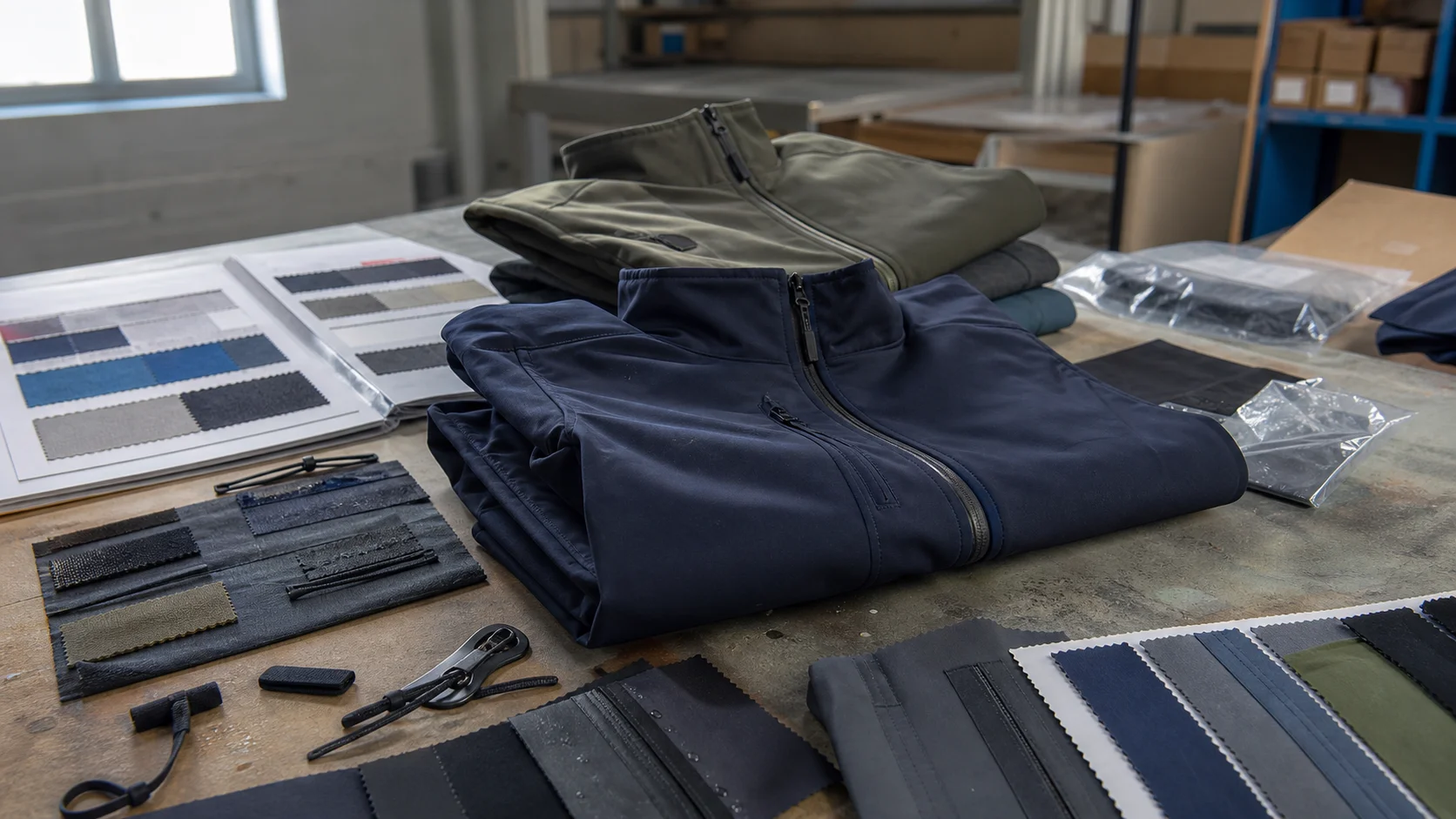
A sourcing-focused outline for transport hub buyers auditing wholesale softshell jacket colorfastness, lab testing, shade control, trim bleed risk, and...
Softshell Jacket Colorfastness Audit for Buyers - MOQ, Cost & Sourcing manufacturing guide
Wholesale softshell jacket colorfastness audit for transport hub buyers is not a cosmetic side task. It is a risk-control process for uniforms that face rain, sweat, abrasion, fluorescent lighting, industrial laundering, vehicle seats, baggage belts, safety vests, radios, and repeated shift wear. Airport, rail, bus, port, warehouse, and logistics teams do not use outerwear lightly. Jackets are often worn daily, stacked in lockers, branded with embroidery or heat transfer logos, and exposed to mixed indoor-outdoor conditions.
Color failure creates several purchasing problems at once. A black or navy softshell that crock-stains a white shirt looks unprofessional. A red or royal blue jacket that fades unevenly after washing can make a uniform program look poorly controlled. A high-visibility contrast panel that bleeds into dark shell fabric can create compliance and appearance concerns. Even if the garment is still wearable, the buyer may face complaints, replacement costs, and pressure from operations teams.
For transport hubs, the audit should not only ask, “Does the fabric pass a lab test?” The better question is, “Will this specific jacket, in this color, with these trims and decorations, survive the buyer’s real use conditions?” That includes wet rubbing from rain, sweat transfer during long shifts, washing at agreed temperatures, contact with reflective tape, and color migration from dark shell fabric into light lining or logo areas.
A practical colorfastness audit protects the purchase order before it protects the brand. The audit should convert color risk into measurable requirements before fabric booking, cutting, and decoration begin.
Transport hub buyers often order across multiple sizes, departments, and seasons. A small color inconsistency can become visible when teams stand together in security lines, concourses, loading bays, or dispatch areas. Shade variation between production lots is also a concern when repeat orders are placed six months later. For this reason, colorfastness and shade control should be treated as part of sourcing strategy, not only as a final inspection checkpoint.
A softshell jacket is a layered product. Common constructions include woven polyester face fabric bonded to TPU, PU, or other breathable membrane, then laminated or bonded to fleece, jersey, mesh, or brushed tricot backing. Some styles include stretch yarn, water-repellent treatment, reflective piping, contrast zippers, chest logos, storm flaps, cuff tabs, drawcords, and pocket bags. Each component can create a colorfastness issue.
A useful audit covers the full jacket, not only the shell yardage. Buyers should request test results and production controls for the shell fabric, contrast panels, lining or backing, pocketing, zipper tape, elastic binding, drawcords, labels, hook-and-loop tabs, reflective materials, embroidery threads, printed logos, and heat transfer films. If the jacket uses multiple dark and light colors, the audit should focus on bleeding and staining between adjacent components.
Buyers sourcing for transport hubs should also decide whether the jacket is a corporate uniform, staff outerwear, high-visibility workwear layer, or promotional teamwear item. The required standard changes with the use case. A low-cost promotional softshell for occasional use may accept moderate fading. A staff uniform worn five days per week should meet stronger wash, rub, perspiration, and shade-control requirements.
If the jacket is intended for operational staff, do not rely only on a supplier’s general fabric data sheet. Ask whether the test report applies to the exact fabric construction, color, finishing, backing, membrane, and production batch. Dark colors, fluorescent colors, red shades, royal blue, orange, and deep green can behave differently from neutral colors. A pass result for black does not automatically cover red, and a pass result for shell fabric does not cover contrast zipper tape.
Buyers can coordinate sourcing, sample review, and pre-shipment inspection through a supplier management process. A structured manufacturing partner should be able to explain how color standards, testing, and bulk checks are handled. For broader sourcing support, buyers may review apparel manufacturing services at fabrikn.com/services/.
Colorfastness testing should be written into the tech pack, purchase order, or quality manual. Vague wording such as “good colorfastness” is not enough. The specification should state the test type, method standard if applicable, required grade, colorway coverage, and whether testing must be completed before bulk fabric cutting.
Most garment buyers use a grey scale rating system from 1 to 5, where 5 is best. Requirements vary by market and product type, but many wholesale outerwear buyers target grade 4 or above for core tests, with grade 3-4 sometimes accepted for difficult colors or lower-risk areas. Transport hub uniform buyers should be cautious about accepting weak ratings for dark shell fabrics because visible staining on shirts, linings, or reflective elements can create immediate complaints.
Test Area What It Checks Typical Buyer Target Practical Risk Colorfastness to rubbing / crocking Dry and wet color transfer from fabric surface Grade 4 dry, grade 3-4 or 4 wet depending on color Staining on shirts, seats, bags, and light linings Colorfastness to washing Color change and staining after laundering Grade 4 for color change and staining where possible Fading, bleeding, dull shade after staff laundering Colorfastness to perspiration Acid and alkaline sweat impact Grade 4 for operational uniforms Underarm staining, collar transfer, inner layer bleeding Colorfastness to water Bleeding or staining when wet Grade 4 for outerwear exposed to rain Color migration during rain or damp storage Colorfastness to light Fading under light exposure Moderate to high rating based on outdoor exposure Uneven fading for staff working outdoors Color migration Dye transfer between components during storage or heat No visible staining after agreed condition Dark shell staining white logos, labels, or liningRubbing colorfastness is one of the most important checks for transport hub jackets. Staff lean against counters, vehicle seats, baggage carts, security equipment, turnstiles, and office chairs. Wet rubbing is especially relevant for rain-soaked jackets or workers moving between outdoor and indoor areas. Dark softshell fabrics with brushed or peach surfaces may look premium but can carry higher surface-dye transfer risk if finishing is not controlled.
Buyers should request both dry and wet rubbing results for each critical color. Navy, black, charcoal, red, royal, orange, and dark green should not be assumed safe. If a supplier proposes a low wet rubbing grade due to color depth, the buyer must decide whether the price saving is worth the complaint risk. For public-facing transport teams, weak wet rubbing is usually a poor tradeoff.
Softshell jackets may be home-laundered, centrally laundered, or washed by contracted uniform services. The audit should reflect the actual care route. A jacket approved only for cold gentle washing may not survive a transport hub uniform program where staff wash garments with mixed workwear or where laundry teams use higher temperatures.
The buyer should specify wash temperature, cycle type, detergent assumptions, and number of wash cycles for evaluation. One wash cycle may identify major bleeding, but repeated cycles better reveal fading, seam puckering, logo damage, and delamination risks. For recurring uniform programs, testing after 5 washes or more can be justified before a large bulk order.
Perspiration testing matters because operational staff may wear jackets over shirts for long shifts. Collars, cuffs, underarms, and inner facings can be exposed to sweat. Acid and alkaline perspiration tests help identify staining risk against light shirts or inner layers. This is especially important for dark outer shells with light grey, white, or high-visibility inner components.
Softshell jackets are often sold as water-resistant rather than waterproof. Even with a durable water-repellent finish, fabric can become wet after extended exposure or after repeated washing. A water colorfastness test helps buyers understand whether dye may bleed when the jacket is damp, folded, or stored in a locker.
If the style includes contrast panels, laminated branding, or reflective piping, wet storage should be considered. A damp navy jacket folded against a white printed logo or light lining can produce staining even when the shell fabric passed a basic wash test. That is why full-garment testing is useful before production approval.
Transport hub workers may spend part of the day outdoors: aircraft stands, bus bays, taxi ranks, freight yards, rail platforms, car parks, and port access points. Lightfastness is less urgent for indoor-only teams but important for outerwear exposed to sunlight. Fluorescent orange, red, and bright blue shades can fade faster than dark neutrals, depending on dye quality and fabric chemistry.
For buyers trying to balance cost, it may be reasonable to set stronger lightfastness requirements for outdoor teams and moderate targets for indoor staff. That segmentation can reduce cost without weakening the whole uniform program.
Softshell colorfastness is affected by more than dye. The face fabric, yarn type, surface finish, membrane, adhesive, backing, and finishing process can all influence performance. A low-cost fabric may pass color shade approval on day one but fail in wet rubbing, washing, or bonded-layer durability.
Common softshell face fabrics include polyester woven stretch, mechanical stretch polyester, polyester-spandex blends, and sometimes nylon blends. Polyester is common because it offers durability, color consistency, and manageable cost. Spandex improves movement but can increase sensitivity to heat and some finishing conditions. Nylon may offer strength but requires careful dye control and can behave differently in lightfastness and washing.
Surface texture matters. Smooth woven faces often show less crocking than brushed or matte surfaces, but the final result depends on dyeing and finishing quality. A very deep black or saturated navy can look sharp in sample review while carrying higher risk of rubbing transfer. Buyers should not judge colorfastness by visual richness alone.
Many softshells use TPU or PU membranes for wind resistance and water resistance. Lamination temperature, adhesive selection, and curing can affect the final hand feel and durability. Colorfastness issues may appear when heat and pressure during bonding influence dye migration, especially with dark shell fabrics or bright contrast colors.
The audit should confirm that test samples are taken after full finishing and bonding, not only from pre-lamination fabric. Pre-bonding fabric results may not reflect the final garment. If the supplier changes lamination mill, adhesive, membrane thickness, or backing material after approval, the buyer should require confirmation testing or a re-approved sample.
Softshell backing is often fleece or brushed tricot. Light-colored fleece bonded to a dark face fabric can show staining if dye migration occurs. Dark backing can also transfer onto light shirts, particularly around collars or cuffs when wet with perspiration. Buyers should inspect both sides of the fabric after rubbing, washing, and wet storage tests.
For transport hub uniforms, a light grey backing may look cleaner than white and reduce visible staining risk. Black backing hides marks but may increase transfer risk onto shirts if the dye is weak. The better choice depends on laundering, shirt color, and user environment.
Reflective piping, tape, or printed reflective logos are common in transport and logistics outerwear. These components may discolor, crack, peel, or stain after washing and heat exposure. Reflective materials can also attract dye migration from dark fabrics during storage.
If reflective performance is safety-critical, colorfastness audit alone is not enough. Buyers should also specify reflectivity, wash durability, placement, and compliance requirements appropriate to the intended market. A decorative reflective trim and a certified high-visibility component are not the same thing.
Zipper tape is a frequent weak point. A black shell with a red zipper, or a navy shell with grey zipper tape, may create staining at the seam edge after wet storage or washing. Elastic binding at cuffs and hems can also bleed. Woven labels and size tabs should be checked when placed against dark fabric, especially if they are white or light grey.
Buyers often focus on shell fabric because it is the main cost driver. That is understandable, but trim failures are still visible and can trigger rejection. The audit should include trim cards and garment-level testing before mass production.
MOQ is a practical constraint in softshell jacket sourcing. Factories and fabric mills may quote separate minimums for fabric dyeing, lamination, garment production, trims, zippers, and decoration. Buyers should clarify whether the MOQ applies per style, per color, per size range, or per fabric order.
Typical wholesale softshell jacket MOQs vary widely. For stock fabric and standard trims, some suppliers may accept around 300 to 500 pieces per color. For custom-dyed fabric, bonded softshell, special membrane, or custom trims, the practical MOQ may move toward 800 to 1,500 pieces per color or more. For fully custom programs with multiple colors, special sizing, branded zippers, and tested performance requirements, buyers should plan for higher MOQs and longer development time.
Sourcing Option Typical MOQ Range Colorfastness Control Best Use Case Stock softshell fabric 300-500 pcs per color, sometimes lower with standard colors Moderate, depends on existing test reports and batch consistency Small uniform runs, urgent replenishment, budget programs Custom color on existing fabric base 800-1,500 pcs per color depending on mill MOQ Better shade targeting, requires lab dips and batch testing Corporate color matching and repeat uniform programs Custom bonded softshell construction 1,000-3,000 pcs per color or higher Strongest control if testing is built into development Long-term transport hub uniform contracts Ready-made blank jacket with logo 50-300 pcs depending on distributor Limited control over dye batch and lab testing Temporary staff, pilot runs, low-risk promotional useCost pressure is real, but colorfastness is not an ideal area for blind cost cutting. Lower-cost fabric may use less stable dyeing, weaker finishing, inconsistent batches, or unverified trims. The buyer may save on unit price and lose more through replacements, complaints, and emergency reorders.
A more balanced approach is to define performance tiers. Public-facing staff and outdoor operational teams can receive higher-spec softshell jackets with stronger testing. Indoor teams or occasional-use departments may use standard softshell if the risk is acceptable. This keeps the sourcing plan commercial without treating every wearer as the same risk profile.
These costs should be viewed against order value and operational risk. A 300-piece order for temporary staff may not justify the same testing budget as a 5,000-piece multi-site uniform rollout. Still, even smaller orders benefit from basic rub, wash, and shade checks when dark colors or light logos are involved.
Buyers who need to discuss custom development, order scope, or sampling timelines can use fabrikn.com/contact-us/ to start a sourcing conversation.
A good sample approval workflow prevents many colorfastness problems before they become expensive. The buyer should not move from attractive salesman sample directly to bulk cutting. Softshell jackets have too many variables for that shortcut: fabric shade, bonding, backing, zipper color, logo method, wash behavior, and bulk trim matching all need review.
Start with a physical color reference. This may be a Pantone textile reference, an existing approved garment, a corporate color standard, or a lab dip target. Digital colors on screens are not enough. The supplier should confirm the light source used for shade evaluation, such as D65 or TL84, if the buyer has strict requirements.
Transport hub buyers should decide whether shade tolerance is strict across all departments or flexible by function. Corporate navy may need tight control for public-facing teams. Warehouse or maintenance teams may accept slightly wider tolerance if performance and durability are stronger.
For custom-dyed fabric, lab dips should be reviewed before bulk dyeing. Buyers should request at least two or three options if shade matching is important. The selected lab dip should be signed, dated, and retained as the master reference. If fabric has a brushed surface or bonded backing, the buyer should evaluate the final look after finishing because shade can change after lamination or brushing.
Before garment sampling moves too far, request colorfastness testing for the selected fabric quality and color. The report should state the fabric composition, color, test method, date, and result. If the supplier only provides an old report for a different color or construction, treat it as supporting information rather than approval evidence.
Fit samples confirm pattern, construction, seam placement, pocket size, cuff function, and overall appearance. Colorfastness is not the only concern at this stage, but it should not be ignored. If the sample uses substitute fabric, the buyer must clearly mark that fabric and color are not approved for bulk.
The pre-production sample should use actual approved bulk fabric, trims, zipper tape, lining, labels, and decoration. This is the sample that matters most for colorfastness review. Buyers should wash it, rub-test high-risk areas, inspect logo edges, check light trims for staining, and compare all panels against the color standard.
If the jacket includes embroidery, heat transfer, screen print, reflective print, or woven badge, colorfastness testing should happen after decoration. Heat and pressure used in logo application can trigger dye migration, especially on dark polyester softshell.
Once approved, keep a sealed pre-production sample for factory reference and buyer inspection. It should include approved trim card, fabric swatch, logo placement, packaging method, care label, and color standard. The final inspection team should compare bulk garments against this sealed sample, not against memory or a low-resolution photo.
Approval Stage Buyer Checkpoint Colorfastness Relevance Color standard Approve physical reference Prevents subjective shade disputes Lab dip Select best shade option Sets target before bulk dyeing Fabric testing Review rub, wash, perspiration, water, light results Confirms performance before cutting Pre-production sample Check actual fabric, trims, logo, and construction Finds migration and trim staining risks Sealed sample Use as inspection reference Controls shade and component consistencyFinal inspection cannot fully replace laboratory testing, but it can catch visible color and shade problems before shipment. The buyer should include colorfastness-related checkpoints in both inline and final inspection instructions.
Inline inspection should happen after bulk fabric arrives and early production begins. Inspectors should compare fabric rolls against the approved shade standard, check roll-to-roll variation, and inspect cut panels before sewing. A common risk is shade variation between body panels and sleeves if fabric rolls are mixed without control.
Roll numbering and shade grouping are important. If a factory cuts sleeves from one dye lot and body panels from another, the jacket may show a visible mismatch under transport hub lighting. This can be hard to correct after assembly. Fabric should be relaxed, checked, and grouped before cutting.
Inline inspection should also check whether trims match approved samples. Zipper tape, pullers, binding, and labels can vary between supplier batches. A small change in zipper shade may look acceptable in isolation but obvious across a uniform group.
Final inspection should include visual shade checks under suitable lighting, random garment comparison to sealed samples, measurement checks, construction review, logo inspection, and packaging review. Colorfastness itself may require lab testing, but final inspection can include practical quick checks such as rubbing a white cloth on dark shell surfaces or checking for staining around logos and light trims.
Quick checks are not a substitute for certified testing. They are screening tools. If a quick wet rub shows visible staining, shipment should not be released without further investigation. If the fabric test report passed but the garment shows migration around heat transfers, the issue may be decoration process or storage conditions rather than base fabric alone.
Packaging can create color migration risk. Dark jackets packed tightly against white labels, reflective prints, or light panels may stain during warm or humid transit. Polybag quality, folding method, carton compression, and moisture control should be considered. Garments should be fully dry before packing, especially after pressing, steaming, or spot cleaning.
Transport hub buyers often store uniforms before distribution to staff. If jackets remain boxed for months, heat and humidity can expose migration issues not seen during a quick inspection. For dark colors with light logos or reflective details, buyers should ask for a migration or storage simulation test when order value justifies it.
The fastest way to identify sourcing risk is to ask specific questions early. Good suppliers can answer clearly or explain what must be tested. Weak suppliers often rely on general assurances.
The answers should be written into the purchase file. Verbal confirmation is weak protection when a shipment arrives with color issues. Buyers should retain lab dips, signed samples, trim cards, test reports, inspection reports, and shipment records for future repeat orders.
Supplier selection also matters. A factory or sourcing partner familiar with outerwear should understand lamination, DWR finishing, seam construction, heat transfer risks, and trim compatibility. General cut-and-sew capability is not always enough for bonded softshell programs. Buyers can learn more about the company background and sourcing approach at fabrikn.com/about-us/.
Not every imperfection needs to stop a purchase order. Buyers should separate serious colorfastness risks from manageable commercial compromises. A slight shade difference between approved lab dip and bulk may be acceptable if it is within agreed tolerance and consistent across all garments. Poor wet rubbing on dark shell fabric is harder to accept because it can create staining complaints as soon as jackets are worn in rain.
A moderate lightfastness result may be acceptable for indoor concourse staff but not for ramp, yard, or platform staff exposed to sunlight. A stock fabric with existing test results may be fine for a 300-piece pilot order, but a full transport hub rollout should use batch-specific testing. A low MOQ blank jacket may solve a short-term staffing problem, yet it gives the buyer limited control over future shade consistency and repeatability.
Issue Buyer Decision Reason Slight bulk shade variation within approved tolerance Usually acceptable if consistent Low operational risk if all garments look uniform together Visible panel mismatch on finished jackets Reject or rework affected units Public-facing uniforms will look inconsistent Weak wet rubbing on dark shell Reject for transport hub uniform use High risk of staining shirts, seats, and equipment Logo staining after heat transfer Hold shipment and investigate Migration may worsen during storage and transit Old test report for different color Use only as reference, not approval Color and batch performance can differ materially Supplier refuses pre-cut fabric testing for large order Treat as sourcing risk Defects become expensive after cutting and sewingThe best sourcing decision is not always the highest specification. It is the right specification for the job. Transport hub buyers should classify wearers by exposure, visibility, laundering, and replacement difficulty. Then they can apply stronger requirements where they matter and avoid unnecessary cost where the risk is low.
Colorfastness audits affect timeline. Buyers often underestimate the time needed for lab dips, corrections, fabric booking, lamination, testing, pre-production samples, inspection, and shipment booking. If a uniform launch date is fixed, the color approval calendar should be built backward from that date.
Typical development timelines vary by supplier and season, but buyers can use cautious planning ranges. Lab dips may take 5 to 10 working days per round. Custom fabric dyeing and lamination may take 20 to 45 days after approval, depending on mill capacity and raw material availability. Garment sampling may take 7 to 20 days per round. Bulk production for wholesale softshell jackets may take 30 to 60 days after all approvals, with longer timelines for large orders, custom trims, or peak season capacity.
Testing also consumes time. Basic fabric colorfastness tests may take several working days, while repeated wash testing, lightfastness, migration checks, and third-party lab scheduling can extend the calendar. If the buyer waits until final inspection to ask for tests, the shipment may be delayed or released with unresolved risk.
Buyers can reduce delay by approving a realistic color standard, limiting unnecessary custom trim colors, testing fabric before cutting, and reserving time for one correction round. Rushing color approval is rarely worth it for uniform outerwear. Once bulk fabric is cut, the buyer’s options become narrower and more expensive.
The purchase order should not only state quantity, size breakdown, price, and delivery date. It should include quality expectations that are clear enough for the supplier, inspector, and buyer to use. Colorfastness requirements can be summarized in the PO and detailed in the tech pack or quality manual.
For large or repeat orders, buyers should also define what happens if tests fail. Will the supplier replace fabric, re-dye, rework garments, discount goods, or cancel affected units? This discussion is easier before production than after goods are packed.
Care labeling should align with test results. If the jacket only passes cold washing, do not label it for warmer washing. If decoration cannot tolerate tumble drying, the care label should say so. A mismatch between care instructions and actual performance creates avoidable claims.
A wholesale softshell jacket colorfastness audit for transport hub buyers should begin before the fabric is booked and continue through sample approval, production, inspection, packaging, and repeat order planning. The buyer’s goal is not to make the supplier produce paperwork. The goal is to prevent visible fading, staining, migration, and shade inconsistency in a uniform program that must perform under daily operational use.
The strongest purchasing approach is simple: define the end use, classify wearer risk, approve physical color standards, test the actual fabric and color, review a true pre-production sample, inspect bulk shade control, and keep records for repeat orders. MOQ and cost will influence what level of testing is reasonable, but dark colors, light logos, reflective trims, and outdoor exposure deserve extra attention.
Softshell jackets are practical garments for transport environments when sourced correctly. They offer warmth, mobility, branding space, and weather resistance without the bulk of heavy outerwear. Their main risk is assuming that a good-looking sample equals durable color performance. For transport hub buyers managing staff visibility and uniform consistency, that assumption is too expensive.
Get a free quote from Fabrikn — your trusted B2B clothing manufacturer with 10+ years of experience. MOQ as low as 200 pieces.
Get a Free Quote →A softshell jacket colorfastness audit is a sourcing and quality-control process that checks whether the jacket fabric, trims, lining, and decoration resist fading, bleeding, staining, and color transfer. For transport hub buyers, it should cover rubbing, washing, perspiration, water exposure, light exposure, and color migration between components.
Wet and dry rubbing tests are especially important because transport staff often wear jackets in rain and high-contact environments. Washing, perspiration, water, and lightfastness tests are also important depending on whether the garment is used indoors, outdoors, or in mixed-duty roles.
For standard stock fabric, buyers may see MOQs around 300 to 500 pieces per color. Custom-dyed softshell fabric often starts around 800 to 1,500 pieces per color, while custom bonded constructions, special membranes, or custom trims may require 1,000 to 3,000 pieces per color or more. Actual MOQ depends on fabric mill, trim supplier, factory capacity, and order complexity.
Existing reports are useful only if they apply to the exact fabric quality, color, finish, membrane, backing, and production batch. A report for a different color or older batch should be treated as reference material, not final approval for a transport hub uniform order.
Staining can happen when dye transfers through rubbing, moisture, perspiration, heat, pressure, or storage conditions. Dark polyester softshell fabrics, especially deep navy, black, red, and royal blue, should be checked against light linings, white shirts, reflective trims, and heat transfer logos before bulk shipment.
Both stages can matter. Fabric testing should happen before cutting to avoid wasting production cost on weak material. Garment-level checks should happen after decoration because heat transfer, embroidery backing, reflective print, and pressing conditions can create new migration or staining risks.
Buyers can focus stronger testing on high-risk colors, outdoor teams, public-facing staff, and garments with light logos or reflective trims. Stock fabrics with credible recent reports may be acceptable for low-risk or small runs, while custom uniform programs should use batch-specific testing and sealed pre-production samples.
Buyers should reject visible panel shade mismatch, obvious staining around logos or trims, unacceptable bulk shade deviation, weak wet rubbing signs, and any unapproved material substitution. If a color issue appears during inspection, shipment should be held until the cause and commercial remedy are agreed.