
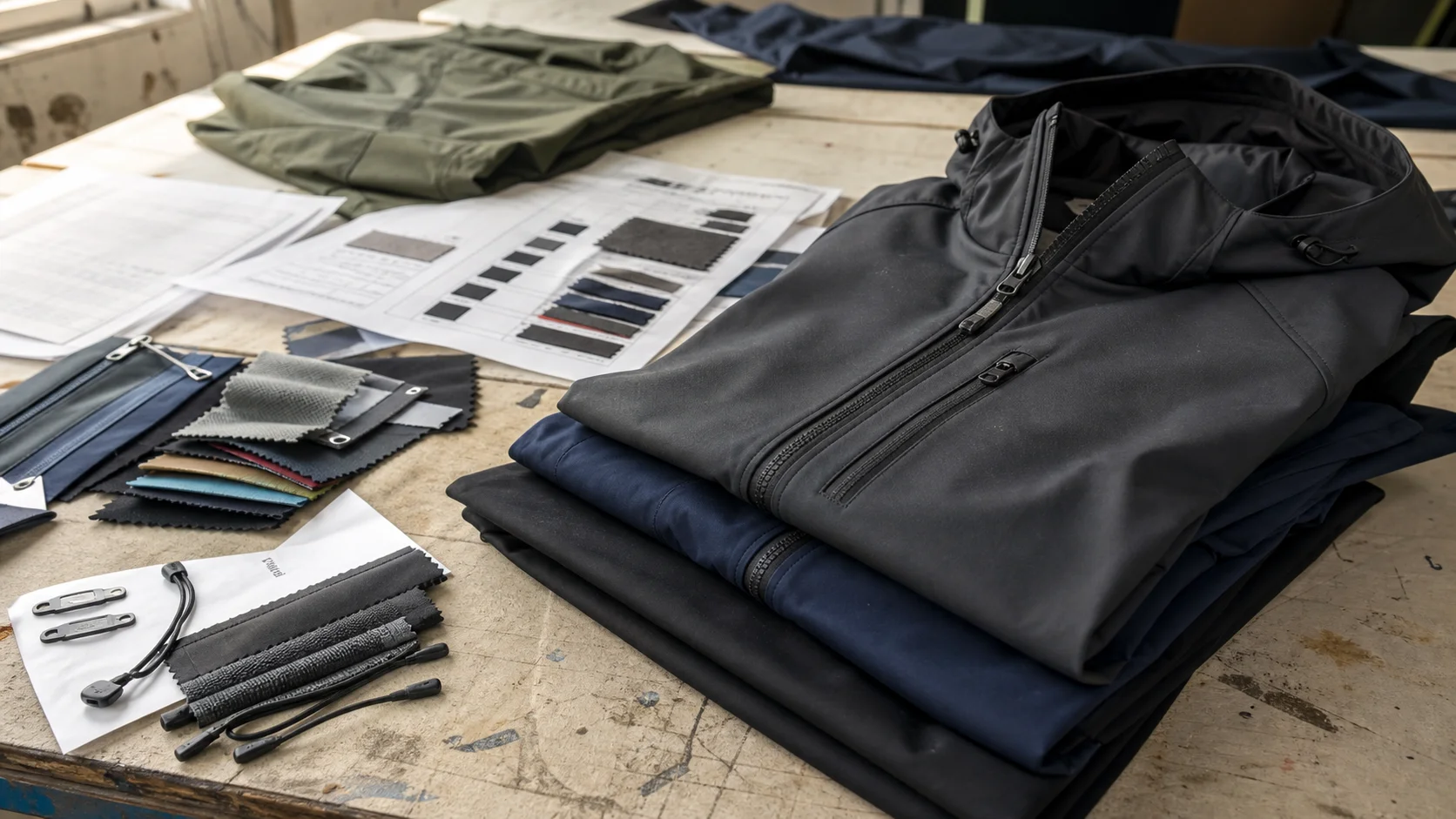
A practical landed cost outline for transport hub buyers sourcing wholesale softshell jackets, covering jacket specs, decoration, freight, duties,...
Buying softshell jackets for transport hubs is less about chasing the lowest ex-factory quote and more about controlling the full landed cost. For airport operations, rail terminals, bus depots, logistics parks, and multi-site transport networks, the final cost per jacket can move a lot between quote and warehouse receipt. Freight mode, carton density, labeling, sampling rework, duty treatment, and inspection fallout all affect the number that matters: the real cost delivered into your distribution point.
This guide breaks down wholesale softshell jacket landed cost for transport hub buyers in practical terms. It covers price drivers, typical MOQ ranges, sampling steps, lead-time dependencies, fabric and trim choices, inspection risks, and the tradeoffs that shape a sane sourcing decision. The aim is not to sell the cheapest jacket on paper. The aim is to avoid surprises when the shipment lands.
Softshell Jacket Landed Cost Guide for Hub Buyers - MOQ, Cost & Sourcing manufacturing guide
Landed cost is the total cost to get the jacket from the supplier’s production floor to the buyer’s receiving point, ready for internal issue or resale. For a transport hub buyer, that usually means more than FOB or ex-works pricing. It includes freight, insurance, customs clearance, import duty, brokerage, domestic delivery, and the hidden costs of delays or quality failures.
Softshell jackets are a useful but sensitive category. They are lighter than insulated outerwear, but they are not simple tee shirts. The fabric stack, bonding quality, zipper grade, and water-resistant finish can vary widely. That variability makes landed cost analysis essential. A jacket that looks inexpensive on a quote can become expensive if it needs a second sample round, a stronger zipper, or a higher-value freight class due to packaging volume.
For hub buyers, landed cost should be evaluated per approved, usable unit. A shipment with 4% defects is not really priced at the quote amount. A late shipment that forces emergency air freight also changes the number. The better model is total program cost divided by received, accepted units.
Softshell jacket landed cost usually has six layers. Each one deserves attention during sourcing, especially when orders are tied to seasonal deployment or uniform rollouts across multiple sites.
Cost Element What It Covers Common Risk Base garment price Fabric, labor, trims, factory margin Low quote may exclude details like chest embroidery, tape, hangtags, or premium zippers Sampling and development Proto sample, size set, color approval, pre-production sample Extra rounds increase time and cost Packaging and packing labor Polybag, size sticker, carton labeling, folding, master cartons Poor carton planning can raise freight cost International freight Ocean, air, rail, or express courier Mode choice can change unit cost materially Duty and taxes Import duty, VAT/GST where applicable, customs fees Incorrect HS classification creates underbudgeting or delays Inbound handling Port fees, brokerage, drayage, domestic transport, warehouse receiving Hub locations with tight receiving windows can incur additional handling chargesBase garment price is only one piece of the puzzle. A strong factory quote should state fabric composition, weight, membrane or lamination type, zipper brand or grade, seam construction, and decoration placement. Without that detail, comparison shopping becomes unreliable.
Softshell jackets are usually built from a woven face, a bonded mid-layer or membrane, and a fleece or brushed backing. Common constructions include 2-layer, 2.5-layer, and 3-layer builds. A 3-layer construction tends to cost more, but it usually improves weather resistance and shape retention. For buyers who need a cleaner profile and better durability, the extra cost often makes sense. For low-visibility warehouse or shuttle staff roles, a simpler construction may be acceptable if the climate is mild and the use cycle is short.
Fabric weight matters. A 280-320 gsm softshell may be enough for transitional weather. Heavier constructions improve warmth and hand feel, but they also raise cost and can affect carton density. Heavier fabric is not always the best buy. If the jacket is part of a layered uniform system, overbuilding the softshell can create heat stress and reduce wear compliance.
Zippers, toggles, cuff adjusters, storm flaps, reflective piping, and heat transfer logos all affect landed cost. YKK or similar branded zipper programs cost more than generic hardware, but they reduce the chance of early failure. For transport hub buyers, zipper failure is not a cosmetic issue. It turns into replacement labor, stock write-off, and complaints from field teams.
Trim consistency matters as much as trim price. A low-cost zipper with inconsistent tape color or poor smoothness can cause approval delays. A short delay can cost more than a slightly more expensive approved zipper. The same logic applies to reflective trims used for visibility in nighttime operations.
MOQ shapes landed cost more than many buyers expect. A factory may quote a competitive unit price at 3,000 pieces but apply a different cost structure at 300 or 500 pieces. Development amortization, fabric purchase minimums, dye lot constraints, and cutting efficiency all change with quantity.
Typical wholesale softshell jacket MOQ ranges often fall into these bands, though the exact number depends on the factory setup and customization level:
Lower MOQ can be useful for pilot programs, but the landed cost per unit usually rises. That is not automatically a bad deal if the goal is to test fit, comfort, and wash performance before scaling. The wrong decision is to treat a pilot quote as if it will hold at production scale. Transport hub buyers should separate pilot economics from program economics.
For multi-site buyers, a mixed-size run also affects cost. Breaks in size curve efficiency can trigger fabric waste or extra cutting time. A tall-person size range, extended women’s sizing, or high-volume 4XL and above may add cost and extend sourcing time. That should be budgeted early, not discovered after the purchase order is issued.
Cost control starts with a clear specification. A softshell jacket without a disciplined spec becomes a moving target. The more the buyer changes the material target mid-development, the more likely the landed cost climbs through re-sampling, line disruption, or material substitution.
A practical softshell spec for transport hub use should usually define:
Water-resistant does not mean waterproof. That distinction matters. A softshell used by ground crew, baggage handlers, or depot staff often needs weather protection, not full rainwear certification. If the buyer over-specifies waterproof performance, the factory may need a different membrane or seam strategy, which increases cost. If the buyer under-specifies weather protection, the jacket may fail in real-world use and trigger complaints or replacement spending. The right answer depends on the operating climate and job function.
Fit is another cost lever. A very tailored pattern can look better in a showroom, but it may not be ideal for layered workwear or rotational use across different body shapes. A slightly more forgiving fit often reduces size-exchange pressure and improves adoption. For transport hubs, wearability usually beats fashion.
Sample discipline is one of the best ways to protect landed cost. Each skipped approval step increases the chance of bulk rejection, rework, or rushed freight.
A cautious sample sequence usually looks like this:
Hub buyers should not treat sample approval as a formal checkpoint only. It is a cost control tool. A weak approval process often shows up later as mismatched zippers, incorrect hem construction, or embroidery that sits too close to a seam. Those errors are expensive because they are difficult to fix after production starts.
Documentation helps. The buyer should keep a written approval trail for fabric, trim, logo placement, carton marks, and size specs. When different sites participate in the purchase, a single approved reference is easier to enforce than verbal sign-off. If the buying process involves multiple stakeholders, a central point of control is worth the administrative effort. For structured sourcing support, review the services page or send a query through contact.
Lead time is not just production time. For softshell jackets, it usually includes development, fabric booking, trim procurement, cutting, sewing, packing, inspection, and transit. Buyers who only look at sewing days often underestimate delivery by several weeks.
Typical lead-time dependencies include:
For transport hubs, seasonality can be the real constraint. Fall and winter transitions drive volume, and the best factories fill early. If the jackets are needed for a uniform launch, a depot opening, or a regional operations rollout, the purchase order should move earlier than the internal wear date suggests. Lead time has to absorb both normal production and a buffer for any rework.
Ocean freight usually delivers the best unit economics for bulk quantities, but it introduces schedule risk. Air freight can rescue a late order, yet it can erase the margin advantage of the product quickly. A practical buyer plans the main shipment by sea and reserves air only for a limited shortfall, if at all.
Softshell jackets look straightforward until bulk inspection begins. The common failure points are predictable, and a smart buyer budgets for them in both time and cost.
Common inspection risks include:
For hub programs, size accuracy and packing accuracy are often more important than runway-level finish. A jacket that passes visual review but arrives in the wrong size curve creates operational friction. If a depot receives too many medium sizes and too few larger sizes, distribution labor increases and the program looks inefficient even if garment quality is acceptable.
Inspection should be viewed as a cost filter, not a paperwork step. The more standard the spec, the less likely the shipment will require partial rework, replacement units, or emergency rerouting.
A pre-shipment inspection is usually worth the cost for bulk orders. It helps catch carton count errors, trim inconsistencies, and visible workmanship problems before the freight leaves origin. That is especially important for time-sensitive hub supply programs, where a corrected shipment after arrival may be more expensive than the inspection itself.
Most landed cost decisions come down to tradeoffs. The cheapest option is rarely the cheapest delivered outcome. The right choice depends on role, climate, expected wear life, and replenishment policy.
A lower-cost softshell may be sufficient for occasional field use, visitor wear, or moderate climates. For daily operational wear, a slightly better fabric package usually pays back through fewer replacements. A jacket that lasts one extra season can lower the real annual cost more than a small unit-price discount.
Stock styles move faster and usually reduce sample time. Custom builds allow tighter brand alignment, but they raise development cost and can lengthen lead time. For transport hubs that need stable recurring supply, a semi-custom platform is often the practical middle ground. It gives enough flexibility for branding and size management without turning each reorder into a full development project.
Ocean freight generally wins on cost. Air freight only makes sense when the commercial impact of a shortage is greater than the freight premium. For hubs with safety, service, or public-facing requirements, a delayed uniform issue can create more disruption than a higher shipping bill. Even so, air should be treated as a contingency, not a standard sourcing assumption.
Multiple logos, reflective elements, and special packaging can improve presentation. They also increase handling time and error risk. If the jacket is for internal use, a clean, durable, single-logo program is usually easier to manage and less costly to land.
Suppliers that can support both development discipline and production scale are worth comparing carefully. Buyers who want to benchmark a broader sourcing approach can review the about page for company context and the services page for capability scope.
The numbers below are illustrative only. They show how the structure works, not a guaranteed market price.
Cost Item Example Per Unit Notes Ex-factory jacket price $18.50 Mid-range softshell with basic branding Sampling amortization $0.60 Spread across a modest production run Packaging $0.75 Polybag, size sticker, carton contribution Ocean freight and origin charges $2.10 Depends on carton density and route Duty and customs-related cost $3.20 Varies by HS classification and destination Domestic delivery and receiving $0.85 Final move to hub warehouse or DC Total landed cost $26.00 Illustrative delivered cost per accepted unitThis simple model leaves out hidden costs such as chargebacks, rework, or shortage replacement. If 3% of units are rejected and replaced, the real cost rises. If the shipment arrives late and requires split handling across multiple sites, the total handling cost rises again. Buyers should pressure-test landed cost with a quality-loss assumption rather than assuming every unit lands cleanly.
Before issuing a purchase order, the buyer should confirm the following:
A disciplined sourcing file is worth more than a polished sales quote. Good suppliers can explain what drives cost, where the risks are, and what changes if the buyer upgrades fabric or trims. For teams that want a structured procurement conversation, a direct inquiry through contact us is often the fastest way to compare requirements against capacity.
For transport hub buyers, the best softshell jacket is usually the one that balances durability, comfort, and repeatability at a controlled landed cost. A heavy premium build is not automatically better. A very cheap build is rarely cheaper after defects, delays, and replacements are counted. The strongest programs usually land in the middle: clear spec, manageable MOQ, realistic lead time, and a simple but durable trim package.
Programs that serve safety-sensitive or customer-facing roles should lean toward sturdier zippers, stable fabric quality, and a tighter inspection plan. Programs with high headcount and limited budget can accept simpler materials if the climate and duty cycle support it. The key is to match the jacket to the job, not to the brochure.
For repeat ordering, buyers should track actual landed cost by style and supplier over time. That gives a better basis for negotiation than quote comparisons alone. It also reveals whether a low ex-factory price is being erased by freight inefficiency, carton mispack, or quality loss. Over several cycles, that data usually points to the right sourcing model.
Get a free quote from Fabrikn — your trusted B2B clothing manufacturer with 10+ years of experience. MOQ as low as 200 pieces.
Get a Free Quote →For many custom programs, 300 to 1,000 pieces per style or color is a common working range. Lower MOQs are possible, but the unit price usually rises because fabric, trims, and development costs are spread over fewer units.
Freight and duty are the most common surprises, followed by rework from sample approval gaps. A quote that looks competitive ex-factory can become expensive once shipping mode, import charges, and replacement units are added.
That depends on the job and climate. Water-resistant softshells are usually enough for general outdoor movement and transitional weather. Waterproof requirements raise cost and can affect breathability, so they should be specified only when the use case justifies them.
Three to five rounds is common when the product is customized: proto, material approval, fit or size-set, pre-production, and sometimes a top-of-production reference. A simple stock-style order may need fewer rounds.
Check size accuracy, color consistency, zipper function, logo placement, seam finish, carton counts, and packing accuracy. For softshell jackets, fabric bonding and water-repellency consistency should also be reviewed if they are part of the specification.
Start with a detailed spec sheet and a realistic target landed cost. Then compare supplier capability, sample discipline, and delivery reliability. If a supplier can support both development and bulk production, the process is usually easier to control. Relevant starting points are the services page, the about us page, and contact us.
Softshell jacket sourcing for transport hubs works best when every cost driver is visible before production starts. Clear specs, disciplined sampling, realistic MOQ planning, and a careful landed cost model are what keep the order under control.