
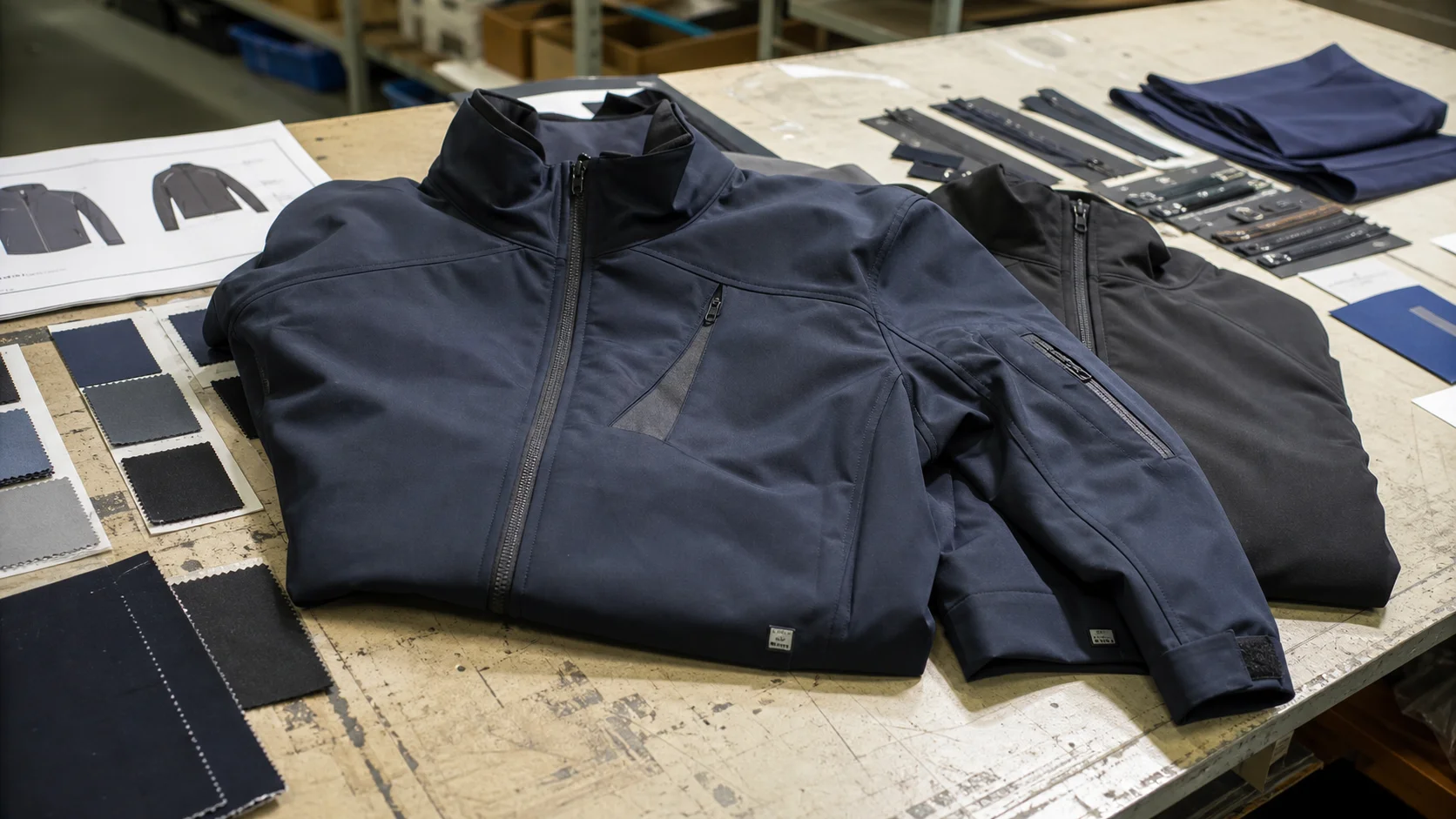
A practical SEO outline for airport uniform buyers reviewing wholesale softshell jacket MOQ, pricing drivers, decoration options, sizing, compliance, and...
Softshell Jacket MOQ Pricing for Airport Uniform Buyers - Outerwear & Jackets manufacturing guide
Airport uniform programs are not ordinary outerwear orders. A softshell jacket for airport teams has to look sharp at check-in counters, hold up during ramp work, allow staff to move without restriction, and stay consistent across departments, seasons, and reorders. That makes MOQ pricing more complicated than simply asking, “What is the lowest price per jacket?”
For procurement teams, uniform distributors, aviation service providers, and branded workwear buyers, the real question is: what order quantity gives the best balance between unit cost, quality control, size coverage, branding accuracy, and reorder flexibility?
This review explains how softshell jacket MOQ pricing usually works for airport uniform teams, what affects quotes, where buyers often lose money, and how to structure a purchase brief before approaching a manufacturer. The focus is wholesale, custom, and private-label production rather than retail stock buying.
Softshell jackets sit in a useful middle ground between a fleece layer and a heavy winter coat. For airport environments, that middle ground matters. Staff may move between terminals, jet bridges, baggage areas, shuttle points, loading zones, parking facilities, and open-air ramp areas during the same shift. A bulky insulated parka can be too warm indoors. A basic fleece may not block enough wind outside.
A well-specified softshell jacket gives moderate warmth, wind resistance, light rain protection, and a polished uniform appearance. It can be worn over shirts, polos, knitwear, or light midlayers without looking oversized if the pattern is built properly.
Airport buyers usually choose softshell jackets for these reasons:
The purchasing judgment is straightforward: softshell is a strong airport uniform choice when the climate is mild to cool, staff move between indoor and outdoor areas, and the buyer wants a smart jacket that can be reordered consistently. It is not the best single outerwear option for freezing ramp conditions unless paired with a thermal liner or separate winter coat.
MOQ stands for minimum order quantity. In wholesale softshell jacket production, MOQ is the smallest quantity a factory or supplier is willing to produce under a given specification, color, fabric, size range, and branding method.
MOQ is not always one fixed number. A supplier may quote different minimums depending on the level of customization:
Airport uniform teams should treat MOQ as a cost structure signal, not just a barrier. A very low MOQ can be useful for trials, new routes, seasonal staff, or small subcontracted teams. A higher MOQ may produce better unit pricing and more control over color, fabric, trims, and branding consistency.
For airport uniform procurement, the best MOQ is rarely the absolute lowest MOQ. It is the lowest quantity that still protects brand consistency, size availability, fabric reliability, and future reorder planning.
Buyers should also ask whether MOQ applies per style, per color, per gender fit, or per purchase order. A supplier may say the MOQ is 300 pieces, but that could mean 300 pieces per color and design. If the airport program needs navy for ground staff and charcoal for supervisors, the real minimum could become 600 pieces.
Softshell jacket pricing is shaped by more than fabric weight and order quantity. In airport uniform orders, the total cost is usually affected by at least ten variables.
Softshell fabric may be two-layer or three-layer bonded fabric. A common construction is polyester stretch outer fabric bonded to microfleece. Higher-performance versions may include a TPU or PU membrane between layers for improved water resistance and breathability. More technical construction increases cost and often increases MOQ because the fabric is less generic.
Typical softshell fabric weights range from around 260 gsm to 380 gsm. Lighter weights work for indoor-outdoor staff in moderate climates. Heavier weights are better for colder outdoor use but may feel bulky under harnesses, high-vis vests, or layered uniforms.
Buyers often see specifications such as 5,000 mm water resistance and 3,000 g/m²/24h breathability. These numbers should be treated carefully. A jacket with a membrane may test well in fabric form, but seam construction, zipper choice, and design details determine real garment performance. Most softshell jackets are water-resistant, not fully waterproof.
Mechanical stretch can be enough for many airport uniforms. Spandex or elastane improves comfort but can add cost and affect long-term recovery if the fabric quality is poor. Ground handling and baggage teams benefit from better stretch recovery because the jacket is repeatedly pulled during lifting and bending.
Zippers influence both price and field performance. A low-cost zipper can fail before the fabric wears out. For airport teams, front zipper durability is important because staff repeatedly open and close jackets when moving between indoor and outdoor zones.
Reflective piping, tape, prints, or transfer films increase cost. The buyer should define whether reflective details are decorative visibility accents or compliant safety elements. If a garment needs certified high-visibility performance, that is a different product category from a standard uniform softshell.
Embroidery is durable and premium-looking but can affect waterproofing if stitched through certain panels. Heat transfer logos are clean and can work well on softshell but require correct temperature, pressure, and adhesive compatibility. Woven patches, rubber badges, and silicone logos all create different cost and MOQ implications.
Unisex jackets simplify inventory but can fit poorly across large teams. Separate men’s and women’s fits improve wearer satisfaction but may double development work and complicate MOQ. Airport uniform teams with customer-facing staff often benefit from better fit segmentation, while ramp teams may prioritize layering room and mobility.
Individual polybags, size stickers, department labeling, barcode labels, carton assortments, and private-label packaging add cost. These details are worth specifying early if the jackets will be distributed across multiple terminals or service locations.
Colorfastness, dimensional stability, pilling resistance, seam strength, and restricted substance testing may be requested depending on buyer requirements. Testing adds cost and time, but it can reduce risk in long-running uniform programs.
MOQ and price vary by country of production, material availability, labor rates, customization level, and current freight conditions. The following ranges are typical planning references for wholesale softshell jacket buyers, not guaranteed quotes.
Order Type Typical MOQ Typical Use Case Pricing Notes Stock softshell jacket with logo 50–200 pieces Small airport teams, trial orders, subcontractors Higher unit cost, limited color and fabric control Existing style with custom branding 200–500 pieces Regional airport uniform programs Better price than stock, moderate customization Custom color using existing pattern 500–1,000 pieces per color Airline ground service teams, terminal staff Fabric dyeing or special sourcing may set MOQ Private-label custom softshell 800–2,000 pieces Large uniform programs, multi-site deployment Best control over fit, trims, labels, and repeat orders Technical softshell with membrane and special trims 1,000–3,000 pieces Outdoor ramp, cold-weather operations, premium workwear Higher fabric and trim MOQ, longer development cycleFor broad budgeting, basic wholesale softshell jackets may fall into a lower price band when using existing materials and standard trims. Mid-range custom softshell jackets with good fabric, reliable zippers, and one or two logo applications usually cost more but offer a better balance for airport uniforms. Technical or premium versions with membrane fabric, branded trims, multiple pockets, reflective details, and custom packaging will sit at the higher end.
The main purchasing risk is comparing quotes without matching specifications. A 320 gsm three-layer softshell with a durable zipper and tested logo application should not be compared directly with a lightweight stock jacket using lower-grade fabric. The cheaper quote may be acceptable for short-term promotional wear, but it may fail as a daily uniform garment.
A good airport softshell jacket brief should describe fabric and trims clearly enough for suppliers to quote the same product. Vague wording such as “good quality softshell” will produce inconsistent offers.
Airport buyers should not over-specify every detail if price control is the priority. A jacket with standard cuffs, standard zippers, and one embroidered logo can be efficient and reliable. On the other hand, cutting cost on zipper quality, pocket reinforcement, or logo durability can create visible problems after the uniform has been issued.
Different airport teams need different jacket specifications. Combining all staff into one jacket can reduce MOQ complexity, but it may create performance compromises.
Check-in staff, lounge teams, information desk staff, and supervisors usually need a clean silhouette and consistent brand color. Fabric should resist pilling and maintain a neat surface after repeated wear. A moderate-weight softshell is often enough because these staff spend significant time indoors.
For these teams, fit and logo placement matter. A bulky jacket can look untidy over shirts or blouses. Separate men’s and women’s fits may be worth the added MOQ complexity if appearance is a priority.
Ramp agents, baggage handlers, and ground handling teams need mobility, abrasion resistance, and more weather protection. The jacket should allow reaching, lifting, crouching, and turning without pulling excessively across the shoulders or back.
Reflective details may be useful, but buyers must separate decorative visibility from certified high-visibility requirements. If the softshell must be part of a safety uniform, the purchasing team should check applicable standards before requesting quotes.
Security and operations staff may need pockets for radios, ID cards, access devices, or small tools. These additions affect cost because they add cutting, sewing, reinforcement, and quality control points. Too many pockets can make the jacket look tactical rather than corporate, so the design should match the airport’s brand environment.
Short-term staff may not justify a fully custom jacket. A stock or semi-custom softshell with a logo can be more practical, especially if the size mix is uncertain. The tradeoff is reduced control over shade matching and long-term reorder consistency.
Sampling is where many softshell jacket orders are either protected or weakened. Airport uniform teams should not move to bulk production based only on a product photo, especially when branding, fit, or color consistency matters.
A common mistake is approving a fit sample made from substitute fabric, then being surprised when bulk fabric behaves differently. Softshell thickness, stretch, and bonding all affect fit. A jacket made from lighter sampling fabric may feel more comfortable than the final production garment.
For airport uniform buyers, a practical approval route is to test the sample with actual wearers from different roles. One person in procurement cannot fully judge sleeve mobility for baggage handling or desk appearance for front-of-house staff. Wear trials do not need to be complicated, but feedback should be specific: shoulder movement, zipper smoothness, pocket access, logo position, warmth, and appearance after sitting or bending.
Softshell jacket lead time depends on whether the order uses stock garments, available fabric, custom-dyed fabric, or fully developed private-label production. Buyers should plan lead times around approval milestones, not only the sewing schedule.
Stage Typical Time Range What Can Delay It Initial quote and specification review 2–7 days Incomplete tech pack, unclear MOQ split, missing logo files Fabric and trim sourcing 1–3 weeks Custom color, special zipper, reflective material, recycled fabric requirement Sample development 2–4 weeks Pattern changes, substitute fabric, logo approval delays Pre-production approval 1–2 weeks Fit corrections, color comments, trim changes Bulk production 4–8 weeks Fabric arrival, production capacity, quality issues, complex size ratio Inspection, packing, and shipping 1–5 weeks Failed inspection, carton relabeling, freight congestion, customs documentsFor stock jackets with logo decoration, delivery may be much faster if inventory is available. For custom airport uniform softshell jackets, a realistic planning window is often 10–16 weeks from clear specification to shipment, with longer timelines for complex materials or large multi-size programs.
Buyers ordering for autumn or winter rollout should avoid approving samples too late in the season. Softshell factories and fabric suppliers can become congested before cold-weather peaks. Freight costs may also shift, especially when delivery deadlines are tight.
Softshell jackets have several inspection risks that do not always show up in simple visual checks. Airport uniform programs should pay attention to durability, appearance, sizing, and branding placement.
Inspection should include measurements across key sizes, zipper function tests, logo placement checks, seam appearance, pocket construction, label accuracy, carton marking, and random visual review. If the jacket has water-resistance claims, buyers may request fabric or garment testing depending on the contract.
AQL inspection can be useful for larger orders, but airport buyers should define critical defects carefully. A logo placed visibly off-center on a customer-facing jacket may be more serious than a minor inside seam thread. For ramp teams, zipper failure or weak pocket stitching may be the bigger concern.
MOQ pricing decisions are mostly tradeoffs. A jacket can be cheaper because the fabric is lighter, the zipper is lower grade, the logo is simpler, the pattern is generic, or the order quantity is higher. Some savings are sensible. Others create long-term uniform problems.
The best value for airport uniform buyers is often a mid-spec jacket with reliable fabric, good fit, durable zippers, and controlled branding. Premium technical features are only worth paying for when the work environment needs them. Basic stock jackets are only a good buy when speed, low MOQ, or temporary use matters more than long-term consistency.
A clear RFQ makes pricing more accurate and reduces back-and-forth. Suppliers can quote faster when they know the expected quantity, construction, size range, branding, and delivery needs.
Buyers who are still developing their specification can start with a service discussion before requesting firm production pricing. Fabrikn’s services page outlines apparel manufacturing support areas that can help structure development, sourcing, and production planning for uniform and outerwear projects.
Supplier selection should be based on capability fit, not just the lowest opening quote. Airport uniform jackets require repeatability and operational reliability. A supplier that handles basic promotional jackets may not be the right match for multi-role airport teams with strict brand standards and reorder needs.
A strong supplier should be willing to discuss tradeoffs. If the buyer asks for a low MOQ, custom color, membrane fabric, multiple logo applications, and low unit pricing at the same time, the supplier should explain which parts conflict. Practical sourcing depends on these conversations.
For buyers assessing manufacturing partners, the company background and production approach also matter. Fabrikn provides more context on its business through the about us page. Buyers preparing a softshell jacket RFQ can also use the contact page to start a specification-based discussion.
Airport uniform buyers can improve pricing by grouping demand intelligently. Instead of ordering small quantities for each department separately, review total jacket needs across ground handling, passenger service, supervisors, contractors, and seasonal teams. A combined order may unlock better pricing, even if the jackets use department-specific branding.
The main caution is color and style fragmentation. Every additional color, gender fit, department badge, reflective layout, or pocket configuration can increase complexity. Complexity raises sampling time, inspection burden, and the risk of distribution errors.
A practical strategy is to define a core jacket platform first:
This platform approach keeps MOQ more manageable while still allowing uniform hierarchy. Supervisors may receive an additional sleeve mark. Ramp teams may receive reflective accents. Customer-facing teams may keep a cleaner version. The shared base jacket helps control cost and supports future reorders.
Reorder planning is often overlooked during first purchase negotiations. Softshell jackets are not single-use items, and airport teams change constantly. Staff turnover, new contracts, route expansion, weather changes, and damage replacement all create demand after the first delivery.
Buyers should ask suppliers whether future reorders can be produced below the initial MOQ. Some suppliers may accept lower replenishment quantities if fabric and trims remain available. Others may require a new MOQ if the material is no longer in stock or if the color must be dyed again.
Size ratios need equal attention. A standard S–3XL size curve may not match the actual team. Airport uniform programs often need extended sizes, and excluding them creates operational problems. Extended sizes may carry surcharges or require separate patterns. This should be discussed at the quote stage, not after bulk production begins.
For first orders, buyers may use staff measurement data, historical uniform issue records, or a size set trial. A size set costs money, but it can reduce exchanges and improve satisfaction. For large teams, that cost is usually easier to justify than reworking a poorly chosen size ratio.
Stock softshell jackets are useful when speed and low MOQ matter. The buyer chooses an available style, adds embroidery or heat transfer branding, and accepts the supplier’s existing fabric, fit, and color range. This is often suitable for small teams, pilot programs, or temporary contracts.
Private-label softshell jackets are better when the airport uniform program needs brand-specific color, controlled trims, consistent sizing, special labels, and planned reorders. The unit cost may be better at higher quantities, but the development process is longer and the initial MOQ is usually higher.
Option Best For Main Advantage Main Limitation Stock jacket with logo Small teams, fast rollout, temporary staff Low MOQ and short lead time Limited control over fit, color, and future availability Semi-custom jacket Medium airport uniform programs Reasonable customization without full development cost Some dependence on existing pattern and materials Private-label jacket Large teams and long-term programs Best brand control and repeatability Higher MOQ, longer sampling, more approvalsThe buying decision should follow the uniform program’s expected life. If the jacket will be used for one season, stock may be the sensible route. If it will represent the airport or service provider for several years, private-label development is usually easier to defend.
For airport uniform teams, softshell jacket MOQ pricing should be evaluated through total program cost, not only unit price. A low-cost jacket that pills, fits poorly, or cannot be reordered in the same shade can become expensive after complaints, replacements, and inconsistent staff presentation.
The most dependable sourcing path is to set a clear specification, approve fabric and trims before sampling, test fit across real roles, lock branding methods early, and inspect bulk production against written standards. MOQ should be negotiated with reorder needs in mind.
Airport buyers with smaller teams may start with stock or semi-custom softshell jackets to reduce risk. Larger uniform programs should consider a custom or private-label platform that balances cost control with long-term consistency. In both cases, the jacket should be built around the working environment: terminal polish, ramp mobility, weather exposure, safety visibility, and distribution practicality.
Get a free quote from Fabrikn — your trusted B2B clothing manufacturer with 10+ years of experience. MOQ as low as 200 pieces.
Get a Free Quote →Typical MOQ can range from 50–200 pieces for stock jackets with logo decoration, 200–500 pieces for existing styles with custom branding, and 800–2,000 pieces or more for private-label softshell jackets. Custom color, special fabric, or separate men’s and women’s fits can raise the MOQ.
Most softshell jackets are water-resistant rather than fully waterproof. They can handle light rain and wind if the fabric and finish are suitable. For sustained rain, buyers should consider waterproof seam-sealed outerwear instead of relying on a standard softshell.
Many airport uniform softshell jackets fall around 280–340 gsm. Lighter fabric may suit terminal staff and mild climates. Heavier fabric or membrane softshell may be better for outdoor teams, but it can reduce comfort indoors if staff move between environments often.
Embroidery is durable and has a premium uniform look, but it can create needle holes and slight puckering on some softshell fabrics. Heat transfer gives a clean finish and works well for detailed logos, but it must be tested for adhesion and wash durability. The best method depends on the fabric, logo design, and use conditions.
A custom softshell jacket program often needs 10–16 weeks from clear specification to shipment. Stock jackets with logo decoration can be faster if inventory is available. Custom fabric, special trims, sample revisions, testing, and freight method can extend the timeline.
Unisex fits simplify MOQ and inventory management, which can reduce cost. Separate fits usually improve appearance and wearer satisfaction, especially for customer-facing roles. Large airport uniform programs may justify both fits, while smaller teams may prefer a well-graded unisex pattern.
Inspection should cover measurements, zipper function, seam quality, logo placement, color consistency, pocket construction, label accuracy, packing ratio, and overall appearance. For performance claims, buyers may also request fabric testing for water resistance, pilling, colorfastness, or dimensional stability.
Yes, if departments use the same base jacket, fabric, and color. MOQ efficiency improves when only the logo or identifier changes. Separate colors, patterns, trims, and reflective layouts may create separate minimums and reduce the pricing benefit.