
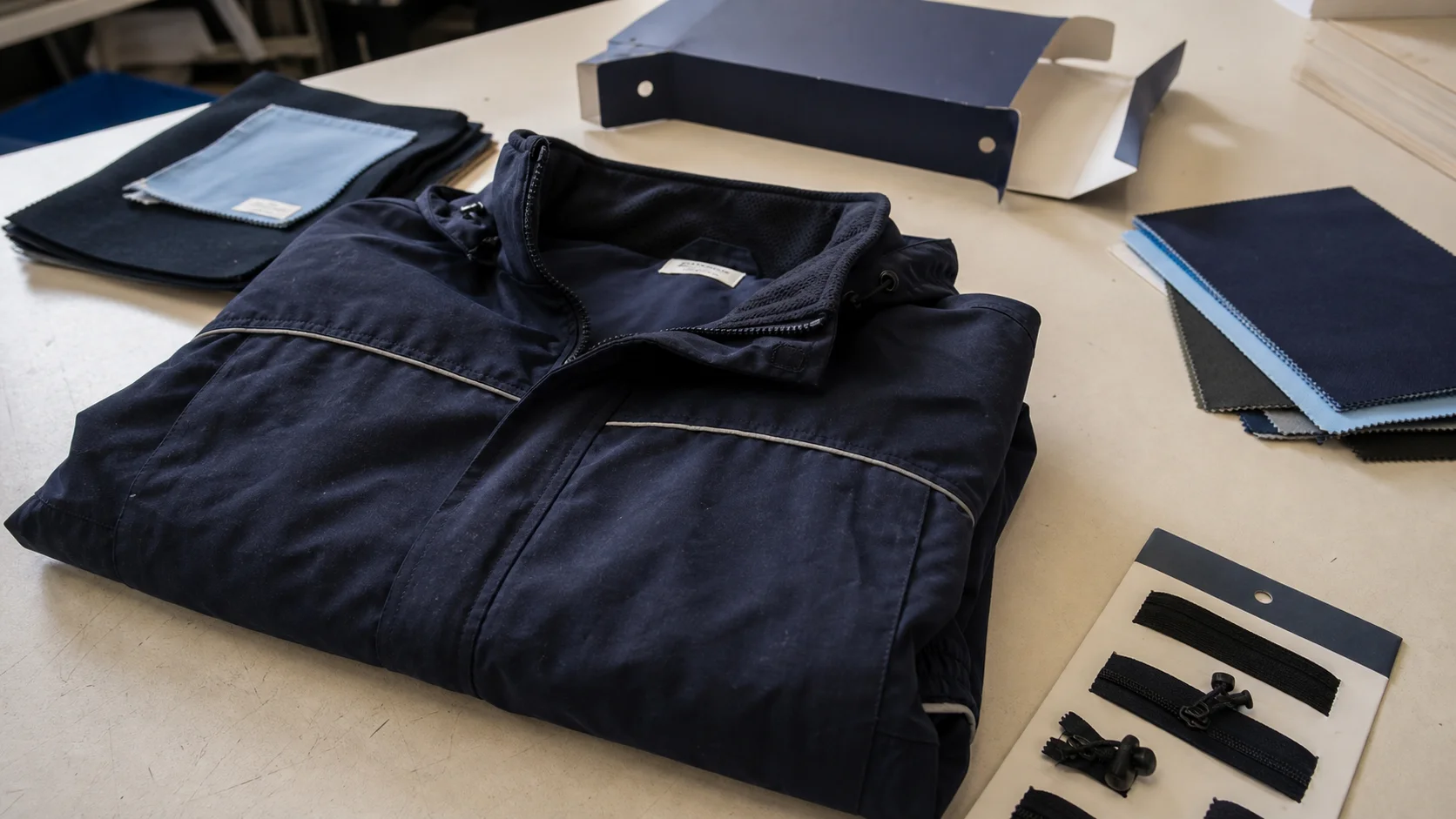
A product-specific outline for outdoor school buyers evaluating wholesale storm jacket reorder risks, including fabric continuity, waterproof specs,...
Storm Jacket Reorder Risk Review for School Buyers - Outerwear & Jackets manufacturing guide
Wholesale storm jacket reorder risk review for outdoor school buyers is not just a price check. It is a practical sourcing exercise that protects uniform continuity, student safety, budget timing, and parent satisfaction across multiple school terms. Storm jackets are exposed to rougher use than standard school fleeces or lightweight windbreakers, so reorder mistakes show up quickly: leaking seams, broken zippers, inconsistent navy shades, missing sizes, and late replenishment during wet-season demand.
For schools, outdoor education providers, sports programs, and uniform resellers, the key question is simple: can the same jacket be reordered reliably next term, next year, and across different student intakes? A low first-order price can be attractive, but the reorder risk may be high if the fabric is not locked, trims are not specified, the supplier cannot reserve dye lots, or the factory treats the jacket as a one-off seasonal style.
This guide reviews the main risks school buyers should check before placing or repeating a wholesale storm jacket order. It covers MOQ expectations, fabric and trim specifications, sample approval, lead-time dependencies, inspection points, and purchasing tradeoffs. The aim is to help buyers avoid shortfalls, mismatched garments, and expensive emergency orders.
School outerwear programs run on consistency. Parents expect the approved jacket to match the uniform policy. Schools expect students to receive the correct size before camps, excursions, sports travel, or wet-weather terms. Resellers expect to hold sensible stock without being trapped by obsolete colors or discontinued components.
Storm jackets create higher reorder risk than polos, sweatshirts, or basic track pants because they rely on more technical inputs. A typical jacket may include coated or laminated shell fabric, mesh or taffeta lining, seam tape, waterproof zippers or storm flaps, elastic cuffs, drawcords, press studs, reflective trims, woven labels, embroidery, heat-transfer logos, and branded packaging. If any one of these inputs changes between orders, the reordered jacket may not match the original.
The risk is worse when school buyers approve a style from a showroom sample but do not receive a full technical file. Without a confirmed fabric code, waterproof rating, lining specification, zipper type, color standard, seam tape width, and logo placement guide, the next batch is open to interpretation. That interpretation may be made by a salesperson, merchandiser, fabric mill, or production line supervisor who was not involved in the first order.
For school jackets, reorder reliability is usually worth more than a small unit-price saving. The cheapest first order can become expensive if the second order arrives in a different shade, with weaker waterproofing, or after the school camp date.
Outdoor school buyers do not all purchase storm jackets for the same purpose. A sourcing review should start with the actual use case, because the right specification for a daily school rain jacket may be different from the right specification for outdoor education camps.
Daily uniform jackets need strong color consistency, broad size coverage, and stable year-round replenishment. They are often worn over school shirts, polos, hoodies, or jumpers. Comfort matters, but policy compliance matters too. Navy, black, bottle green, maroon, and charcoal shades often need to match existing uniform ranges.
Outdoor education jackets need higher performance. The buyer may need improved waterproof ratings, taped seams, secure pockets, adjustable hoods, and stronger abrasion resistance. Reorder quantities may be seasonal, with heavy demand before camp periods. The risk is late delivery or under-specified fabric that fails in rain.
Sports storm jackets often require a cleaner athletic fit, team colors, reflective trims, and embroidery or heat-transfer logos. Reorders are difficult when team rosters change close to travel dates. Size flexibility and fast top-up production are important.
Uniform shops need predictable repeat supply. They may carry stock across several schools, each with different logos and colors. Their main risk is inventory imbalance: too many slow sizes, not enough core sizes, and supplier delays during back-to-school peaks.
Buyers managing multiple outerwear styles may benefit from a broader manufacturing review through Fabrikn's apparel manufacturing services, especially when storm jackets sit alongside fleece jackets, softshells, puffer jackets, and sports outerwear.
Reorder risk usually comes from gaps in specification, production planning, and quality control. These gaps may not be obvious on the first order because the buyer is focused on getting the initial delivery approved. They become clear when a school asks for another 300 jackets six months later and the supplier cannot reproduce the same item.
Risk Area What Can Go Wrong Buyer Control Point Fabric Different shell weight, coating, handle, shade, or waterproof rating Lock fabric code, GSM, construction, finish, and color standard Trims Changed zipper puller, weak snap buttons, different drawcord, missing reflective tape Approve trim card with supplier codes and backup options Fit Second batch measures smaller or larger than approved sample Use graded size specs and tolerance tables Logo Embroidery shade, scale, or placement changes between orders Keep artwork file, thread codes, and placement measurements Lead Time Reorder misses school term, camp, or retail selling window Plan fabric booking and production slots early Inspection Water leakage, seam tape lifting, zipper failure, dirty packing, mixed sizes Inspect inline and pre-shipment using jacket-specific checkpointsA reorder should not be treated as a casual repeat email. It should be checked against the last approved production standard. If the supplier says “same as before,” the buyer should still confirm whether the same fabric mill, coating, zipper, thread, tape, label, and packing method are available.
The shell fabric is the largest driver of storm jacket performance and visual consistency. For school buyers, the fabric specification should be clear enough that another production team could reproduce it without guessing.
Common school storm jacket shells include polyester pongee, polyester oxford, taslon, ripstop polyester, nylon taslan, and polyester mechanical stretch. Each fabric has a different look, hand feel, noise level, abrasion resistance, and cost. A smoother pongee may look cleaner for uniforms, while oxford or taslon may suit outdoor programs that need tougher wear.
Typical shell weights may range from about 90 GSM to 180 GSM depending on fabric construction and coating. Lightweight shells can reduce cost and improve packability, but they may feel flimsy for school use. Heavier shells can improve durability, though they may reduce breathability and increase bulk.
Storm jackets often use PU coating, TPU lamination, or other waterproof barriers. PU-coated polyester is common in school and promotional outerwear because it balances cost and water resistance. Laminated fabrics usually cost more but can improve performance and hand feel when properly specified.
The buyer should confirm whether the coating is white, clear, milky, or printed, and whether it changes the inside appearance of the shell. If the jacket is unlined in some areas, coating appearance can affect perceived quality.
School jackets commonly use mesh lining in the body and taffeta lining in the sleeves. Mesh can improve comfort and airflow. Taffeta in sleeves makes the jacket easier to pull over shirts or fleece layers. Full taffeta lining may feel smoother, but it can trap more heat and may not suit active outdoor use.
Color drift is a common reorder problem. “Navy” is not a specification. The buyer should use a Pantone TCX reference, fabric lab dip approval, or physical approved cutting from the first production batch. For school uniform jackets, keep an approved shade standard in storage and require the supplier to match it before bulk fabric dyeing.
Storm jackets for schools are often sold with performance claims, but buyers should be careful with vague language. “Water-resistant,” “waterproof,” and “stormproof” are not equal. A jacket can resist light rain without being suitable for heavy outdoor use.
For many school uniform rain jackets, a waterproof rating around 3,000 mm to 5,000 mm may be considered a practical entry-to-mid level range, depending on local climate and price point. Outdoor education programs may request 8,000 mm to 10,000 mm or higher. Higher ratings usually increase fabric cost and may require better seam sealing and improved quality control.
Breathability is also important. A jacket that keeps rain out but traps sweat may be uncomfortable for students walking, hiking, or playing sport. Common breathability claims may range from about 3,000 g/m²/24h to 8,000 g/m²/24h for school and active outerwear, though test methods and real-world performance vary. Buyers should ask which test method is used and avoid comparing numbers from different standards without context.
A coated fabric does not make a fully waterproof jacket by itself. Needle holes at seams can allow leakage. Taped seams are usually required when the garment is marketed as waterproof. Critical seam sealing may cover shoulder seams, hood seams, and upper body seams. Fully taped seams cover all major seams and cost more.
For school buyers, the tradeoff is budget versus complaint risk. If the jacket is mainly for light rain between classrooms, critical seam sealing may be enough. If the jacket is for outdoor camps, fully taped seams are safer. The decision should be stated clearly in the purchase order.
Buyers can request fabric test reports for water pressure, colorfastness, tear strength, and seam slippage. Finished garment rain testing is also useful, especially for reorders where supplier changes may occur. Not every school budget supports full laboratory testing on every reorder, but at minimum the buyer should require consistent fabric documentation and practical water leakage checks during inspection.
Performance Level Typical Use Common Specification Direction Light Rain Protection Daily commute, playground, basic uniform outerwear Water-resistant shell, basic coating, limited seam protection School Storm Jacket Wet terms, excursions, general outdoor school use Waterproof coated shell, critical taped seams, secure hood Outdoor Education Jacket Camps, hiking, field programs, extended rain exposure Higher waterproof rating, full seam taping, stronger trimsTrims are often the hidden reason a reorder looks different. A zipper puller changes shape. A drawcord becomes thinner. A snap button is replaced by a cheaper version. Reflective tape shifts from silver to grey. These changes may seem minor to a factory, but they are visible to schools and parents.
Main front zippers should be specified by type, size, color, brand or supplier code where relevant, slider style, puller shape, and whether the zipper is waterproof, reverse coil, molded plastic, or standard coil. For school jackets, a robust reverse coil zipper with storm flap can be more cost-effective than a fully waterproof zipper. Waterproof zippers look technical but may be stiffer and more expensive.
A storm flap can reduce water entry at the front zipper. It may use hook-and-loop tape, snap buttons, or a clean concealed design. Hook-and-loop is practical but can collect lint and damage some fabrics during washing. Snap buttons look tidy, but poor-quality snaps can loosen or crack. The buyer should approve snap strength and placement.
Elastic cuffs are cheaper and simple for younger students. Adjustable hook-and-loop cuffs provide better fit but add trim cost and potential failure points. Hoods may be fixed, detachable, or packable. Detachable hoods need secure snaps or zippers and create a lost-part risk. Packable hoods can be useful, but the collar may become bulky.
Reflective piping, heat-transfer prints, or tape can improve visibility, especially for younger students walking to school. Buyers should confirm reflectivity requirements, wash durability, and placement. Reflective trims can peel, crack, or lose brightness if low-quality material is used.
Minimum order quantity is one of the most important reorder risk points. School buyers often need uneven size curves, especially across youth and adult sizes. Factories, fabric mills, and trim suppliers may prefer larger, cleaner production runs. The result is tension between what the school needs and what the supply chain can produce economically.
Typical wholesale storm jacket MOQs vary widely. For custom color and custom logo production, a practical MOQ may range from 300 to 1,000 pieces per style and color. Some suppliers may accept 100 to 300 pieces for repeat orders if fabric and trims are in stock. More technical jackets, custom-dyed fabric, laminated shells, or special trims may require 800 to 1,500 pieces or more. If the buyer needs multiple colors, each color may have its own MOQ.
Stock-supported programs can reduce MOQ pressure. If the jacket uses a standard fabric color and standard trims, the supplier may be able to decorate or relabel smaller quantities. The tradeoff is less control over exact shade, fabric performance, and long-term continuity.
School jacket size curves can be difficult. A primary school may need youth sizes 4 to 14, while a secondary school may need youth 12 through adult 3XL. Outdoor programs may require layering allowance, so students size up. If the buyer uses a generic size ratio, shortages can appear in middle sizes or larger adult sizes.
A sensible reorder review should compare actual sales, returns, exchanges, and size complaints from the last order. Guessing from enrollment numbers is not enough. If adult sizes sold faster than expected, increase them in the next ratio. If the smallest youth sizes were slow, do not repeat the same curve just because it was convenient for the factory.
Order Type Typical MOQ Direction Reorder Risk Blank stock jacket with school logo Lower, often 50 to 300 pieces depending on supplier stock Lower MOQ, but higher risk of stock discontinuation Custom school color and logo Often 300 to 1,000 pieces per style/color Better consistency if specs are locked, but longer lead time Technical outdoor education jacket Often 800 to 1,500 pieces or more depending on materials Higher performance, but higher fabric and trim dependencyBuyers should negotiate reorder rules before the first order. The purchase agreement should state whether small top-up quantities are possible, which sizes can be reordered, and whether fabric will be held or re-dyed. If a supplier only supports full MOQ reorders, the buyer needs a stronger stock plan.
A reorder should start with the approved standard, not with a new interpretation of the style. The sample process can be shorter than first development, but it should not be skipped.
The buyer should gather the approved pre-production sample, size specification, fabric swatches, trim card, artwork approval, packaging details, and inspection report from the previous order. If these documents are missing, the reorder risk is already elevated.
The supplier should confirm whether the original shell fabric, lining, seam tape, zippers, and trims are still available. If any item has changed, the buyer should request a replacement swatch or component sample before bulk production.
If fabric is re-dyed, approve lab dips against the original standard. If the supplier uses stock fabric, request a cutting from current stock. Shade approval should happen under controlled lighting where possible, not only from phone photos.
A reorder sample should be made using current production materials. It should be checked for fit, measurements, trims, logo, seam sealing, lining, and packing. For repeat school jackets, buyers sometimes approve a photo sample for speed, but that is risky if materials have changed.
If the supplier changes factory, pattern, fabric, or lining, request a size set. Storm jackets can feel smaller when lining, seam tape, or shell stiffness changes. A size set helps catch grading problems before bulk cutting.
Once approved, the supplier should seal the sample and use it as the factory standard. The buyer should keep one approved sample and the supplier should keep one approved sample. This reduces arguments if the production batch does not match.
Skipping reorder samples saves a little time at the front end, but it removes one of the strongest controls against shade, trim, and fit changes.
Storm jacket lead times depend on more than sewing capacity. Fabric booking, dyeing, coating, lamination, seam tape availability, logo application, inspection, and shipping can all affect delivery. School buyers should work backward from the required in-store date or student issue date, not from the factory's best-case production promise.
For custom wholesale storm jackets, a cautious total timeline may range from 8 to 16 weeks after final approval, depending on material availability, order quantity, factory schedule, decoration complexity, and shipping method. Stock-based decorated jackets may be faster, sometimes 2 to 6 weeks, but only if the right sizes and colors are available. Sea freight adds time but controls cost. Air freight can rescue deadlines, but it can destroy margin on bulky outerwear.
Back-to-school periods, winter ordering peaks, and outdoor camp seasons are predictable. The buying calendar should reflect that. If the school needs jackets in March, the reorder review should not begin in February unless stock garments are already available. A stronger approach is to review sell-through and size gaps at the end of each term, then book replenishment before the supplier's peak period.
Buyers who need help aligning product development, sourcing, and production timing can use the enquiry route on Fabrikn's contact page to discuss outerwear program requirements and realistic lead-time planning.
Storm jacket inspection must go beyond counting cartons and checking labels. A jacket can look acceptable on a hanger and still fail in use. School buyers should require inspection points that reflect rainwear construction and student wear conditions.
Inspectors should check key measurements across sizes: chest, body length, sleeve length, shoulder, hood opening, cuff, hem, and zipper length. Tolerances should be agreed in advance. For outerwear, small deviations can affect layering comfort, especially over school jumpers or sports uniforms.
Seam tape should be centered, bonded smoothly, and free from lifting, wrinkles, burns, or skipped sections. Corners and curved hood seams need close attention. Poor seam tape application is a common leakage risk. A practical water spray or leakage check can be useful, but it does not replace proper fabric and seam testing when higher performance is claimed.
Main zippers should run smoothly without catching lining or storm flaps. Pocket zippers should open and close cleanly. Snaps should be secure but not so tight that students tear the fabric when opening them. Hook-and-loop pieces should align properly.
Embroidery can create needle holes, puckering, or seam distortion if applied poorly. Heat transfers can peel if pressure, temperature, or dwell time is wrong. Logo placement should match the approved sample, especially for school crest positioning. Incorrect logos are a high-sensitivity defect because they are visible and difficult to repair.
Outerwear cartons are bulky. Mixed sizes, incorrect carton marks, and poor folding can slow school distribution. Each polybag should show size and style information clearly. Cartons should be strong enough for freight and storage. If the school or reseller distributes by campus, house, or team, packing instructions should be stated before production.
Inspection Point Common Defect Risk to Buyer Shell fabric Shade variation, stains, coating marks, fabric pulls Uniform mismatch and parent complaints Seam tape Lifting, wrinkles, missing tape, poor bonding Water leakage and product returns Zippers Rough slider, broken teeth, lining caught in zipper Functional failure during school use Logo Wrong thread color, crooked placement, peeling transfer Brand rejection or rework cost Measurements Short sleeves, tight chest, inconsistent grading Size exchanges and stock imbalance Packing Mixed sizes, weak cartons, unclear labels Distribution delays and admin workloadSchool buyers often face pressure to keep jacket prices accessible for families. That is reasonable. The mistake is cutting cost in areas that create higher reorder or complaint risk.
Some cost reductions are sensible. A standard stock navy fabric may be better than a custom-dyed shade if the school does not need exact color matching. A storm flap over a durable reverse coil zipper may be better value than a premium waterproof zipper. Critical seam taping may be enough for a daily commute jacket.
Other cuts are risky. Weak zippers, poor seam tape, thin shell fabric, unstable coating, and vague logo approvals can lead to returns and reputational damage. A school storm jacket is not a disposable promotional item. It is often worn for one or more years, passed between siblings, or resold second-hand. Durability matters.
The strongest purchasing decision is not always the most technical jacket. It is the jacket that matches the school's real use, can be reproduced, fits the size curve, arrives on time, and stays within an acceptable family price point.
A good supplier should be able to answer detailed reorder questions without treating them as unusual. If the supplier cannot confirm material continuity, MOQ, timing, and inspection controls, the buyer should treat the reorder as higher risk.
Buyers should keep the answers in writing. A clear email trail and updated purchase order reduce disputes. If the supplier's quote is lower because materials have changed, the buyer should review the change before accepting the saving.
For outdoor school buyers, the safest wholesale storm jacket reorder strategy is to build a repeatable program rather than chase a one-off low price. That means locking the technical specification, holding approval samples, tracking size demand, and placing reorders early enough to avoid emergency freight.
If the jacket is for daily uniform use, prioritize color continuity, fit comfort, robust trims, and manageable MOQ. If the jacket is for outdoor education, prioritize waterproofing, seam sealing, hood function, and inspection discipline. If the jacket is for a reseller, prioritize replenishment rules, carton-level size accuracy, and predictable supplier communication.
A practical reorder plan should include these controls:
The main tradeoff is flexibility versus control. Stock jackets give lower MOQ and faster replenishment but may be discontinued or inconsistent. Fully custom jackets give better control and school identity but require stronger forecasting, larger MOQs, and longer lead times. For most schools with stable enrollment and repeated annual demand, a controlled custom or semi-custom program is usually the better long-term purchasing route.
Buyers comparing suppliers should also assess whether the manufacturer understands school apparel, not just generic outerwear. Uniform programs need documentation, repeatability, and careful communication. To understand more about the type of apparel sourcing partner behind a program, review Fabrikn's company background and compare that against the level of production support your school or resale operation needs.
Get a free quote from Fabrikn — your trusted B2B clothing manufacturer with 10+ years of experience. MOQ as low as 200 pieces.
Get a Free Quote →For custom school storm jackets, a typical MOQ may range from 300 to 1,000 pieces per style and color. More technical jackets or custom-dyed fabrics may require 800 to 1,500 pieces or more. Stock jackets with logo decoration may allow lower quantities, sometimes 50 to 300 pieces, depending on supplier inventory.
For custom production, buyers should allow roughly 8 to 16 weeks after final approval, depending on fabric, trims, decoration, factory capacity, inspection, and shipping. Stock-decorated jackets may be faster, but availability must be confirmed. Reorders for back-to-school or camp periods should be reviewed well before peak demand.
Many daily school rain jackets use practical waterproof ratings around 3,000 mm to 5,000 mm, while outdoor education jackets may need 8,000 mm to 10,000 mm or higher. The right rating depends on climate, use, budget, and whether seams are properly taped. Buyers should confirm test methods before relying on performance claims.
Fully taped seams are safer for outdoor education, camps, and extended rain exposure. Critical taped seams may be acceptable for daily school outerwear where rain exposure is lighter. If the jacket is marketed as waterproof, buyers should specify seam sealing clearly and inspect tape bonding before shipment.
The most common problems are fabric shade changes, discontinued trims, altered zipper quality, inconsistent sizing, late production, and weak seam sealing. These risks increase when the original order does not have a complete specification pack and approved physical samples.
Stock jackets are useful for lower MOQ, faster delivery, and budget control. Custom jackets are better for school color matching, logo integration, performance control, and long-term program consistency. Schools with repeat annual demand usually benefit from a documented custom or semi-custom program if forecasting is reliable.
Inspection should cover measurements, shell fabric shade, coating defects, seam tape bonding, zipper function, snap strength, hood construction, logo placement, heat-transfer adhesion, embroidery quality, carton packing, and size labeling. For waterproof products, leakage risk should be checked carefully rather than relying only on appearance.
Buyers can reduce emergency costs by tracking size sales, placing reorders before peak season, confirming material availability early, holding buffer stock in core sizes, and agreeing top-up rules with the supplier. Air freight should be treated as a last resort because storm jackets are bulky and freight costs can quickly erode margin.