
A 2500-word SEO outline for construction safety buyers auditing wholesale sublimated teamwear panels, with compliance checkpoints for artwork, fabric...
Sublimated Teamwear Panel Checklist for Buyers - Decoration & Printing manufacturing guide
Buying wholesale sublimated teamwear for construction safety teams is not the same as ordering standard sports uniforms. The garment has to carry brand identity, department color coding, worker names, sponsor marks, emergency response references, and sometimes reflective or high-visibility components. It also has to survive jobsite abrasion, repeated washing, sweat, dust, UV exposure, and inconsistent wearer care.
This checklist is written for procurement teams, safety managers, uniform distributors, and branded apparel buyers who need a practical way to review sublimated panels before bulk production. The goal is simple: reduce compliance risk before the fabric is printed, cut, sewn, packed, and shipped.
Direct purchasing judgment: sublimation is a strong decoration method for teamwear because the print does not sit on top of the fabric. The tradeoff is that mistakes are locked into the fabric once printed. Panel checking before production is where most avoidable cost is controlled.
Sublimated teamwear is often used for crews, site supervisors, plant maintenance teams, event build teams, logistics crews, and contractor groups. In construction environments, the apparel is not just promotional clothing. It can help identify role, company, trade, zone, shift, or emergency response function.
That means each printed panel carries more responsibility than it would on a casual jersey. A misplaced logo may be a branding issue. A misplaced high-visibility color block, unreadable name panel, or non-compliant reflective layout can become a site identification problem.
Buyers should separate two ideas. Sublimation can produce vivid, durable decoration. It does not automatically make a garment safety compliant. If the garment must meet a recognized high-visibility or protective clothing standard, that requirement needs to be specified, tested, and supported by appropriate documentation. A bright printed shirt is not automatically a certified safety garment.
For construction safety teams, panel compliance usually includes four layers:
The biggest mistake is treating sublimated teamwear as a graphic design job only. It is a cut-and-sew production job where artwork, fabric, pattern, panel grain, size grading, sewing tolerance, and quality inspection all affect the final result.
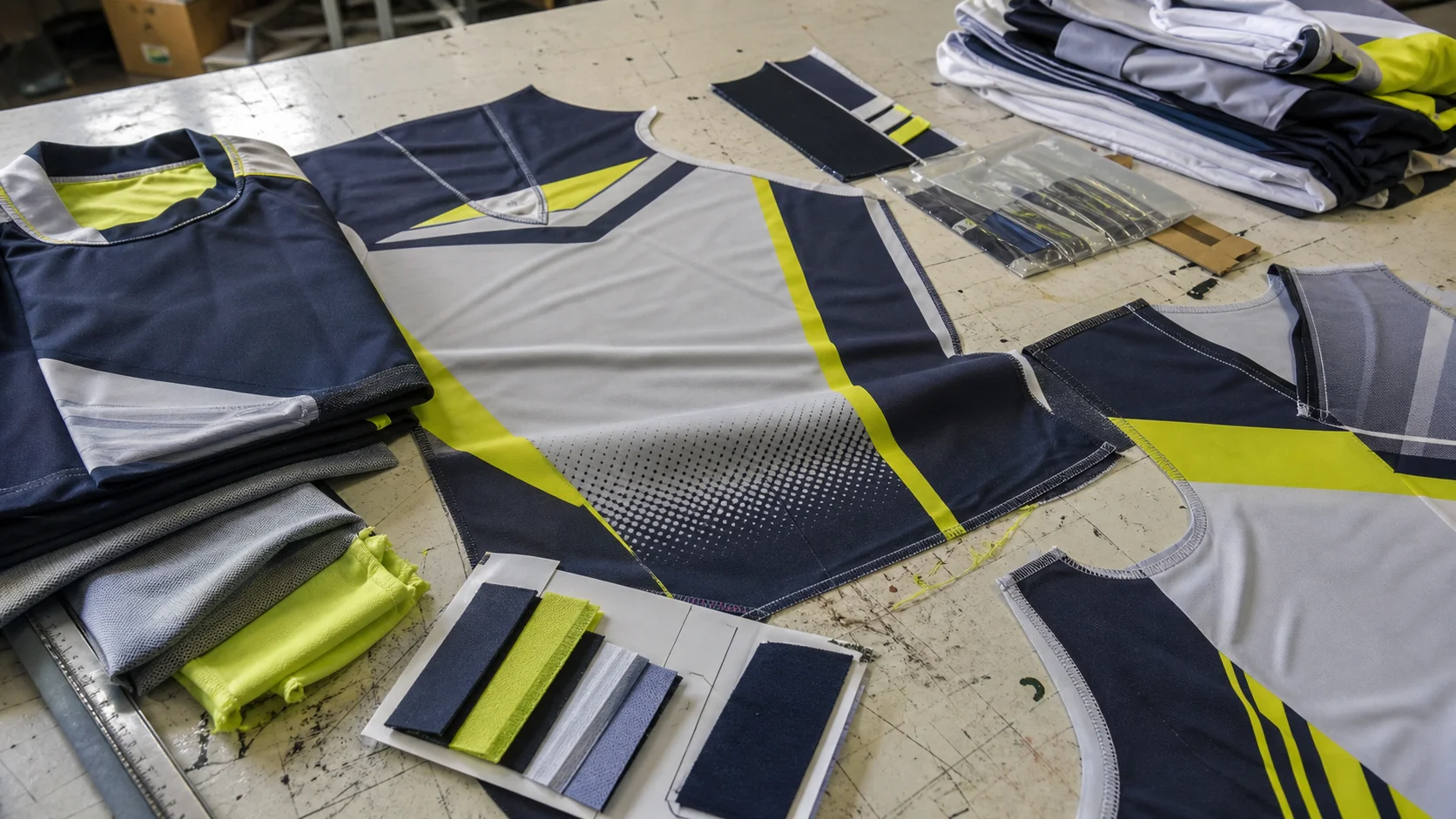
In sublimated apparel production, a panel is a shaped fabric piece that is printed before sewing. Common panels include front body, back body, left sleeve, right sleeve, side panels, collar pieces, shoulder yokes, cuffs, and sometimes pocket or placket sections.
Panel compliance means each of those pieces is correct before assembly. The buyer is checking whether the panel is fit for purpose, not just whether it looks attractive on a screen.
A strong supplier will usually ask for more than a logo file. They may request a technical pack, size chart, Pantone references, fabric weight, trim details, label artwork, packaging requirements, carton marks, and inspection standard. If the supplier does not ask, the buyer should still provide them.
For buyers comparing production options, it can help to review available manufacturing and customization capabilities through pages such as Fabrikn services. A clear service scope helps determine whether the supplier can manage printing, cutting, sewing, labeling, packing, and quality control as one connected workflow.
Sublimation works best on polyester-rich fabrics. That makes it a natural fit for sportswear and teamwear, but construction safety teams need a more careful performance review. The fabric must print well and wear well.
Construction use puts stress on seams, shoulders, elbows, side panels, and lower front areas. If the teamwear is worn under vests, harnesses, tool belts, or outerwear, abrasion zones should be reviewed before approving fabric.
Buyers should be cautious with very low-cost polyester. It may print acceptably in a sample but show issues in bulk, including streaking, poor moisture handling, shade inconsistency, excessive pilling, or weak seam performance. A cheap base fabric can turn into a high complaint rate once the team starts wearing the garments on site.
Color is one of the highest-risk areas in sublimated teamwear. Screens are not reliable approval tools. Sublimation color depends on artwork file setup, ink system, transfer paper, heat press settings, fabric type, fabric base shade, and production control.
For construction safety teams, buyers should treat color in two categories: brand color and visibility color.
Brand colors may include company navy, orange, red, green, black, grey, or custom accent colors. Sublimation can reproduce complex graphics, gradients, and patterns, but exact Pantone matching is not guaranteed unless the supplier has tested the color on the chosen fabric.
Safety teams often use bright yellow, lime, orange, or red zones for visibility. Sublimation can print these colors, but a printed bright color is not the same as certified high-visibility material unless the garment has been designed and verified to the applicable standard.
If the garment is intended as jobsite identification only, the buyer can specify “high-visibility inspired” or “bright teamwear color.” If the garment is intended to meet a safety standard, the buyer should request certification details, material test data, and layout confirmation before ordering.
Practical tradeoff: fully sublimated panels give design freedom, but certified high-visibility programs may require approved background fabrics and reflective materials. Do not assume one production method satisfies both branding and safety compliance.
Small text is a common failure point. Construction teamwear may include phone numbers, website URLs, crew names, job categories, or emergency contact marks. Text that looks sharp on a digital proof may become difficult to read on textured fabric. Buyers should approve printed samples, not only digital mockups.
Artwork placement is where sublimated teamwear can become expensive quickly. Since panels are printed before sewing, the layout must account for seam allowance, size grading, cut tolerance, and body shape. A logo placed too close to the seam on a size medium may disappear into the side seam on a size 3XL.
A buyer should not rely on verbal placement instructions. “Logo on chest” is not enough. The tech pack or production brief should define approximate dimensions, position from center front, distance from neckline, distance from sleeve seam, and whether the logo scales by size.
For wholesale programs, size grading creates more complexity. The same artwork must work across small, medium, large, extended sizes, and sometimes tall or women’s fits. Buyers should decide whether logos remain the same size across all garments or scale with garment size. Both choices have tradeoffs.
Same-size logos create consistent branding across the team. Scaled logos may look better proportionally on large sizes but can create production management challenges. If the program includes personalized names or numbers, the buyer should provide a clean data file and check spelling before printing.
Many construction safety teams need visual hierarchy. Site managers, safety officers, first aid responders, crane teams, traffic control, and subcontractor groups may need different colors or printed identifiers. Sublimation makes this possible, but version control becomes critical.
Buyers should approve each version, not just the main design. A small crew label change can create a wrong shipment if the purchase order, artwork file, and packing list do not match.
Trim compliance is often underestimated. Sublimated teamwear may include collars, cuffs, buttons, zippers, reflective tape, heat transfer labels, woven labels, size tabs, care labels, hangtags, polybags, and carton labels. Each trim needs to be compatible with the garment’s use and production method.
Reflective tape is a special risk area. Some buyers want sublimated shirts with reflective strips added after printing. This can work for identification or enhanced visibility, but if a certified high-visibility garment is required, the reflective material and layout must meet the relevant requirement.
Sewn reflective tape is generally durable but can affect garment stretch and comfort. Heat-applied reflective transfers may look cleaner, but adhesion depends on fabric, heat settings, and wash conditions. Buyers should request wash testing or at least a clear care instruction when reflective trims are part of the order.
Labels matter because they communicate fiber content, size, origin, care instructions, and brand details. For wholesale orders, missing or incorrect labels can delay receiving, resale, or distribution.
Private label programs should be specified early. Switching from standard supplier labels to custom woven labels or heat transfer neck labels may affect MOQ, cost, and lead time. Buyers planning a full brand program can review supplier background and operating scope through pages such as Fabrikn about us before shortlisting.
A disciplined sample process is the strongest control point in sublimated teamwear purchasing. Digital mockups help with concept approval, but they cannot confirm fabric hand feel, print quality, garment fit, seam alignment, or trim behavior.
Not every program needs every sample stage. A repeat order with the same fabric, pattern, and design may only need a confirmation strike-off or pre-production sample. A new construction safety teamwear program with multiple role colors, reflective trims, and extended sizing should go through a more complete process.
A common purchasing mistake is approving a sample based only on the front view. The back panel, sleeve marks, side seams, inside labels, and carton labeling may be where the eventual distribution problems appear.
Minimum order quantities for wholesale sublimated teamwear vary by supplier, fabric availability, customization level, and size breakdown. Buyers should treat any MOQ as a commercial and production planning figure, not a universal rule.
Small MOQs can be useful for pilot teams, new contractors, or event-specific crews. The tradeoff is higher unit cost and sometimes less flexibility in fabric or trim sourcing. Larger orders usually improve unit price, but they increase the cost of any mistake. That is why approval discipline matters more as volume rises.
Typical production lead time may range from 3-6 weeks after final approval for straightforward sublimated teamwear. More complex programs can take 6-10 weeks or longer when they include custom fabric, reflective trim sourcing, private labels, testing, multiple samples, or large size sets.
Lead time usually depends on:
Buyers should build approval time into the calendar. A two-week delay in approving a strike-off can push the entire production schedule. If the garments are needed for site mobilization, project kickoff, or seasonal work, late approval can be more expensive than a slightly higher unit price.
Inspection for sublimated construction teamwear should cover both apparel workmanship and print accuracy. It is not enough to count cartons and check general appearance.
Construction teams often order mixed sizes and roles. Packing mistakes are common when one order includes several colors, personalized names, and extended sizes. Buyers should specify whether cartons are packed by size, by crew, by project, by wearer name, or by distribution location.
Every buyer should define measurement tolerances. For knit teamwear, common tolerances may be around plus or minus 1 cm for smaller points and plus or minus 2 cm for larger body measurements, but the correct tolerance depends on garment type, fabric stretch, and supplier standard.
Critical measurement points often include:
Workmanship should be checked at stress points. Construction teamwear may be pulled on and off frequently, worn under PPE, or washed in bulk. Weak seams, skipped stitches, loose threads, and poor bartacks can become field complaints quickly.
Wholesale buyers often use AQL-style inspection methods for bulk apparel. The exact inspection level and acceptable quality limit should be agreed before production. For high-risk programs, buyers may choose stricter checks on color, logo placement, personalization, and reflective trim attachment.
A practical inspection plan should include:
If the order has strict compliance requirements, inspection should not replace testing or certification review. Inspection confirms production consistency. Testing confirms whether specified materials and performance requirements are met.
Most production problems start as communication gaps. The buyer assumes the supplier understands the use case. The supplier assumes the buyer only needs a standard sublimated team shirt. A proper wholesale brief removes those assumptions.
Before placing a purchase order, buyers should ask direct questions. Are the panels printed before cutting or after cutting? Is the fabric already in stock? Will the sample be made from production fabric? Who checks spelling on personalized garments? What is the tolerance for logo placement? What happens if bulk color differs from the approved strike-off?
A supplier that answers clearly is easier to manage. A supplier that avoids technical details may still produce acceptable basic garments, but construction safety teamwear has less room for vague production control.
For buyers ready to discuss a program brief, a page such as Fabrikn contact us is a sensible next step for sharing order scope, artwork, and timing requirements.
This checklist can be used before approving sublimated teamwear panels for construction safety teams. It is deliberately practical. Each item should be answered before bulk printing begins.
Strong buying practice is not about making the supplier’s work difficult. It is about preventing unclear decisions from becoming printed fabric waste, late deliveries, or jobsite complaints. Sublimated teamwear can be an efficient and durable choice for construction safety teams when the buyer controls the brief, sample approval, and inspection process.
The main tradeoff is flexibility versus compliance certainty. Sublimation gives broad design freedom, fast visual customization, and good wash durability on polyester fabrics. Certified safety apparel may require stricter material, layout, and documentation controls. Buyers should decide which requirement leads the project before approving the design.
Get a free quote from Fabrikn — your trusted B2B clothing manufacturer with 10+ years of experience. MOQ as low as 200 pieces.
Get a Free Quote →Yes, sublimated teamwear can be used for construction safety teams when the goal is crew identification, branding, role labeling, or coordinated uniforms. If the garment must meet a formal safety or high-visibility standard, the buyer should specify that requirement before quotation and request supporting documentation.
No. A bright printed shirt is not automatically certified high-visibility apparel. Certified high-visibility garments usually require approved background materials, reflective components, layout rules, and testing. Buyers should not rely on color appearance alone for safety compliance.
Typical MOQs may range from 50-100 pieces for simple sublimated team shirts, 100-300 pieces for custom polos, and 300 pieces or more for private label or trim-heavy programs. Exact MOQ depends on supplier setup, fabric availability, artwork versions, labels, and compliance requirements.
Simple orders may take around 3-6 weeks after final sample approval. More complex construction teamwear programs with multiple role versions, reflective trims, private labels, testing, or large size sets can take 6-10 weeks or longer. Approval delays are one of the most common causes of late delivery.
Buyers should approve the technical brief, digital mockup, printed fabric strike-off, fit sample, pre-production sample, and size set when needed. The pre-production sample should include final fabric, print, trims, labels, measurements, and packaging details.
The main risks are shade variation, logo misplacement, seam mismatch, unreadable text, wrong names or role labels, reflective tape defects, measurement issues, and mixed packing. Orders with personalization or multiple crew versions need especially careful inspection.
Yes. Sublimation is well suited to names, numbers, crew codes, and role identifiers because the artwork is printed into the fabric. Buyers must provide an accurate personalization list and approve spelling before production because corrections after printing are costly.
Polyester-rich fabrics are usually required for sublimation. Common choices include polyester interlock, birdseye, pique, and polyester-spandex blends. For construction use, buyers should check snag resistance, moisture management, wash durability, UV exposure, and seam strength rather than choosing fabric by print appearance alone.