
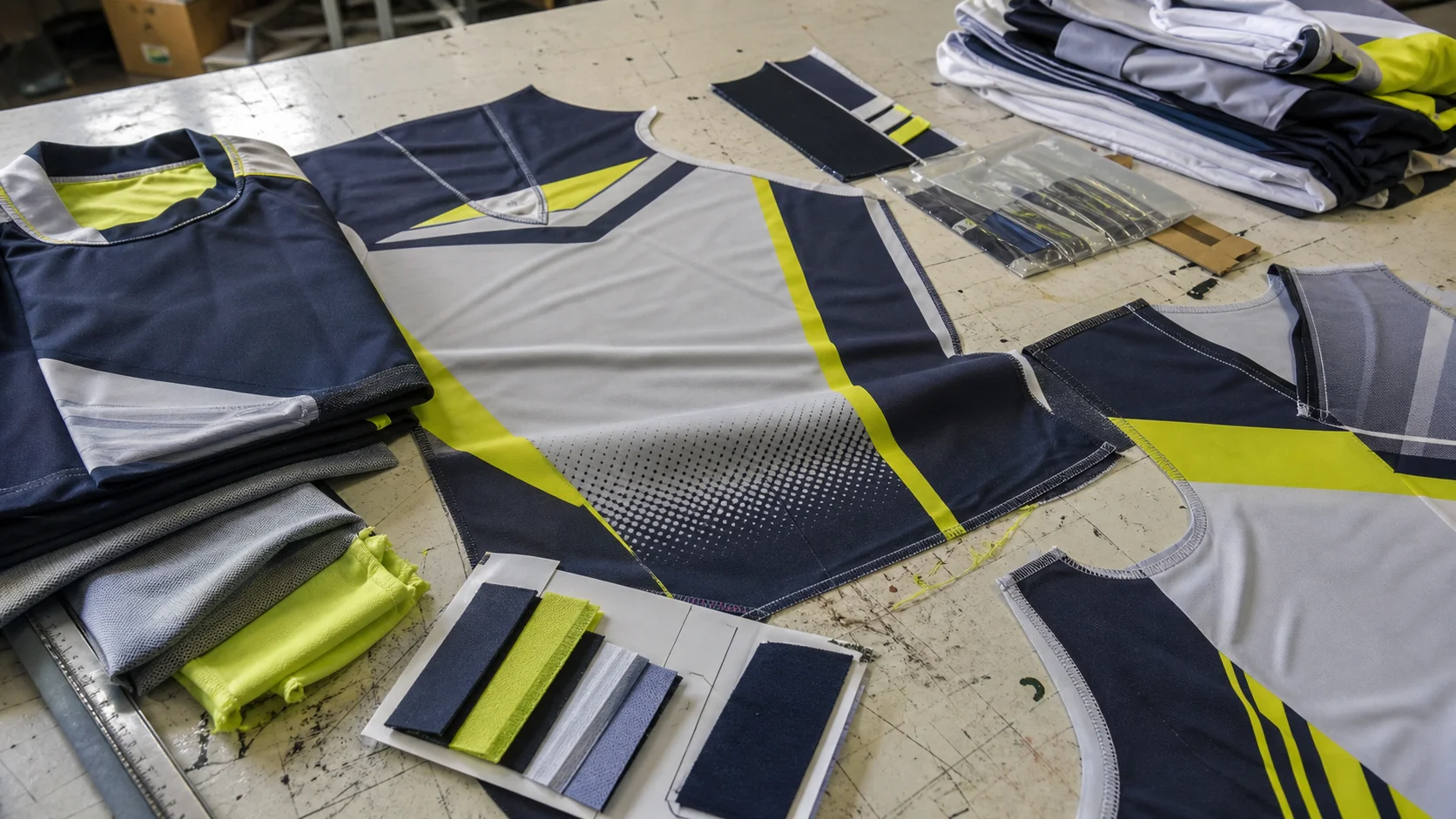
An SEO-focused outline for security contractors comparing wholesale sublimated teamwear panel MOQ pricing, production considerations, artwork setup, and...
Wholesale Sublimated Teamwear Panel MOQ Pricing - Fabrikn production reference
Wholesale sublimated teamwear panel MOQ pricing is rarely a simple price-per-shirt exercise. For security contractors, the buying decision usually sits at the intersection of visibility, professionalism, durability, and replenishment planning. Panel sublimation can sharpen branding and improve consistency across shifts, but it also changes the cost structure. The number of colors, panel layout, fabric choice, size run, and artwork complexity all affect the minimum order quantity, sample process, and final landed price.
This review focuses on practical sourcing considerations for security contractor uniforms and teamwear, with an emphasis on decoration and printing. The aim is not to guess at a “best” price, but to explain where pricing moves, what MOQ levels are typical, and where buyers can save money without creating quality problems later. If you are comparing suppliers, it is worth reviewing their broader manufacturing scope on Fabrikn services and confirming the contact path early through contact us.
Security contractors need garments that look authoritative, survive repeated washing, and present a clear identity across different sites and shifts. Panel sublimated teamwear works well because it can place logos, shoulder blocks, chest bands, side panels, and role identifiers in a controlled way. For site supervisors and guards, that makes it easier to distinguish departments or contract teams at a glance.
Panel construction is also useful when the garment needs contrast sections for visibility without moving into fully hi-vis standards. A dark body with lighter shoulder or chest panels is common in contract security, event security, and facilities teams. The print is part of the fabric decoration rather than a surface application, so the appearance tends to stay cleaner over time than low-grade transfer work. That said, the finish is only as good as the artwork, fabric selection, and print calibration.
Buyers should treat panel teamwear as a managed uniform program, not a one-off promotional item. Once the garment shape, panel map, and trim pack are locked, repeat orders become easier. That can justify a higher first sample cost if the long-term unit economics improve on replenishment.
MOQ rises when the product requires more setup, more color separation, or more controlled cutting. Panel sublimation usually starts with printed fabric rather than finished-garment printing, which means the factory must prepare artwork by panel, print the yardage, dry or cure it, then cut and sew it in the correct sequence. The production floor needs confidence that the printed panels will align cleanly after sewing, especially around seams, plackets, collars, cuffs, and pocket areas.
For simple sublimated tops, some factories accept lower starting quantities because the process is straightforward and the artwork repeats easily. Panel teamwear is different. If the garment uses multiple panel shapes, custom pattern blocks, or matching across several sizes, a supplier may ask for a higher MOQ to justify fabric setup and cutting waste. In practical terms, the minimum is often less about the ink and more about managing fabric yield and labor efficiency.
Security contractors should also consider size distribution. A tight size ratio with many small runs can drive up the effective MOQ even if the nominal order is acceptable. When a supplier prices by total units, they often still need enough volume in each size to keep cutting efficient and reduce leftover printed fabric. This is one reason why a 100-piece order can price very differently from a 300-piece order, even when the design looks similar.
There is no universal MOQ for wholesale sublimated teamwear panel pricing, but practical sourcing ranges usually fall into a few buckets. Low-complexity teamwear may begin around 50 to 100 pieces per design, while more complex panel garments often start at 100 to 300 pieces. Orders below those levels can still be possible, but they often carry a sample-like surcharge or a higher unit price that erodes the advantage of going wholesale.
For pricing, the main issue is not a single retail-style number. A basic sublimated panel top may price lower once the fabric, print area, and panel count are settled, while a more tailored security shirt or long-sleeve performance top can move up depending on collar construction, moisture-management fabric, reflective details, and embroidery or badge attachments. Buyers should expect the quote to change if they request premium zippers, reinforced elbows, anti-snag fabric, or custom labels.
Order Type Typical MOQ Range Pricing Behavior Buyer Notes Simple sublimated panel tee 50–100 pcs Lower setup cost, moderate unit price Best for trial runs and small teams Panel polo or performance top 100–200 pcs Better unit price at higher volume Watch collar, placket, and trim changes Security uniform top with custom details 150–300 pcs Higher setup and inspection burden Approach like a program order, not a sample runA cautious buyer should treat any unusually low MOQ quote as a signal to check the assumptions. Some suppliers quote low quantities by using stock fabric, simplified construction, or limited size runs. That can be workable if the uniform requirement is modest. It becomes risky if the program needs consistent reorders, color matching, or multiple branch rollouts.
For a broader view of production capability, the product development and decoration approach can be reviewed through about us before requesting a quote. That helps separate marketing claims from actual manufacturing scope.
Wholesale sublimated teamwear panel MOQ pricing is shaped by a small number of variables that buyers can control. The first is fabric. Polyester interlock, birdseye mesh, performance knit, and brushed performance fabrics all price differently. Some are easier to print, some hold color better, and some are more comfortable for long shifts. A security contractor should not choose fabric purely on price; hand feel, breathability, wash performance, and snag resistance matter more in day-to-day use.
The second driver is trim complexity. A garment with contrast cuffs, reinforced shoulders, zip pockets, or reflective inserts needs more sewing operations. Even when the print is efficient, trim complexity increases labor time and creates more chances for alignment issues. A clean panel layout often delivers better economics than a heavily decorated garment that looks busy but offers little functional gain.
The third driver is artwork. A bold panel design with limited color transitions is usually easier to manufacture than a design with gradients, fine text, or many thin stripes. Security branding often benefits from a simple, high-contrast look because it reads clearly at distance. That practical choice can also reduce production risk and improve pricing.
The fourth driver is labeling and packaging. Custom woven labels, printed neck transfers, barcoding, individual polybags, size stickers, and department sorting all add cost. Some of these extras are essential for uniform distribution, but others are optional. Buyers should ask which items are included in the quote and which are charged separately.
Sample approval should be treated as a gate, not a formality. For panel sublimated teamwear, the factory may issue a digital mockup first, then a fabric strike-off or pre-production sample, then a size set sample if the order is large enough. Each stage reveals something different. Mockups confirm layout. Strike-offs confirm color and print sharpness. Pre-production samples confirm fit, sewing quality, and the interaction between print and construction.
A buyer should expect iteration. Even a well-prepared design can need one or two rounds of revision if the panel lines shift after pattern making or if the logo placement looks too close to a seam. Security contractors often want a polished but restrained appearance, and that aesthetic can be unforgiving if proportions are off. It is better to correct artwork early than to discover a layout problem after bulk fabric has already been printed.
Lead time depends heavily on approval speed. If the buyer responds quickly and artwork is final, production can move faster. Delays usually come from incomplete tech packs, late logo files, uncertain Pantone references, or changes to decoration placement after sampling starts. The prudent approach is to freeze the spec sheet before sampling, then keep any later changes to a minimum.
In panel sublimation, the cheapest quote is not always the best buy. A slightly higher price from a supplier with tighter pre-production control can save money if it reduces misprints, rework, and delayed delivery.
To get a usable quote, security contractors should send a complete spec pack rather than a loose request. Vague enquiries invite vague pricing, and vague pricing usually hides assumptions that will reappear later in the process. A practical buyer brief should make the garment, decoration, and delivery expectations clear from the start.
Buyers should also ask whether the quotation includes sampling, plate or print setup, and shipping. A quote that looks attractive on a per-piece basis can become expensive once sampling, freight, duties, and packaging are added. If the supplier will handle a broader program, it is worth confirming the communication path and order management process through the main business contact on contact us.
Panel sublimated garments carry a few predictable inspection risks. One of the most common is panel misalignment. If the pattern is not managed carefully, a chest stripe may not sit level across sizes, or side panels may appear to drift after sewing. This issue can be minor on a small run but obvious across a security uniform program where teams wear the same garment side by side.
Color variation is another risk. Sublimation depends on fabric type, heat settings, ink behavior, and batch consistency. A buyer should not assume every re-order will match perfectly unless the supplier has a clear color control process and stores the same approved fabric reference. Even then, slight variation is normal. The question is whether the variation stays within an acceptable operational range.
Sewing quality matters as much as print quality. Security garments are often worn for long shifts and washed often, so weak seams, loose threads, and poor reinforcement create fast wear problems. Pay attention to underarm seams, shoulder joins, pocket edges, and collar points. If the garment uses reflective tape or contrast inserts, those junctions need close inspection because they are common failure points.
Size consistency is another concern. Uniform buyers often focus on the sample size and overlook the rest of the run. That can be costly. A well-fitting medium sample does not guarantee the same proportional accuracy across small and 3XL sizes. Ask for a graded size spec and, where possible, review a size set before bulk approval.
For security contractors, the right sourcing decision is usually a balance between cost control and program reliability. If the teamwear is for a short campaign or a small shift team, a lower MOQ with simpler construction may be the best route. If the garments will be used across multiple contracts, a higher MOQ can be worthwhile because it lowers the repeat-order headache and gives better control over branding.
The most sensible buying strategy is to simplify wherever possible. Choose one or two approved fabric options, keep the panel map clean, and avoid decorative features that do not improve performance. A restrained design often looks more professional on site and leaves more margin for quality control. It also gives the supplier a better chance of hitting target cost and delivery dates.
Buyers should also think about replenishment. A security contractor may need replacement units months later, and the cheapest first order is not useful if the supplier cannot repeat the same fabric, trims, or print standard. Ask whether the factory can archive the approved spec, keep the print file, and support repeat runs without reworking the entire development process. That capability often matters more than shaving a small amount off the opening quote.
For teams that want to compare production capability before ordering, the service overview at services is a useful starting point. It helps clarify whether the supplier is set up for full program handling, decoration control, and repeat uniform production rather than just one-off print jobs.
Get a free quote from Fabrikn — your trusted B2B clothing manufacturer with 10+ years of experience. MOQ as low as 200 pieces.
Get a Free Quote →Typical MOQs often start around 50 to 100 pieces for simpler styles and 100 to 300 pieces for more complex panel garments. The exact number depends on fabric, panel count, size range, and trim requirements.
Panel sublimation usually requires printed fabric, pattern alignment, cutting, and sewing control. Each step adds setup and inspection risk, so the supplier builds those costs into the quotation.
Yes, but small test runs often carry higher unit pricing and may not reflect the economics of a full program order. They are still useful when the garment is new, the branding is not finalized, or the supplier relationship is being tested.
Polyester performance fabrics are common because they print well and dry quickly. The best choice depends on climate, shift length, and whether the team needs extra breathability, snag resistance, or a heavier hand feel.
At minimum, the artwork placement, garment spec, color reference, size set, and sample construction should be approved. If reflective details or custom labels are included, those should be checked as part of the pre-production sample.
Keep the design simple, confirm all specs before sampling, and ask the supplier to state what is included in the quotation. Clear artwork, stable fabric choices, and a defined delivery plan usually do more to control cost than aggressive price negotiation alone.