
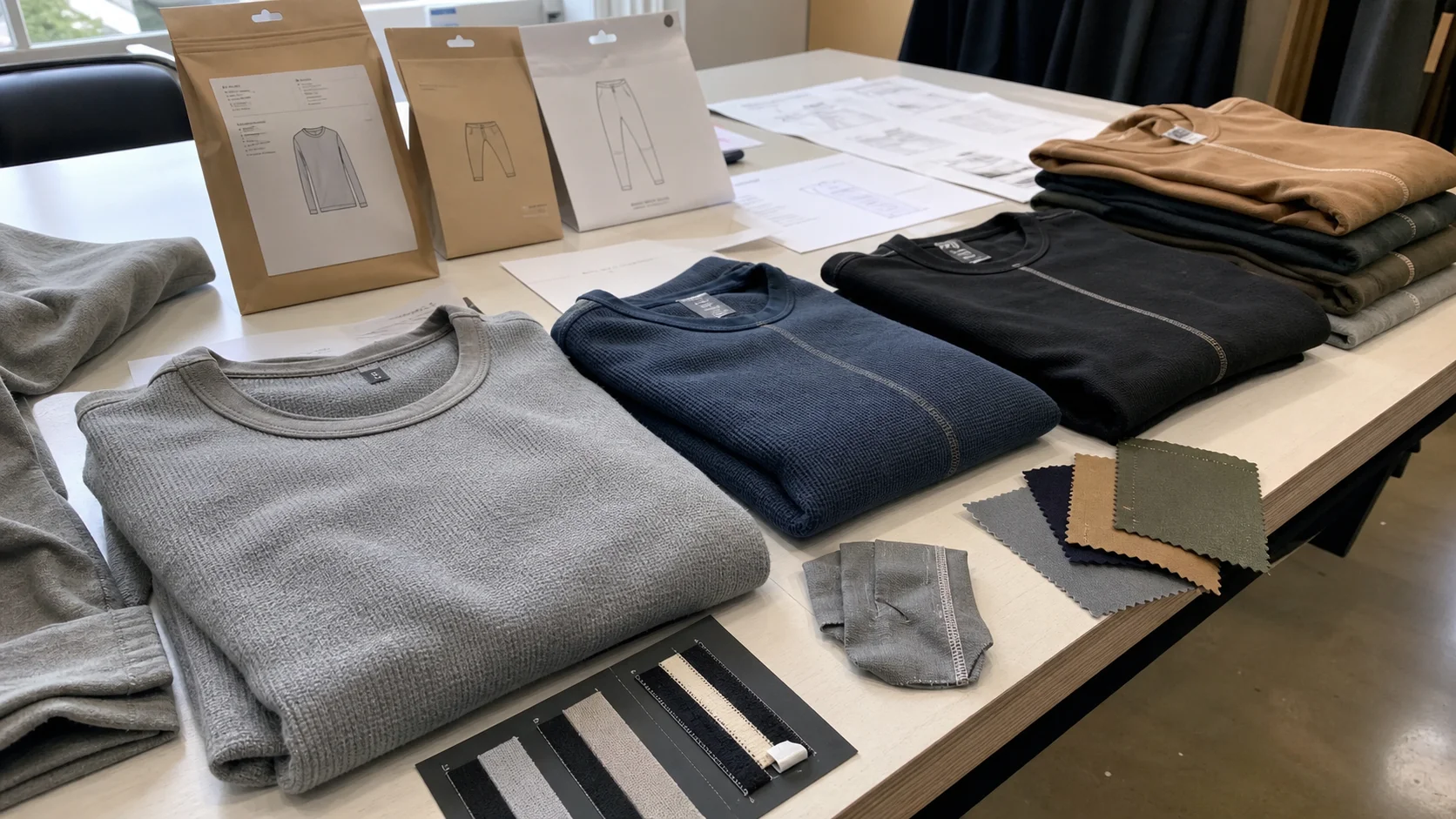
A sourcing-focused outline for evaluating wholesale team tracksuits through wash testing, seam durability checks, decoration performance, shrinkage review,...
Team Tracksuit Wash Tests for Repair Chain Buyers - Fabrikn production reference
For repair chain buyers, a team tracksuit is not just a uniform item. It is a repeat order product that has to survive frequent washing, retain shape, keep branding legible, and stay acceptable across multiple branches. That is why a wholesale team tracksuit wash test review matters before you place volume orders. A supplier can show a neat sample on day one, but the real sourcing question is whether the garment still performs after repeated laundering, drying, and handling in store operations or staff use.
This article is written for buyers comparing wholesale team tracksuits under MOQ, cost, and sourcing constraints. The focus is practical: what wash tests to ask for, what failures to look for, how fabric and trim choices affect durability, and how to balance price against long-term replacement risk. If you are building a repeat program for repair chain staff, event teams, or branded workwear, this review can help you avoid expensive reorders caused by poor colorfastness, shrinkage, or decoration failure.
A repair chain typically needs uniform apparel that looks consistent across multiple wear cycles. Tracksuits can face frequent laundering because they are used for staff uniforms, promotion kits, customer-facing team wear, or indoor-outdoor operational use. Once a garment starts fading, twisting, pilling, or shrinking unevenly, the whole program looks less professional. In repeat orders, that problem compounds. New stock no longer matches older stock, and branch managers start requesting exceptions.
Wash testing is the simplest way to reduce this risk. It shows whether the selected fabric, dyes, sewing thread, rib, zipper, and printed logo can tolerate realistic care conditions. A low-cost tracksuit that fails after three or five washes is not cheap in the end. The real cost includes returns, replacement labor, stock inconsistency, and complaints from branch buyers.
For wholesale sourcing, the best wash test is not just a lab label. It is a review of how the garment behaves under expected laundering conditions. Buyers should define those conditions in advance: water temperature, detergent type, drying method, and the number of cycles required before approval. If the supplier cannot explain how the fabric was tested, the buyer is taking a guess at quality.
A proper team tracksuit wash test should cover the main failure points, not only the fabric face. The jacket and pants are both construction-heavy garments with different stress areas. One part may pass while another fails, so the buyer should review the garment as a system.
For repair chain buyers, these details are useful because staff uniforms are often washed more frequently than fashion tracksuits. If the garment is used in a service environment, the tolerance for surface wear is lower. A product that looks acceptable after one or two washes may still become a sourcing problem when the same branch orders again six months later.
There is no single universal protocol, but a sensible wholesale review usually includes at least 3 to 5 wash cycles on the sample set before approval. For more demanding programs, buyers may request 10 or more cycles using the expected care method. If the end user is likely to wash in warm water and tumble dry, test under similar conditions rather than a gentle laboratory-only setting.
Test Area What to Check Common Risk Fabric face Fade, pilling, surface roughness Appearance loss after repeated laundering Seams Thread breakage, seam twisting Panel distortion and weak points Rib/cuffs Recovery, stretch, waving Loose openings and poor fit retention Decoration Cracking, peeling, lifting Brand damage and uneven appearance Hardware Zipper pull, tape, teeth alignment Failure in daily use after washingSuppliers may present test reports from their fabric mill or a third-party lab. That is useful, but buyers should still ask for the exact fabric lot, color, and decoration method used in the sample. A report on one fabric construction does not automatically cover the production line version if the supplier changes yarn count, dye house, or print method.
The fabric decision has the biggest effect on wash performance and cost. For team tracksuits, buyers commonly review polyester, polyester-cotton blends, brushed fleece, interlock, and tricot constructions. Each option has different tradeoffs.
Polyester is popular because it resists shrinkage, dries quickly, and usually handles repeated laundering better than many natural-fiber-heavy options. It is often the safer choice for consistent fit across repeat orders. Colorfastness can still vary based on dye quality and finishing. Low-grade polyester may hold color well at first, then show surface shine, heat sensitivity, or pilling at stress points.
For repair chain buyers, polyester-rich tracksuits are often a practical middle ground when cost control matters. The tradeoff is hand feel. Some lower-cost constructions can feel less premium, and if the fabric is too thin, the garment may show transparency or abrasion quicker than expected.
Poly-cotton can improve comfort and reduce the synthetic feel, but shrinkage and wrinkling become more important. If the cotton content is too high and the finishing is weak, size consistency may drift after washing. Buyers should ask for the exact blend ratio, yarn count, fabric weight, and pre-shrunk treatment. A 60/40 or 65/35 blend can be workable for team use, but only if wash testing confirms stable dimensions.
Brushed fleece offers warmth and a soft hand. It is common for tracksuit sets used in cooler conditions. The surface can pill faster if the yarn quality is poor or if the fabric is lightly constructed. Wash tests should include both appearance and texture review because a garment can still fit correctly while looking worn out after a few cycles.
Buyers should also watch for shade variation between production lots. Brushed fabrics often show slight visual changes after washing depending on dye penetration and finishing. That matters in chain programs where replacement stock must match the original issue.
Tricot can deliver a cleaner, more athletic look and usually performs well in washing if the construction is stable. It is often less prone to pilling than brushed surfaces, though the face can snag or shine if abrasion is constant. Buyers should review seam smoothness carefully because tricot may show stitching marks more readily than heavier fleece.
Wash testing is not complete without checking decoration and trim. Many tracksuit complaints are not about the fabric itself. They come from logo failure, zipper trouble, or trim shrinkage.
Screen printing is common for bold logos and can be cost-effective at scale. The risk is cracking or surface stiffness if the ink deposit is too heavy or the curing process is weak. Heat transfer prints can give sharp detail, but edge lifting, peeling, and gloss change are common if wash adhesion is poor. Buyers should ask for the exact application method, curing standard, and whether the logo sits on a stretch zone.
For repair chain buying, decoration placement matters as much as method. Logos across the chest, upper sleeve, or thigh may flex differently during wear and laundering. A print on a high-stretch area should be treated as a higher-risk decoration and tested longer.
Embroidery usually handles washing well, but there are still risks. Dense embroidery can create puckering if the base fabric is light. Backing material may feel stiff, and thread quality affects color retention. Poor digitizing can create edge fray or distorted shapes after repeated cycles.
Embroidery is often preferred for a more durable brand presentation, but it adds cost and may affect wearer comfort on lightweight tracksuits. Buyers need to weigh the premium feel against increased unit price and potential bulk under the logo area.
Zippers should be tested open and closed after washing, not only before. A tape that shrinks slightly or a slider that catches can create a warranty headache. Labels should stay legible and not curl. Drawcord tips, snaps, and elastic components should also be checked. Trim failures are often small in isolation but damaging in volume.
A good wholesale tracksuit may still fail the program if the trim package is weak. Buyers should treat zippers, rib, thread, and labels as part of the product specification, not as afterthoughts.
MOQ decisions affect wash-test strategy. A supplier may quote a lower price at higher volume, but that only makes sense if the sample result is stable. For team tracksuits, typical wholesale MOQ ranges can vary widely depending on fabric, color, and decoration. In many sourcing programs, MOQ might start around 100 to 300 sets per colorway for standard constructions, while custom fabric, special trims, or complex multi-panel designs can require higher minimums.
Buyers should separate sample cost from bulk cost. A low sample price means little if the production version changes after approval. A better approach is to ask whether the supplier can lock key specs: fabric weight, composition, dye lot tolerance, trim type, logo placement, and stitching standard. If those are not controlled, wash-test approval has limited value.
When sourcing for repair chains, buyers often need a balanced spec rather than the cheapest garment available. The lowest-priced tracksuit may be fine for a one-off promotion, but it can become expensive if it must be replaced early across several branches. In many cases, a modest upgrade in fabric weight or thread quality reduces lifecycle cost.
If you are comparing suppliers and need a basic production review, the service overview at https://fabrikn.com/services/ can help frame the discussion around sampling, development, and bulk manufacturing support. For direct inquiry planning, the contact page at https://fabrikn.com/contact-us/ is the natural next step when you are requesting quotes or discussing specifications.
A disciplined sample process reduces expensive mistakes. The buyer should not approve a team tracksuit based on appearance alone. The right sequence is simple: product brief, first sample, wash test, revision if needed, then pre-production sample or size set approval before bulk.
The most common mistake is approving visual appearance too early. A tracksuit can look fine on a hanger and still fail after laundering. Another mistake is treating one sample as proof of production stability. If the supplier changes fabric source or decoration subcontractor later, the approved result may not hold.
Lead time also depends on the test plan. Standard sourcing might take a few weeks from sample to confirmation, but custom fabrics, special pant cuts, or lab testing can extend the schedule. Buyers should build wash testing into the timeline rather than squeezing it after the purchase order is issued.
Before bulk shipment, the buyer should review production against the approved sample. Wash test review is not a substitute for inspection. It is one quality gate within a broader sourcing process.
Inspection risk rises when the order is split across multiple production lots. If one branch receives a slightly different shade or fit, replacement orders become difficult to manage. For chain buyers, consistency is as important as absolute quality. A product that is acceptable in isolation may still be unsuitable for a chain-wide program if repeatability is weak.
Use the following checklist when reviewing wholesale team tracksuits for repair chain sourcing:
If your organization is still shaping the product brief, the company background on https://fabrikn.com/about-us/ can be useful for understanding the manufacturing approach behind sampling, development, and production communication. That matters because wash test success depends not only on the garment spec, but also on how consistently the supplier can execute it.
Buyers often ask whether they should spend more on fabric or decoration. The answer depends on use case. For a repair chain uniform program, fabric stability usually deserves priority over decorative extras. A slightly better yarn, a proper pre-shrink finish, and reliable thread quality can protect the order more effectively than a premium print effect.
There are places to save. A simplified color palette can reduce risk. Fewer panel joins can improve sewing efficiency and lower defect potential. Standard zipper hardware is usually safer than special fashion hardware if the tracksuit is intended for regular use. Saving on an unstable fabric, by contrast, is usually false economy.
Buyers should also be careful with over-specifying the garment. Not every team tracksuit needs heavy athletic construction or luxury finishing. A repair chain may value durability, neat appearance, and reorder consistency more than high-end styling. The winning sourcing decision is often the one that best matches the actual use environment.
A wholesale team tracksuit wash test review is one of the most useful controls in MOQ, cost, and sourcing decisions for repair chain buyers. It reveals the real cost of a garment before the order scales up. When wash testing is done properly, it helps buyers reduce returns, maintain chain-wide consistency, and avoid repeat-order surprises.
The best results come from clear specs, realistic laundering tests, and disciplined sample approval. Focus on fabric stability, shrinkage, colorfastness, trim durability, and decoration performance. Keep the order practical. Buy for the way the tracksuit will actually be used, washed, and replaced. That is the sourcing judgment that protects both budget and brand presentation.
Get a free quote from Fabrikn — your trusted B2B clothing manufacturer with 10+ years of experience. MOQ as low as 200 pieces.
Get a Free Quote →Many buyers start with 3 to 5 wash cycles on the approved sample, then request more cycles if the garment is for frequent-use uniforms or chain programs. The exact requirement should match the care conditions of the end user.
MOQ often starts around 100 to 300 sets per colorway for standard wholesale programs, but custom fabric, special trims, or complex decoration can push the minimum higher. Always confirm MOQ against the actual specification, not a generic quote.
Polyester-rich fabrics usually offer the most stable wash performance for shrinkage and shape retention. Poly-cotton can be more comfortable, but it needs better control on pre-shrink and laundering performance. The right choice depends on the target use and budget.
Embroidery is often more durable in wash cycles, while print can be cheaper and lighter. Print may crack or peel if the curing or adhesion is weak. The best option depends on logo size, placement, and how often the garment will be washed.
The main risks are shade variation, shrinkage drift, logo failure, weak seams, zipper problems, and fabric substitution. Buyers should compare bulk output against the approved sample and confirm that the production lot matches the agreed specification.
Lock the fabric composition, weight, trim type, decoration method, and tolerance ranges in writing. Keep an approved reference sample, test wash performance before bulk release, and ask the supplier to confirm that future production will match the same specification.