
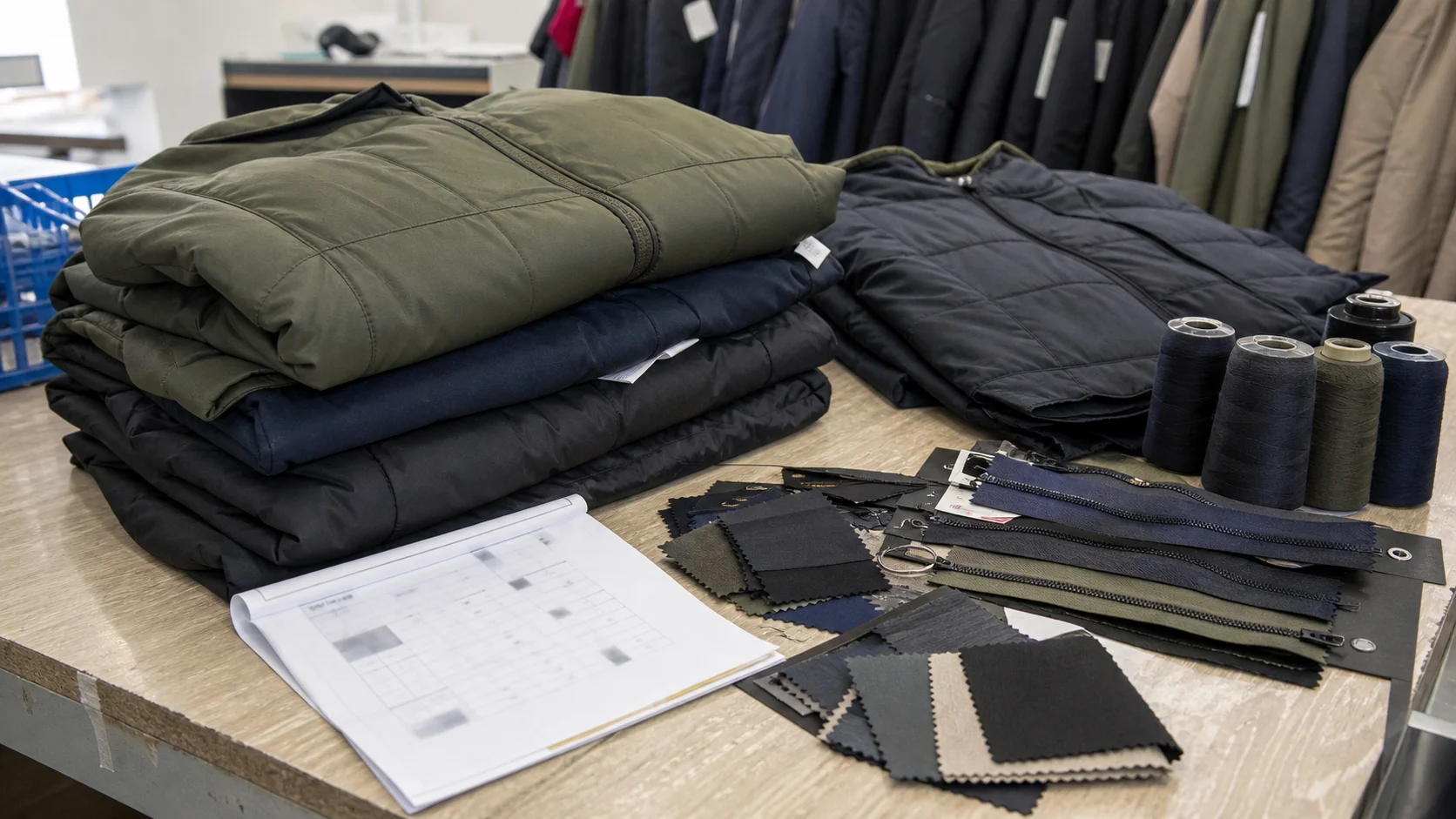
A practical audit framework for clinic purchasing teams to verify thermal parka colorfastness before wholesale approval, with pass/fail criteria, lab...
For clinic purchasing teams, a thermal parka is not just a winter garment. It is part of the visible uniform system, a cost item that gets worn hard, washed often, and judged quickly by staff and visitors. Colorfastness sits near the top of the audit list because poor dye performance shows up early: faded panels, patchy sleeves, bleeding onto trims, and a uniform line that looks tired before the season ends.
This checklist is written for wholesale procurement, where decisions are made before bulk production starts and mistakes multiply fast. A good audit does not stop at “pass or fail.” It checks the dye system, fabric construction, trim compatibility, sample approval flow, and the supplier’s ability to hold shade across repeat orders. For clinics buying through tender, framework contracts, or multi-site programs, that discipline matters more than branding claims.
For teams comparing suppliers, it also helps to work with a vendor that can document testing, sample control, and production oversight clearly. Fabrikn’s services page is a useful starting point for understanding how a production partner structures sampling, development, and bulk order handling. If you need a direct procurement conversation, the contact page is the right place to start. Background on capabilities and company scope is available on the about page.
Wholesale Thermal Parka Colorfastness Audit Checklist - Outerwear & Jackets manufacturing guide
Clinic outerwear has a different risk profile from fashion outerwear. Staff wear it in repeated cycles, often between indoor and outdoor temperature swings. A parkas can sit against scrubs, polos, or lab coats, then be exposed to cleaning agents, rain, friction from seat belts, and crowded storage. If the fabric releases dye, the damage is visible on day one. If the color fades unevenly, the garment looks nonstandard even when it is structurally intact.
Colorfastness also affects procurement consistency. In healthcare settings, uniforms are often ordered in waves. If one batch is slightly darker or softer than the next, staff notice. That can create inventory sorting problems, return requests, and avoidable reordering. A colorfastness audit is really a supply control exercise: it reduces the chances that “same style, same color” turns into a mismatched lot.
For thermal parkas, the usual weak points are shell fabric dye stability, lining shade transfer, stitch thread compatibility, zipper tape staining, reflective tape bleeding, and print or badge applications that do not survive laundering. In colder climates, salt, dampness, and long wear cycles make the problem worse.
A buyer should treat the color audit as part of a broader pre-production approval package. The goal is not only to confirm that the swatch looks right. The goal is to verify that the chosen color can survive production, trimming, washing, and field use without drifting outside acceptable limits.
For clinic purchasing teams, the most important question is practical: will this parka still look controlled after repeated wear and care, or will it become a maintenance problem? The answer depends on both the dye formula and the process discipline behind it.
Use the following checklist during supplier review, sample approval, and pre-shipment inspection. A “yes” on paper means little if the supplier cannot show the test method, report date, and tested construction.
Audit item What to check Why it matters Typical buyer target Fabric test reports Ask for current third-party or in-house reports for the actual shell fabric and colorway. Testing a similar fabric is not enough. Reports tied to style, fabric composition, and color code. Wash fastness Confirm resistance to laundering under the expected care method. Clinic parkas are often cleaned repeatedly and handled by different users. Common commercial target is around grade 4 or above, depending on standard and color. Crocking / rubbing Test dry and wet rubbing on shell fabric and dark trims. Color transfer to scrubs, car seats, and storage shelves is a real complaint driver. Prefer stable results on both dry and wet rub tests. Perspiration resistance Check acid and alkaline perspiration performance. Wear against the neck, cuffs, and inner placket exposes dye weakness. Avoid low grades on darker colors. Light fastness Verify resistance to daylight exposure, especially for branded or high-visibility colors. Uniforms stored near windows or worn outdoors can fade unevenly. Prefer better light stability on navy, black, and red tones. Shade band control Request approved tolerance ranges for panel shade variation. Cut-and-sew outerwear shows mismatches across large panels quickly. Clear A/B/C shade standard before production. Trim color stability Check zippers, pullers, labels, tapes, and binding for bleed or fading. Trim issues can make a good shell fabric look defective. Match trim testing to the same wash and rub conditions. Logo application Test embroidery backing, heat transfer, screen print, or badge adhesion. Decorations can stain or distort during laundering. Approve decoration method before bulk.Do not approve color from a screen image alone. Ask for a physical lab dip or strike-off in the target shade, then compare it against the reference under standard lighting. If the clinic needs specific branding alignment, define the exact reference: Pantone, a physical swatch, or a master garment. Small wording differences create disputes later.
A supplier may say the fabric is “colorfast,” but that is too vague for procurement use. Ask which method was used, what the tested specimen was, and whether the result applies to the shell fabric only or to the finished garment. For outerwear, the relevant test often needs to cover the whole fabric system, including membrane, coating, backing, and any bonded layer.
Navy, black, charcoal, and deep green tend to show wash and rub issues more visibly. Bright or saturated clinic colors can be more sensitive to light fading. Treat each colorway as its own risk item. A supplier’s good result on one color does not guarantee similar stability on another.
Some parkas are expected to be spot-cleaned only. Others are machine washed on a regular schedule. If the care label does not match the real use case, the audit is incomplete. Choose the laundering profile first, then confirm that the fabric and trims tolerate it.
Color mismatch can hide under flat inspection lights and appear outdoors or under fluorescent clinic lighting. Hold the sample in different angles. Look for panel-to-panel variation, especially at sleeves, yokes, hoods, plackets, and patch pockets. This is where low-grade bulk control usually shows up.
Sampling should be handled as a controlled sequence, not as a casual back-and-forth of prototypes. For wholesale thermal parkas, a reasonable approval chain is: design confirmation, fabric approval, lab dip approval, trim approval, pre-production sample, then size-set and shade confirmation. Skipping steps can save time on paper and cost more later.
Most disputes happen when the approved sample is not clearly tied to the bulk order. Keep a signed record of the approved shade, test reports, construction notes, and any exception tolerances. If the supplier offers revisions after approval, make sure the revised sample is re-approved in the same file.
Color approval should not be treated as a design preference. For clinic purchasing, it is a production control point. If the standard is not written down, it is not controlled.
Colorfastness is influenced by more than dye choice. Fabric construction and finishing affect how color behaves in use. A thermal parka with a coated shell, quilted lining, or laminated membrane can pass one test and fail another if the full structure is not understood.
These details are not secondary. In outerwear procurement, the wrong trim or fabric finish can undermine an otherwise acceptable dye result. That is why the technical pack should state acceptable alternatives up front instead of letting the supplier substitute parts late in development.
Clinic buyers often want low-risk ordering, but wholesale outerwear has minimum economic thresholds. For custom thermal parkas, a typical MOQ might range from 200 to 500 pieces per color for a simple program, while some suppliers will ask for 500 to 1,000 pieces or more when multiple custom trims, special insulation, or branded packaging are involved. The exact figure depends on fabric availability, print or embroidery complexity, and whether stock materials are being used.
Lead time also moves with the approval chain. A fast repeat order using approved materials can be much shorter than a new color development. A realistic schedule often depends on:
Buying teams should be careful about pushing for a short delivery window while also asking for strict shade control. Those goals can conflict. If a supplier is forced to rush, shade variation and trim substitution risk usually rise. The cleanest approach is to lock the spec early, approve samples quickly, and reserve production capacity before seasonal demand peaks.
Even when a sample passes, bulk production can still drift. The most common problems are not dramatic failures. They are small inconsistencies that become expensive when repeated across a large order.
Inspection should include both visual and technical checks. A visual pass confirms matching appearance. A technical pass confirms the supplier actually used the approved materials and maintained the correct process. For clinic purchasing, the second item is often the one that prevents surprises after distribution.
It is sensible to require inline inspection at the start of production and a final random inspection before shipment. If the order is large or time-sensitive, a midline checkpoint can catch color drift early enough to correct it. That is usually cheaper than rejecting finished goods.
Some buying teams over-focus on minor packaging details and under-focus on the fabric system. For a thermal parka, that is backward. Packaging can be standardized later. Fabric, color stability, and trim compatibility define whether the garment is fit for use.
The right place to spend time is on the reference standard, the test evidence, and the approval chain. The wrong place to save time is the lab dip review and pre-production garment inspection. Those steps are where the cost of a bad bulk order is still avoidable.
Clinic purchasing teams should also avoid accepting a supplier’s generic compliance statement without looking at the exact construction. A shell fabric that is stable in one color may not perform the same way in another. A reflective trim that looks fine in a showroom may behave poorly after laundering. A good audit assumes variation until the evidence says otherwise.
For teams that want a production partner with a structured process for development and order handling, the practical next step is to ask for the testing route, approval timeline, and bulk control method in writing. That is where sourcing discipline starts.
The main tests are wash fastness, dry and wet rub fastness, perspiration resistance, and light fastness. For clinic use, trim and logo durability should be reviewed as part of the same package, not separately.
A common range is 200 to 500 pieces per color for straightforward programs, with higher minimums for custom fabrics, special trims, or complex decoration. The real MOQ depends on the supplier’s material sourcing model and production setup.
No. A lab dip confirms the target shade in small-scale form. Bulk consistency still depends on the dye batch, fabric lot, trim selection, and production control. A sealed golden sample and shade band limits help reduce risk.
Yes. Rubbing matters because the garment can transfer color to scrubs, car seats, desk chairs, or storage areas. Wet and dry crocking tests are useful even when laundering is infrequent.
The biggest mistake is approving a visual sample without tying it to test reports, fabric lot control, and a documented production standard. That usually leads to shade drift, trim mismatch, or post-delivery complaints.
Re-testing is wise when the fabric lot changes, the supplier changes a trim source, or the order is placed months later. Even a repeat style can behave differently if the mill, dye lot, or finishing process changes.
Get a free quote from Fabrikn — your trusted B2B clothing manufacturer with 10+ years of experience. MOQ as low as 200 pieces.
Get a Free Quote →A solid wholesale thermal parka colorfastness audit is not complicated, but it has to be specific. Define the target shade, test the actual fabric and trims, approve the sample chain in order, and insist on production controls that can hold color across lots. That approach protects clinic budgets, reduces rework, and keeps the uniform program looking deliberate rather than patched together.