
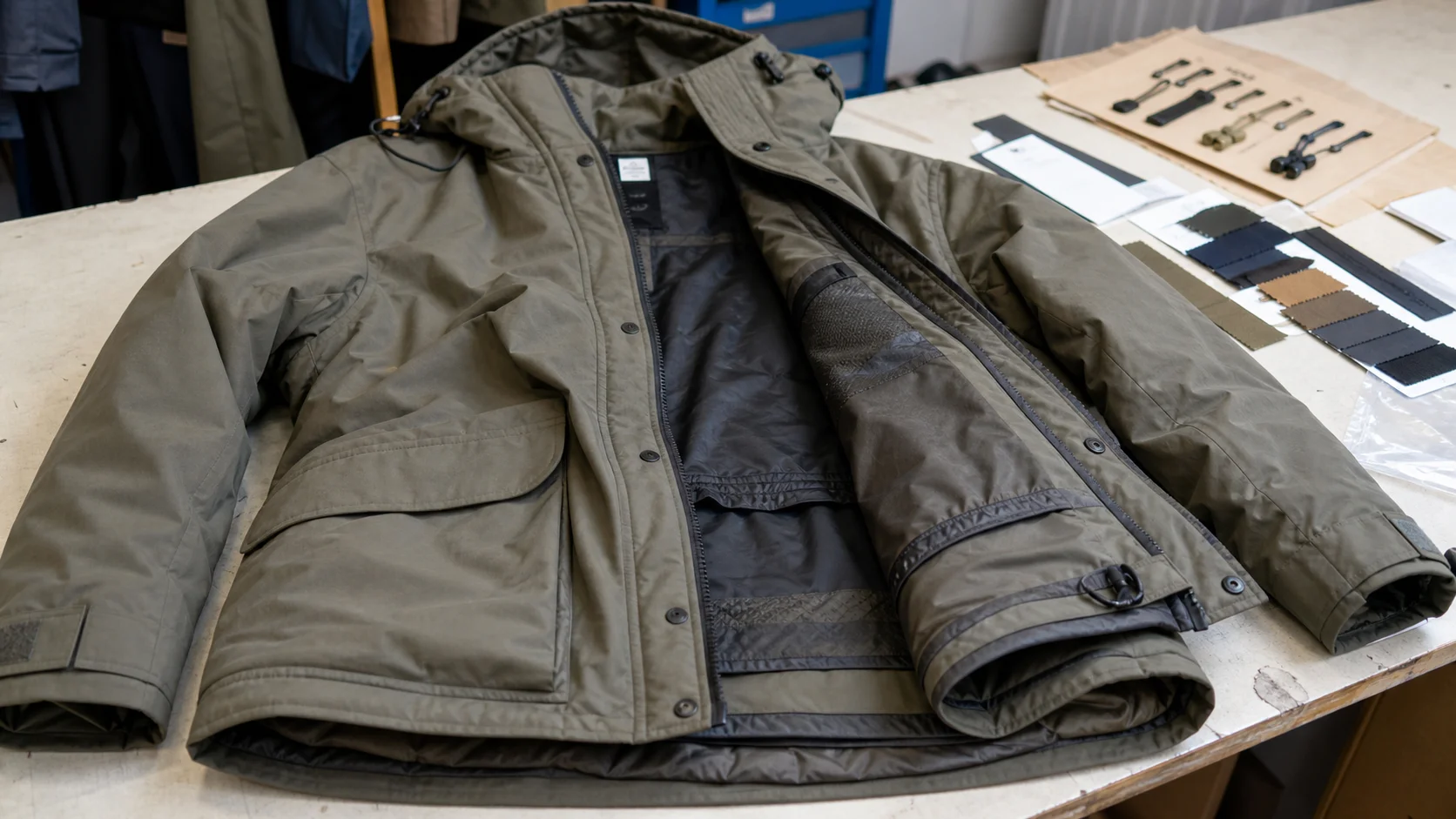
A quality inspection outline for gym program buyers reviewing wholesale thermal parka seam strength, stress points, test methods, and production artifacts...
Thermal Parka Seam Review for Gym Buyers - Quality & Inspection manufacturing guide
Wholesale thermal parkas look straightforward on a line sheet: outer shell, insulation, lining, zipper, hood, pockets, and branding. The real buying risk sits in the seams. For gym program buyers, seam strength is not a minor technical detail. It decides whether a parka survives daily staff wear, outdoor training events, sideline use, winter commute programs, and team distribution without early returns.
Gym buyers usually source parkas for staff uniforms, personal trainer teams, outdoor bootcamp groups, branded retail, member rewards, or seasonal merchandise. These garments are expected to feel warm, look consistent, and carry the gym’s logo cleanly. They also get pulled, stuffed into lockers, worn over hoodies, zipped while tight across the chest, and washed more often than many casual outerwear pieces. Weak seams show quickly under those conditions.
A seam strength review should happen before purchase order approval, not after cartons arrive. Once bulk goods are packed, the buyer has fewer options. Reworking insulated outerwear is expensive because each repair may involve shell fabric, insulation displacement, lining access, and water resistance concerns. Rejecting the full shipment can also delay a launch window. The better approach is to define seam expectations during sampling, confirm construction before bulk cutting, and inspect high-risk areas during production.
For gym program buyers, the best parka is not only the warmest sample. It is the one with seams strong enough for repeated movement, layering, storage abuse, and team-level distribution.
This review explains what buyers should check when sourcing wholesale thermal parkas, how seam strength is affected by materials and construction, which areas fail most often, and what practical inspection steps should be built into a buying program. It is written for commercial sourcing decisions, not lab theory alone.
This article is for gym owners, fitness franchise buyers, corporate wellness teams, branded merchandise managers, procurement teams, and apparel program coordinators ordering thermal parkas in volume. It is especially relevant if the order includes embroidery, heat transfer branding, staff size grading, or repeated reorders.
Gym programs have different needs from fashion retailers. A fashion parka can sometimes prioritize silhouette and shelf appeal. A gym program parka must balance durability, fit, brand presentation, and cost control. Buyers often need a garment that can be issued across a mixed team: front desk staff, trainers, outdoor instructors, maintenance staff, event teams, and management. That means seams must hold across a wide fit range and different wearing habits.
For buyers managing a private label or custom uniform project, working with a structured apparel partner can help organize the sample, specification, and inspection process. Fabrikn’s apparel manufacturing services page is a useful starting point for understanding how production support can be arranged around design, sourcing, and bulk execution.
A thermal parka is a layered garment. Seam strength depends on how the outer shell, insulation, lining, and trims are joined. A seam that looks clean from the outside may still be weak if the stitch density is too low, seam allowance is too narrow, fabric slips under stress, or the wrong thread has been used.
The outer shell carries much of the stress from movement and handling. Common shell fabrics include polyester pongee, polyester taslon, nylon taslan, recycled polyester, polyester oxford, or coated woven fabrics. Buyers should check whether the shell fabric is strong enough for the intended use and whether the seam construction matches the fabric weight.
Lightweight shells feel comfortable and reduce cost, but they can pucker, fray, or slip at the seam if the weave is loose. Heavier shell fabrics improve abrasion resistance but may require stronger needles, thread, and stitch settings. If the parka is intended for outdoor bootcamp staff or event teams, shell durability matters more than a soft hand feel alone.
Thermal parkas often use synthetic insulation such as polyester padding, recycled polyester fill, or sheet insulation. Some programs may request down or down-like fill, though synthetic insulation is more common for gym uniform and wholesale programs because it is easier to manage, typically lower cost, and more tolerant of damp conditions.
Insulation can create seam bulk. If seams are not compressed or controlled properly during sewing, stitches may skip or form uneven tension. Bulky seams at the shoulder, armhole, and side panels are common problem areas. Buyers should review whether the insulation is quilted, tacked, or loose inside panels. Loose insulation can migrate and create cold spots or lumpy seams after wash and wear.
Lining seams are easy to ignore because they are inside the garment. That is a mistake. Weak lining seams can tear when users pull the parka over a sweatshirt, reach into interior pockets, or remove the garment quickly. A torn lining may not make the parka unusable immediately, but it damages the user’s perception of quality.
Common lining fabrics include polyester taffeta, brushed tricot, fleece, or quilted lining. Smooth taffeta helps the parka slide over layers. Fleece adds warmth and perceived value, but it increases bulk. Quilted linings may improve insulation stability, but stitch quality must be reviewed because quilting threads can snag or break.
Hood seams receive pulling stress, especially if drawcords, toggles, or storm flaps are included. Collar seams are also high contact areas. Users grab the collar to adjust the garment, hang it on hooks, or pull it closed in cold weather. If the collar is padded or fleece lined, seam bulk must be controlled.
Buyers should check whether the hood is fixed, detachable, or packable. Detachable hoods add zipper or snap stress points. These attachment points must be reinforced because users often pull the hood off quickly instead of removing it carefully.
Not all seams carry the same risk. A practical seam strength review focuses first on areas that receive movement, pulling, and load. The following seams deserve direct attention during sample evaluation and inspection.
Shoulder seams support the garment’s weight and are stressed when the wearer carries a backpack, gym bag, or equipment. For gym staff, this is common. A weak shoulder seam may open gradually rather than fail at once. Look for stitch elongation, fabric slippage, and uneven seam allowances.
For heavier parkas, buyers should consider reinforced shoulder construction or a yoke design. A yoke can distribute stress, but it adds seams and can increase cost. The tradeoff is sensible for staff uniforms and outdoor programs, less necessary for lightweight promotional parkas.
Armholes are one of the most important areas in a thermal parka. Trainers and staff move actively, lift arms, carry items, and layer the parka over hoodies. Tight armholes or weak stitching can lead to seam popping.
Check armhole shape, sleeve pitch, and ease. A seam can be technically strong but still fail if the fit is too restrictive. Gym buyers should test samples over realistic layers, not just over a thin T-shirt. If the parka is part of a winter staff kit, sample fitting should include a hoodie or fleece underneath.
Side seams receive stress when users sit, bend, zip the garment tightly, or keep items in pockets. Long parkas add more stress at the hip area. If the program includes a broad size range, side seam strength becomes more important because fit pressure varies widely across users.
Buyers should inspect side seam alignment and stitch consistency from underarm to hem. Uneven feeding can cause twisting, especially when shell and lining fabrics have different stretch or slip behavior.
Pockets are failure points in gym outerwear. Users place phones, keys, access cards, gloves, snacks, and small equipment in them. Pocket bags tear, pocket openings pull, and bartacks can break if construction is weak.
Hand-warmer pockets should have reinforced corners. Zippered pockets need clean stitching around the zipper tape. Patch pockets require secure edge stitching and bartacks at stress points. If a parka includes internal media or phone pockets, lining strength should be reviewed carefully because users may pull against the pocket while removing devices.
The center front zipper area carries repeated stress. Users pull the zipper while the garment is under tension. If the zipper tape is not securely sewn or if the storm flap is misaligned, the garment looks cheap and becomes difficult to use.
For wholesale gym programs, zipper quality should match the garment level. A low-cost zipper can damage the entire program even if the shell fabric is acceptable. Buyers should specify zipper type, size, puller style, and whether the zipper is plastic coil, molded plastic, or metal. Molded plastic zippers are common in heavier outerwear, while coil zippers can work well for lighter insulated jackets.
Hems and cuffs take abrasion and pulling. Elastic cuffs, rib cuffs, hook-and-loop tabs, or inner storm cuffs all create different stress patterns. If cuffs are too tight, seams may fail when users pull sleeves over watches or gloves.
Longer parkas should have secure hem stitching and possibly adjustable drawcords. Drawcord exits need reinforcement. Poorly reinforced eyelets or cord channels can tear the shell fabric.
Seam strength is not only a sewing issue. Materials determine how well a seam can perform. A buyer who approves a soft shell fabric without checking tear strength, seam slippage, and coating behavior may face failures later.
Component Typical Options Seam Strength Concern Buyer Judgment Outer shell Polyester pongee, taslon, nylon, oxford Slippage, fraying, coating cracking, needle damage Choose tighter weaves for staff uniforms and repeated wear Insulation Polyester padding, recycled fill, sheet insulation Bulk at seams, uneven compression, migration Confirm fill weight and quilting method before bulk cutting Lining Taffeta, fleece, tricot, quilted lining Tearing at armhole, pocket, and side seams Use stronger lining for staff issue programs Thread Polyester spun, core-spun polyester, bonded thread Breaking, abrasion, poor tension Match thread size to shell weight and seam stress Zippers Coil, molded plastic, water-resistant zipper Tape tearing, slider failure, seam distortion Do not under-spec zippers on premium gym merchandise Branding Embroidery, woven patch, heat transfer, silicone badge Needle holes, puckering, adhesive failure Test branding on actual shell and insulation constructionOuter shell fabric weight is usually discussed in GSM or denier, depending on the material. Many wholesale parkas use shell fabrics around 70 to 160 GSM, though heavier workwear-style shells can exceed this. A low GSM fabric can be suitable for lightweight promotional programs, but staff uniforms usually need better tear resistance and seam stability.
Coatings also matter. PU, TPU, or water-resistant finishes can improve weather performance, but coating quality affects sewing. Some coated fabrics show needle marks, seam puckering, or cracking if sewn with the wrong needle or tension. Seam tape may be requested for water resistance, but seam taping adds cost and requires compatible fabric and proper machinery.
Insulation is commonly specified by GSM. Lightweight thermal jackets may use around 80 to 120 GSM padding. Warmer parkas may use 160 to 220 GSM or more, depending on the target climate and garment design. Higher insulation weight does not automatically mean better product value. It can increase warmth, but it also increases bulk, sewing difficulty, packing volume, freight cost, and seam stress.
Gym buyers should align insulation weight with use case. A staff parka for mild winter commuting does not need the same fill level as sideline outerwear for cold outdoor events. Overbuilding the garment can make it expensive and uncomfortable indoors. Underbuilding it creates complaints about warmth.
Polyester thread is standard for most synthetic outerwear. Core-spun polyester may be preferred for better strength. Thread size should match fabric weight and seam demand. Too fine a thread may break under stress; too heavy a thread may damage lightweight shell fabric or create bulky seams.
Stitch density is usually reviewed as stitches per inch or stitches per centimeter. For many woven outerwear seams, a range around 8 to 12 stitches per inch is common, depending on fabric and seam type. Too few stitches reduce seam security. Too many stitches can perforate the fabric and weaken it. Buyers should avoid treating higher stitch count as automatically better.
Bartacks are small but important. They are commonly used at pocket openings, zipper ends, vents, drawcord channels, and stress points. Missing or weak bartacks are a typical inspection issue in bulk outerwear.
Reinforcement may include extra fabric patches, binding, double stitching, or seam tape. These features improve durability but add labor cost. For gym program buyers, reinforcement is worth considering on pocket corners, hood attachment points, zipper base, and side entry pockets. It may not be necessary across every seam if budget is tight.
Formal lab testing can be valuable, especially for larger orders or premium programs. Common tests may include seam strength, seam slippage, tear strength, tensile strength, colorfastness, and wash performance. The exact test method should be agreed with the supplier or third-party lab based on fabric type and market requirements.
Not every gym buyer needs a full lab package for a small seasonal order. Yet every buyer should perform practical sample checks. A showroom sample that cannot survive basic handling is not ready for bulk approval.
A manual pull check is not a replacement for lab testing, but it reveals obvious weakness. Hold the seam on both sides and apply firm, controlled pressure. Look for thread breakage, seam opening, fabric slippage, and stitch elongation. Focus on armholes, shoulders, pockets, center front zipper seams, and hood attachment points.
This should be done on the fit sample and pre-production sample. If the seam opens easily, do not assume bulk production will improve without written correction. Sampling defects often become bulk defects unless the construction is changed.
A short wear trial helps buyers see stress points. Have testers wear the parka over the expected base layer. Ask them to zip it fully, raise arms, sit, bend, reach forward, place items in pockets, pull the hood, and carry a bag over one shoulder.
The goal is not to abuse the garment. The goal is to simulate realistic use before approving hundreds or thousands of pieces. After the trial, inspect seams for visible strain, popped stitches, lining tears, and pocket distortion.
Thermal parkas may not be washed as often as T-shirts, but gym staff garments do get cleaned. Buyers should request care instructions and test at least one sample according to the proposed care label. After washing, inspect seam puckering, insulation clumping, lining shrinkage, zipper waviness, and branding damage.
Heat drying can be risky for coated fabrics, synthetic insulation, trims, and heat transfers. If the garment requires gentle care, the buyer must decide whether that is realistic for staff use. A garment that looks good only under careful home laundering may not suit a high-turnover uniform program.
For larger wholesale programs, third-party lab testing can reduce risk. Buyers may request seam strength testing on critical seams, fabric tear strength, colorfastness, dimensional stability, and component performance. Testing adds cost and time, but it can prevent larger losses.
A sensible approach is to reserve full lab testing for higher-value programs, franchise-wide rollouts, retail resale items, or harsh use conditions. For smaller internal orders, detailed sample review plus inline and final inspection may be enough.
Sample approval should follow a clear sequence. Rushing from a nice-looking prototype to bulk production is one of the easiest ways to miss seam problems.
The buyer should define the parka’s intended use, target retail or program budget, fabric type, insulation level, size range, branding method, color, trims, and packaging. A basic tech pack should include garment measurements, seam construction notes, pocket details, hood design, zipper requirements, and logo placement.
If the buyer does not have a complete tech pack, a manufacturer or sourcing partner may help build one. This is where early decisions matter. A vague request for “warm winter parka with strong seams” leaves too much room for interpretation.
The proto sample confirms design direction. It may not use final fabric or trims, depending on sourcing stage. Buyers should review fit, silhouette, seam placement, pocket location, hood size, and general construction.
At this stage, do not overreact to every material issue if substitutes were declared. Do focus on structural risks. If the armhole feels restrictive or the pocket opening is poorly placed, those problems should be corrected before the next sample.
The fit sample should be tested on realistic body types and with expected layers. Gym programs often issue garments to people with athletic builds, broader shoulders, and varied proportions. Standard size charts may not fully reflect the wearer group.
Fit affects seam strength. A tight chest or narrow shoulder pushes stress into the seams. A parka can pass a seam test on the table and still fail in use if the pattern does not allow movement.
The pre-production sample should use approved bulk fabric, insulation, lining, trims, thread, branding, and construction. This is the most important approval sample before bulk production. Buyers should not approve production based only on a proto sample made from substitute materials.
Review every critical seam. Check stitch density, seam allowance, bartacks, zipper attachment, lining security, hood attachment, cuff construction, and pocket strength. Any approved pre-production sample should be retained as the standard for inspection.
A size set confirms grading across the size range. This matters for seam strength because larger sizes may experience different stress patterns and smaller sizes may become too tight when layered.
For gym buyers, review at least the core sizes expected in the program. If the order includes extended sizes, do not skip them. Extended sizes often require pattern adjustments, not only simple grading.
Branding can affect seams and shell performance. Embroidery adds needle holes and can compress insulation. Heat transfers require temperature and pressure that may affect coated fabrics. Woven patches add stitch lines and local stiffness.
Test branding on the actual fabric and construction. A logo that works on a flat fabric swatch may pucker on an insulated panel. Placement should avoid high-stress seam areas unless reinforcement is planned.
Buyers who need help organizing a custom apparel project can review Fabrikn’s about page for background on its manufacturing focus and sourcing approach.
Wholesale thermal parka programs vary widely in minimum order quantity. Typical MOQs may range from 100 to 300 pieces for simple stock-based customization, 300 to 600 pieces for semi-custom programs, and 800 to 1,500 pieces or more for fully custom development with dedicated fabric, insulation, trims, and color. These ranges are not fixed. They depend on supplier capacity, fabric availability, trim sourcing, branding method, and whether the buyer uses existing patterns.
Lower MOQs usually mean fewer customization options or higher unit cost. Higher MOQs can unlock custom colors, better trim control, size set development, and stronger price negotiation. The right choice depends on program risk. A gym ordering staff parkas for one location may prefer a stock shell with branding. A franchise network or retail resale program may justify custom development.
Lead time for thermal parkas is driven by more than sewing time. Fabric knitting or weaving, dyeing, coating, insulation sourcing, zipper availability, sample rounds, lab testing, branding approvals, and packing requirements all affect the schedule.
These are planning ranges, not guarantees. A buyer should confirm timing with the supplier before committing to a launch date. Late artwork, delayed sample comments, unavailable zippers, failed lab tests, or revised sizing can all push delivery.
Seam strength has cost implications. Stronger thread, better fabric, reinforced pockets, higher quality zippers, and more careful sewing all add cost. The question is whether those upgrades reduce returns and protect the brand.
For a one-time promotional giveaway, the buyer may accept a lighter construction if expectations are clear. For staff uniforms, a cheap parka can become expensive when seams fail, replacements are needed, and staff lose confidence in the program. For retail resale, seam failures create refund risk and poor reviews.
The practical buying judgment is simple: spend money where the garment takes stress. Pocket corners, armholes, shoulders, zipper seams, hood attachment, and cuffs deserve priority. Decorative details can be simplified if budget is tight.
Bulk inspection should be planned before production starts. Parkas are more complex than basic tops, and many defects are hidden inside the garment. A final random inspection can catch many issues, but it may not catch every internal construction problem once goods are packed.
Inline inspection is useful when order volume is meaningful or construction is new. Inspecting early production allows corrections before the full order is completed. This is especially important for custom parkas because the supplier may be working with new fabric, new insulation, or a new pattern.
Inline checks should focus on seam construction, stitch density, bartacks, zipper attachment, branding placement, and measurement consistency. If seam defects appear in early production, the buyer should request corrective action and review the next output before production continues at full speed.
Final inspection usually checks finished goods against approved sample, purchase order, size specs, workmanship standards, labeling, packing, and carton marks. For seam review, inspectors should conduct visual inspection and controlled seam stress checks on sampled units.
Inspection standards should define major and minor defects. An open armhole seam is usually a major defect. Slight thread trimming may be minor unless excessive. Missing bartacks at stress points should be treated seriously because they predict early failure.
Thermal parkas are bulky. Factories may compress garments to reduce carton volume, but heavy compression can flatten insulation and distort seams. Polybag size, folding method, and carton packing should be reviewed before shipment.
Vacuum packing is sometimes used for bulky outerwear, but buyers should be cautious. It can reduce freight volume, yet it may affect loft, appearance, and customer presentation. If vacuum packing is proposed, test it before approving bulk packing.
A clear checklist helps buyers compare samples and avoid emotional decisions based only on appearance. Use the following points before approving a wholesale thermal parka order.
Review Area What to Check Pass Condition Shoulders Seam allowance, stitch tension, fit over layers No pulling, slippage, or popped stitches during movement Armholes Sleeve pitch, seam strength, movement comfort Wearer can raise and reach without seam strain Pockets Bartacks, pocket bag fabric, zipper tape Pocket holds phone and keys without distortion Zipper Attachment seam, slider function, base reinforcement Zipper runs smoothly and seam stays flat under tension Hood Attachment seam, drawcord exits, snap or zipper points Hood can be adjusted without tearing or seam strain Lining Armhole, side seam, pocket attachment No tearing when worn over hoodie or fleece Branding Puckering, needle damage, adhesion, placement Logo sits cleanly and does not weaken shell panelSome defects deserve immediate caution. If a sample shows seam opening after light handling, the construction is not ready. If the supplier cannot confirm fabric and trim specs, the buyer may not receive the same garment in bulk. If the pre-production sample uses substitute materials, approval risk increases. If branding causes puckering or needle damage, the logo method or placement should be revised.
A buyer should also be cautious when the price is significantly lower than comparable offers. The saving may come from lighter shell fabric, weaker lining, cheaper zipper, reduced insulation, lower stitch quality, or fewer reinforcements. Sometimes that tradeoff is acceptable. It should never be accidental.
For most gym staff and program buyers, a balanced thermal parka specification is better than an extreme one. The garment should be warm enough for outdoor transitions, durable enough for repeated staff use, and clean enough for branded presentation.
A practical mid-range specification might include a durable polyester or nylon shell with water-resistant finish, synthetic insulation selected for the target climate, smooth polyester lining or fleece body lining, reinforced pocket openings, reliable molded or coil zipper, secure hood construction, and embroidery or patch branding tested on the finished panel. Seam construction should prioritize armholes, shoulders, side seams, zipper attachment, pockets, cuffs, and hood attachment.
Premium programs may add stronger shell fabric, higher loft insulation, branded zipper pullers, seam tape in selected areas, internal pockets, storm cuffs, and retail-grade packaging. Budget programs can simplify hood features, reduce pocket complexity, use stock colors, and limit custom trims while still protecting critical seams.
If the order requires custom manufacturing support, buyers can contact Fabrikn through the contact page to discuss project scope, specifications, and production requirements.
A wholesale thermal parka seam strength review should be part of every serious gym apparel program. The garment may look like a branding item, but it performs like equipment when staff and members use it in cold weather. Weak seams damage the program faster than small color or packaging differences.
The strongest buying approach is to define the use case first, then build the specification around stress points. Review the outer shell, insulation, lining, thread, zipper, pocket construction, hood attachment, and branding method as one system. A strong thread cannot save a fabric that slips badly. A good shell cannot compensate for weak pocket bartacks. A warm fill can still disappoint if seams fail at the armhole.
Gym buyers should avoid approving bulk production from appearance alone. Request a proper pre-production sample, test it over realistic layers, inspect critical seams, confirm materials, and agree on inspection standards. For higher-volume programs, consider lab testing and inline inspection. For smaller programs, at minimum perform manual seam checks, wear trials, and wash review before committing.
The best parka is not always the cheapest or the heaviest. It is the one with the right balance of warmth, durability, fit, branding, and production reliability. Seam strength is where that balance becomes visible.
Get a free quote from Fabrikn — your trusted B2B clothing manufacturer with 10+ years of experience. MOQ as low as 200 pieces.
Get a Free Quote →Seam strength refers to how well stitched areas resist pulling, movement, and fabric slippage. In thermal parkas, it is especially important at shoulders, armholes, pockets, zipper seams, side seams, cuffs, and hood attachment points.
Typical MOQ ranges may start around 100 to 300 pieces for stock parkas with logo decoration, 300 to 600 pieces for semi-custom programs, and 800 to 1,500 pieces or more for fully custom parkas. Actual MOQ depends on fabric, trims, color, branding, and supplier capacity.
Common failure areas include armholes, pocket openings, lining seams, zipper attachment, shoulder seams, and hood attachment points. These areas receive the most pulling, movement, and daily handling.
Both can work, but each has tradeoffs. Embroidery feels durable and premium, but it adds needle holes and can pucker insulated panels. Heat transfers can look clean, but they must be tested for adhesion on the actual shell fabric and coating. Patches are another option when direct decoration creates risk.
No. Heavier insulation can improve warmth, but it also increases bulk, sewing difficulty, freight volume, and seam stress. Gym buyers should choose insulation based on climate, use case, comfort, and budget.
Lab testing is useful for larger orders, retail resale programs, premium parkas, or demanding outdoor use. Smaller staff orders may rely on careful sample review, manual seam checks, wear trials, wash testing, and final inspection if budget does not allow lab testing.
The review should confirm bulk fabric, insulation, lining, trims, zipper, thread, branding, measurements, seam construction, bartacks, pocket strength, hood attachment, and packing method. The approved pre-production sample should become the standard for bulk inspection.
Buyers can reduce risk by approving a complete pre-production sample, checking high-stress seams, confirming material specs, requesting bartacks at stress points, testing fit over layers, reviewing wash performance, and arranging inline or final inspection before goods ship.