
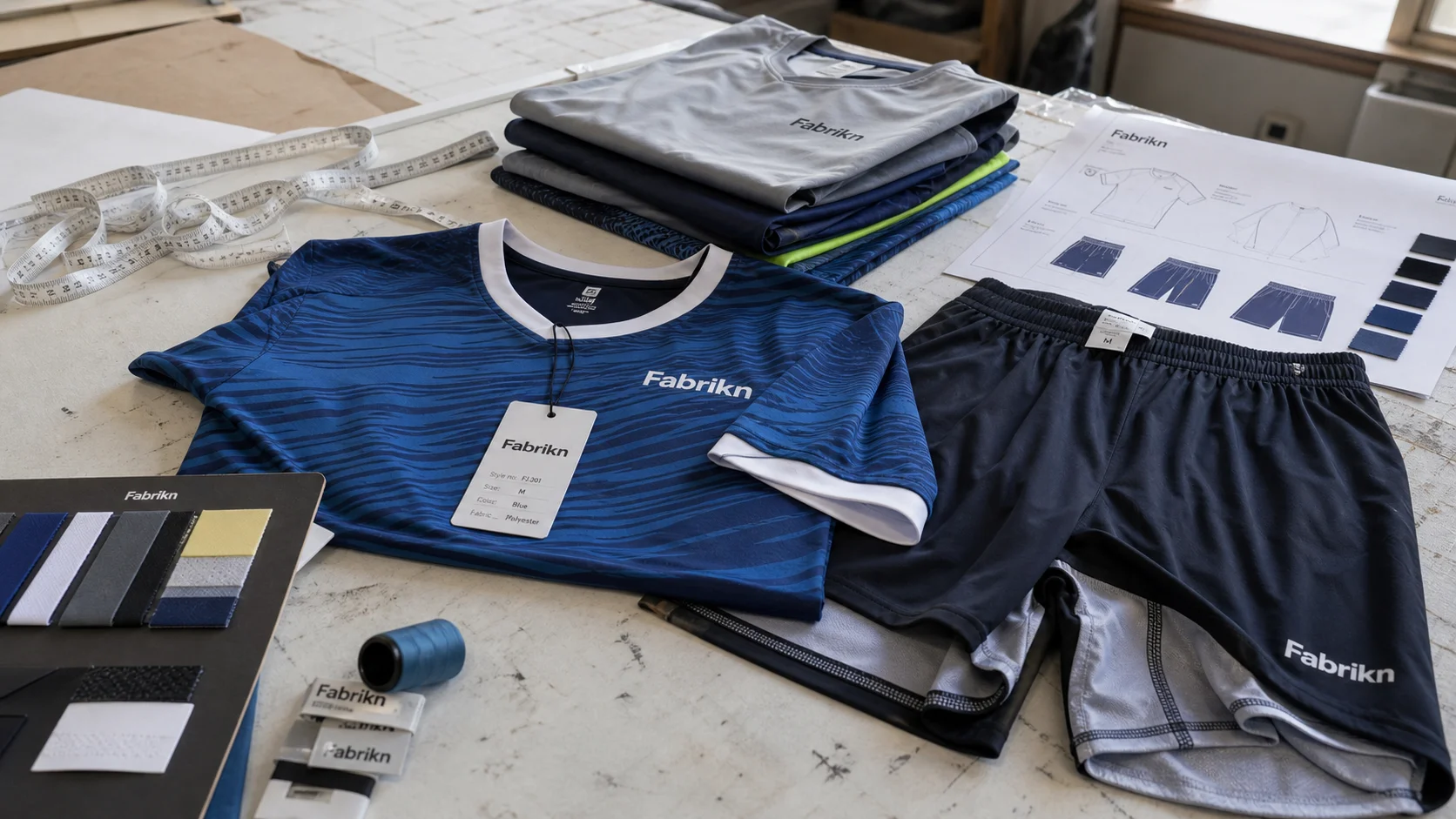
A product-specific SEO outline for sportswear startup buyers comparing wholesale tracksuits, MOQ thresholds, factory production details, and decoration choices for launch-ready orders.
Wholesale Tracksuits MOQ Factory for Startup Buyers - Fabrikn production reference
For startup sportswear buyers, MOQ is usually the first hard commercial barrier when sourcing wholesale tracksuits. The term stands for minimum order quantity, but in real factory negotiations it means far more than one number on a quotation sheet. MOQ affects pricing, fabric booking, color options, trim sourcing, decoration setup, carton planning, and production line efficiency.
In tracksuit manufacturing, MOQ often applies at several levels at once. A supplier may quote one MOQ per style, another per color, and another per fabric composition. That distinction matters because a startup brand ordering 300 sets across three colorways may find that the fabric mill requires a higher dye lot minimum than the sewing factory requires for cutting and stitching.
Typical startup-facing MOQ ranges for wholesale tracksuits often fall into these bands:
Those numbers are not universal. A startup buyer should treat low MOQ claims with caution. A factory may accept a small sewing order but still require the buyer to compromise on fabric weight, available color, or decoration type. That is why MOQ should be reviewed as a package decision, not a headline offer.
For brands comparing partners, it helps to ask whether the MOQ is based on ready fabric stock, greige fabric to be dyed, or a fully custom development route. A low MOQ using in-stock polyester interlock is useful for market testing. A low MOQ for a custom cotton-poly brushed tracksuit is less common and usually carries a price premium.
Sportswear startups do not buy like mature retail programs. They tend to place smaller opening orders, revise tech packs more often, and test product-market fit before committing to wider size curves or color ranges. A tracksuit factory that is ideal for a large chain retailer may not be the right fit for a new brand launching its first two or three SKUs.
The main issue is factory alignment. Large-volume factories prioritize stable repeat orders and broad line loading. Startup buyers need flexibility in development, not just production scale. A practical sourcing decision is to favor a supplier that can explain what can be simplified to hit MOQ without damaging the look of the tracksuit.
That often means asking direct questions:
Startup buyers should be wary of over-customizing early production. A tracksuit can look premium without custom drawcord tips, injected logo pullers, branded elastic, woven tape, and individual gift boxes on the first order. Every extra component pushes MOQ pressure upstream.
A more efficient path is to confirm the silhouette, fit, base fabric, and core branding first. Once sell-through is proven, deeper customization becomes easier to justify.
Buyers exploring production planning and vendor support can review broader sourcing capabilities through Fabrikn’s services. That is often a sensible next step before sending a first tech pack.
MOQ alone does not make a factory suitable. A startup buyer should evaluate whether the supplier can produce consistent tracksuits within the target price range and quality expectation. In practical terms, that means checking process control, communication quality, and the supplier’s willingness to define limitations early.
Tracksuits are commonly made in tricot, interlock, jersey, scuba, double knit, brushed fleece, or cotton-poly blends. The correct fabric depends on end use. A lightweight teamwear tracksuit has different performance needs than a lifestyle fleece set.
Ask for clear fabric specifications such as:
Any supplier that cannot confirm these basics is not ready for serious startup production. Fabric inconsistency is one of the fastest ways to create reorder problems.
Tracksuits look simple until grading issues appear. Sleeve pitch, jogger rise, cuff opening, waistband recovery, and hem balance all affect sellable fit. A startup buyer should ask whether the factory builds first patterns from a spec sheet, a reference sample, or an existing block. Each route has different risk.
A factory working from an existing house block may move faster and support lower MOQ, but the fit may not match the startup’s intended brand identity. A fully fresh pattern gives more control, though it usually adds development time and cost.
Zippers, cords, elastic, eyelets, labels, and packaging components often create hidden MOQ friction. It is common for branded zipper pulls or custom jacquard waistband elastic to require higher trim minimums than the garment itself. Startup buyers should ask for a trim matrix early so they can see which items are stock and which need custom booking.
For decoration-heavy tracksuits, inspection risk rises around print registration, embroidery placement, color matching between top and bottom, and seam puckering near zip areas. Ask whether inline inspection and final random inspection are available, and whether measurement tolerance sheets are used by the quality team.
A reliable supplier should be able to explain common failure points instead of simply promising flawless output.
Since this topic sits under Decoration & Printing, the buyer should pay close attention to how the factory handles branding application. Tracksuits combine stretch, movement, and repeated washing, which means not every decoration method performs equally well on every fabric base.
Screen printing is often cost-effective for medium to larger runs, especially when logo placements are simple. It works well on cotton-rich fleece and some stable knit surfaces. Yet very slick polyester shells may need special ink systems or pre-treatment for good adhesion.
Startup buyers should confirm:
Dye migration is a real concern on sportswear. If the supplier does not discuss it, the buyer should bring it up directly.
Heat-applied graphics are common for startup orders because they reduce setup complexity and support lower quantities. They can also give sharp logo detail. The tradeoff is durability variation. Application temperature, pressure, dwell time, and fabric surface all affect bond strength.
This route can be practical for launch collections, but only if wash testing is reviewed during sample approval.
Embroidery creates a premium look on many tracksuits, especially chest logos and small branding on jogger legs. It can also distort lightweight fabric if backing and stitch count are not managed properly. On tricot or thin polyester knits, puckering is a common issue.
For small startup runs, embroidery may be worth using selectively rather than across multiple large placements.
Sublimation is suitable for polyester-based garments where all-over graphics, side panels, or bold color blocking are needed. It avoids some MOQ issues tied to multi-color printing, but it requires the correct fabric base and careful pattern alignment. Cut-and-sew sublimation can look strong when executed well, though panel mismatch remains a quality risk if process control is weak.
Buyers that need advice on product development and decoration choices often benefit from discussing requirements in advance through Fabrikn’s contact page. Early clarification usually saves sampling rounds later.
Many startup buyers focus on the final order quantity and overlook the approval path that protects that order. In tracksuit production, poor sample control is one of the main causes of bulk disappointment. A sensible factory process should break development into clear stages.
A typical approval flow may include:
Startup buyers should avoid compressing these steps unless they are using stock fabric and a very simple logo application. Skipping a pre-production sample is risky when both jacket and pant need coordinated color, zipper balance, cuff recovery, and consistent branding placement.
A practical checkpoint list for approval should cover:
Bulk mistakes often start with vague comments. Buyers should return consolidated sample feedback in writing, with marked photos where needed. That sounds basic, but it materially reduces interpretation problems.
Lead time for wholesale tracksuits depends on fabric readiness, trim status, sample approval speed, decoration method, and production load. Startup buyers should treat any very short promise with caution unless the order is based on ready materials and limited customization.
Typical lead-time ranges often look like this:
Stage Typical Range Main Dependency Proto sample 7 to 14 days Pattern readiness, available fabric, artwork clarity Fit revision 7 to 10 days Comment accuracy, material substitution needs Lab dips / print strike-offs 3 to 10 days Custom dyeing, print approval method Pre-production sample 7 to 14 days Bulk fabric and trim availability Bulk production 25 to 45 days Order size, line loading, decoration complexityThese are planning ranges, not guarantees. A buyer should ask which component sits on the critical path. In many cases, it is not sewing. It is custom dyeing, zipper procurement, or waiting for artwork approval on transfers.
Inspection timing also matters. If final inspection happens only at the end, startup buyers have less room to correct decoration defects or measurement drift. Inline checks are more useful for preventing repeated errors.
One more point deserves emphasis: top and bottom color matching can become a problem if the jacket and pant panels come from different dye lots or fabric mills. Tracksuits are sold as sets, so mismatch is more visible than on separate garments. Buyers should request confirmation that matching controls are in place.
The cheapest MOQ offer is rarely the best buying decision. Startup sourcing works best when the buyer understands which cost reductions are sensible and which create quality instability.
Reasonable cost-saving moves include:
Riskier cost cuts include:
For startup tracksuits, price must be judged alongside reorder potential. If the first run cannot be repeated consistently because the fabric source is unstable or the print method is marginal, the apparent savings do not hold up commercially.
A better buying framework is to request a quotation with options. For example, compare price levels for stock fabric versus custom dye, embroidery versus transfer logo, and standard zipper versus branded puller. That approach helps buyers see which upgrades matter to brand presentation and which can wait.
Before placing a wholesale tracksuit order, startup buyers should have written confirmation on the main production variables. Verbal alignment is not enough when MOQ, decoration, and fit are all involved.
Startup buyers that want to understand a supplier’s background and general manufacturing orientation can also review the about page before moving into detailed discussions. That step can help frame whether the supplier’s service model fits a growing sportswear brand.
In the end, the best wholesale tracksuits MOQ factory for startup buyers is not simply the one advertising the lowest entry quantity. It is the supplier that can explain what drives MOQ, where customization pressure comes from, and how to protect quality when order sizes are still modest. That kind of transparency matters far more than a sales promise that looks attractive on a landing page but falls apart during sampling.
For sportswear startups, the strongest purchase strategy is usually disciplined rather than ambitious: simplify the first range, choose stable fabric and decoration methods, lock approvals carefully, and build toward scale after the initial sell-through proves demand. That is how startup buyers reduce risk while still creating a tracksuit product that looks market-ready and commercially repeatable.
Get a free quote from Fabrikn — your trusted B2B clothing manufacturer with 10+ years of experience. MOQ as low as 200 pieces.
Get a Free Quote →A common starting point is around 100 to 300 sets per style, depending on whether fabric and trims are in stock or fully custom. Custom dyeing, branded trims, and multiple logo applications usually push the MOQ higher.
Yes, but the options may be narrower. Heat transfer or simpler print programs often work better for lower quantities than highly complex multi-location decoration. Buyers should still ask for wash testing and print approval samples.
The main reasons are fabric mill minimums, dye lot efficiency, trim supplier requirements, and decoration setup costs. Even if the sewing factory can handle small runs, upstream material suppliers may not support very low quantities economically.
There is no single best option. Screen printing can be cost-effective on suitable fabrics, embroidery can add a premium look in small placements, and heat transfer can support lower-volume launches. The right choice depends on fabric type, logo detail, wash expectations, and budget.
Bulk production commonly takes about 25 to 45 days after sample approvals and material readiness. Total development time is longer if proto samples, fit revisions, custom dyeing, or print strike-offs are still pending.
Key checkpoints include fabric weight consistency, color matching between jacket and pants, print durability, embroidery puckering, zipper quality, waistband recovery, measurement tolerance, and overall sewing cleanlines around pockets and cuffs.
Not always. A lower MOQ can help cash flow, but it may come with a higher unit price, fewer fabric options, or reduced customization. Buyers should compare the full package, not only the order minimum.