
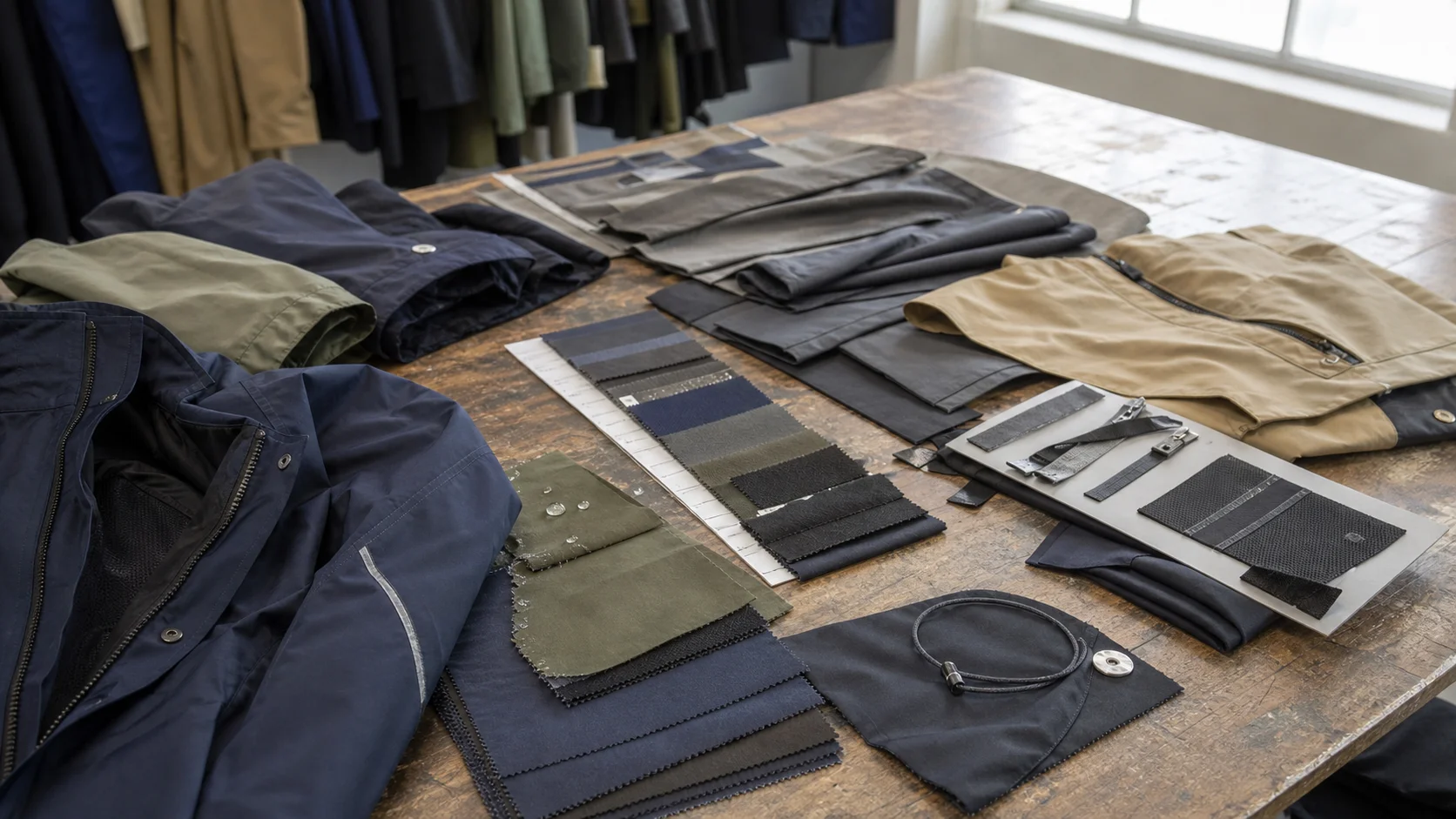
A product-specific testing outline for distributor buyers evaluating wholesale travel coat fabrics, covering performance, durability, comfort, care,...
Travel Coat Fabric Tests for Distributor Buyers - Outerwear & Jackets manufacturing guide
Category: Outerwear & Jackets
Distributor buyers do not need a laboratory degree to buy better travel coats, but they do need a disciplined fabric testing checklist. A travel coat sits in a difficult product space: it must look presentable, pack well, resist weather, survive commuting, and still meet target landed cost. Fabric selection drives most of that performance.
This wholesale travel coat fabric testing guide for distributor buyers explains the key tests, specifications, approval steps, and inspection risks that should be addressed before bulk production. It is written for buyers placing OEM, private label, or wholesale outerwear orders where fabric performance can affect return rates, margin, and brand reputation.
Travel coats are often sold on functional promises: lightweight, water-resistant, wrinkle-resistant, breathable, packable, warm, or easy-care. Those claims are easy to print on a hangtag and much harder to support in production. If the fabric has poor dimensional stability, weak coating adhesion, or inconsistent water repellency, the finished garment can fail even when the sewing quality is acceptable.
For distributor buyers, the risk is amplified because products may move through multiple sales channels. A coat could be sold to retailers, corporate uniform programs, travel accessory shops, online marketplaces, or promotional distributors. Each channel has different customer expectations, but all will penalize obvious defects: leaking seams, faded colors, pilling at the shoulder, broken zippers, coating peel, or shrinkage after care.
Fabric testing reduces uncertainty before committing to bulk. It does not eliminate all risk, and it should not be treated as a paperwork exercise. The strongest value comes when testing is linked to the actual end use, price point, climate, care instructions, and warranty expectations.
A travel coat fabric should be tested against the product promise, not just against a generic outerwear checklist. A budget commuter coat and a premium waterproof travel shell do not need the same test package.
Before asking a supplier for lab reports, define the commercial role of the coat. This keeps the test plan focused and prevents overspending on performance that the customer will not pay for.
A distributor buying an entry-level polyester travel coat may only need basic colorfastness, shrinkage, water repellency, and seam strength checks. A buyer sourcing a premium 3-layer travel raincoat needs a broader program covering hydrostatic pressure, breathability, seam sealing, abrasion, coating or membrane durability, and wash performance.
If you need support building a sourcing specification, a manufacturing partner’s development team can help translate commercial requirements into workable fabric and construction details. For example, buyers can review broader production support through Fabrikn’s services when planning outerwear programs.
Travel coats use many different fabrics. The “best” fabric depends on price point, appearance, weather protection, and packing behavior. Distributor buyers should avoid approving fabric based only on hand feel or swatch appearance.
Polyester is common in travel coats because it is relatively stable, quick-drying, cost-efficient, and suitable for coatings or durable water repellent treatments. It generally resists wrinkles better than cotton and can be engineered in light weights for packable garments.
The tradeoff is comfort. Low-cost polyester can feel clammy, noisy, or plasticky, especially with heavy coatings. Dye lot variation and poor heat setting can also cause shade inconsistency or shrinkage. Buyers should check GSM, yarn count or denier, weave structure, finish, and coating type.
Nylon is often used for lightweight travel shells and packable coats. It can offer strong tear resistance relative to weight and a smoother hand feel. It works well for compact garments that need to be folded into a pouch.
The risk is colorfastness and heat sensitivity. Some nylon fabrics can show shade variation, color bleeding, or coating issues if finishing is poorly controlled. Nylon can also be more expensive than polyester at comparable performance levels.
Cotton-polyester or cotton-nylon blends are used for travel coats with a more natural look. They can feel less technical and more suitable for city travel, business wear, or casual retail programs.
The tradeoff is maintenance. Cotton blends may wrinkle more, absorb water, dry slower, and shrink more than synthetic fabrics. If the coat is marketed as easy-care, wrinkle resistance and dimensional stability tests become especially important.
Coated fabrics and laminated membrane fabrics are used when water resistance or waterproof performance is central to the product. PU coatings, TPU films, and other membrane systems can improve protection, but they add cost and technical risk.
Potential problems include delamination, reduced breathability, poor hand feel, odor, coating cracks, and seam sealing failures. Buyers should not accept “waterproof” claims without test results and clear construction details.
A basic wholesale fabric testing package for travel coats should cover construction, stability, strength, color, comfort, and weather protection. The exact standards may vary by destination market and buyer requirements, but the categories remain consistent.
Composition affects labeling, duty classification, performance, and customer claims. If the approved swatch is described as 100% recycled polyester, polyester-spandex, nylon, or cotton blend, buyers should confirm it through supplier documentation and, for larger orders, third-party testing.
Composition errors create commercial and compliance risk. Incorrect fiber labels can trigger relabeling costs, customs complications, or retailer rejections. Recycled content claims require stronger documentation than ordinary fiber composition claims.
GSM, yarn density, denier, weave type, and coating weight should be recorded. A travel coat fabric that looks fine in a small swatch may feel too flimsy or too heavy when made into a full garment.
Typical lightweight travel shell fabrics may sit around 60-120 GSM. Midweight woven coat fabrics may range from 130-220 GSM. Heavier cotton blends or structured outerwear fabrics can exceed that. These are general ranges, not universal specifications. The right GSM depends on silhouette, lining, insulation, coating, and price point.
Dimensional stability testing checks shrinkage or growth after washing, steaming, or dry cleaning. For machine-washable travel coats, this is a core test. Even small shrinkage can distort sleeve length, lining balance, zipper alignment, and hem shape.
Many buyers set shrinkage tolerance around 3% or less for woven outerwear fabrics, though tighter limits may be needed for tailored styles or mixed-material garments. If the shell, lining, interlining, and seam tape shrink differently, garment twisting or puckering can occur.
Travel coats face stress from luggage straps, seat backs, shoulder bags, pockets, and repeated movement. Tensile strength measures resistance to pulling force, while tear strength indicates how easily a small cut or snag can spread.
Lightweight packable fabrics must be tested carefully because low weight can reduce durability. A fabric that feels attractive at sampling can become a return problem if it tears near pocket openings or underarm seams.
Water performance is one of the most misunderstood areas in travel coat sourcing. “Water-repellent,” “water-resistant,” and “waterproof” are not the same. Distributor buyers should define the claim before approving fabric.
A spray rating test evaluates surface water repellency. It shows how well water beads and rolls off the fabric surface. This is relevant for light rain and drizzle, especially for DWR-finished woven fabrics.
Surface repellency can decline after washing, abrasion, or contamination with oils. Buyers should ask whether the rating is before wash only or after a defined number of washes. A coat that performs well in the showroom but wets out after one wash will create customer dissatisfaction.
Hydrostatic pressure measures resistance to water penetration under pressure. It is more relevant for waterproof or highly water-resistant coats. Higher ratings generally indicate better water resistance, but the garment construction must also support the claim.
A fabric with good hydrostatic pressure can still leak through seams, needle holes, pocket entries, or poorly bonded seam tape. Waterproof claims should be evaluated at both fabric and garment level.
DWR treatment durability should be checked after washing and abrasion. Some lower-cost finishes lose effectiveness quickly. Fluorine-free finishes are increasingly common due to environmental and regulatory pressure, but performance can vary depending on formulation and fabric structure.
The purchasing tradeoff is clear: stronger water repellency may cost more or require more controlled finishing, while cheaper finishes may pass initial tests but fail after limited use. Buyers should specify both initial and after-care performance where the claim matters.
Travel coats are often worn in airports, trains, taxis, and changing climates. A fabric that blocks rain but traps heat can feel uncomfortable during movement. Breathability is especially important for lined coats, laminated shells, and packable rainwear.
Moisture vapor transmission rate, often shortened to MVTR, measures how well moisture vapor passes through the fabric. It is useful for evaluating technical fabrics, though results vary depending on test method.
Buyers should avoid comparing numbers from different test standards as if they are identical. A supplier’s “high breathability” claim needs context: method, unit, test conditions, and whether the result is for fabric only or finished laminate.
Air permeability measures airflow through the fabric. A highly air-permeable fabric may feel comfortable but offer less wind resistance. A tightly woven or coated fabric may block wind but feel less breathable.
This is a product judgment issue. A travel trench for mild weather can tolerate more airflow. A cold-weather travel coat needs better wind blocking. A rain shell with coating may have low air permeability but can still offer vapor transfer through the membrane if engineered properly.
Not every comfort issue appears in a lab report. Fabric hand, stiffness, rustling noise, and drape should be assessed through full-size samples, not just swatches. Travel coats are handled often by shoppers and worn for long periods. A noisy or boardy fabric can reduce perceived value.
Ask for enough sample yardage to make a proto sample or salesman sample before bulk commitment. Small swatches can hide problems in drape and garment balance.
Durability matters because travel coats are exposed to repeated friction from bags, seats, belts, and luggage. The most common failures are pilling, abrasion marks, seam slippage, coating wear, and tearing at stress points.
Abrasion testing helps predict wear at shoulders, elbows, cuffs, pocket edges, and seat-contact areas. For travel coats sold to commuters or frequent travelers, abrasion should be part of the test package.
Low-cost brushed fabrics, soft-touch coatings, and lightweight synthetics can show surface wear early. A fabric may pass visual approval at sampling yet develop shiny patches after limited rubbing.
Pilling is common in blends, brushed surfaces, and fabrics with loose fibers. It is more visible on dark solid colors and can make a coat look old quickly.
Buyers should check pilling after abrasion or standard pilling tests, especially for cotton blends, polyester-viscose blends, and soft shell-like materials. If the product is aimed at premium retail, pilling tolerance should be stricter.
Seam slippage occurs when yarns pull apart at the seam under stress. It is a major risk for loosely woven fabrics and lightweight travel coat shells. Even if the fabric itself is strong, seam areas can fail if yarns shift.
This test is particularly important near armholes, side seams, pocket openings, back vents, and center-back seams. Sewing thread, stitch density, seam allowance, and seam type must be aligned with the fabric.
Coated or laminated fabrics should be checked for adhesion. Delamination can appear as bubbling, peeling, cracking, or separation after washing, folding, or heat exposure.
For travel coats that are packed tightly, coating flexibility matters. A coating that performs on a flat lab sample may crack after repeated folding if it is too brittle.
Outerwear buyers often focus on color approval under a light box, but color performance must also be tested. Travel coats rub against shirts, bags, scarves, car seats, and luggage. Poor colorfastness can lead to staining claims and returns.
Dry and wet rubbing tests are important for dark colors, saturated shades, and coated fabrics. Navy, black, burgundy, olive, and deep brown can transfer color if dyeing or finishing is weak.
Wet rubbing is usually more difficult to pass than dry rubbing. If the coat may be worn in rain, wet rubbing performance matters more than it would for an indoor garment.
Care instructions must match fabric performance. A machine-washable claim requires testing after wash cycles. Dry clean only garments should be tested for dry cleaning compatibility if that is the intended care route.
Mixed-material coats need special attention. Shell fabric, lining, rib trims, drawcords, labels, zipper tapes, and prints may react differently to washing. One weak component can compromise the whole garment.
Lightfastness is relevant for outerwear because coats are exposed to sunlight. Fading can be especially noticeable on dark or bright shades. For travel retail and outdoor use, colorfastness to light should not be ignored.
Buyers should also consider shade continuity across bulk lots. If production is split over multiple fabric lots, panels may not match. Shade banding between sleeves, body panels, hoods, and pocket flaps is a common visual defect.
Travel coats are often promoted as packable or wrinkle-resistant. These are performance claims that require evaluation. A garment that looks crushed after one suitcase trip will not satisfy customers, even if it passes water resistance tests.
Wrinkle recovery testing helps assess how well fabric returns after folding or compression. Polyester and nylon generally perform better than cotton-rich fabrics, but finishes, weave, and fabric weight all influence results.
Buyers should test wrinkle appearance after realistic packing. Fold the sample garment into a pouch or luggage compartment for a defined period, then hang it and evaluate recovery. This practical check should sit alongside any lab test.
Some coated fabrics develop pressure marks or permanent crease lines when folded tightly. This is a major risk for packable travel coats. Metallic coatings, matte PU coatings, and soft-touch finishes can be particularly vulnerable.
If the garment is sold with a pouch, test the coat after repeated packing. The packaging method should not damage the finish before the customer even wears it.
Fabric thickness, lining, insulation, zipper size, and seam construction all affect packability. A low-GSM shell does not guarantee a compact garment if the lining is bulky or the trims are oversized.
Distributor buyers should request packed measurements and weight for finished samples. These details help with carton planning, freight cost, retail display, and online product descriptions.
Fabric does not work alone. Zippers, snaps, buttons, drawcords, linings, seam tape, interlinings, labels, and pocket bags must be compatible with the shell fabric. Many outerwear problems come from mismatched components rather than the main fabric itself.
The lining should move with the shell and not shrink, twist, bleed, or create static problems. If the shell is stretchy but the lining is not, movement can feel restricted. If the lining shrinks more than the shell, hems and cuffs may pull out of shape.
For travel coats, lightweight polyester taffeta, mesh, brushed tricot, or stretch linings may be used depending on style. Each option changes warmth, comfort, and cost.
Lightweight fabrics can pucker around heavy zippers. Waterproof zippers add cost and stiffness. Vislon, nylon coil, metal, and reverse coil zippers all create different appearance and performance outcomes.
For water-resistant coats, zipper tape colorfastness and water resistance should be reviewed. For premium coats, zipper smoothness and slider durability affect perceived quality.
If the coat claims waterproof performance, seam sealing may be required. Seam tape must bond properly to the fabric coating or laminate. Poor bonding can cause peeling, leaking, or stiffness.
Buyers should request seam tape compatibility testing before bulk. The test should reflect actual production temperature, pressure, tape type, seam construction, and fabric finish.
A structured sample approval process prevents confusion and reduces the chance of approving a good-looking sample with weak bulk reproducibility. Distributor buyers should keep approved fabric, trims, measurements, and test reports linked under one product file.
Start with fabric swatches showing color, hand feel, weight, and finish. Ask for technical details: composition, GSM, width, finish, coating, DWR type where relevant, and available colors.
Swatches are only a first filter. They are not enough for bulk approval because they do not show garment drape, sewing behavior, lining balance, or packability.
Lab dips should be reviewed under standardized lighting. Buyers should specify the approved light source if color consistency is important. Dark colors and neutrals used across multiple styles require tighter control.
For repeat programs, keep approved color standards from the previous season. Shade drift can damage continuity for distributors selling replenishment programs.
The proto sample checks silhouette, construction, fabric behavior, and obvious fit issues. At this stage, buyers should evaluate whether the fabric suits the design. If the fabric puckers, sags, rustles, or feels too warm, fixing it later becomes expensive.
Fit approval should consider movement, layering, sleeve rotation, and travel use. A travel coat may be worn over shirts, sweaters, or business jackets. Tight armholes or stiff shell fabrics reduce comfort.
Size set samples help identify grading problems. Larger sizes may place more stress on seams, zippers, and armholes, so durability concerns should not be judged only on a medium sample.
The pre-production sample should use approved bulk fabric, trims, lining, labels, and construction. This is the critical checkpoint before mass production. Any change after PP approval should be documented and reapproved.
For more structured production planning, buyers can compare the supplier’s process with expectations outlined through Fabrikn’s company information and sourcing approach.
Testing decisions affect MOQ, lead time, and unit cost. A distributor buyer should understand these tradeoffs early rather than after the order is placed.
MOQ varies by fabric type, dyeing method, trims, and factory capacity. For travel coats, typical wholesale garment MOQ may range from around 300 to 1,000 pieces per style for simpler stock fabric programs. Custom fabric, custom colors, special coatings, or laminated materials may require higher commitments, often 1,000 to 3,000 pieces or more per color or fabric lot.
These ranges are not guarantees. A supplier using available fabric may accept lower quantities, while a mill-developed fabric can require significantly more. Buyers should confirm whether MOQ is per style, per color, per size, or per fabric order.
Fabric testing can take several days to several weeks depending on the test package and lab availability. Basic composition, GSM, shrinkage, and colorfastness tests may be faster. Waterproof performance, wash durability, coating adhesion, and restricted substance testing may take longer.
If testing is added after fabric is already in production, delays can become expensive. The better approach is to build testing into the development calendar before PP sample approval.
Performance fabrics cost more because they require better yarns, denser construction, coating, lamination, finishing control, or branded components. Testing also has direct cost. For small orders, a full premium test package can feel disproportionate.
The purchasing question is not whether testing is cheap. It is whether the claim, customer expectation, and order value justify the test. For a basic promotional coat, a limited test package may be acceptable. For a travel coat sold as waterproof, breathable, and packable, weak testing is a false economy.
Even tested fabric can fail in bulk if production control is weak. Distributor buyers should include fabric and garment inspection points before shipment.
Factories should inspect fabric rolls before cutting. Common defects include shade variation, stains, coating streaks, holes, slubs, creases, bowing, skewing, and uneven width. Roll-to-roll shade variation is especially risky for outerwear because large panels make shade differences visible.
Buyers should confirm whether the supplier uses a 4-point inspection system or another documented fabric inspection method. Defect records should be tied to roll numbers.
Fabric direction matters. Nap, sheen, coating direction, print direction, and mechanical stretch can all affect appearance. If panels are cut in mixed directions, the finished coat may show shade or texture mismatch.
For coated or laminated fabrics, cutting and handling must avoid permanent creases. Spreading tension should be controlled to prevent distorted panels.
Needle size, stitch density, thread type, and seam construction should be appropriate for the fabric. Lightweight coated fabrics may show needle damage. Dense fabrics may cause skipped stitches or seam puckering. Loosely woven fabrics may suffer seam slippage.
Water-resistant garments need careful pocket, hood, cuff, and closure construction. A strong fabric does not compensate for weak seam design.
Finished garment inspection should include measurements, workmanship, shade matching, stains, seam puckering, zipper function, snap strength, lining balance, label accuracy, and packing condition. Functional checks should match the product claim.
If a coat is sold as packable, inspect the packed appearance. If it is sold as water-resistant, check whether critical openings are constructed reasonably. If it is sold as machine washable, care labels must match tested performance.
A good travel coat fabric specification is not the longest possible document. It is a clear set of requirements that protects the buyer’s main selling claims. Distributor buyers should spend testing budget where failure would be visible, costly, or legally risky.
A basic test package may be enough for a low-risk travel coat using standard woven polyester, stock colors, simple lining, and light water-repellent positioning. In this case, focus on composition, GSM, shrinkage, colorfastness, seam strength, and basic water repellency.
This approach can work for lower MOQ programs, promotional apparel, and simple private label orders where the product is not sold as technical outerwear. The buyer still needs clear approved samples and final inspection.
More testing is justified when the coat carries stronger claims or a higher price point. Waterproof, breathable, seam-sealed, packable, recycled, wrinkle-resistant, or premium commuter coats should receive more scrutiny.
Technical claims increase customer expectations. They also give retailers more reason to reject goods if documentation is weak. For larger distributor programs, the cost of one failed shipment can exceed the cost of proper testing many times over.
Substitution is a common risk in wholesale outerwear. A supplier may propose a similar fabric if the original fabric is unavailable, too expensive, or below MOQ. Similar appearance does not mean equal performance.
Any substitute fabric should be treated as a new approval: swatch, technical data, lab dip if needed, test results, and garment sample. This is especially important for coated fabrics, stretch fabrics, recycled materials, and custom colors.
The purchase order should reference the approved fabric quality, color standard, performance requirements, testing responsibilities, inspection criteria, packing method, and care label. Vague terms such as “same as sample” are not enough on their own.
For buyers preparing a new travel coat program, direct supplier communication at the development stage is useful. Distributor teams can contact a manufacturing partner through Fabrikn’s contact page to discuss specifications, sampling, and order planning.
Travel coat fabric testing is not only a technical exercise. It is a purchasing control system. The fabric must support the product promise, the care label, the sales channel, and the expected price. A coat that looks good in one sample can still fail through shrinkage, color transfer, leaking, pilling, seam slippage, or coating breakdown.
Distributor buyers should start with product positioning, define measurable claims, approve fabric through structured sampling, and request testing that matches real use. MOQ, lead time, and cost will vary by fabric and performance level, so testing should be planned early rather than added at the last minute.
The safest buying approach is direct: do not pay for technical features the customer will not value, but do not under-test claims that drive the sale. For travel coats, fabric performance is the foundation of margin protection.
Get a free quote from Fabrikn — your trusted B2B clothing manufacturer with 10+ years of experience. MOQ as low as 200 pieces.
Get a Free Quote →The most important tests usually include fiber composition, GSM, dimensional stability, colorfastness to rubbing and washing, tear strength, seam slippage, abrasion resistance, and water repellency. If the coat is sold as waterproof or breathable, hydrostatic pressure, breathability, seam tape compatibility, and coating adhesion should also be included.
Typical garment MOQ may range from about 300 to 1,000 pieces per style when using available stock fabric. Custom colors, custom coatings, laminated fabrics, or mill-developed materials may require around 1,000 to 3,000 pieces or more per color or fabric lot. Actual MOQ depends on the supplier, fabric mill, trim requirements, and production schedule.
No. Water-resistant fabric can resist light moisture but may allow water through under pressure or prolonged exposure. Waterproof fabric should meet higher water penetration standards, often measured by hydrostatic pressure. Garment construction also matters because seams, zippers, pockets, and needle holes can leak even when the fabric itself performs well.
Both stages matter. Initial fabric testing helps screen material before commitment. Garment samples then show how the fabric performs in real construction, including drape, seam behavior, lining balance, packability, and trim compatibility. Final pre-production approval should use actual bulk fabric and trims.
Buyers should check fabric weight, coating flexibility, wrinkle recovery, pressure marks, and appearance after repeated folding. A practical packing test is useful: fold the garment into its pouch or luggage-like condition, leave it for a defined period, then hang and inspect recovery, creases, coating marks, and zipper function.
Common failures include shade variation, seam puckering, weak seam strength, coating streaks, zipper malfunction, lining imbalance, poor water repellency, stains, skipped stitches, incorrect labels, and packing creases. Coated and laminated fabrics also carry risks of delamination, tape peeling, and permanent pressure marks.
Treat the substitute as a new material. Request full technical details, compare hand feel and weight, approve lab dips if color is affected, run relevant tests, and make a garment sample before bulk approval. Do not rely only on visual similarity.
They need the same performance testing as conventional polyester, plus documentation for recycled content claims. Buyers should request credible certification or transaction documentation where required by the sales channel. Recycled content does not automatically guarantee equal durability, colorfastness, or coating performance.