
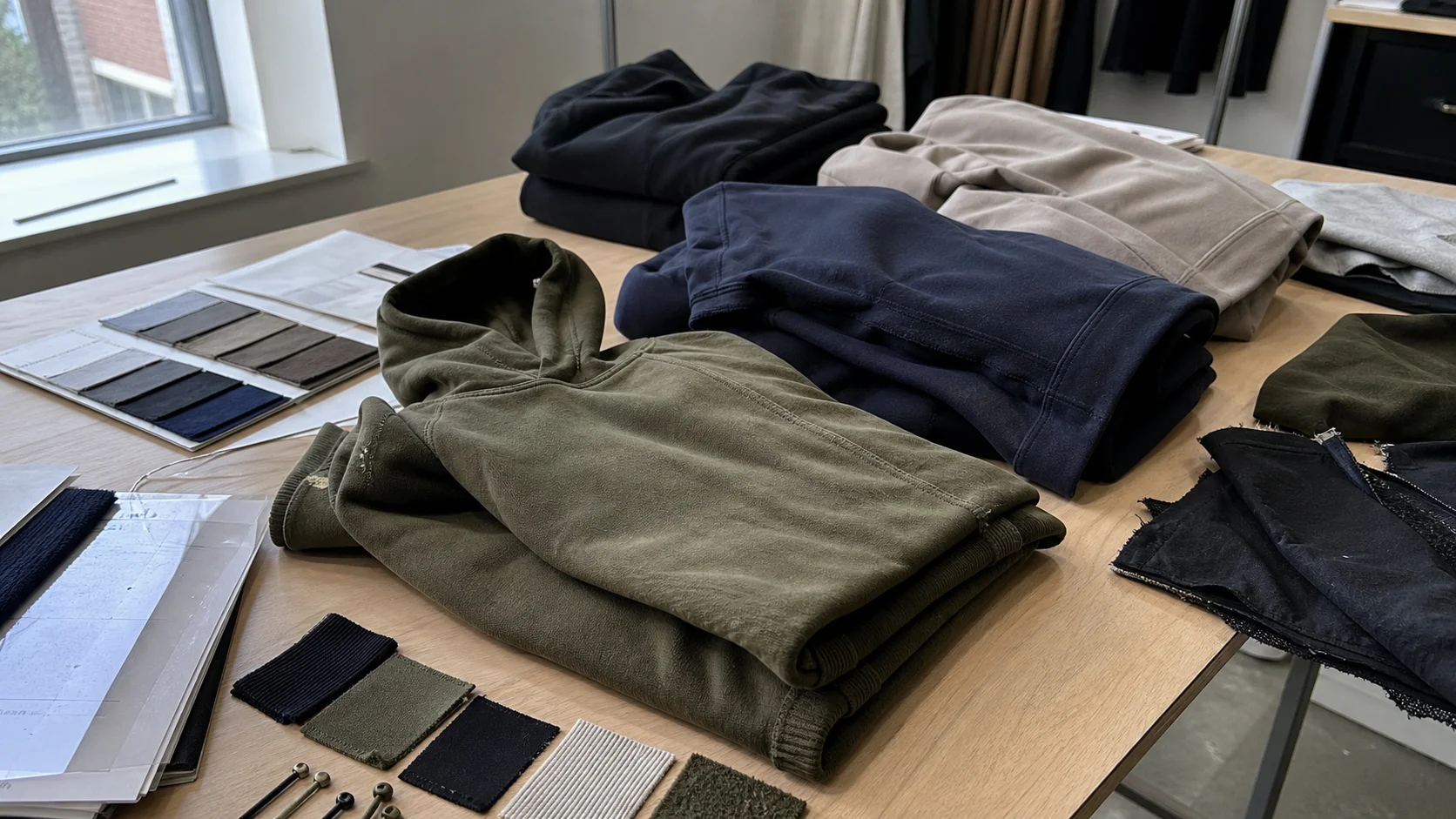
A practical production-focused outline for security contractors buying wholesale undyed twill coats, covering shrinkage testing, fiber behavior, wash...
Wholesale Undyed Twill Coat Shrinkage Control Plan - Fabrikn production reference
For security contractors, coat performance is not a styling detail. It affects comfort, uniform consistency, durability, and how the garment holds up after repeated wear and laundering. When the product is a wholesale undyed twill coat, shrinkage control becomes even more important because the fabric is often left in its natural state, with less chemical processing and fewer finishing interventions to stabilize dimensions. That can be a strength from a sustainability standpoint, but it also means buyers need a clear control plan before production starts.
This article covers how to specify, test, and manage shrinkage risk for wholesale undyed twill coat programs serving security contractors. It is written for sourcing teams, uniform program buyers, and private-label customers who need practical production guidance rather than broad sustainability claims.
An undyed twill coat is typically made from cotton, cotton-rich blends, or other natural-fiber fabrics that retain their base color rather than being dyed after weaving. The twill weave gives the fabric diagonal structure, which is useful for workwear because it usually improves abrasion resistance, drape, and visual body.
For security contractors, the coat usually serves as outer identification or a layered uniform piece. Depending on the program, it may include features such as patch pockets, reinforced seams, epaulets, reflective tape, branded labels, or concealed closures. The simpler the construction, the easier it is to keep shrinkage and fit variation under control. The more trim elements and lining components added, the more variables the buyer needs to manage.
Undyed fabric is often attractive in sustainable fashion programs because it can reduce wet processing inputs associated with dyeing. That does not eliminate the need for technical review. Natural-colored fabrics can still shrink, twist, skew, and distort if the yarn, weave, finishing, and washing methods are not properly controlled.
In a retail coat, small size drift may be tolerated. In a contractor uniform program, shrinkage problems become a service issue. A coat that changes length or chest width after laundering can affect a team’s appearance and can also create comfort complaints. When a security contractor outfit is issued in bulk, inconsistency across sizes is often more damaging than a single defective unit.
There are three common business consequences:
For programs with multi-site uniform distribution, shrinkage is not just a textile issue. It becomes a logistics and procurement issue. A buyer should define acceptable dimensional change early, not after production is already underway.
Pure cotton twill usually has more shrinkage risk than stabilized blends, especially if the fabric has not been pre-shrunk or compacted. Cotton-poly blends often shrink less, but the buyer should not assume low shrinkage without test data. Even blends can distort if the cotton component is high or if finishing is weak.
Looser constructions may relax more after the first wash. Tighter weaves can be more stable, but they may feel heavier or less breathable. That tradeoff matters for security work, where movement and temperature control both matter.
Compacting, sanforizing, or other stabilization methods can reduce shrinkage. If the fabric is undyed, some mills may still use mechanical finishing to improve stability without adding color. Buyers should ask exactly what was done, not rely on generic claims like “pre-shrunk.”
Seam balance, stitch density, seam allowance, and fusible components all affect how the coat behaves after washing. A coat with fused facings or collars can pucker if the fabric and interlining shrink at different rates.
The same garment may perform differently under home washing, industrial washing, or repeated low-temperature wash cycles. Security contractor uniforms often enter mixed laundering environments, so the care instruction must match reality. If the buyer expects machine washing, the garment should be tested under that exact condition.
A useful shrinkage control plan has five parts: fabric selection, lab testing, sample approval, production control, and end-use care alignment. Each part reduces risk in a different way. Skipping any one of them leaves a gap.
Before sampling starts, define the acceptable shrinkage range. For many woven workwear programs, buyers often look for shrinkage in the low single digits after first wash, but the exact tolerance should be set by the product spec and end-user requirements. The key is consistency. A uniform program can tolerate a modest shrink rate better than unpredictable variation across size sets.
For wholesale undyed twill coat production, the safest approach is often a fabric that has already been mechanically stabilized. Ask for the fabric mill’s finishing method, fabric width, grams per square meter, yarn count, and fiber composition. If the program is sustainability-led, buyers may want to avoid excessive chemical finishing, but that decision should be balanced against the need for dimensional stability.
There is a practical tradeoff here: the more natural and minimally processed the fabric, the more testing and wash validation you need. Sustainability does not replace technical compliance.
Fabric shrinkage testing should be done before cutting bulk fabric. Ask for results from a recognized method such as a wash dimensional stability test suitable for woven cotton or blends. The test should reflect the actual laundering expected for the coat. If the program uses industrial laundering, test that scenario. If it uses home laundry, test that scenario.
Useful checks include:
Approvals should not stop at a paper spec. The right process is to review a proto sample, a fit sample, and a pre-production sample after wash testing. In a coat program, the pre-production sample matters most because it reflects the final fabric, final trim package, and final construction method.
When reviewing samples, look at length, sleeve balance, pocket position, collar shape, closure alignment, and reflective or badge placement if relevant. A coat that looks fine before washing can shift after laundering. That is why sample approval should include a washed version, not only an unwashed version.
Different trims shrink or react differently. Cotton tape, polyester webbing, fusible interfacing, buttons, snaps, and reflective tape all behave differently in wash conditions. A shrinkage plan should state the exact trim suppliers or at least the exact trim specifications. Substitution without approval creates avoidable risk.
Shrinkage control is not only about the main fabric. A stable coat can still fail if collars, cuffs, facings, or tape shrink at a different rate from the body fabric.
A technical pack for wholesale undyed twill coat sourcing should include more than size and color. For shrinkage control, the buyer should specify the details that determine wash behavior and construction stability.
Specification Area What to Define Why It Matters Fiber content Cotton, organic cotton, cotton-poly blend, or other natural blend Affects shrinkage, breathability, and wash recovery Fabric weight GSM or oz/yd² Influences drape, durability, and drying performance Weave Twill angle, yarn count, construction density Changes stability, hand feel, and abrasion resistance Finishing method Pre-shrunk, compacted, sanforized, or equivalent Directly affects dimensional stability Interlining Type, weight, fusibility, shrinkage behavior Prevents puckering and collar distortion Thread Fiber type and ticket size Different thread shrinkage can cause seam tunnel effects Closures Buttons, snaps, zippers, hook-and-loop, or concealed placket Hardware must remain functional after laundering Care label Wash temperature, drying method, ironing limits Aligns end-user behavior with tested performanceIf the coat is being developed as part of a broader sustainable fashion uniform line, the buyer should also ask whether any coatings, resin finishes, or heavy chemical softeners were used. These can affect hand feel and shrinkage behavior, and they may complicate environmental claims.
Sample approval is where many shrinkage problems are caught early, but only if the process is disciplined. A visual review alone is not enough. The sample should be measured before and after wash, then compared to the approved size spec.
A practical approval flow often looks like this:
The most common mistake is approving a sample because it “looks good” unwashed. That creates false confidence. A coat can pass a visual check and still fail dimensional tolerance once it is laundered.
Buyers working with fabrikn.com can review service options at /services/ and use the /contact-us/ page to request sample support or technical follow-up. For sourcing teams that need background on capability and process, the /about-us/ page is also useful.
Once bulk production starts, the shrinkage plan still needs control. Fabric lots can vary, and a stable sample does not guarantee every roll will behave the same way. This is where pre-production and in-line checks matter.
For bulk inspection, the buyer should require measurement records from random units taken from the first production lot. If the program is large, it is sensible to check more than one size and more than one production bundle. Shrinkage may not appear uniformly across the size range.
It is also wise to confirm how the factory stores cut panels before sewing. High humidity or long storage can alter natural-fiber dimensions. That risk is often overlooked when teams focus only on final wash testing.
A shrinkage control plan is incomplete if the care label conflicts with real use. Security contractors may wash uniforms frequently, sometimes with mixed loads and limited temperature control. The care instructions need to be realistic, easy to follow, and consistent with testing.
If the coat has been validated for low-temperature machine washing and line drying, state that clearly. If tumble drying is expected to increase shrinkage, the label should warn against it. Buyers should not rely on the assumption that users will follow ideal care. They usually do not.
Good care guidance is simple:
For contractor uniforms, the best care instruction is the one that protects the product and can still be followed in the field.
Sustainable fashion sourcing is often framed around material choice, but technical stability is part of sustainability too. A coat that shrinks excessively creates waste through returns, remakes, and shortened service life. That undermines the environmental case for using undyed fabric in the first place.
Buyers should evaluate the whole program:
There is a practical sourcing judgment to make here. A slightly more engineered undyed twill may be the better sustainable choice if it lasts longer and reduces replacement volume. Lower processing is not automatically the greener outcome if the garment becomes short-lived.
Wholesale coat programs often depend on fabric availability, testing, and trim sourcing. For undyed twill coat production, MOQs can vary widely by material and construction complexity. A simple, standardized style may be possible at a lower quantity, while custom trims, specialty finishing, or multiple size runs usually push the minimum higher.
As a rough planning reference, many wholesale woven outerwear programs start around a few hundred pieces per colorway or style, while more specialized sustainable fabric requests can require higher commitments. Lead time usually depends on the time needed for fabric procurement, wash testing, sample approval, and bulk sewing capacity. A realistic schedule should include extra time for shrinkage testing and any corrective sample round.
Buyers should be cautious about compressed timelines. When a supplier promises fast delivery without discussing wash testing or fabric stabilization, the risk usually shifts to the buyer later in the program.
A reliable wholesale undyed twill coat shrinkage control plan is built on measurable fabric stability, controlled sampling, and realistic care guidance. For security contractors, the goal is not simply to make an environmentally friendly coat. The goal is to make a uniform piece that stays consistent after wear and laundering.
If the fabric is selected carefully, the trim package is locked early, and wash testing is tied to the actual end use, shrinkage can be managed to an acceptable level. If any of those steps are skipped, the risk of fit complaints and replacement costs rises quickly.
For teams building a sustainable fashion uniform line, the most reliable approach is to treat shrinkage control as part of product quality, not as a separate technical afterthought.
Get a free quote from Fabrikn — your trusted B2B clothing manufacturer with 10+ years of experience. MOQ as low as 200 pieces.
Get a Free Quote →There is no single best option, but a stable cotton or cotton-rich twill with mechanical pre-shrinking is often a practical starting point. The right choice depends on the balance between sustainability goals, durability, and wash performance.
Acceptable shrinkage depends on the product spec, size range, and laundering method. Many buyers aim for low single-digit dimensional change after wash, but the exact target should be written into the technical pack and confirmed by test results.
Yes. Undyed fabric can still shrink, skew, or distort. Natural color does not reduce the need for dimensional stability testing.
Common causes include unstable fabric finishing, unbalanced construction, incompatible interfacing, and laundering conditions that do not match the original test method.
Yes, but the sourcing team needs to balance reduced processing with enough stabilization to keep the garment functional. Sustainability works best when the product lasts and performs consistently.
Buyers can review capability information on /services/, learn more about the company on /about-us/, or send a sourcing inquiry through /contact-us/.