
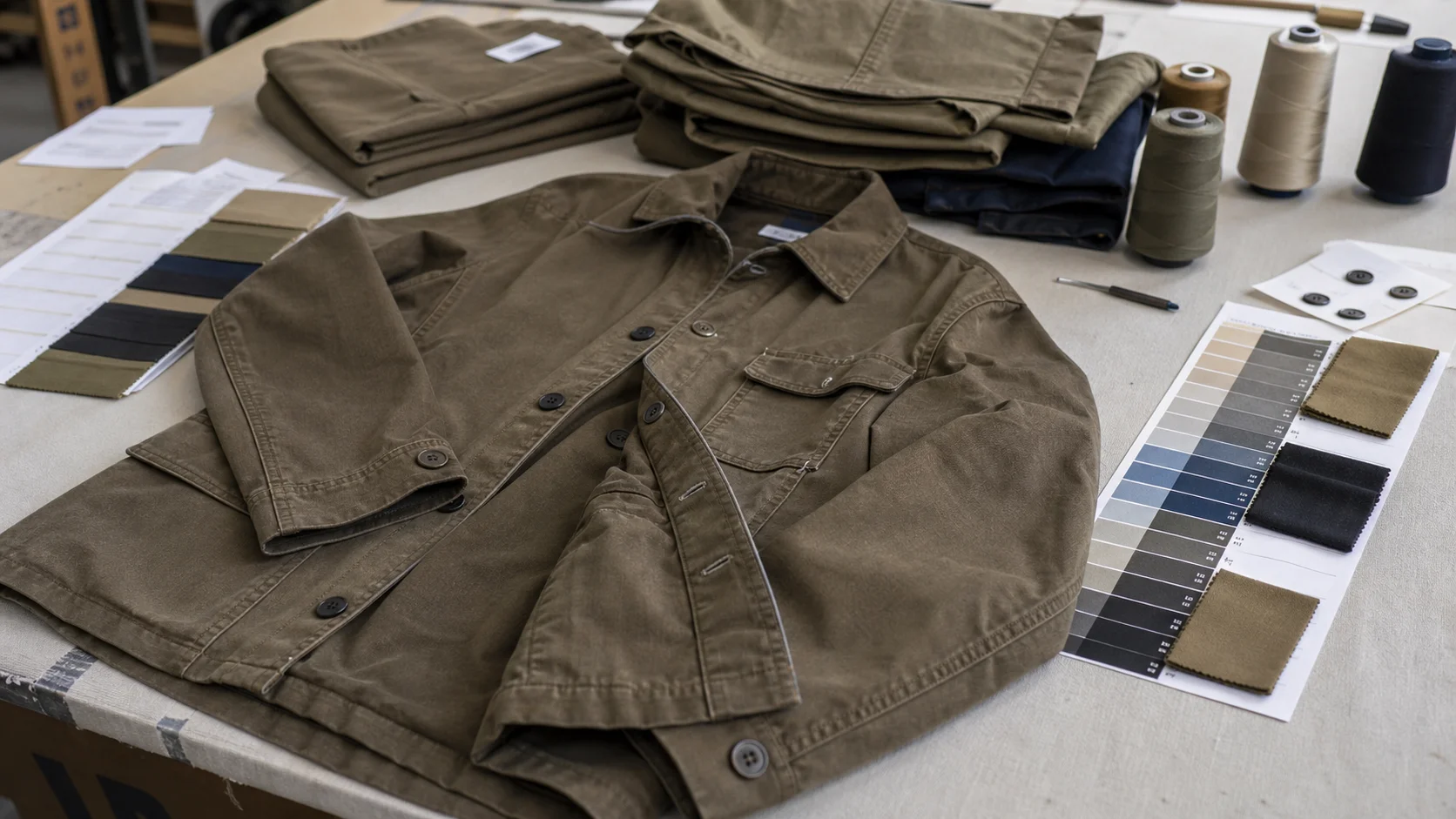
A distributor-focused outline for auditing wholesale utility coat colorfastness, including fabric risks, lab tests, trim checks, wash validation,...
Utility Coat Colorfastness Audit for Buyers - Outerwear & Jackets manufacturing guide
Wholesale utility coat colorfastness audit for distributor buyers is not a cosmetic checkpoint. It is a commercial risk control step. Utility coats are expected to handle outdoor wear, repeated laundering, warehouse handling, retail display lighting, and contact with bags, gloves, scarves, vehicle seats, and other garments. When color transfers, fades unevenly, stains labels, or bleeds during washing, the distributor is usually the party facing returns, markdowns, chargebacks, and retailer complaints.
For buyers sourcing utility coats in bulk, colorfastness should be audited before bulk fabric cutting, during production, and before shipment. The audit should connect lab test results with real production materials: shell fabric, lining, pocketing, tapes, drawcords, buttons, snaps, zipper tapes, badges, labels, and trims. A coat can pass shell fabric testing and still fail in the market because a dark cord bleeds onto a light lining or a garment wash causes shade variation across panels.
This guide is written for distributor buyers, importers, and wholesale outerwear teams that need practical control over colorfastness before placing large orders. It covers the audit scope, common failure points, test methods, fabric and trim specifications, MOQ realities, sample approval steps, lead-time dependencies, inspection risks, and purchasing tradeoffs.
Utility coats sit between fashion outerwear and workwear-inspired casual jackets. They often use cotton twill, cotton-poly blends, nylon-cotton, canvas, ripstop, corduroy collars, garment-dyed fabrics, pigment-dyed finishes, enzyme washes, wax-touch coatings, or water-repellent treatments. These materials and processes can create a strong retail look, but they also increase the chance of color movement.
Distributor buyers usually handle multiple selling channels: boutiques, workwear retailers, online stores, promotional buyers, uniform accounts, or regional wholesalers. Each channel has a different tolerance for shade difference and post-sale complaints. A fashion retailer may accept slight garment-dye irregularity if it is part of the approved look. A uniform buyer may reject the same variation because all staff jackets must match.
Colorfastness failures are expensive because they are often discovered late. The coat may look acceptable at final inspection under factory lighting. The problem appears after a customer wears a dark olive coat over a white hoodie, washes a black utility coat with lighter garments, or stores tan coats next to dark trims during humid transport. At that stage, the buyer cannot solve the issue with a simple repair.
For wholesale utility coats, colorfastness should be treated as a performance requirement, not only a shade approval issue. Buyers should confirm how color behaves under rubbing, washing, water, perspiration, light, and pressing conditions.
Colorfastness risk is not equal across all programs. It rises when the order uses deep shades, garment dyeing, heavy washing, contrast trims, light linings, brushed surfaces, or multiple fabric suppliers. It also increases when a buyer requests short lead times and skips lab testing to hit a selling season.
For distributor buyers, the direct risks include rejected deliveries, retailer claims, delayed launches, extra inspection costs, customer refunds, damaged brand perception, and inventory that must be discounted. The indirect risks can be even larger. A poor-performing jacket can make retailers question the distributor’s technical control, even if styling and pricing were competitive.
Colorfastness also affects compliance documentation. Many retailers and corporate accounts require minimum performance levels in their vendor manuals. A distributor that cannot provide test reports may lose shelf space or be forced into extra third-party testing at a late stage. That is rarely efficient.
A proper audit starts before purchase order confirmation. The buyer should define the required colorfastness standards in the tech pack, purchase contract, and approved sample records. Vague language such as “good colorfastness” is not enough. It gives the supplier too much room to interpret what is acceptable.
The audit should cover material selection, lab testing, sample review, bulk fabric approval, inline checks, final inspection, and packaging conditions. It should also confirm whether all production components are the same as the tested components. Substitution is a common problem in bulk orders, especially when suppliers are under cost or timing pressure.
Buyers sourcing through manufacturing partners can request structured development and production support through Fabrikn’s services when building outerwear programs that require defined material control and sampling steps.
The fabric choice largely determines colorfastness risk. A utility coat made from solution-dyed synthetic fabric behaves differently from a garment-dyed cotton canvas coat. Buyers should understand the practical tradeoff before approving a style only on appearance.
Material or Finish Typical Colorfastness Risk Buyer Control Point Cotton canvas or twill May fade with washing and rubbing, especially in dark shades Check dry and wet rubbing, wash fastness, shrinkage, and after-wash shade Cotton-poly blend Usually more stable than pure cotton, but blend dyeing must be controlled Confirm fiber dye compatibility and bulk lot consistency Nylon or polyester shell Can perform well, but poor dye fixation or coating issues may cause crocking Test rubbing, water, perspiration, and heat/pressing response Garment-dyed cotton High shade variation and bleeding risk if not properly fixed Approve washed garment standard, require batch testing, and set shade tolerance Pigment-dyed fabric Intentional fading may produce poor rubbing fastness Decide if the aesthetic justifies the higher complaint risk Wax-touch or coated fabric Color may shift with heat, abrasion, or folding pressure Check packing creases, rubbing marks, and surface migration Water-repellent finish Finish can affect shade, handfeel, and reprocessing stability Test after finishing, not only on greige or dyed fabricCotton canvas is popular because it gives structure and a familiar workwear look. It is also one of the materials where colorfastness must be watched closely. Dark navy, black, charcoal, forest green, and deep brown shades can show dry rubbing on light surfaces. Wet rubbing may be worse if dye fixation is weak or if the fabric has been heavily softened.
Buyers should ask whether the fabric is piece-dyed, yarn-dyed, garment-dyed, pigment-dyed, or reactive-dyed. Reactive dyeing can perform well on cotton when properly fixed and washed off, but performance still depends on the mill’s control. Pigment dyeing can create an attractive washed look but often carries lower rubbing fastness. That is a purchasing tradeoff, not a lab detail to ignore.
Nylon, polyester, and blended shells can reduce some fading issues, but they introduce different risks. Coatings, laminations, and water-repellent finishes can change shade or affect rubbing performance. Heat used in pressing or fusing can also create visible variation. If a utility coat includes quilted lining, insulation, or bonded parts, the buyer should confirm color stability after finishing and pressing.
Blended fabrics need careful dye selection. If cotton and polyester portions do not dye evenly, the garment may show a heathered effect that was not intended. In some cases, it looks acceptable on a swatch but becomes uneven across large coat panels. Bulk approval should be based on full-width fabric and garment samples, not only small lab dips.
Many utility coat colorfastness failures come from components rather than the main shell fabric. Distributor buyers sometimes focus on the approved shell color and overlook zipper tape, drawcords, labels, inner binding, lining, or pocketing. The customer does not separate those details. If a black drawcord bleeds onto a stone-colored collar, the finished coat fails.
Outerwear has more components than a basic shirt. That means more suppliers and more opportunities for mismatch. Every dark trim touching a light surface should be considered a risk point. Components that face moisture, friction, or heat need special attention.
Specification sheets should identify trim color codes, material composition, supplier references where available, and minimum colorfastness levels. If exact supplier disclosure is not possible, the buyer should at least require that bulk trims match approved samples and pass agreed testing before production use.
Buyers do not need to be lab technicians, but they should know what each test is meant to reveal. Colorfastness performance is not one single number. A fabric may pass washing but fail wet rubbing. Another may pass rubbing but fade under light. The audit should reflect the coat’s real use conditions.
Test Area What It Checks Why It Matters for Utility Coats Colorfastness to rubbing or crocking Color transfer under dry and wet friction Important for dark coats worn over light garments or handled frequently Colorfastness to washing Shade change and staining after laundering Critical for washable utility coats and uniform programs Colorfastness to water Staining or bleeding under water exposure Relevant for rain, damp storage, and humid shipping Colorfastness to perspiration Color movement under acidic or alkaline sweat conditions Useful around collars, cuffs, underarms, and shoulder areas Colorfastness to light Fading after exposure to light Important for retail display and outdoor wear Colorfastness to pressing or heat Shade change or staining under heat Relevant for fusing, ironing, steaming, and finishing Color migration Dye movement between materials during storage Important when dark and light components touch in packed cartonsCommon international methods may include ISO, AATCC, or retailer-specific protocols, depending on the sales market. Buyers should not assume one test report covers every risk. If the coat is sold in the United States, AATCC methods may be requested by certain retailers. If the coat is sold in Europe or other international markets, ISO methods may be more common. Large retailers may provide their own manual with exact methods and minimum ratings.
Many commercial outerwear buyers target ratings around Grade 4 or higher for key colorfastness areas, with some tolerance for dark shades or special washed effects. Wet rubbing is often the hardest area for deep cotton shades, and some programs may accept Grade 3 to 4 if the garment has clear positioning and care instructions. For uniform and corporate programs, buyers should push for stronger performance and tighter shade control.
These ratings should not be copied blindly across every fabric. A pigment-dyed utility coat may not realistically reach the same rubbing performance as a clean reactive-dyed cotton-poly coat. If the target cannot be achieved, the buyer must decide whether to change the fabric, change the finish, accept the risk, adjust the market positioning, or cancel the color.
Colorfastness control improves when buyers follow a disciplined sample approval process. Rushing directly from a nice-looking proto sample to bulk production is risky, especially for utility coats with garment washes or dark shades.
The pre-production sample is the key stage. It should represent the final coat as closely as possible. If the supplier submits a sample made with substitute fabric or temporary trims, the buyer should record it as a construction reference only, not a full approval for colorfastness.
Buyers working on a new outerwear program can review Fabrikn’s background to understand the type of manufacturing coordination expected when multiple development stages, fabric decisions, and quality checks must align.
MOQ and lead time have a direct impact on colorfastness control. Lower MOQs are attractive for market testing, but they can limit access to custom-dyed fabric, stable trim lots, and dedicated finishing control. Higher MOQs can give buyers more control over custom fabric and lab dips, but they increase inventory exposure if the color does not sell.
These ranges are only practical market references. Actual MOQ depends on fabric mill minimums, trim availability, dyeing method, garment complexity, size range, packaging requirements, and factory capacity. Buyers should ask for the MOQ by fabric color, not only by total order quantity. A supplier may accept 1,000 pieces total, but still require 300 pieces per color because fabric dyeing and trim ordering are color-specific.
Utility coat lead times vary widely. A simple stock-fabric coat may move faster than a custom garment-dyed coat with multiple trims and performance testing. For wholesale programs, buyers should build the timeline around approvals rather than only the sewing schedule.
Shortening the calendar usually means accepting more risk. The most dangerous shortcut is skipping testing on the actual bulk material. A development swatch that passed three months earlier does not guarantee that the production lot will perform the same.
Final inspection cannot replace lab testing, but it can catch visible and handling-related risks before goods leave the factory. The inspector should check more than measurements and workmanship. For utility coats, the inspection should include shade, rubbing-prone areas, dampness risk, packaging contact points, and component consistency.
A simple manual rub check during inspection is not a formal lab test, but it can reveal obvious crocking. Inspectors may use a clean white cloth to lightly rub high-risk areas, especially on dark shades. If visible transfer appears during a basic check, shipment should pause until the buyer reviews lab data and production samples.
Inspection teams sometimes check only the outside shell and miss inner surfaces. That is a mistake. Color migration often happens inside the garment or during packing. Dark collar stands, labels, zipper tapes, pocket bags, and sleeve linings should be checked because they touch skin, sweat, and other fabrics.
Lighting is another issue. Shade variation may be hidden under yellow factory lights and become obvious under daylight or retail LED lighting. Buyers should ask inspectors to review shade under suitable light conditions and compare against approved standards. For large orders, shade band approval can reduce disputes by defining acceptable variation before inspection begins.
Colorfastness control is not only about rejecting risky materials. Sometimes the right decision is to accept a known limitation because the look is commercially valuable. The key is to make that decision deliberately and document it.
A heavily washed black utility coat may deliver the exact retail aesthetic a buyer wants, but it may not perform like a clean synthetic shell. A pigment olive coat may look authentic and rugged, but it may show rubbing faster at seams and pockets. A low-cost stock fabric may support a small MOQ, but the buyer may not get enough historical testing data or future repeatability.
For distributor buyers, the safest approach is not always the most profitable. A very conservative fabric may pass testing but fail to excite retailers. A high-character washed coat may sell strongly but need clearer care labeling and tighter market positioning. The buyer’s job is to match the product risk to the sales channel.
If the coat is intended for corporate, uniform, school, staff, or workwear-adjacent programs, prioritize repeatability and wash durability. If the coat is intended for fashion wholesale, a controlled worn-in appearance may be acceptable, but color transfer onto other garments is still a serious defect.
Good sourcing questions prevent vague promises. Buyers should ask suppliers for specific information before confirming bulk orders. The answers reveal whether the supplier understands colorfastness as a production control issue or treats it as a paperwork formality.
Buyers should be cautious when a supplier says colorfastness is “no problem” without naming tests, ratings, materials, and production stages. A practical supplier will discuss limitations early, especially for deep cotton shades, pigment finishes, garment dyeing, and special washes.
A clear specification helps reduce disputes. The buyer should define both visual standards and performance requirements. For utility coats, the specification should include shell fabric weight, construction, color code, approved lab dip, finish, shrinkage tolerance, colorfastness requirements, trim materials, and care instructions.
For example, a dark navy cotton twill utility coat might require a specific GSM range, reactive dyeing, pre-shrink finishing, dry rubbing Grade 4, wet rubbing Grade 3 to 4 or better, washing fastness Grade 4, and no visible staining on lining after the approved wash method. If the design includes a natural cotton drawcord, the trim should be tested separately and in contact with the shell.
The buyer should also specify whether shade is approved by Pantone, fabric standard, lab dip, or previous production lot. Pantone is useful for communication, but fabric approval should rely on physical material standards. Different fibers and finishes reflect light differently, so an exact Pantone match on paper may not translate cleanly to cotton canvas or coated nylon.
The care label must match actual performance. If the coat only passes when washed cold and separately, the label should not suggest warm machine washing with mixed colors. If the coat has a wax-touch finish or garment-dyed character, the label may need more specific warnings. Buyers should avoid using generic care labels across different outerwear fabrics without confirming test results.
Care warnings cannot excuse unacceptable bleeding. They can reduce misuse, but they should not be used to cover avoidable production defects. A dark coat that stains other garments during normal expected wear is still a commercial problem.
Third-party lab testing is advisable when the order value is significant, the color is deep, the fabric is new, the finish is special, the retailer requires documentation, or the buyer has limited history with the supplier. It is also useful when the coat will be sold across multiple channels where one failure can trigger broad returns.
Supplier in-house testing may be helpful for development screening, but it should not be the only evidence for high-risk wholesale orders. In-house results can vary by equipment, method, and reporting discipline. For final commercial approval, third-party reports offer stronger documentation.
The buyer should specify who pays for testing, when testing occurs, what happens if results fail, and whether retesting is allowed. These terms should be set before the purchase order. If the buyer waits until production is complete, leverage is weaker and delays become more expensive.
When a test fails, the corrective action depends on the failure type. Rubbing failure may require better washing-off, improved dye fixation, a different dye class, fabric reprocessing, or a design change. Wash staining may require reworking the dye process, changing trims, separating contrast materials, or adjusting care instructions. Light fading may require a different dye selection or acceptance that the color is unsuitable for the intended use.
Not every failure can be fixed economically after production. Once garments are cut and sewn, options narrow. Rewashing can improve some unfixed dye issues but may change garment measurements, handfeel, shade, and finish. Replacing trims after sewing is costly and may damage the garment. Re-dyeing finished coats is risky and can create uneven shade, trim damage, or shrinkage.
This is why buyers should test before bulk cutting. The cost of delaying fabric approval is usually lower than the cost of repairing finished outerwear.
Distributor buyers should maintain a clear approval trail. If a dispute arises, documentation helps determine whether the supplier used approved materials and whether the buyer accepted known risks.
Clear records also support future reorders. If the utility coat becomes a repeat style, the buyer can compare new lots against historical performance. That is especially important for distributor programs where retailers expect continuity across seasons.
The strongest colorfastness programs combine technical testing with practical inspection and commercial judgment. Buyers should not rely on only one checkpoint. A lab report can miss a substituted trim. A final inspection can miss wash staining. A good-looking sample can hide weak wet rubbing.
Buyers planning a new wholesale utility coat program can contact Fabrikn to discuss development, sourcing, and production coordination requirements for outerwear and jacket orders.
A utility coat colorfastness audit protects the buyer’s margin, reputation, and retailer relationships. It is most effective when built into the sourcing process from the beginning. The buyer should define performance expectations, approve color and fabric properly, test actual production materials, inspect high-risk contact points, and make informed tradeoffs between appearance, MOQ, price, lead time, and durability.
For wholesale distributor buyers, the main lesson is simple: do not treat colorfastness as an afterthought. Utility coats are component-heavy garments exposed to rubbing, moisture, washing, heat, light, and long storage. A strong audit reduces preventable failures and gives the buyer more control before goods reach the market.
Get a free quote from Fabrikn — your trusted B2B clothing manufacturer with 10+ years of experience. MOQ as low as 200 pieces.
Get a Free Quote →A utility coat colorfastness audit is a structured review of how the coat’s shell fabric, lining, trims, labels, and finishes resist fading, bleeding, rubbing, staining, and color migration. It usually includes lab testing, sample approvals, bulk fabric checks, inline review, and final inspection.
Wholesale utility coats are sold in quantity and often distributed across multiple retailers or accounts. A colorfastness failure can lead to returns, complaints, markdowns, and retailer chargebacks. Dark shades, garment dyeing, washed finishes, contrast trims, and light linings increase the risk.
Buyers commonly request testing for rubbing or crocking, washing, water, perspiration, light, pressing, and color migration. The exact method may depend on the sales market, retailer requirements, and fabric type. ISO, AATCC, and retailer-specific methods are commonly used in apparel sourcing.
Many buyers target around Grade 4 or higher for key areas, although wet rubbing on dark cotton or pigment-dyed fabrics may be harder to achieve. Uniform and corporate programs should use stricter standards. Fashion programs may accept some controlled fading, but visible staining or transfer remains a serious risk.
Yes. Zipper tape, drawcords, labels, patches, binding, hook-and-loop tape, collars, and pocketing can all cause color transfer. A shell fabric may pass testing while a dark trim fails during washing, rubbing, or humid storage.
Testing should happen before bulk cutting whenever possible. Buyers should test development fabric for screening, then test actual or production-representative bulk fabric and trims before final approval. Finished garment testing is also useful for washed, garment-dyed, coated, or complex utility coats.
Typical MOQs may range from 100 to 300 pieces per color for stock fabric styles, 300 to 800 pieces per color for custom-dyed fabrics, and 500 to 1,500 pieces or more for special finishes, coatings, or complex outerwear programs. Actual MOQ depends on fabric, trims, color count, size range, and supplier capacity.
Some issues can be improved with re-washing, fixation, or trim replacement, but finished-garment correction is often costly and risky. Reprocessing may change shade, measurements, handfeel, and finish. Testing before bulk cutting is the safer purchasing decision.
Buyers can require dry garments, proper carton storage, controlled humidity, separation between dark and light materials, suitable tissue placement, and packing methods that avoid heavy compression of high-risk trims against light surfaces. Final inspection should include packing contact points.
The specification should include fabric composition, weight, dye method, finish, color standard, trim details, required test methods, minimum ratings, shade tolerance, care label instructions, sample approval requirements, and rules for bulk material substitution. Clear specifications reduce disputes and improve supplier accountability.