
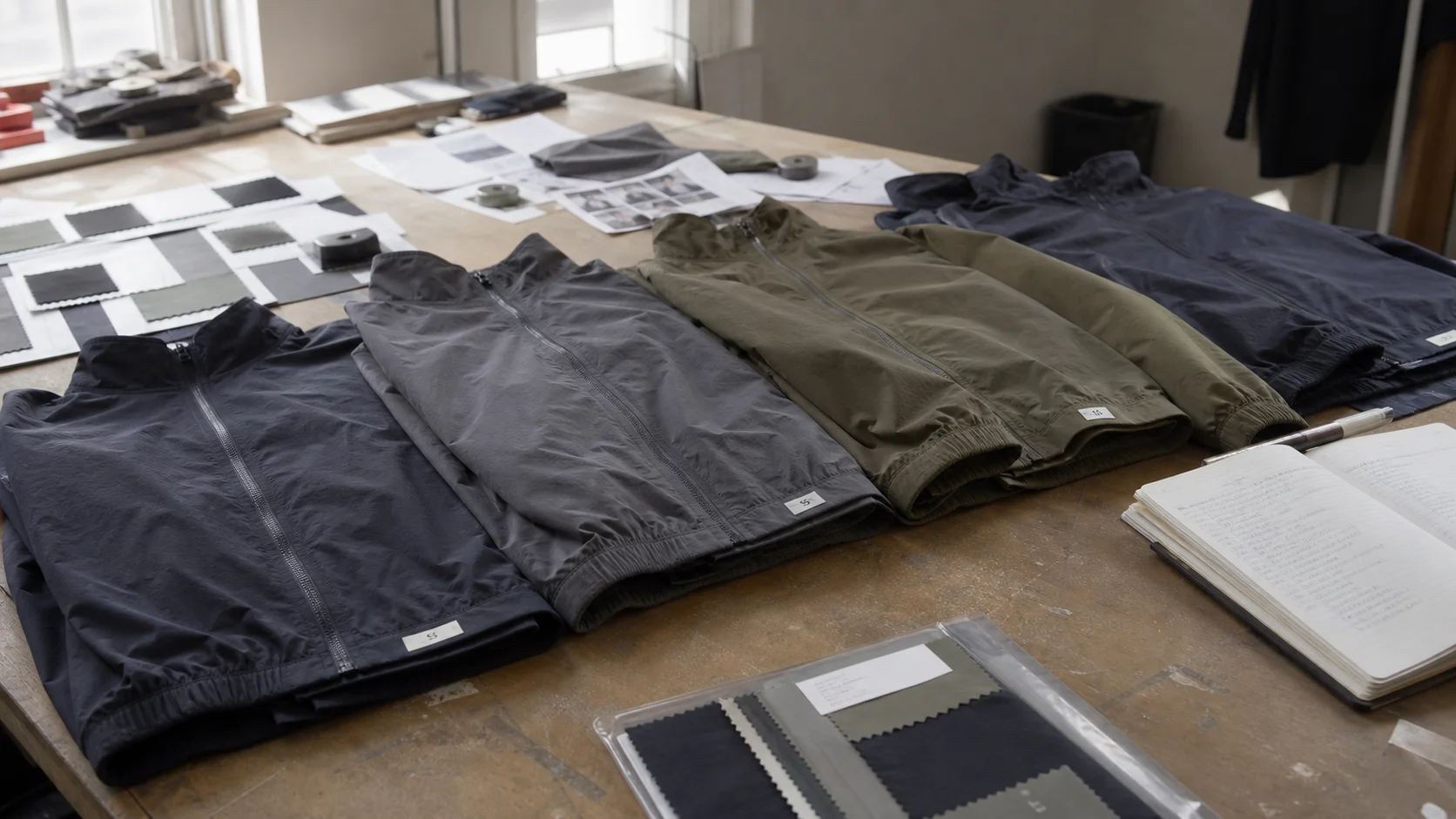
A product-specific outline for gym program buyers evaluating wind jacket manufacturer size grading, fit consistency, sample reviews, and bulk order readiness.
Wind Jacket Size Grading Review for Gym Buyers - Outerwear & Jackets manufacturing guide
For gym program buyers, wind jacket size grading is not a small technical detail. It decides whether a branded outerwear drop feels professional, whether staff can move comfortably, and whether members actually wear the jacket outside the facility. A wind jacket may look simple on a line sheet, but the grading work behind it is more sensitive than many buyers expect.
Gym jackets sit between performance apparel and promotional outerwear. They need enough ease for warm-ups, coaching, commuting, outdoor training, and layering over tees or hoodies. At the same time, they cannot look oversized or sloppy when worn by front desk staff, trainers, or retail customers. Poor grading usually shows up first in the shoulders, sleeve length, sweep, and armhole. Once bulk production is cut, those errors are expensive to correct.
A wind jacket manufacturer size grading review should test whether the supplier understands athletic use, not just casual jacket production. The manufacturer should be able to discuss base size selection, size increments, tolerance standards, fabric behavior, elastic tension, zipper length, hood shape, and real movement needs. If the conversation stays at “send your size chart,” the buyer should slow down.
Good size grading protects sell-through, staff adoption, and brand perception. Bad grading turns a useful gym jacket into dead inventory.
The category also has a wide user base. Gym programs may serve slim runners, strength athletes, older wellness members, youth teams, and staff wearing uniforms over other garments. A single size chart cannot satisfy every body type, but a disciplined grading system can reduce complaints and returns. The best starting point is to define the intended fit before discussing price.
A manufacturer can only grade accurately when the buyer provides a clear product brief. For wind jackets, the brief should describe the program use, target wearer, size range, fit preference, fabric, trims, branding positions, and expected order quantity. Buyers often send a reference image and ask for a quote. That is not enough for a reliable size grading review.
A practical brief should state whether the jacket is for staff uniform, retail resale, tournament giveaway, outdoor training, corporate wellness, or premium gym merchandise. Each program has a different fit priority. Staff uniforms need consistent appearance and repeat replenishment. Retail jackets need sellable sizing across a broader membership base. Team jackets may need room for warm-up layers. Giveaway jackets may use a simpler size curve to control cost.
The brief should also define the fit language. “Regular fit” means different things to different factories. Use measurable terms instead. For example, specify chest ease over body measurement, jacket length preference, sleeve length target, and sweep allowance. If the jacket is expected to layer over a hoodie, say so before the first sample is made.
For buyers building a full gym apparel program, it is useful to align the jacket size structure with tees, hoodies, joggers, and staff polos. Fabrikn’s manufacturing services page can be used as a starting point for thinking through product development, sourcing, and production coordination across categories.
The base size is the foundation of the entire grading system. Most adult jacket programs develop from a medium sample, though some women’s programs use small, and extended-size programs may review both medium and 2XL. The decision matters because every smaller and larger size will be calculated from that base.
For gym buyers, the base size should represent the most important commercial size, not simply the sample size the factory prefers. If the sales curve is heavily medium and large, a medium base may work. If the program is for strength gyms, collegiate athletics, or staff uniforms with many larger bodies, the buyer may need an additional large or XL fit check before approving the grade.
Unisex wind jackets are especially risky. Many gym programs choose unisex sizing to simplify inventory and reduce MOQ pressure. That can be sensible, but unisex grading often compromises women’s fit at the shoulders, sleeve length, and hip sweep. A unisex jacket may sell well for casual outerwear, yet fit poorly for a women-heavy training studio. Buyers should look at their membership profile before accepting a default unisex chart.
A smart approach is to request the manufacturer’s standard body measurement chart and finished garment measurement chart separately. Body measurements show the intended wearer. Finished garment measurements show the actual jacket. The difference between them is the wearing ease. If the supplier cannot explain that difference, the grading review is not yet complete.
Program Type Suggested Base Review Key Risk General gym retail Medium sample plus size set in S, M, L, XL Middle sizes may fit, while XS and XXL drift too far Staff uniform Medium and XL fit checks Layering and repeat-order consistency Women’s studio program Small or medium base with hip and sleeve review Shoulders and sleeve length may grade too masculine Strength or team program Large or XL wear test in addition to medium Chest, bicep, and back width may be restrictiveA wind jacket size grading review should focus on the measurements that affect comfort, appearance, and production consistency. Chest width is important, but it is only one part of the fit. Gym buyers should review the full measurement set before approving a size chart.
Chest width controls the overall fit impression. For lightweight wind jackets, finished chest ease often ranges from 10 cm to 18 cm over body chest circumference, depending on fit type and layering expectation. Slim athletic jackets may sit at the lower end. Staff or outdoor warm-up jackets usually need more room.
The grade between adult sizes commonly ranges from 4 cm to 6 cm in total chest circumference. A tighter 4 cm grade creates a more controlled size run but may not give enough jump for larger sizes. A 6 cm grade supports broader body differences but can make upper sizes feel boxy if length and shoulder are not balanced.
Shoulder grading is one of the most visible fit risks. Too narrow, and the jacket pulls across the upper back during movement. Too wide, and it looks cheap or borrowed. Raglan sleeves reduce some shoulder-width risk, which is why many gym wind jackets use raglan or modified raglan construction. Set-in sleeves look cleaner for lifestyle retail but require more accurate shoulder grading.
Sleeve length complaints are common in unisex gym jackets. If the sleeve grades too aggressively, larger sizes may become too long. If it grades too little, tall wearers may expose the wrist during warm-ups or coaching. Elastic cuffs can hide minor sleeve variation, but they do not fix a poor sleeve grade.
For adult jackets, sleeve length grade increments often range from 1 cm to 1.5 cm per size, depending on sleeve construction and target market. Buyers should test arm raise, driving position, and forward reach. A jacket that looks fine standing still may pull badly during movement.
Body length shapes the jacket’s commercial appeal. Cropped wind jackets may work for fashion-led women’s studio merchandise. General gym programs usually need coverage at the waist and upper hip. If the jacket rides up during overhead movement, the length or sweep may be wrong.
Length grading often ranges from 1 cm to 2 cm per size. A manufacturer should explain whether the length grade changes evenly across all sizes or slows down at the top end. Excessive length in 2XL and 3XL can make the garment look like a rain shell rather than a gym windbreaker.
The sweep is the bottom opening. It is critical for comfort over hips, joggers, leggings, and hoodies. A tight sweep causes the jacket to bunch above the hip. A wide sweep lets wind enter and can look untidy. Elastic hems, drawcords, and toggles change the fit behavior, so finished measurements should be reviewed both relaxed and extended when relevant.
Armhole depth and bicep width decide whether the jacket works for athletes. Strength-focused gyms should pay special attention here. A clean chest measurement does not guarantee room in the bicep. Too-low armholes can also restrict movement because the entire body lifts when the wearer raises their arms.
If the jacket includes a hood, the hood opening, depth, and neck drop should be graded carefully. A hood that fits medium may feel shallow in XL or oversized in XS. Drawcords can adjust the opening, but they should not be used to hide poor shape. For youth or certain markets, drawcord regulations may affect design choices.
Grade rules are the increments used to move from one size to another. In a wind jacket manufacturer size grading review, buyers should ask to see the grade rule table, not just the final size chart. This shows how the pattern changes across the size range.
Typical adult outerwear grade rules vary by market, fit, and body standard. A practical gym wind jacket may use approximately 4 cm to 6 cm total chest grade, 4 cm to 6 cm sweep grade, 1 cm to 1.5 cm sleeve length grade, and 1 cm to 2 cm body length grade between sizes. These are not universal rules. They are review ranges that help buyers question unrealistic charts.
Measurement Point Typical Adult Grade Range Buyer Comment Chest circumference 4 cm-6 cm per size Use smaller grades for slimmer retail fit, larger grades for inclusive programs Sweep circumference 4 cm-6 cm per size Review hip comfort, especially for women’s and unisex jackets Body length 1 cm-2 cm per size Avoid excessive length in larger sizes Sleeve length 1 cm-1.5 cm per size Test with arm movement, not only flat measurement Across back 1 cm-2 cm per size Important for trainers and strength athletes Bicep circumference 1.5 cm-3 cm per size Do not ignore athletic upper armsExtended sizes need special attention. A straight grade from XS to 4XL may not produce a good garment. Larger sizes often require adjusted proportions, not only scaled measurements. Armhole shape, neck opening, pocket placement, and body length may need separate review. Buyers ordering 3XL or above should request a top-size sample before approving production.
Petite and youth-adult crossover sizing also needs caution. A women’s XS and youth XL may appear close in chest measurement, but sleeve length, shoulder slope, body shape, and hood scale can differ. Substituting one chart for another is a common sourcing shortcut that creates fit problems.
Size grading cannot be approved from a spreadsheet alone. Gym buyers should build fit review into the sampling process. The minimum standard is to approve a base size sample, then review a size set before bulk cutting. For tighter budgets, a limited size set of S, M, XL, and 2XL can still reveal major grading issues.
The fit model should reflect the target wearer. A fashion model with narrow shoulders may not reveal jacket problems for a trainer or strength athlete. A staff member who normally wears the target size can provide useful feedback, but buyers should avoid relying on one person’s preference. Fit approval should combine body measurements, garment measurements, movement tests, and visual review.
Useful wear-test movements include raising both arms overhead, reaching forward, crossing arms, jogging lightly, zipping over a hoodie, placing hands in pockets, and tightening hood or hem adjusters. The jacket should not pull sharply across the back, expose the wrist excessively, ride up at the waist, or choke at the neck when zipped.
Buyers should document fit comments in measurable language. “Sleeve feels long” is less useful than “reduce sleeve length 1.5 cm on size M and adjust grade to avoid excess at XL.” Good comments reduce sampling rounds and prevent the manufacturer from guessing.
Wind jacket sizing depends heavily on fabric and trim behavior. A non-stretch woven shell requires more ease than a stretch woven. A coated fabric may feel stiffer and noisier, so tight grading becomes more noticeable. A lightweight 60-90 gsm shell behaves differently from a 120-160 gsm shell with lining.
Common wind jacket shell fabrics include polyester taffeta, nylon taslan, polyester pongee, ripstop polyester, recycled polyester woven, and stretch woven blends. Buyers should specify weight, composition, coating, finish, and performance claims. Water-repellent finish, breathability, wind resistance, and hand feel all affect the final wearer experience.
Fabric shrinkage and relaxation can alter finished measurements. Woven wind jacket fabrics usually have less shrinkage than knits, but coating, heat pressing, fusing, and finishing can still affect dimensions. Heat transfers and reflective prints may require temperature and pressure that influence lightweight fabric. The manufacturer should test this before production approval.
Component Size-Grading Impact Buyer Review Point Elastic cuff Controls wrist fit and hides small sleeve variation Check relaxed and stretched opening Drawcord hem Allows sweep adjustment but adds safety and trim considerations Confirm cord length, toggle quality, and regulation needs Full-front zipper Locks body length and front balance Check zipper length after size grading Mesh lining Reduces cling but can restrict if undersized Measure lining against shell ease Heat-transfer logo May distort lightweight shell if poorly applied Test placement on curved sizes Reflective tape Can restrict stretch or change seam behavior Review across shoulder and sleeve movementBranding placement also changes with grading. A left-chest logo may look balanced on medium but too close to the armhole on XS or too high on 3XL. Back prints can distort across curved panels. Sleeve logos may shift if sleeve length grade is not considered. Buyers should ask for graded placement specs, especially for retail-quality gym merchandise.
Minimum order quantity affects size grading decisions. Many wind jacket manufacturers prefer MOQs from 300 to 1,000 pieces per style and color for custom production, though some programs may be higher depending on fabric sourcing, dyeing, trims, and branding. Stock fabric programs can sometimes support lower quantities, while custom colors, recycled fabrics, special coatings, or branded zippers usually require more commitment.
For gym buyers, the practical question is not only total MOQ. It is MOQ per size and color. A 500-piece order across six sizes and two colors spreads quickly. If the size curve is not planned carefully, the buyer may end up with too few medium and large jackets or too many fringe sizes. A supplier should help create a size breakdown based on the channel and wearer base, but the buyer should make the final commercial decision.
Sampling lead times often range from 7 to 21 days per sample round, depending on fabric availability and trim complexity. Bulk production may take 30 to 60 days after pre-production approval for many standard programs. Custom fabric, lab dips, performance testing, imported trims, or peak-season factory capacity can extend this. Shipping method also matters. Air freight is faster but can damage margin. Sea freight needs more planning but is more realistic for larger outerwear programs.
A cautious development calendar includes time for size set review. Buyers sometimes skip size sets to save two weeks, then lose far more time handling complaints or reorders. For a new gym jacket style, the size set is usually worth the cost. For a repeat style with stable pattern history, a pre-production sample and measurement review may be enough.
Buyers comparing manufacturing support can review Fabrikn’s company background to understand how sourcing coordination, product development, and program planning may fit into a broader apparel launch.
Inspection should not wait until finished cartons are packed. Measurement risk starts at pattern approval and continues through cutting, sewing, pressing, and packing. Wind jackets are especially vulnerable because lightweight fabric can shift during cutting and sewing. A small cutting error at the armhole or sleeve can change movement comfort.
A proper quality plan should define the measurement tolerance for each point of measure. Common tolerances may range from plus or minus 0.5 cm for small details to plus or minus 1.5 cm or more for larger circumference measurements. Tolerances should reflect garment type and production reality. Unrealistically tight tolerances create false failures. Loose tolerances allow poor fit to pass.
Inspection teams should measure garments flat using the approved method. Chest width, sweep, and length measurements can vary if the jacket is stretched, wrinkled, or not aligned. Elastic openings require relaxed and extended measurement standards where relevant. Hood measurements should be clearly defined because factories and buyers often measure hoods differently.
Bulk inspection should include a size-run measurement audit, not only random pieces from the easiest size. If the order includes XS through 3XL, each size needs review. Top and bottom sizes are where grading failures usually appear.
Color and fabric consistency also affect perceived sizing. A stiffer coated black shell may feel tighter than a softer light-color shell using the same measurements. If a program orders multiple colors, buyers should check whether all colors use the same fabric batch quality and finishing. One color can pass fit while another feels restrictive.
A capable wind jacket manufacturer should be able to support pattern development, grading, sampling, fabric sourcing, trim selection, and quality control. Price matters, but it should not be the only selection factor. A low quote can become expensive if the first production run does not fit the gym’s audience.
During supplier review, buyers should ask for sample measurement charts, grading examples, tolerance standards, and fabric test information. The manufacturer does not need to reveal proprietary customer details, but it should be able to explain its process. Vague answers about fit, grading, and quality control are warning signs.
The buyer should also check communication discipline. Good suppliers confirm changes in writing, update tech packs, and distinguish between body measurements and finished garment measurements. Poor suppliers rely on chat messages and unclear sample comments. That creates risk when production moves from development staff to factory floor.
Review Area Strong Supplier Response Warning Sign Size grading Provides grade rules and explains measurement logic Only sends a generic size chart Sampling Offers proto, fit, size set, and pre-production samples Pushes direct bulk order from first sample Fabric States composition, weight, finish, and performance limits Uses broad terms like “good polyester” Trims Confirms zipper, elastic, drawcord, toggles, and branding method Substitutes trims without approval Inspection Defines tolerances and measurement method No clear QC plan before productionBuyers should ask direct questions before paying for samples:
If a buyer is ready to discuss a gym outerwear program, the next practical step is to prepare target specs, order quantity, branding requirements, and size range before reaching out through Fabrikn’s contact page.
The best size grading decision is not always the most technical one. It must fit the commercial reality of the gym program. A boutique studio selling a premium cropped wind jacket needs different grading than a multi-location gym buying staff uniforms. A marathon training group needs different ease than a weightlifting club.
Unisex sizing can reduce complexity, but it may weaken fit satisfaction for women. Gender-specific sizing improves fit, but it increases development work, inventory planning, and MOQ pressure. Extended sizing broadens inclusivity and staff coverage, but top sizes may require separate samples and more pattern attention. A low MOQ stock-shell option reduces risk for a first test order, but it limits control over fit, color, fabric, and branding.
Buyers should decide where the program sits on the spectrum between promotional item and retail-quality product. Promotional wind jackets can tolerate simpler grading if the price point is low and the use is occasional. Retail-quality gym jackets need better size consistency, stronger trims, cleaner branding, and proper size-set approval. Staff uniform jackets sit somewhere in the middle: they need durability, repeatability, and broad comfort more than trend styling.
A practical purchasing framework is to divide decisions into must-have, should-have, and optional features. Must-have items may include correct chest and sleeve grading, reliable zipper, acceptable water-repellent finish, and brand color match. Should-have items may include recycled fabric, reflective details, packable pocket, or mesh lining. Optional features may include custom zipper pullers, specialty coatings, or advanced seam finishing.
A standard grade can be acceptable when the jacket uses a proven pattern, the order is small, the target audience is general, and the buyer reviews a size set. This is common for first-time gym merchandise tests. The advantage is speed and lower development cost. The tradeoff is less control over fit identity.
Custom grade rules are worth considering when the program has a defined athletic audience, extended sizing, women’s-specific needs, or repeat seasonal demand. Custom grading costs more in development time, but it protects long-term consistency. If the jacket will become a core gym uniform or recurring retail item, the investment is easier to justify.
A smaller size range can be sensible for low-volume programs. Offering S-XXL instead of XS-3XL may improve stock depth in core sizes and reduce leftover inventory. The tradeoff is reduced inclusivity. For staff uniforms, reducing size range is often a poor decision because the employer still needs to fit real people. For event retail, it may be acceptable if demand data supports it.
Extended sizing supports better member service and staff coverage, but it should be planned properly. Do not add 3XL or 4XL as an afterthought. Larger sizes may need adjusted length, bicep, armhole, hood, and pocket placement. Order depth also matters. Adding sizes with only a few pieces each can create high unit costs and replenishment problems.
Before approving a wind jacket manufacturer for a gym program, buyers should complete a structured review. This checklist is designed to catch the most common grading failures before bulk cutting.
This process may feel slower than approving a jacket from a photo, but it is faster than repairing a failed bulk order. Gym buyers should treat size grading as part of product quality, not a back-office pattern task. The jacket has to work on real bodies, during real movement, across the full size curve.
A wind jacket manufacturer size grading review for gym program buyers should be practical, measured, and commercially grounded. The buyer does not need to become a pattern maker, but they do need to ask better questions. Base size, grade rules, fabric behavior, trim tension, size set approval, and inspection tolerances all shape the final result.
The safest route for most gym programs is to approve a base fit sample, review a limited size set, confirm graded specs, and lock the pre-production sample before bulk cutting. For small promotional orders, a standard manufacturer grade may be enough if expectations are realistic. For premium retail, staff uniforms, women’s programs, or extended-size ranges, custom review is worth the time.
Good grading does not guarantee a best-selling jacket, but poor grading can sink an otherwise strong product. Gym buyers should spend the extra attention before production, when changes are still possible and inexpensive.
Get a free quote from Fabrikn — your trusted B2B clothing manufacturer with 10+ years of experience. MOQ as low as 200 pieces.
Get a Free Quote →Size grading is the process of increasing or decreasing a garment pattern from a base size to create the full size range. For wind jackets, grading affects chest, sweep, sleeve length, body length, shoulder width, bicep, hood, cuff, and pocket placement.
Many adult gym programs use XS-XXL or S-3XL. The right range depends on the wearer base, order quantity, budget, and whether the jacket is for staff, retail, teams, or events. Staff programs usually need broader sizing than limited retail drops.
Unisex sizing reduces complexity and can lower inventory risk. Gender-specific sizing usually improves fit, especially in shoulders, sleeve length, waist, and hip sweep. For women-heavy studios or premium retail programs, gender-specific development may be worth the added sampling and MOQ pressure.
Typical custom wind jacket MOQs often range from 300 to 1,000 pieces per style and color. Stock fabric or existing patterns may support lower quantities, while custom colors, special coatings, branded trims, or recycled materials may require higher MOQs.
A cautious process includes a proto sample, fit sample, size set, pre-production sample, and top-of-production sample. Smaller programs may reduce sample rounds, but new styles should not skip fit approval and graded size review if quality matters.
Chest, sweep, sleeve length, body length, shoulder, across back, bicep, cuff opening, and hood measurements are all important. For athletic use, across-back movement and bicep room deserve more attention than many generic jacket charts provide.
Finished chest ease often ranges from about 10 cm to 18 cm over body chest circumference, depending on fit type and layering needs. Slim athletic fits use less ease. Staff uniforms and outdoor warm-up jackets usually need more.
Stretch woven fabrics can tolerate closer fits, while non-stretch or coated fabrics usually need more ease. Fabric weight, coating, lining, heat-transfer branding, and shrinkage can all change how the finished jacket feels on the body.
Approving from one medium sample is risky for a new wind jacket program. A medium sample can confirm base fit, but it does not prove that XS, XL, or 3XL will fit correctly. A size set is the better option before bulk production.
The biggest risks include inconsistent sleeve length, tight biceps, poor sweep grading, undersized lining, incorrect elastic tension, unbalanced logo placement, and top-size proportions that were never sampled. Inspection should include multiple sizes, not only the base size.