
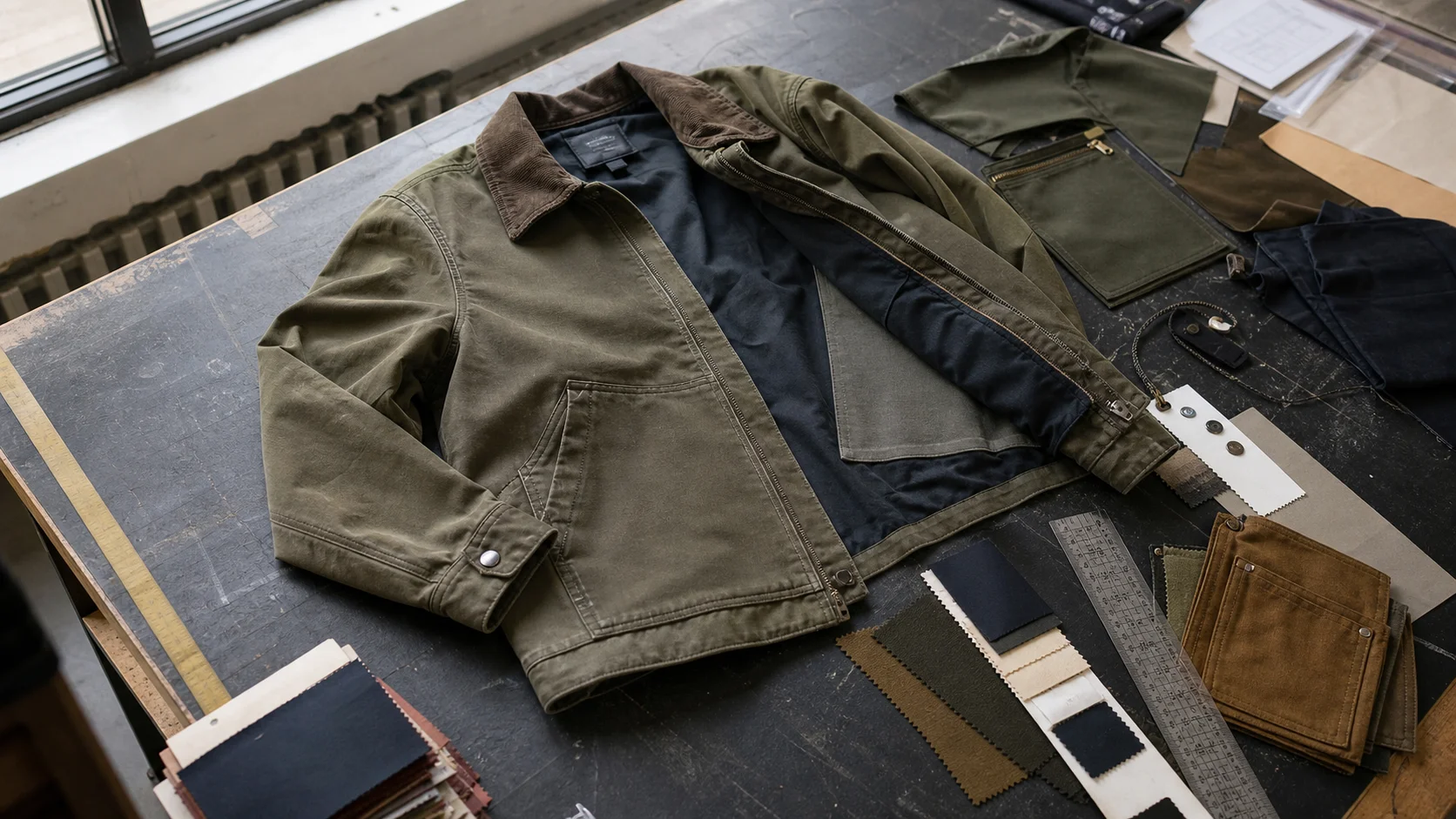
A practical outline for reviewing work jacket size grading so field service buyers can improve fit coverage, mobility, layering comfort, and reorder...
Work Jacket Size Grading Review for Field Teams - Outerwear & Jackets manufacturing guide
A work jacket size grading review for field service teams is not just a technical pattern exercise. It directly affects mobility, safety, wear rate, reorder accuracy, and employee acceptance. Field technicians bend, drive, kneel, climb, lift tools, reach overhead, and often layer garments under the jacket. A jacket that looks correct on a showroom form can fail quickly when worn over a hoodie, tool belt, radio harness, or high-visibility vest.
For B2B apparel buyers, the core issue is consistency across sizes. A medium may fit well, but the extra-large may pull across the shoulders. A 3XL may gain width but not enough sleeve length. A small may have a chest that grades down correctly, while the armhole becomes too tight for movement. These are common grading problems in outerwear because jackets are more structured than T-shirts and usually include more components: shell fabric, insulation, lining, zipper, storm flap, collar, cuffs, pocket bags, snaps, reflective tape, binding, and internal labels.
Field service teams also tend to have a wider wearer profile than fashion retail customers. A utility company, HVAC contractor, logistics operation, telecom installer, or equipment maintenance group may need sizes from XS to 5XL, sometimes with tall options. The size curve can be uneven. One department may need mostly L to 2XL, while another needs smaller sizes or short lengths. Poor grading causes higher exchange rates, slower deployment, and unnecessary inventory.
Practical purchasing judgment: do not approve a work jacket range only because the base size sample fits. Outerwear grading must be checked at the smallest, middle, and largest intended production sizes before bulk approval, especially if the program covers field service staff across multiple regions.
This review focuses on how sourcing teams should evaluate work jacket size grading before committing to bulk production. It covers the measurements that matter, the tradeoffs behind fit decisions, expected MOQ ranges, sample approval steps, lead-time dependencies, fabric and trim issues, and inspection risks that often show up late if the buyer does not control them early.
A size chart is only useful when it reflects the job. Field service work jackets should be graded around the wearer’s movement and layering requirements, not around a generic retail outerwear block. The first decision is the intended fit type.
Many size grading errors start when a buyer approves a jacket based on chest width only. Chest is important, but it does not guarantee movement. Field teams usually notice problems in the shoulder, upper back, sleeve pitch, bicep, cuff opening, front length when seated, and hem sweep over work pants. A jacket that feels acceptable standing still can become restrictive when the wearer reaches forward to open a service panel or climbs into a vehicle.
Layering should be defined before pattern development. A simple note such as “fits over light fleece” or “fits over hoodie and base layer” helps the pattern maker build the correct ease. Without this direction, the supplier may use a standard jacket block. That can reduce bulk cost and make the sample look neat, but it may not work for field technicians.
For buyers building a new workwear program, it is useful to discuss these inputs before requesting pricing. A supplier can quote faster when the intended construction and size range are clear. If the garment is part of a larger uniform rollout, services such as sourcing, sampling, and production coordination can be planned through a manufacturing partner’s development process. Fabrikn outlines this type of support on its services page.
Size grading is the process of increasing or decreasing a base pattern into other sizes. For work jackets, the base size is often M, L, or XL depending on the target wearer profile. The grade rules determine how much each key measurement changes from one size to the next.
A simple example: if the chest circumference increases by 4 cm between sizes, the half-chest measurement increases by 2 cm. That sounds straightforward, but a jacket has multiple connected pattern pieces. Chest width, shoulder width, armhole, sleeve cap, bicep, cuff, body length, collar, pocket placement, zipper length, and lining must all remain balanced. Increasing one area without adjusting another can create twisting, tightness, or poor appearance.
Work jackets often need a different grade rule than casual fashion jackets. Larger sizes may require extra width in the bicep, belly, and sweep. Tall versions may need added sleeve and body length without adding excess width. Smaller sizes may need proportionally narrower shoulders and shorter sleeves, but not so much reduction that movement becomes restricted.
A practical grade review should compare the supplier’s proposed size chart against the buyer’s wearer profile. If the team includes many broad-shouldered technicians, a standard retail grade may not be enough. If the jacket is for indoor facility service, a cleaner, less bulky grade may be better. There is no universal perfect chart. The correct chart is the one that fits the job, the climate, and the size curve.
A work jacket spec sheet should include more than chest, length, and sleeve. Those measurements are a start, but they do not give enough control for field performance. A complete grading review should include body, sleeve, collar, pocket, and trim placement measurements.
Measurement tolerance should be realistic for outerwear. A woven work jacket may commonly allow around plus or minus 1 cm for many width points and around plus or minus 1.5 cm for larger lengths, depending on construction and supplier capability. Heavily padded styles may need slightly broader tolerances because bulk affects measurement handling. Tight tolerances look good on paper but can create disputes if they do not reflect the fabric, padding, and sewing method.
Buying judgment: set tighter tolerances on functional points that affect fit and safety, such as chest, bicep, sleeve length, and reflective placement. Allow practical tolerance where minor variation does not affect wear, such as some internal pocket bag dimensions.
Fabric choice changes how a graded jacket feels. Two jackets can share the same size chart and wear differently if one uses stiff canvas and the other uses a stretch softshell. A size grading review should always be tied to the actual bulk fabric and trims, not just a prototype fabric.
Common work jacket shell fabrics include polyester oxford, nylon taslon, cotton canvas, polyester-cotton twill, softshell, ripstop, and coated waterproof fabrics. Each has different movement behavior. Canvas is durable but can feel restrictive unless the pattern has enough ease or action-back construction. Softshell may allow a closer fit because it has mechanical stretch. Coated fabrics can feel stiff and noisy, especially in cold conditions.
Typical fabric weights vary widely. A lightweight shell may sit around 120-180 gsm. Mid-weight woven or softshell fabrics may sit around 240-330 gsm. Heavy cotton canvas can exceed 300 gsm and may require extra seam strength, needle selection, and shrinkage testing. Insulated outerwear may use polyester padding measured in gsm, such as 80 gsm, 120 gsm, or 160 gsm, depending on warmth requirements. These are broad commercial ranges, not a substitute for performance testing.
Lining can reduce friction and make the jacket easier to put on over uniforms. Polyester taffeta, pongee, mesh, fleece, and quilted linings are common options. A fleece-lined jacket feels warmer but adds bulk and can grab against hoodie sleeves. Quilted padding adds warmth but changes sleeve circumference and armhole behavior. If the lining pattern is not properly graded with the shell, it may pull, twist, or restrict movement.
The lining should be checked in the largest sizes. Large-size lining shortages are a frequent hidden defect. The shell may measure correctly, but the wearer feels tightness because the lining is smaller than the outer shell or attached with poor allowance at the armhole.
Zippers, snaps, cuffs, drawcords, labels, pocket bags, and reflective materials all influence fit and production quality. A heavy molded zipper can add stiffness at the center front. Rib cuffs can improve warmth but may feel tight if the opening is under-graded. Hook-and-loop cuff tabs offer adjustment but can snag knit gloves or attract lint. Reflective tape can reduce fabric flexibility if placed across high-movement areas.
Trim specifications should be included in the technical package. A vague trim note such as “good quality zipper” is not enough for a B2B workwear program. Buyers should define zipper type, size, puller style, color, tape quality, slider direction, pocket closure type, cuff closure, drawcord quality, elastic specification, snap finish, and label placement. If safety or brand standards apply, trim substitutions must require written approval.
A disciplined sample process reduces production risk. For work jacket size grading, the buyer should review the base size first, then test the grade across the size range before approving bulk. Skipping graded samples may save time upfront, but it increases the chance of costly exchanges and complaints later.
Size set review is the most important step for grading. The buyer does not always need every single size as a sample, especially for tight timelines. A practical approach is to request the smallest size, base size, largest regular size, and one extended size if applicable. For example, if the range is S-4XL, review S, L, 2XL, and 4XL. If tall sizes are included, review at least one tall sample because adding length can affect pocket position, zipper length, and hem balance.
Field wear testing does not need to be overly complicated, but it should be structured. Select wearers who represent the size curve and job movement. Ask them to perform common tasks: driving, reaching forward, lifting arms, crouching, carrying a tool bag, closing the jacket over layers, using pockets with gloves, and bending at the waist. Collect comments by measurement area, not just “fits” or “doesn’t fit.”
These comments are more useful than general feedback. They allow the pattern maker to adjust the correct grade points instead of increasing the whole garment and creating new issues.
MOQ and lead time depend on fabric availability, trim customization, order complexity, size range, branding, and factory capacity. For work jackets, typical MOQ ranges may start around 300-500 pieces for a simpler style using available fabric and standard trims. More customized jackets may require 800-1,500 pieces or more, especially when fabric is custom dyed, laminated, printed, quilted, or ordered from a mill with its own minimums. Extended size ranges, multiple colorways, and separate men’s and women’s patterns can increase the practical MOQ because production must be split across more SKUs.
A low MOQ is attractive, but it can limit options. The buyer may need to accept stock fabric colors, standard zipper pulls, available reflective tape, or fewer size options. A higher MOQ may support better fabric control, custom trims, improved color consistency, and more stable repeat orders. The correct decision depends on the program size and reorder plan.
A reasonable production timeline for custom work jackets can range from roughly 60-120 days after final sample and material approval, depending on complexity. Sampling before bulk approval may take several weeks or longer if multiple revisions are needed. Rush timelines are possible in some cases, but they usually reduce choices and increase risk.
Buyers should also consider size distribution. Ordering equal quantities across sizes is rarely efficient for field teams. A realistic size curve reduces leftover stock. Common workwear programs may lean heavily toward M-2XL, with smaller quantities in XS, S, 3XL, 4XL, and 5XL. A tall-size program may be valuable for wearer satisfaction, but it adds SKU complexity. If the workforce is stable and reorders are predictable, the added complexity may be justified. If turnover is high and forecasting is weak, a simpler size range may control inventory better.
Purchasing tradeoff: extended sizes improve inclusivity and wearer fit, but they need disciplined forecasting. If the order volume is low, negotiate a practical size set and consider planned replenishment rather than overbuying rare sizes.
For buyers who need to map design, sizing, and production steps before ordering, a direct inquiry through Fabrikn’s contact page can help clarify whether the project is better suited to stock-based customization or a more developed manufacturing program.
Outerwear inspection should not focus only on workmanship. It must verify that grading, labeling, packaging, and functional details match the approved specification. Work jackets are more complex than basic apparel, so small errors can affect wearability.
Inspection should include a measurement audit across sizes, not only the base size. The inspector should measure a statistically meaningful sample according to the agreed inspection standard and compare results to the final spec sheet. For critical sizes or new suppliers, buyers may request extra measurement checks on the largest sizes because those often reveal grading weakness.
Packaging accuracy is also important. Field service rollouts often ship to multiple branches or departments. A carton with mixed sizes or incorrect labels can create delays at distribution. Each carton should show style number, color, size, quantity, PO number, and any required destination code. Individual polybags may need barcode labels if the buyer’s warehouse or uniform platform requires scanning.
Testing requirements should be agreed before production. If the buyer needs compliance with a specific safety standard, that must be stated clearly and verified through appropriate testing. A general description such as “hi-vis style” is not the same as certified high-visibility apparel.
A good work jacket size grading review combines fit, construction, commercial planning, and inspection controls. The buyer should not treat grading as a supplier-only responsibility. It is a shared approval process, and the buyer’s input determines whether the final garment fits the actual workforce.
For a first order, buyers should avoid overcomplicating the jacket unless the program volume supports it. Every extra feature adds cost, lead time, inspection points, and failure risk. A detachable hood, multiple hidden pockets, dual-entry pockets, storm cuffs, reflective print, quilted lining, and custom hardware can all be useful. They also add production variables. The best work jacket is not always the one with the most features. It is the one that field staff will wear correctly and that the buyer can reorder consistently.
Unisex sizing can work for some field teams, particularly when the jacket has a relaxed fit and broad size coverage. It is simpler to buy and easier to manage in inventory. The tradeoff is that some wearers may get poor shoulder, hip, sleeve, or bust fit. Separate men’s and women’s patterns improve fit but increase development time, sample cost, MOQ pressure, and SKU count.
A practical approach is to review the workforce profile. If a significant portion of the team needs better fit than a unisex block can provide, separate patterns may be worth the added complexity. If the order is small and the jacket is worn mainly as a loose outer layer, unisex may be acceptable. The decision should be based on wearer data, not assumptions.
Size grading review should also support reorders. Once the approved pattern and grade rules are locked, the buyer should maintain version control. The technical pack should include the date, style code, size chart, grade rules, fabric codes, trim codes, color standards, label artwork, packaging instructions, and approved sample reference. If a future reorder changes fabric or supplier, the jacket should be rechecked. A new fabric can change fit even when the pattern stays the same.
For buyers evaluating long-term manufacturing support, it is worth reviewing a supplier’s background, production approach, and communication process. Fabrikn provides company context on its about page, which can help buyers understand whether the service model fits their sourcing needs.
A work jacket size grading review for field service teams should be handled as a practical risk-control step, not a paperwork formality. The most expensive sizing problems often appear after distribution, when technicians begin wearing the jacket in real work conditions. At that stage, the buyer may face exchanges, morale issues, urgent reorders, and inconsistent branch inventory.
The best results come from clear fit intent, detailed measurement control, size set sampling, field movement testing, realistic tolerances, and inspection discipline. Buyers should pay close attention to bicep, armhole, sweep, sleeve length, lining ease, and extended-size grading. These areas often determine whether a work jacket performs in the field.
Cost pressure is real, especially for large uniform programs. Still, reducing sample rounds or skipping size set approval can be a false economy. A better tradeoff is to simplify unnecessary features while protecting the fit and grading process. Field teams do not need decorative complexity. They need jackets that fit over the right layers, move with the body, hold up to daily use, and arrive correctly labeled by size.
Get a free quote from Fabrikn — your trusted B2B clothing manufacturer with 10+ years of experience. MOQ as low as 200 pieces.
Get a Free Quote →Size grading is the process of increasing or decreasing a base jacket pattern into other sizes. In work jackets, grading must control chest, shoulder, sleeve, bicep, sweep, length, lining, and pocket placement so the garment fits consistently across the size range.
Field service teams move more actively than typical casualwear users. They may drive, lift, bend, climb, reach overhead, and wear layers or tools. The jacket needs enough ease and correct sleeve mobility without becoming oversized or unsafe.
At minimum, buyers should review the base size plus the smallest and largest planned sizes. If the range includes extended sizes or tall sizes, at least one of those should be sampled before production approval.
Typical MOQs may start around 300-500 pieces for simpler jackets using available fabrics and standard trims. More customized outerwear often requires 800-1,500 pieces or more, especially when custom fabric, colors, insulation, trims, or multiple size blocks are involved.
A common production window is roughly 60-120 days after final sample and material approval, depending on fabric availability, trim development, testing, production capacity, and order complexity. Sampling and revisions should be planned before that bulk production timeline.
Chest, shoulder, sleeve length, bicep, armhole, sweep, front length, and back length are key. Bicep, armhole, and sweep deserve special attention because they strongly affect movement and layering comfort.
Unisex sizing can work for relaxed outerwear and smaller programs because it simplifies buying and inventory. Separate men’s and women’s patterns may provide better fit when the workforce profile justifies the added development time, MOQ pressure, and SKU complexity.
Common issues include incorrect measurements in larger sizes, tight lining, sleeve twisting, mismatched labels, poor reflective tape placement, unapproved trim substitutions, weak seams, and carton packing errors. Inspection should check multiple sizes, not only the base size.
Yes. Stiff canvas, stretch softshell, coated polyester, quilted insulation, and fleece lining all affect how the jacket wears. A size chart that works in one fabric may not perform the same way in another fabric.
The safest approach is to define the field use case, approve a detailed spec, review fit and size set samples, test movement with intended layers, confirm all materials and trims, and set inspection controls before bulk production begins.