
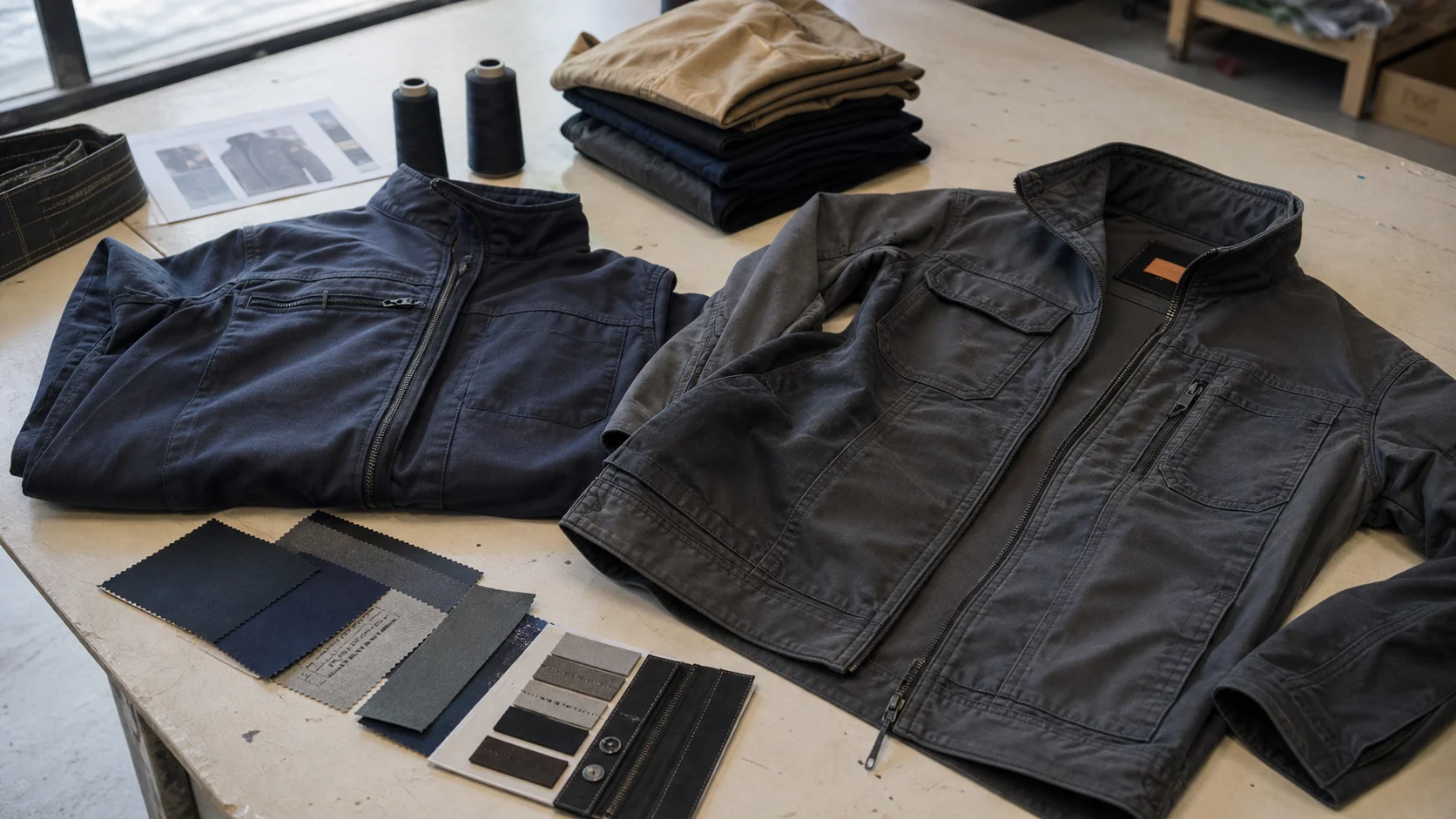
A product-focused outline for sourcing reflective tape, zippers, snaps, rib, and labels for work jackets used by field service teams, with a review of...
Field service uniforms live or die on the details. Fabric weight, seam strength, and sizing matter, but trim choices often decide whether a work jacket is practical in the field or frustrating after a few wear cycles. Zippers, snaps, reflective tape, cuffs, hem adjusters, pocketing, labels, hangtags, and heat-transfer branding all carry sourcing risk. A jacket can pass a visual sample review and still fail in use if trim quality, placement, or compatibility is off.
This work jacket supplier trim sourcing review looks at what buyers should check before approving a program for field service teams. The goal is not just to make the jacket look right on a hanger. The goal is to support daily movement, repeated laundering, weather exposure, and brand consistency across replenishment orders. For sourcing support, see our services, learn more on about us, or reach out through contact us.
Work Jacket Trim Sourcing for Field Service Teams - Fabrikn production reference
Field service teams use jackets differently from retail consumers. The garment may be worn in vehicles, around tools, in changing weather, and across repeated wash cycles. That creates a higher risk of trim failure than many buyers expect. A broken zipper pull, peeling logo transfer, or stiff cuff closure can turn a functional jacket into dead inventory or a constant complaint item.
Trim sourcing deserves as much attention as shell fabric selection because trim controls the daily user experience. A technically strong jacket can still underperform if the pocket zippers snag gloves, the reflective tape cracks, or the brand label irritates the neck. The right supplier should treat trim as part of performance, not decoration.
For field service teams, trim decisions usually need to balance five priorities:
Zippers are one of the highest-risk trims in a work jacket. They affect comfort, closure security, and perceived quality. For field service use, buyers often prefer injected molded plastic zippers, coil zippers, or branded nylon zippers depending on the jacket style and weather exposure. Metal zippers can feel sturdy, but they may add weight, corrode in humid environments, or be uncomfortable in cold conditions.
The sourcing review should cover zipper tape width, slider finish, tooth size, and puller style. If gloves are standard issue, the puller should be large enough to grab quickly. A small fashion-style puller may look neat on a sample and still be inconvenient in daily use.
Snaps often appear on storm plackets, cuffs, removable hoods, and pocket flaps. Poorly set snaps are a common quality issue because the problem may not appear until after washing or repeated use. Buyers should confirm snap material, coating, holding strength, and backing reinforcement. If the jacket will be worn in wet or dusty environments, snap corrosion resistance matters.
Buttons are less common on high-use work jackets, but if used, they should be securely stitched with adequate shank height and reinforcement. Decorative buttons may be attractive, yet they can be a poor fit for active field work.
Hook-and-loop is useful for cuff tabs, pocket closures, and name patch systems, but it can wear quickly if the quality is low. Buyers should check open-and-close cycle expectations and lint resistance. A weak hook surface tends to lose grip after repeated laundering, especially when exposed to dust, fibers, or road debris.
Placement matters as much as quality. If hook-and-loop is too close to exposed fabric, it can snag knit cuffs, lining, or base layers. Good pattern alignment reduces user complaints and extends garment life.
Reflective tape or heat-applied reflective transfers may be required for visibility, depending on the work environment and safety policy. The review should confirm whether the reflective material is stitched, heat sealed, segmented, or applied as a logo element. Each option has tradeoffs in flexibility, wash durability, and cost.
Reflective trim should be evaluated under real movement, not only under still photos. It should lie flat, not curl at the edges, and remain visible after laundering. Buyers should ask for wash test data if the product is intended for frequent cleaning.
Cuff and hem trim influence fit, wind protection, and wear life. Rib knit cuffs offer comfort and a close seal, but they can stretch out if the yarn quality is weak. Elastic binding can be neat and functional, though it needs the right stretch recovery. Hem drawcords and cord locks can improve fit, but they may not be appropriate for every work setting due to snag risk.
For field service jackets, comfort under movement is usually more important than a fashion-forward finish. The trim should support bending, lifting, and reaching without binding the wearer.
Pocket openings, bartacks, flaps, and edge bindings are easy to overlook in spec review. They are also high-wear points. Field service teams often place phones, tools, meters, notepads, and small parts in jacket pockets. That means the pocket trim needs to resist tearing and fraying.
Reinforced pocket corners, secure bartacks, and edge bindings can extend the jacket’s useful life. The sourcing tradeoff is simple: stronger reinforcement usually adds cost and may slow production, but weak pocket trim creates a higher replacement rate.
Inside labels are not just administrative details. They affect wearer comfort, compliance, and reordering accuracy. Buyers should specify whether the neck label is woven, printed, heat transfer, or tear-away. If the jacket will be layered over uniforms, a soft label or printed neck mark may be preferable to a bulky woven label.
External branding should be reviewed for durability, especially if the company logo is applied by embroidery, heat transfer, or patch. Embroidery is durable but can affect hand feel on lightweight jackets. Transfers can look cleaner, but they must be tested for wash longevity and cracking.
A work jacket supplier trim sourcing review should go beyond the product sheet. The supplier needs to show control over trim sourcing, color matching, testing, and repeat production. Some suppliers can source shell fabrics well but rely on unstable trim vendors. That is where quality drift begins.
Start with the supplier’s trim control process. Ask who approves zipper mills, reflective tape vendors, snap providers, and label printers. Ask whether the supplier has approved substitute trims for back-up production, and what happens if a trim item goes out of stock during the season. If the answer is vague, the risk is higher than it first appears.
A good supplier should be able to explain:
It also helps to ask for trim swatches early. Looking at a zipper tape, reflective strip, and label sample in isolation is not enough, but it is better than discovering mismatch at pre-production stage. Small visual differences can become large problems when the jacket is worn across a uniform program.
Trim sourcing and sample approval are tightly connected. Many delays in jacket programs come from trim lead times, not from cutting or sewing. If a custom zipper pull or branded label needs tooling, the timeline expands quickly.
Typical MOQ ranges vary by trim type and supplier base. As a practical sourcing guide:
Those are not fixed market rules, only common sourcing patterns. Buyers should always confirm quantities early because trim MOQ can determine whether a jacket style is commercially viable.
A sensible sample process usually includes four steps:
Skipping any of these steps can save time at the front end and cost more later. A zipper that looks acceptable on a proto sample may still fail in bulk if the supplier swaps to a different slider or tape supplier without notice.
Good sourcing depends on precise trim specifications. Buyers should avoid general phrases like “heavy-duty zipper” or “strong snap” without measurable detail. The purchase order, tech pack, or specification sheet should define the trim clearly enough that the supplier cannot interpret it loosely.
Trim Spec points to define Common sourcing risk Zipper Type, size, tape width, slider style, puller length, color, finish Slider mismatch, weak tape, poor gliding Snap Diameter, finish, material, plating, holding strength, backing reinforcement Corrosion, detachment, inconsistent setting Reflective trim Width, placement, stitch type, wash rating, certification if required Cracking, curling, poor visibility after wash Label Type, size, content, care instruction format, placement Itchiness, incorrect content, fading Cuff/hem trim Fiber content, stretch recovery, color, attachment method Stretch-out, pilling, seam bulk Patch/logo trim Artwork size, backing, thread count or transfer method, placement tolerance Misplacement, edge lift, poor branding consistencyTrim placement tolerances should be specified as well. A logo that is off-center by a small amount can still look acceptable on a retail item, but in a corporate field service program it may trigger rework or rejection. The same applies to reflective strip alignment and pocket symmetry.
Inspection should focus on function, not only appearance. A first article inspection may catch obvious defects, but trim failures often show up after wear simulation, wash testing, or practical handling. Buyers should ask the supplier what tests are applied to each trim class and what acceptance criteria are used.
Key risks include:
Inspection should include both in-line checks and final random inspection. A supplier may produce one clean sample and still miss bulk variation. If the trim vendor changes dye lots, the issue may not be obvious until cartons are opened for distribution.
For field service teams, the cheapest trim is rarely the lowest-cost decision. The right trim is the one that survives use, laundering, and replenishment without generating avoidable complaints.
Buyers should also confirm packaging controls. Trims can be damaged in packing if garments are folded tightly against zipper pulls, reflective areas are creased under pressure, or labels are scuffed in transit. Those are minor issues on a garment-by-garment basis, but they add up across a program.
Trim sourcing is a balancing act. Higher-end trims can improve field usability and reduce replacement rates, but they also raise unit cost and sometimes minimum order commitments. Procurement judgment should focus on total program cost, not only ex-factory price.
As a general rule, spend more where the failure cost is high. That often means zippers, snaps, reflective components, and pocket reinforcement. Spend carefully on decorative elements that do not affect safety or daily utility. If the jacket is part of a company-issued uniform, a consistent clean look matters, but it should not crowd out performance decisions.
There are three common approaches:
The balanced build is often the safest choice for most field service programs. It avoids overpaying for styling that the wearer does not need, while reducing the repair and replacement burden associated with weak trim choices.
Many buyers now ask for recycled content, restricted substance compliance, and better traceability in trims. These requirements can be helpful, but they should be verified carefully. Not every “eco” trim performs equally, and a sustainability claim is not a substitute for functional testing.
Ask suppliers for material declarations where relevant, especially for labels, prints, coatings, and reflective materials. If the jacket must meet corporate compliance requirements, request written confirmation of chemical standards and testing scope. A vague declaration is weaker than traceable documentation.
When sustainability is part of the brief, buyers should check whether recycled zippers, recycled polyester labels, or lower-impact packaging affect durability. The tradeoff is usually manageable, but only if tested under real use conditions. If a greener trim weakens performance, the environmental win can disappear through early replacement.
Not every outerwear supplier is strong on trim sourcing. Some are better at basic garment assembly than at coordinating multiple trim vendors under a tight delivery schedule. For field service teams, the supplier should demonstrate control over the full trim stack, not only shell fabrication.
A practical supplier review should include these questions:
Suppliers that answer clearly, with written spec sheets and realistic lead-time guidance, usually create fewer surprises. That is particularly valuable in field service programs where replacement orders may need to match prior shipments exactly.
Get a free quote from Fabrikn — your trusted B2B clothing manufacturer with 10+ years of experience. MOQ as low as 200 pieces.
Get a Free Quote →Zippers, reflective trims, and labels usually generate the most complaints. Zippers fail mechanically, reflective trims can peel or crack, and labels can irritate the wearer or fade after laundering.
It depends on the trim type. Standard stock trims may be available in low quantities, while custom labels, branded zipper pulls, reflective components, and dyed-to-match trims often require MOQs in the low thousands. Always confirm with the supplier early.
Either can work, but many field service programs prefer durable coil or molded plastic zippers for lighter weight, better comfort, and reduced corrosion risk. The best choice depends on weather exposure, jacket weight, and budget.
A typical process includes trim review, proto or fit sample, and pre-production sample. Complex programs may need extra rounds if branding, reflective placement, or custom hardware is involved.
At minimum, include trim type, material, dimensions, color, finish, placement, and any performance requirement such as wash durability or holding strength. The more precise the spec, the lower the risk of production variation.
Use clear specs, approve samples carefully, test the garment in realistic use conditions, and inspect bulk production for trim consistency, reinforcement, and placement. Keep an eye on changes in trim lot supply during repeat orders.
For sourcing support on outerwear and workwear programs, see services, review about us, or start a conversation through contact us.