
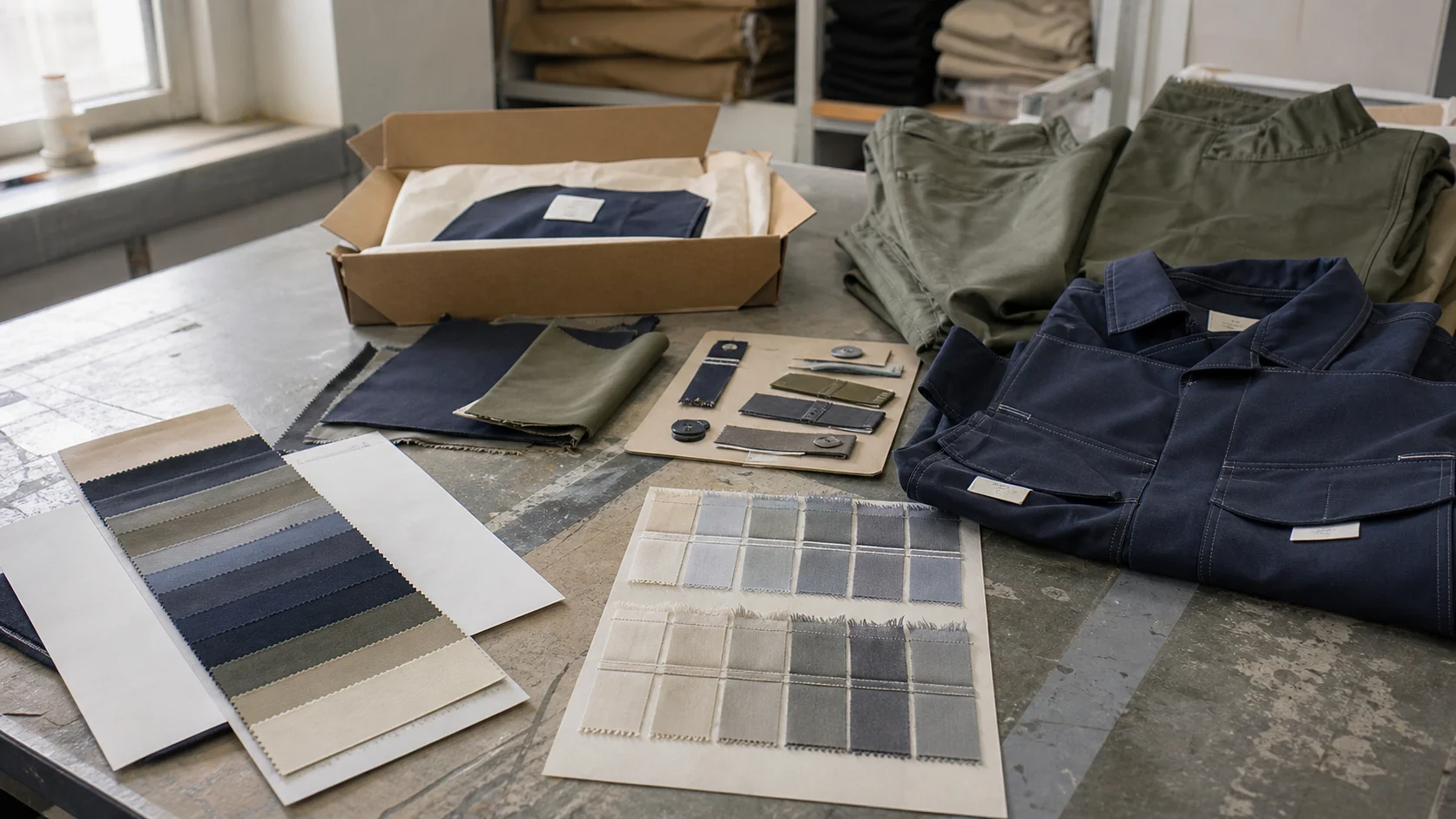
A 2500-word SEO outline for distributor buyers auditing mono material workwear uniforms for colorfastness, shade consistency, laundering durability, and...
Workwear Colorfastness Audit for Buyer Approval - Sustainable Fashion manufacturing guide
For distributor buyers, a mono material workwear uniform colorfastness audit is not a laboratory formality. It is a purchasing control point that protects repeat orders, brand reputation, and end-user trust. When a uniform program is built around one dominant fiber family, such as 100% recycled polyester, 100% cotton, or a mono-material cotton-rich concept without mixed-fiber trims, the color story must hold across fabric lots, garment panels, trims, washing cycles, and workplace exposure.
Colorfastness failures are expensive because they usually appear after the order has moved beyond easy correction. A fabric may look approved at lab-dip stage, then shift after bulk dyeing. A dark navy jacket may crock onto a pale inner shirt. A black trouser may fade unevenly after industrial laundering. A high-visibility contrast panel may bleed into a lighter base fabric. For distributors selling to facilities, logistics teams, maintenance crews, food service operators, and field technicians, these are not cosmetic defects. They become claims, chargebacks, and lost framework agreements.
This article explains how buyer approval should be handled for mono material workwear uniform colorfastness, what to specify before production, which tests matter, how to read risk, and where distributor buyers should push suppliers before signing off. For buyers building lower-impact uniform programs, the audit should also support sustainability claims by reducing rejects, re-dyeing, and premature garment replacement.
Workwear is judged differently from casual apparel. It is washed more often, exposed to abrasion, sometimes handled in industrial laundries, and expected to stay visually consistent across teams. A distributor may deliver uniforms to multiple sites over several months, which means shade continuity matters beyond the first shipment.
Colorfastness is the ability of dyed or printed material to resist color change or staining under specific conditions. In workwear, the key risks are washing, rubbing, perspiration, water, light exposure, chlorine exposure, heat transfer, and contact between dark and light panels. Each risk should be tested against the actual use case, not against a generic apparel standard that may be too weak for uniforms.
Mono material uniform programs add another layer. The buyer may choose mono material construction to improve recyclability, simplify material declarations, or support a lower-impact product line. That direction is useful, but it does not remove dyeing risk. In some cases, mono material programs narrow the technical options because the buyer wants matching trims, labels, buttons, zipper tapes, and reinforcement materials from the same fiber family. The result can be cleaner from a material strategy point of view, yet harder to execute consistently.
A practical buyer approval rule: do not approve a mono material workwear program only because the lab dip is attractive. Approve it because the full garment survives the intended washing, rubbing, and shade continuity requirements.
Buyer approval should not be a single signature on a color swatch. It should be a staged decision that confirms shade, performance, garment appearance, and production control. For distributor buyers, this is especially important because the end customer often expects a stable uniform identity across replenishment orders.
A complete approval package normally includes the target shade reference, lab dip submission, fabric quality details, trim color references, prototype sample, size set or pre-production sample, test reports, bulk fabric shade bands, and final inspection criteria. If the order includes embroidery, heat transfer logos, reflective tape, contrast stitching, or garment washing, these elements must be included in the audit.
Buyers should avoid vague shade language such as “standard navy” or “corporate grey.” Navy can vary widely by dye house, fiber, finish, and light source. Grey can shift green, blue, red, or brown depending on dye combination. A distributor working with corporate accounts should specify a physical reference or a recognized color system, then define the acceptable tolerance using grey scale rating, instrumental measurement, or both.
For sourcing support, buyers can review broader production and product-development capabilities through Fabrikn services. A structured sourcing process helps keep color approval tied to real production controls rather than isolated sample-room decisions.
Mono material workwear is usually discussed in the context of recycling, simplified waste streams, and reduced material complexity. A uniform made from one main fiber type may be easier to sort and process at end of life than a garment with multiple blended layers and incompatible trims. This does not automatically make the product sustainable, but it can be a stronger design direction when combined with durable construction, responsible dyeing, repair planning, and longer service life.
Colorfastness is part of that sustainability equation. A uniform that fades quickly is replaced earlier. A garment that stains other laundry creates waste and claims. A bulk lot that fails shade approval may need reprocessing, discounting, or disposal. From a buyer’s viewpoint, durability and low return rates are not separate from sustainability; they are commercial proof that the product is fit for purpose.
Mono material also affects dyeing. Polyester normally requires disperse dyes and heat setting. Cotton normally uses reactive, vat, sulfur, or pigment systems depending on color and cost target. Recycled polyester may have more variability in base tone if the feedstock is not tightly controlled. Cotton can show lot-to-lot variation due to yarn quality, absorbency, and preparation. These are manageable issues, but only when the supplier understands that the audit covers more than the approved sample.
A workwear colorfastness audit should start with the garment’s end-use environment. Office uniforms, warehouse uniforms, industrial maintenance workwear, food-service uniforms, outdoor field uniforms, and laundry-rental garments do not need the same test package. Over-specifying can raise cost without improving real performance. Under-specifying creates claim risk.
The audit scope should cover the following areas:
Distributor buyers should also decide whether testing will be done on fabric only, garment only, or both. Fabric testing is useful before cutting. Garment testing catches risks caused by construction, trims, interlinings, print, embroidery backing, and finishing. For workwear, both are usually justified on first production or new color introductions.
Test methods vary by market and buyer standard. Common references include ISO, AATCC, EN, and sometimes retailer-specific protocols. The buyer should state the required standard in the purchase specification instead of leaving the supplier to choose a convenient method.
Audit Area Typical Test Focus Buyer Judgment Washing Shade change and staining after specified wash cycles. Critical for all uniform programs. Industrial laundry needs tougher conditions than home wash. Rubbing or crocking Color transfer under dry and wet friction. High risk for black, navy, red, bottle green, and sulfur-dyed cotton shades. Perspiration Staining and shade change in acidic and alkaline perspiration. Important for shirts, polos, trousers, waistbands, and high-contact areas. Water Bleeding and staining when wet. Useful for rain exposure, wet handling, and mixed-color garments. Light Fading under controlled light exposure. Important for outdoor workwear, delivery uniforms, and site uniforms. Chlorine or bleach Resistance to chlorinated cleaning or laundering. Only specify if the end user or laundry process requires it, because it can limit color options. Heat pressing Color change or migration during logo application. Relevant when heat transfers, reflective film, or post-production branding is used.Most buyer specifications use grey scale ratings for shade change and staining, often on a 1 to 5 scale where 5 is best. A common commercial target is grade 4 or above for many categories, with grade 3 to 4 sometimes accepted for difficult dark shades or severe conditions. Workwear buyers should be careful with relaxed acceptance. If wet rubbing is only grade 2 to 3 on a dark trouser, claims are predictable when workers sit on pale vehicle seats or wear light base layers.
The right test package depends on the garment and market. A warehouse polo may need strong washing, perspiration, and rubbing control. A high-visibility outer jacket may need light exposure, wet handling, and trim migration checks. A chef jacket may need laundering and resistance to repeated washing at higher temperatures. The audit should reflect these realities.
Colorfastness cannot be separated from the bill of materials. A buyer may approve the shell fabric but overlook sewing thread, pocketing, zipper tape, collar rib, elastic, buttons, reflective tape, hook-and-loop fastener, or printed care labels. In mono material workwear, the temptation is to assume that matching fiber type equals matching color behavior. That assumption is unsafe.
Each material should have a color reference and performance expectation. If the garment is 100% polyester, the shell fabric, thread, zipper tape, binding, and label substrate may all be polyester, but they may come from different suppliers and be dyed using different processes. A black zipper tape may have excellent dry rubbing but poor migration under heat. A polyester thread may appear slightly brighter than the shell under daylight. A rib collar may absorb dye differently from woven fabric even if the fiber family is the same.
For cotton mono material programs, yarn count, fabric construction, mercerization, pre-treatment, dye class, and finishing all influence shade and fastness. Reactive dyes can provide good wash fastness when properly fixed and washed off, but poor soaping can leave unfixed dye and staining risk. Sulfur black can be economical and deep, but it can create rubbing, oxidation, and tendering concerns if poorly managed. Pigment dyeing can offer a casual look, but it usually behaves differently from uniform-grade solid dyeing and may not be suitable for strict corporate shade programs.
A useful purchase specification should include:
A disciplined sample workflow prevents many color disputes. Distributor buyers should not skip stages simply because the order is time-sensitive. Fast approval is useful only when the approval is meaningful.
The buyer should send the color reference, garment style, material strategy, expected washing method, target market, and performance standard before lab dips are made. If the buyer wants a recyclable mono material construction, that requirement should be clear at this stage, including whether small components such as care labels or zipper pulls are allowed to differ.
The supplier submits lab dips on the nominated fabric quality. Three to four options are common, but the number depends on dye house practice. The buyer should evaluate under agreed light sources, such as D65 daylight and TL84 store light if relevant. Metamerism must be checked because a shade that matches in daylight may shift under warehouse lighting.
For printed, heat-applied, reflective, or contrast components, the buyer should approve strike-offs or trim samples. This is where many workwear programs develop problems. Shell fabric approval does not guarantee that logo films, reflective tapes, or zipper tapes will behave after heat, washing, or abrasion.
The prototype confirms garment construction, panel placement, trim interaction, and first visual shade balance. It should not be treated as proof of bulk colorfastness, because sample fabric may be made under different conditions from bulk fabric.
The pre-production sample should be made from bulk or production-intent fabric and actual trims. For buyer approval, this is the most important garment sample. It should be washed and reviewed before bulk cutting whenever timing allows.
The supplier should present bulk shade bands from different rolls or dye lots. A narrow shade band is important for uniforms, especially when jackets, trousers, and shirts are reordered separately. If garments from different lots are worn together, shade drift becomes visible quickly.
The sealed sample should represent approved bulk production. Final inspection should compare garments against this sample and the approved shade band, not against memory or digital images. Digital photos are useful for communication but weak as approval evidence because lighting and screens distort color.
MOQ is tied to fabric type, dyeing method, trim sourcing, and whether the color is stock or custom. Buyers often underestimate how much color approval affects timeline. A supplier may be able to sew quickly, but bulk dyeing and testing cannot always be compressed without risk.
Item Typical MOQ Range Lead-Time Impact Stock color workwear fabric Often 300 to 800 pieces per style/color, depending on supplier and size spread. Shorter timeline, but shade continuity across repeat orders still needs control. Custom dyed fabric Often 800 to 2,000 pieces per style/color, or fabric MOQ based on dye lot. Lab dips, bulk dyeing, and testing add time before cutting. Mono material custom trims Often 1,000 to 5,000 units per trim/color, sometimes higher for zippers or tapes. Trim color matching can delay pre-production samples. Industrial laundry workwear Often higher due to testing, fabric performance, and reinforcement needs. Requires stronger wash validation and sometimes repeated garment trials. Replenishment orders Can be lower if fabric or trims are reserved, but not always guaranteed. Shade drift is the main risk if new dye lots are used.These ranges are commercial reference points, not fixed rules. A basic stock-color uniform may be viable at lower quantities. A fully custom mono material program with custom trims, special shade, and branded packaging may need higher commitments. Buyers should ask whether MOQ is driven by fabric dyeing, trim production, cutting efficiency, or supplier policy. The answer affects negotiation.
Typical development timelines may run two to four weeks for lab dips and initial sampling, two to three weeks for testing depending on lab load and test package, and six to ten weeks for bulk production after approvals. Complex programs, custom trims, industrial laundry validation, or multiple colorways can extend this. Peak season capacity and fabric mill schedules can also change timelines.
A direct buying judgment: if the end customer requires strict corporate color across several years, it is worth paying for better shade control, retained standards, and controlled replenishment. If the program is short-term promotional workwear with limited washing expectations, a stock shade may be commercially smarter. Sustainability claims should not be used to justify an over-engineered product that the buyer cannot reorder consistently.
Final inspection should not be limited to measurements and workmanship. Color must be built into the inspection plan. The most common mistake is checking only top-of-box appearance. Color issues can hide across cartons, sizes, dye lots, and garment components.
Inspection should include carton sampling across production lots. Inspectors should compare garments under controlled light where possible and separate possible shade groups. They should check panels, sleeves, collars, cuffs, waistband, pocket flaps, and trims. Side-to-side and front-to-back panel mismatch is a practical defect in uniforms because it is visible during wear.
Dark colors need special attention. Navy and black may pass a quick visual check but fail rubbing or show dusty abrasion marks after handling. Red, burgundy, royal blue, and deep green can bleed or stain adjacent materials if dye fixation is weak. Light colors have a different risk: they can pick up staining from darker trims, packaging, or unwashed contrast panels.
Garments with logos should be checked after heat application. Heat can change shade, create press marks, or trigger dye migration into films. Reflective materials can also behave differently after washing. If the distributor applies branding after receiving blank garments, the buyer should still test the blank garment under the intended heat press settings before bulk decoration.
Packaging can create color problems too. Damp cartons, unventilated polybags, acidic paper, and pressure from folded dark garments can create staining or shade marks. For long shipping routes, moisture control and carton condition should be treated as part of product protection.
A scorecard gives the buyer a consistent way to approve or reject the colorfastness package. It also gives suppliers fewer opportunities to treat color approval as subjective. The scorecard does not need to be complicated, but it should be documented.
Audit Point Pass Indicator Buyer Risk if Weak Approved standard Physical color reference and agreed light source confirmed. Disputes over what “correct color” means. Lab dip Approved on actual fabric quality. Sample shade cannot be reproduced in bulk. Bulk shade band Rolls grouped within agreed tolerance. Visible mismatch across garments and repeat orders. Washing test Meets specified rating after required cycles. Early fading, staining, and customer complaints. Rubbing test Dry and wet crocking meet target. Color transfer to skin, seats, tools, or other garments. Trim match Thread, zipper tape, rib, labels, and closures visually acceptable. Garment looks cheap or inconsistent despite approved shell fabric. Garment wash review Finished garment remains stable after care simulation. Construction and trim risks missed by fabric-only testing. Inspection plan Shade checks included across cartons and sizes. Production variation shipped unnoticed.Scoring can be simple: pass, conditional pass, or fail. A conditional pass should include a corrective action, such as separating shade lots, improving soaping, changing trim source, retesting wet rubbing, or adjusting care instructions. Buyers should be cautious about accepting conditional passes for large programs unless the supplier has corrected the root cause before shipment.
Good suppliers can explain their color control process clearly. Weak suppliers often rely on reassurance without evidence. Distributor buyers should ask targeted questions before placing a bulk order.
Buyers looking to build a more controlled sourcing route can also connect through Fabrikn contact to discuss practical requirements such as specifications, approval steps, and production readiness. Early alignment is usually cheaper than late-stage correction.
Colorfastness improvement has a cost. Better dyes, longer washing-off, stricter shade sorting, better trims, repeated testing, and controlled replenishment all add time or money. The buyer’s job is not to demand maximum performance on every line item. The buyer’s job is to define the right performance for the uniform’s actual use.
For example, a dark polyester warehouse trouser used in weekly home laundering may need strong rubbing and wash fastness but not extreme lightfastness. An outdoor jacket worn daily in sun exposure needs stronger light and weather-related testing. A food-processing uniform washed at high temperature needs laundering performance ahead of fashion shade nuance. A corporate reception uniform may place more importance on shade consistency, hand feel, and visual polish.
Mono material strategy should also be realistic. If every trim must match the main fiber for recyclability, sourcing becomes narrower and MOQ may rise. If small exceptions are allowed, the product may be easier to manufacture but weaker as a mono material claim. Buyers should document the claim boundary clearly. A responsible specification might state that the main fabric and primary trims are mono material, while certain functional components are exceptions. That is better than making a broad claim the product cannot support.
Durability remains the central commercial test. A uniform that keeps its shade, does not stain other items, and survives the intended care cycle will usually deliver better value than a cheaper garment that needs early replacement. In distributor buying, low unit price can be attractive, but repeat complaints quickly erase the saving.
A distributor should keep a complete approval file for each color and style. This protects the buyer during supplier discussions and helps manage repeat orders. The file should include the original brief, approved color standard, lab dip approval record, test reports, sealed sample photos, pre-production sample comments, bulk shade band records, inspection report, and any concession approvals.
Concessions deserve special discipline. If a buyer accepts a slightly lower wet rubbing result or a narrow shade deviation, that decision should be written down with the commercial reason and shipment scope. A concession for one order should not quietly become the new standard for all future orders.
For buyers comparing supplier capability, company background and sourcing approach matter. Reviewing Fabrikn about us can help buyers understand how sourcing partners present their role, values, and operating focus before deeper technical discussions begin.
The first mistake is approving color from a screen. Digital images are useful for early filtering but not for final approval. They do not replace physical standards.
The second mistake is testing only the base fabric. Garments fail because of trims, construction, logos, packaging, and wash behavior. Fabric approval is necessary, but it is not sufficient for workwear.
The third mistake is ignoring replenishment. Uniform programs often run longer than the first order. If the supplier cannot control shade across future dye lots, the distributor may struggle when the customer reorders only trousers, jackets, or a few replacement sizes.
The fourth mistake is accepting weak wet rubbing on dark shades without thinking through the workplace. A garment that transfers color onto vehicle seats, pale tools, white undershirts, or skin will create dissatisfaction even if other tests pass.
The fifth mistake is treating sustainability as a design label rather than a performance requirement. A mono material uniform that fades quickly is not a strong sustainable product. Longevity, repairability, color stability, and clear material declaration all matter.
A mono material workwear uniform colorfastness audit should be treated as a buyer approval gate, not a supplier courtesy. The audit is where the distributor confirms that the product can survive real wear, real washing, and real replenishment demands. It is also where sustainability claims become more credible because the garment is designed to last, not simply designed to sound responsible.
The best commercial approach is balanced. Specify the tests that match the end use. Pay attention to trims and branding. Do not overpay for irrelevant performance, but do not accept weak results on the risks that workers will notice first. For distributor buyers, the strongest uniform program is not the one with the most technical paperwork. It is the one where the approved sample, bulk production, shipment inspection, and repeat order all stay aligned.
Get a free quote from Fabrikn — your trusted B2B clothing manufacturer with 10+ years of experience. MOQ as low as 200 pieces.
Get a Free Quote →A colorfastness audit checks whether fabric, trims, and finished garments resist fading, staining, bleeding, and color transfer under expected use and care conditions. For workwear, it usually includes washing, rubbing, perspiration, water, light exposure, and garment appearance after laundering.
Mono material uniforms are often chosen for simplified material strategy and potential recyclability. Colorfastness is important because the garment still needs to perform in daily use. Poor fading or staining shortens service life and weakens the commercial value of the sustainability claim.
Most workwear programs should consider colorfastness to washing, dry and wet rubbing, perspiration, and water. Outdoor uniforms may need lightfastness. Industrial laundry uniforms need tests that reflect the actual wash temperature, chemistry, and cycle intensity.
Many commercial specifications target grade 4 or above for key tests, although difficult shades or severe conditions may be negotiated differently. Buyers should be cautious with low wet rubbing results on dark garments because color transfer claims are common.
Yes. Garment failure can come from trims, sewing thread, contrast panels, labels, heat-transfer logos, reflective tape, interlinings, finishing, or packaging. That is why garment-level testing and washed sample review are valuable before bulk approval.
Typical custom dyed workwear may start around 800 to 2,000 pieces per style and color, depending on fabric MOQ, trim requirements, and supplier setup. Stock colors may be possible at lower quantities, while custom mono material trims can push MOQ higher.
Lab dips and initial sampling may take two to four weeks. Testing can add two to three weeks depending on the lab and test package. Bulk production often takes six to ten weeks after approval, with longer timelines for custom trims, industrial laundry validation, or multiple colorways.
No. Photos can help with early communication, but final color approval should use physical standards and agreed lighting conditions. Screens, cameras, and room lighting can distort shade and hide metamerism.
Buyers should keep approved physical standards, require bulk shade bands, document tolerances, and ask suppliers how replenishment dye lots will be controlled. For long-term uniform programs, shade continuity should be discussed before the first order is placed.
No. Mono material design can support recyclability and simpler material sorting, but sustainability also depends on durability, dyeing control, repair potential, responsible production, and actual end-of-life handling. A uniform that fails early is not a strong sustainable product.