
A 2500-word SEO outline for security contractors reviewing bulk workwear uniform MOQ pricing, cost drivers, decoration choices, size runs, reorder terms,...
Workwear Uniform MOQ Pricing for Security Buyers - MOQ, Cost & Sourcing manufacturing guide
Category: MOQ, Cost & Sourcing
Bulk workwear uniform MOQ pricing is not just a factory number. For security contractors, it affects tender costing, staff deployment, brand consistency, replacement stock, and cash flow. A low unit price can look attractive on a spreadsheet, but if the MOQ is too high, the buyer may end up holding excess inventory in the wrong sizes or outdated branding.
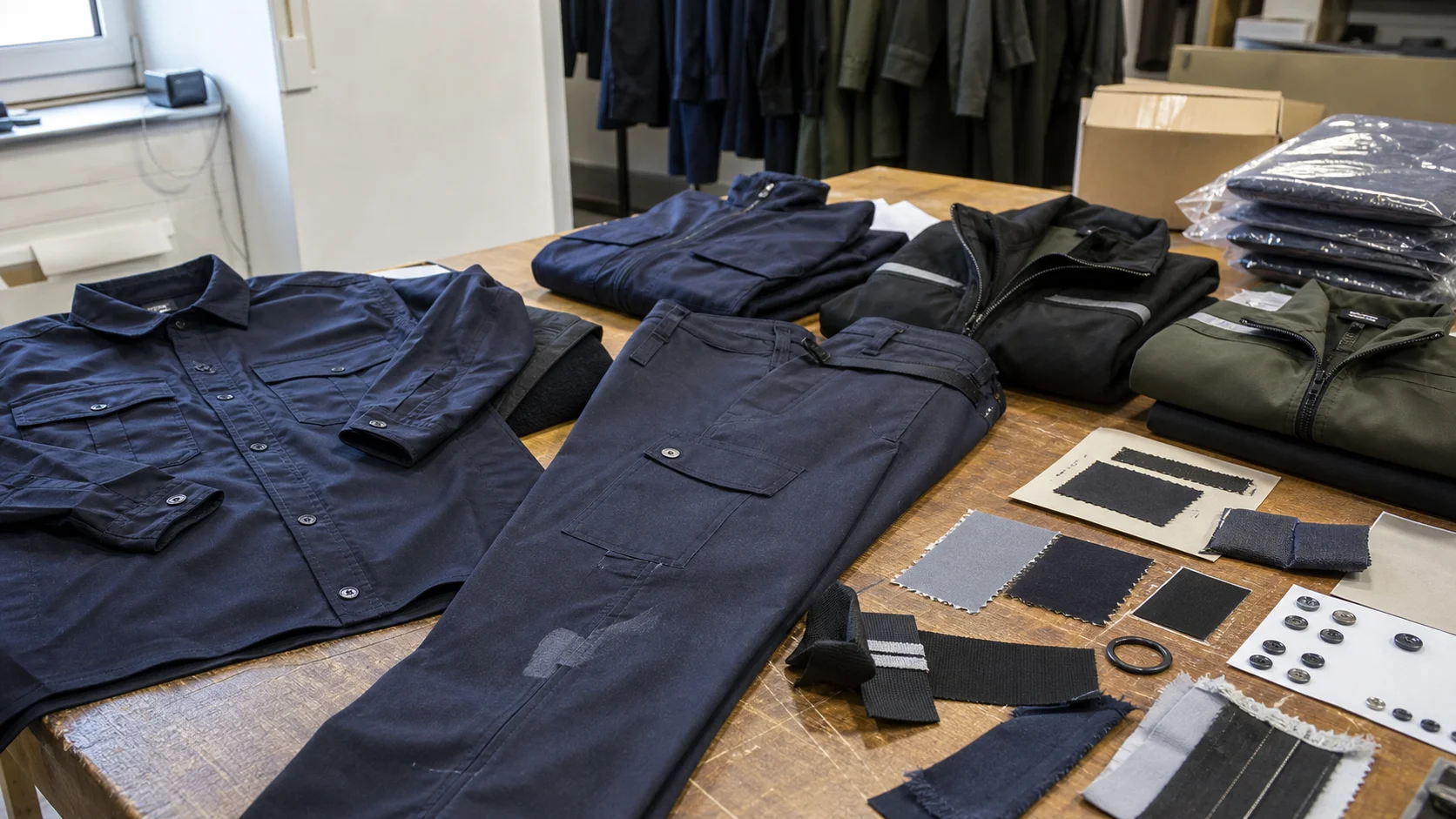
Security uniforms are operational garments. They need to look sharp, withstand repeated washing, support movement, and present a consistent client-facing image. Contractors often need shirts, trousers, jackets, polos, softshells, hi-vis vests, caps, epaulettes, belts, and sometimes bodywarmer layers. Each product has its own MOQ logic. A woven shirt with epaulettes and embroidery does not price the same way as a plain black polo with heat transfer branding.
MOQ decisions are especially sensitive for security companies because headcount can change quickly. A new site contract may require 30 guards this month and 80 next quarter. Seasonal events may require short-term uniform issues. A national contract may require strict color matching across multiple locations. In those cases, buyers need to balance price breaks against flexibility.
The best MOQ is not always the lowest MOQ. It is the quantity that gives acceptable unit cost without creating avoidable size, branding, or cash-flow risk.
For buyers comparing factories, distributors, or sourcing partners, the key question is simple: what is included in the quoted MOQ price? Some quotes include fabric, trims, basic packaging, and one logo application. Others exclude sampling, lab dips, freight, labels, cartons, duty, or inspection. A proper review should separate garment cost from the total landed cost.
Security contractors looking for structured garment sourcing support can review production service options at fabrikn.com/services/. Buyers with a live tender or a replenishment program can also request a sourcing discussion through fabrikn.com/contact-us/.
Security workwear covers more than one garment category. A contractor may call the whole package a “uniform,” but factories usually price each item separately. This matters because fabric type, construction method, branding, packaging, and size spread all influence MOQ and price.
A buyer should avoid treating all of these as one MOQ. A supplier may accept 300 total pieces across several styles, but production economics usually work better when each style reaches a workable quantity. Fabric dyeing, cutting markers, trim sourcing, embroidery setup, and packing all have minimum thresholds.
There is also a difference between stock customization and made-to-order manufacturing. Stock customization uses existing blank garments, usually with embroidery, heat transfer, woven badges, or printed branding. Made-to-order production builds the garment from fabric and trims to the buyer’s specification. Stock customization usually has lower MOQ and faster lead time, but it offers less control over fabric, fit, color, and long-term consistency.
MOQ ranges vary by supplier, fabric availability, decoration method, and country of production. The figures below are typical planning ranges, not fixed promises. Buyers should use them as a starting point when reviewing quotes for security contractor uniforms.
Product Type Typical MOQ Range Practical Notes Stock polo with logo 50-200 pieces Good for small teams, trials, or urgent onboarding. Limited color and fit control. Custom polo 300-1,000 pieces Better fabric and trim control. Unit cost improves once fabric and decoration are consolidated. Woven security shirt 300-800 pieces Epaulettes, pockets, and buttons add labor. Custom yarn-dyed fabrics may push MOQ higher. Cargo or tactical trousers 300-1,000 pieces Many components: zips, snaps, pocket bags, reinforcement panels, elastic, and size grading. Softshell jacket 300-800 pieces Fabric MOQ and lamination type affect price. Custom color may require higher quantities. Hi-vis vest 200-1,000 pieces Reflective tape quality and certification claims must be checked carefully. Waterproof jacket or parka 500-1,500 pieces Seam sealing, lining, padding, and waterproof testing make small runs expensive. Caps and beanies 200-1,000 pieces Embroidery setup is manageable, but custom fabric, labels, or buckles can raise MOQ.Small security contractors often want 50-100 pieces per item. That is realistic for stock blanks and local decoration, but it is rarely the most cost-efficient route for fully custom uniforms. Mid-sized contractors ordering 300-1,000 pieces per style can usually access better fabric options, more stable sizing, and more competitive decoration costs. Large contractors ordering 2,000 pieces or more can negotiate stronger unit pricing, but they must control size ratios and inventory planning tightly.
A useful approach is to split requirements into core and variable items. Core items are the garments used across most contracts, such as black polos, black trousers, and branded softshells. Variable items include site-specific hi-vis colors, badges, client logos, or special jackets. The core range can carry higher MOQ because it replenishes steadily. Variable items should be kept flexible unless a contract is already confirmed.
MOQ and unit price move together, but not always in a straight line. A factory may offer a visible price drop at 500 pieces because cutting, line setup, and decoration become more efficient. Another price break may appear at 1,000 or 2,000 pieces if fabric can be purchased at better mill pricing. Beyond that, savings may slow down unless the buyer simplifies materials, trims, or packaging.
Fabric is usually the largest cost component. Cotton-rich pique, polyester pique, poly-cotton poplin, ripstop, twill, fleece, softshell, and waterproof fabrics all carry different price structures. Security buyers should specify fabric weight, composition, finish, color, shrinkage tolerance, and performance expectations.
For polos, common options include 180-220 gsm polyester pique, cotton-poly blends, or moisture-wicking jersey. For trousers, buyers often review 220-280 gsm poly-cotton twill, mechanical stretch fabric, or nylon-blend tactical fabric. For outerwear, softshell may range from lighter two-layer fabric to bonded three-layer fabric with fleece backing. Waterproof jackets need more detailed specifications, including coating, membrane, seam tape, lining, and water-resistance requirements.
A simple polo has fewer sewing operations than a tactical trouser. Cargo pockets, knee panels, reinforced seams, gussets, adjustable waist tabs, bar tacks, pocket flaps, and zip closures all add labor. Security buyers should be careful when requesting “just one more pocket” because small design changes can affect both price and production time.
Logo application is a major pricing variable. Embroidery is durable and professional but can be costly on large stitch-count logos. Heat transfer is clean and useful for smaller production runs, but durability depends on transfer quality, wash temperature, and fabric compatibility. Woven badges provide a traditional security look but require badge MOQ and sewing labor. PVC patches or rubber badges can look modern, though they may increase setup cost.
Buyers should request logo dimensions, placement, application method, color references, and wash durability expectations before confirming price. If uniforms carry both the contractor logo and end-client branding, confirm whether the order will be split by site or packed as one bulk lot.
Size distribution is often underestimated. A 500-piece order split across XS to 5XL is not as efficient as a 500-piece order concentrated across S to XXL. Extended sizes require additional grading, marker planning, fabric consumption, and sometimes separate fit checks. Some suppliers charge extra for 3XL and above because fabric usage rises materially.
Neck labels, care labels, size labels, woven brand labels, swing tags, polybags, cartons, and carton marks all affect total cost. Care label content should match the destination market and actual fabric composition. Hi-vis garments require extra caution because claims around visibility, reflective tape, and performance standards can create compliance exposure if not supported by documentation.
Sampling is where many uniform programs either become controlled or start drifting. Buyers should avoid releasing bulk production based only on a photo, especially when fit, fabric hand feel, color, and logo placement matter.
For repeat programs, buyers may not need every sample stage each time. A replenishment order using approved fabric, trims, and patterns can move faster. A new security uniform range should not skip the pre-production sample. That sample becomes the control reference for bulk inspection.
Sampling costs vary. Some suppliers charge sample fees and refund them after bulk order confirmation. Others charge separately for courier, fabric sourcing, embroidery setup, or special trims. Buyers should clarify whether the quoted MOQ price assumes approved stock fabric or custom-developed fabric.
Direct judgment: do not approve bulk production from a digital mockup alone unless the order is very low risk and based on stock blanks. For custom workwear, physical samples are cheaper than correcting a full shipment with poor fit, wrong logo position, or weak fabric.
A clear specification protects both buyer and supplier. Security uniforms are exposed to frequent washing, outdoor work, desk posts, vehicle patrols, and sometimes rough handling. Vague descriptions such as “good quality black polo” or “durable security trousers” are not enough for consistent pricing.
Buyers should also specify tolerance for measurements. Typical garment measurement tolerance may be around 1 cm for smaller points and 2 cm for larger body measurements, depending on product type and agreed standard. Tighter tolerance can increase rejection risk and production pressure. Loose tolerance may create fit complaints from guards.
Black and navy security uniforms deserve particular attention. Different fabric lots can show shade variation even when the color name is the same. If polos, trousers, and jackets are made from different fabrics, perfect shade matching may not be realistic. The buyer should decide whether “commercially acceptable” shade matching is enough or whether a stricter standard is needed.
Lead time is not only sewing time. It includes sampling, fabric booking, trim sourcing, lab dips, artwork approval, bulk cutting, production, decoration, inspection, packing, export handling, freight, customs clearance, and final delivery.
For stock garments with local logo application, lead time may be 1-3 weeks if blank inventory is available. For custom security uniforms, planning lead times are often 6-12 weeks after sample approval, depending on fabric availability and order complexity. Waterproof jackets, padded outerwear, or hi-vis certified garments can take longer. Peak season, factory capacity, public holidays, and shipping congestion can extend the timeline.
Security contractors bidding for new contracts should build uniform lead time into mobilisation planning. If a contract starts in four weeks, made-to-order uniforms may not be realistic unless the design already exists and materials are available. In that case, stock blanks with approved branding may be the safer operational decision.
Buyers can learn more about the business and sourcing approach behind Fabrikn at fabrikn.com/about-us/. For time-sensitive uniform planning, early discussion matters because MOQ and lead time are linked.
Inspection should not be treated as a formality. Security uniforms are visible, repeated-use products. Small defects multiply quickly when the same issue appears across hundreds of garments.
Buyers should define an inspection method before production starts. AQL inspection is common in apparel, but the exact acceptable quality limit, defect classification, and sampling level should be agreed in advance. Critical defects may include wrong logo, unsafe trims, sharp objects, incorrect compliance labels, or garments that cannot be issued. Major defects may include visible stains, open seams, wrong measurements, or failed decoration. Minor defects may include small thread ends or slight cosmetic issues within agreed limits.
Pre-shipment inspection is useful, but it does not replace good pre-production control. The buyer should approve the sample, artwork, fabric, trims, and measurement chart before the factory begins bulk production. When the shipment is site-packed, inspection should also check carton assortment against the packing list.
The following table gives a practical framework for reviewing MOQ pricing. Exact prices depend on production country, fabric, wage structure, freight route, currency, and supplier margin. The table is designed for sourcing judgment rather than exact quoting.
Order Scenario Likely MOQ Position Cost Position Best Use Case Main Tradeoff 50-100 stock garments with logo Low MOQ Higher unit cost Small teams, urgent starters, pilot contracts Limited customization and inconsistent future stock risk 200-300 mixed garments Flexible but fragmented Moderate to high Growing contractors testing a uniform range Price breaks may be weak if split across many styles 500-1,000 pieces per core style Commercially workable Improving unit cost Established contractors with steady replenishment Requires better forecasting and size planning 2,000+ pieces per core style Strong production efficiency Better unit cost Large contracts or national uniform programs Higher inventory exposure if demand shifts Custom outerwear program Medium to high MOQ High cash commitment Consistent brand image across cold or wet-weather posts Longer lead time and more specification riskA good MOQ pricing review compares more than unit cost. It should include sample cost, logo setup, fabric testing, packaging, freight, duty, inspection, warehousing, and reorder cost. It should also consider the value of consistent appearance. In security services, a poorly matched uniform can weaken the contractor’s professional presentation at the client site.
One practical method is to request pricing at three quantity levels: minimum workable MOQ, efficient MOQ, and projected annual volume. This shows where the real cost breaks occur. If the price drops only slightly between 500 and 1,000 pieces, it may be better to buy 500 and preserve cash. If the price drops sharply at 1,000 pieces and the garment is a proven core item, the larger buy may be justified.
Security contractors should buy uniforms with the same discipline used for operational equipment. The cheapest uniform is not cheap if it fades quickly, shrinks after washing, fits badly, or arrives too late for contract mobilisation.
Low MOQ is suitable when the team is small, the contract is uncertain, the buyer needs rapid deployment, or the design is likely to change. It is also useful for trialling a new fit or garment category. Stock polos, stock trousers, and stock softshells can work well for these situations.
The tradeoff is weaker control. Stock garments may be discontinued. Color lots may vary between repeat orders. Size availability can be uneven. Branding may be added after garment production, which limits how integrated the uniform can look.
Higher MOQ is more suitable when the contractor has stable headcount, repeat demand, and a clear uniform standard. It allows better control over fabric, trims, logo placement, labels, and packaging. It can also reduce unit cost and make replenishment more predictable if the supplier can hold the approved specification.
The risk is inventory. Security staff turnover, contract loss, rebranding, client-specific uniform requirements, or sizing errors can leave the buyer with unusable stock. Before placing a large order, check issue rates, replacement cycles, size history, and expected new contract starts.
For many security buyers, the strongest model is a hybrid program. Use made-to-order production for core garments with predictable demand, then use stock customization for urgent top-ups, small client-specific runs, and new site launches. This protects brand consistency without forcing every purchase into a high MOQ structure.
Buyers should also ask suppliers about repeat order terms. If the first order meets the fabric mill MOQ, a supplier may be able to support smaller replenishment orders using leftover fabric or planned repeat fabric bookings. This should be confirmed in writing. Do not assume that a 1,000-piece first order automatically guarantees a 100-piece reorder at the same price.
A clean quotation request saves time and reduces price confusion. Suppliers price more accurately when they receive specific requirements rather than broad descriptions.
Security contractors should also ask for price validity. Fabric, freight, currency, and trim costs can move. A quote valid for 15 or 30 days is different from a quote expected to support a six-month tender. If uniforms are part of a public or corporate bid, ask whether the supplier can hold pricing and under what conditions.
It is also sensible to separate development costs from bulk cost. A supplier may quote a low garment price but charge separately for artwork, embroidery setup, lab dips, courier samples, or testing. That can be acceptable if transparent. It becomes a problem when costs appear late in the process.
Bulk workwear uniform MOQ pricing for security contractors is a balance between unit cost, operational readiness, brand control, and inventory risk. Small orders offer flexibility but cost more per piece. Large orders improve production efficiency but require accurate forecasting. Custom production gives better control, while stock customization supports speed and lower commitment.
The safest buying decision depends on certainty. If the contract, headcount, design, and size curve are confirmed, higher MOQ can make commercial sense. If demand is uncertain, keep the order lean and use stock-supported options until the program stabilizes.
For a security contractor, uniform purchasing should not be judged only by the first invoice. The real cost includes replacement frequency, wearer acceptance, inspection failure, late delivery, and whether the garments present a consistent professional image at client sites. A disciplined MOQ review helps buyers avoid both overpaying for small runs and overcommitting to stock they may not use.
Get a free quote from Fabrikn — your trusted B2B clothing manufacturer with 10+ years of experience. MOQ as low as 200 pieces.
Get a Free Quote →Typical MOQ for custom security uniforms often starts around 300-1,000 pieces per style, depending on fabric, trims, branding, and supplier setup. Stock garments with logo application may be available from around 50-200 pieces, but customization control is more limited.
Prices often drop because fabric buying, cutting, sewing line setup, decoration, and packing become more efficient. The biggest improvements usually appear when the order reaches workable fabric and production thresholds. Savings may flatten once those efficiencies are already captured.
Stock uniforms are better for urgent starts, small teams, or uncertain contracts. Custom production is better for established contractors that need consistent fabric, fit, branding, and repeatability. Many buyers use both: stock for short-term needs and custom production for core uniform programs.
Buyers should review past issue data, staff demographics, return history, and contract headcount before setting the size ratio. Extended sizes should be planned carefully because they use more fabric and may move slower. A size set sample is useful before large custom orders.
Buyers should approve the pre-production sample, fabric quality, color standard, trims, logo placement, decoration method, care label, size label, packaging, and measurement chart. Written approval helps avoid disputes when the bulk order is inspected.
Stock garments with branding may take 1-3 weeks if inventory is available. Custom production commonly takes 6-12 weeks after sample approval. Complex outerwear, hi-vis garments, custom fabric, or peak-season capacity pressure can extend the timeline.
The main risks include shade variation, poor logo placement, incorrect measurements, weak seams, defective reflective tape, wrong labels, and packing errors. Site-packed orders need extra checking because carton mistakes can delay uniform issue to guards.
Provide a clear RFQ with garment specs, quantities by style, size ratio, fabric details, trims, branding artwork, packaging needs, delivery destination, and inspection requirements. Ask for pricing at several quantity levels so the real cost breaks are visible.
A higher MOQ is worth considering when the garment is a proven core item, demand is steady, sizing is known, and the specification is unlikely to change. It is less suitable when a contract is unconfirmed, branding may change, or the buyer has limited storage capacity.
Security buyers can review sourcing and production support at fabrikn.com/services/ or send a project enquiry through fabrikn.com/contact-us/.