
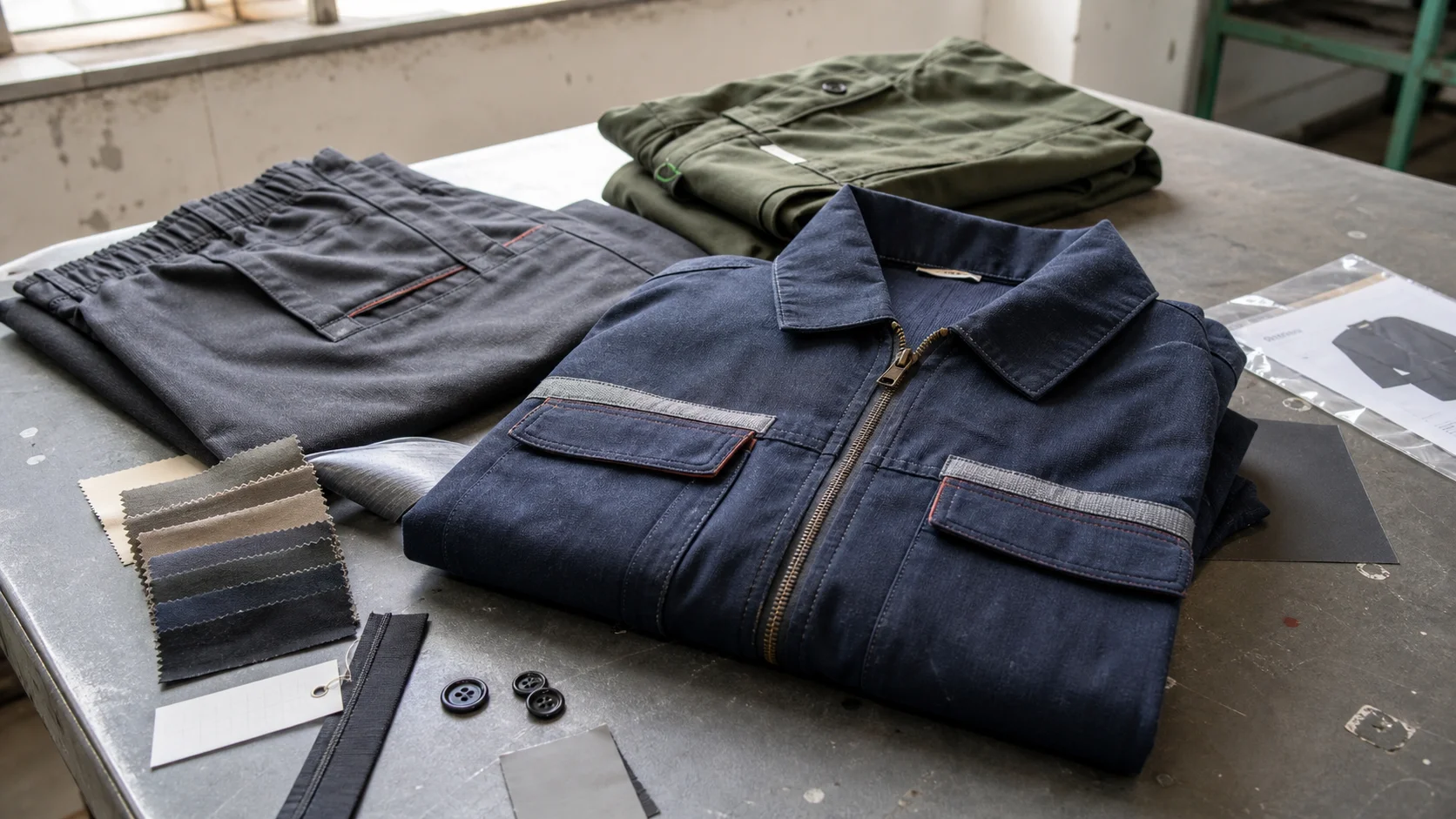
A practical SEO guide for security contractors on reducing shrinkage, overbuying, loss, and reordering costs in workwear uniform orders through size...
Workwear Uniform Shrinkage Control Plan for Buyers - Fabrikn production reference
Security contractor uniforms are not fashion pieces with flexible fit expectations. They are operational garments. A shirt that shortens after laundering, trousers that tighten at the thigh, or a jacket that twists at the side seam can quickly become a field complaint, a replacement cost, and a contract management problem.
For buyers placing workwear uniform orders for security teams, shrinkage control should be treated as a sourcing requirement, not a late-stage quality note. Security uniforms are washed frequently, worn for long shifts, and often issued in bulk across multiple body types. Small measurement changes after laundering can create a large service issue when hundreds or thousands of garments are involved.
The risk is higher when buyers focus only on unit price, MOQ, and delivery date. A low-cost fabric may pass visual inspection before washing but fail after five domestic or industrial laundry cycles. A supplier may quote a competitive price using greige or semi-finished fabric without enough stabilization. A size chart may look correct on paper while the finished garment loses length after the first wash.
A practical shrinkage control plan gives the buyer a way to manage these risks before production starts. It connects fabric choice, lab testing, pattern allowance, sample approval, production monitoring, and final inspection into one purchasing process. This matters especially for security contractors because uniform appearance affects brand image, staff comfort, and contract compliance.
Buyers sourcing through a manufacturing partner can also align shrinkage expectations with broader production planning. If you are still defining supplier capabilities, review available support through Fabrikn services before confirming order scope, fabric route, and inspection expectations.
Shrinkage issues rarely come from one single mistake. They usually come from weak specifications, poor fabric control, rushed approvals, or unclear laundry assumptions. Security uniform buyers should identify the risk profile before requesting quotes.
The commercial impact is straightforward. If 5% of a 5,000-piece order becomes unwearable after laundering, the buyer may face 250 replacements, urgent reorders, freight pressure, and staff dissatisfaction. If the problem affects a core size such as M, L, XL, or 34-inch waist trousers, the disruption can be larger than the percentage suggests.
Purchasing judgment: shrinkage control is cheaper before production than after delivery. Buyers should spend time on fabric testing and sample laundering before approving bulk cutting.
A shrinkage control plan starts with definitions. Buyers should not wait for the supplier to decide what level of shrinkage is acceptable. The acceptable limit depends on garment type, fabric construction, washing method, and contract expectations.
For many woven workwear uniforms, buyers often target residual shrinkage after washing in the range of 2% to 3% in length and width. Some cotton-rich fabrics may need a more realistic limit, especially for lower-cost programs. Knitted polos, sweatshirts, rib collars, and elastic waist items can require different standards because their structures behave differently from woven twill shirts and trousers.
Security uniforms often include shirts, trousers, cargo pants, jackets, vests, polos, and sometimes hi-vis elements. Each garment type needs its own shrinkage expectation. A 2% loss on a short-sleeve shirt may be manageable if the pattern has allowance. A 2% loss on trouser inseam can still generate complaints from taller staff. Jackets with lining, padding, or fused panels bring another layer of risk because shell, lining, interlining, and trims may shrink at different rates.
A well-defined standard makes quotations more comparable. Without it, one supplier may quote pre-shrunk fabric and another may quote untreated fabric at a lower price. The cheaper offer may only look cheaper because the risk has been pushed into the buyer’s warehouse.
Fabric is the biggest driver of shrinkage performance. Cut-and-sew quality matters, but even a strong sewing line cannot fully correct unstable fabric. Security contractors typically need fabrics that balance durability, comfort, color retention, and controlled shrinkage.
For woven security shirts, common weights may range from around 115 gsm to 160 gsm for lighter office-style shirts and 170 gsm to 240 gsm for more durable field shirts. Trousers and cargo pants may use fabrics from around 200 gsm to 300 gsm, depending on climate, wear requirement, and cost target. Heavier fabric is not automatically better. It may reduce transparency and improve durability, but it can also increase heat stress, freight cost, drying time, and wearer complaints.
Fabric finishing should be requested clearly. Terms such as “pre-shrunk,” “sanforized,” “resin finish,” “heat-set,” or “compacted” should be supported by test results, not just supplier claims. For polyester-cotton fabrics, heat setting and finishing consistency can help dimensional stability. For cotton-rich fabrics, mechanical compaction or sanforizing may be important. For knits, compacting and proper relaxation before cutting are critical.
Shrinkage control is not only about main fabric. Security uniforms often include shoulder epaulettes, flap pockets, badges, embroidery, hook-and-loop closures, zippers, reflective tape, elastic adjusters, fusible interlinings, and contrast panels. These components can shrink, stiffen, bubble, crack, or pull against the main fabric after laundering.
Reflective tape is a frequent inspection risk. Some tapes perform well in domestic washing but deteriorate under industrial laundering or high-temperature drying. Fusible interlining is another concern. If the interlining shrinkage or bonding temperature does not match the shell fabric, collars, plackets, cuffs, and waistbands may pucker after wash.
Buyers should request a trim card and approve trims with wash-tested samples. This is particularly important for security contractor uniforms with visible branding, rank markings, or compliance features.
MOQ affects shrinkage control because better fabric sourcing and finishing often require minimum volume. Small orders can still be controlled, but buyers may have fewer fabric choices and higher testing cost per garment.
Typical MOQ ranges vary by supplier, fabric, customization level, and market conditions. As a general sourcing guide, basic stock-fabric uniform shirts or polos may start around 100 to 300 pieces per style or color. Custom-dyed fabric programs may require 500 to 1,000 pieces or more per color. Fully customized woven workwear with special fabric, trims, embroidery, or reflective applications may sit around 500 to 2,000 pieces, depending on fabric mill MOQ and production planning.
Buyers should treat these ranges as planning references, not fixed rules. A supplier may accept lower MOQ at a higher unit price, with limited fabric choices or longer lead time. A larger order can improve fabric control because the supplier can book one continuous fabric lot, run proper lab dips, and apply consistent finishing. Large volume also increases the cost of failure if testing is skipped.
Security contractors often have contract-driven budgets. The direct purchasing judgment is this: do not remove fabric testing to hit a low unit price unless the order is small, low-risk, or repeat-proven. For a first order, new fabric, new supplier, or public-facing security contract, shrinkage testing should remain in the budget.
Order Scenario Typical MOQ Pressure Shrinkage Risk Buyer Recommendation Small replenishment using approved fabric Low to medium Lower if same fabric lot route is used Confirm fabric continuity and run spot wash testing New security shirt program Medium Medium to high Approve fabric test report and washed garment sample before bulk Custom-dyed trouser fabric High High if finishing is unverified Require lab dips, bulk fabric test, and PP wash approval Multi-style contract rollout High High due to mixed materials and trims Create one shrinkage standard across all styles and audit each materialThe control plan should be built before a purchase order is signed. Once fabric is cut, most shrinkage decisions are locked in. A buyer should use the sourcing stage to confirm that the supplier can manage fabric testing, pattern correction, sample laundering, and measurement reporting.
The technical pack should include garment drawings, size chart, grading rules, fabric composition, fabric weight, weave or knit type, color standards, trim specifications, stitching requirements, labeling, packing, and wash-care instructions. The shrinkage section should be specific. It should state the acceptable percentage shrinkage after a defined number of wash cycles and identify who performs the test.
For security contractor uniforms, also include the expected usage environment. Outdoor patrol, indoor reception, event security, industrial site security, and mobile response teams may require different materials. Heat, rain, abrasion, and washing frequency all influence sourcing decisions.
Fabric testing should happen before the buyer invests heavily in garment development. Ask for dimensional stability, colorfastness to washing, colorfastness to rubbing, pilling where relevant, tear strength, tensile strength, and seam slippage for woven fabrics if the garment will be under stress. For hi-vis or reflective elements, request relevant performance evidence based on the intended use and washing method.
Test reports should match the actual fabric construction, composition, color, and finish proposed for the order. Old reports from a different fabric should not be accepted as proof for a new program.
Fabric relaxation is easy to overlook. Woven rolls and knitted fabrics may be under tension from finishing, rolling, shipping, or storage. If fabric is cut immediately after unrolling, panels can shrink or distort before sewing is complete. Knitted fabrics are especially sensitive, but woven fabrics can also move.
Buyers should ask how long the supplier relaxes fabric before cutting. The answer may vary by material. Some fabrics need several hours; others may need longer. The control point is simple: the supplier should have a defined process and should not cut unstable fabric straight from a tight roll when shrinkage control is important.
If fabric testing shows residual shrinkage within acceptable limits, the pattern may still need adjustment. For example, if a trouser fabric consistently shrinks 2% in length after the approved wash process, the pattern and finished measurement tolerance may need to account for that. This must be validated through washed garment samples, not assumed from fabric tests alone.
Pattern compensation is a tradeoff. If the garment is made oversized to allow for shrinkage, it may look too large before washing. If it is made true-to-size before washing, it may become too small later. Buyers should decide whether uniforms will be issued before wash, after garment wash, or after laundry processing. That decision affects the correct measurement target.
A security uniform shrinkage control plan needs more than one sample. A salesman sample may show styling, but it does not prove bulk performance. Buyers should separate fit approval, fabric approval, wash approval, and pre-production approval.
The wash test sample is the key control point. Measure the garment before washing, wash according to the agreed method, dry according to the expected real-use process, condition the garment, then measure again. Record both absolute measurements and percentage change.
Security uniforms should also be assessed for movement after washing. A shirt may technically meet chest measurement tolerance but still feel tight across the back if armhole, shoulder, or sleeve shrinkage is uneven. Trousers may pass waist measurement but fail at thigh, rise, or inseam. Field wear requires more than a flat table measurement.
Lead time depends heavily on sampling discipline. A basic stock-fabric program may move from sample approval to bulk delivery in several weeks if materials are available. Custom fabric, custom dyeing, lab testing, size-set revisions, and trim sourcing can push timelines longer. Buyers should allow time for failed samples. A control plan with no time for correction is only a document, not a working process.
For buyers preparing a new security uniform program, early supplier discussion can prevent avoidable resampling. If specifications are still being organized, use the Fabrikn contact page to start with garment type, estimated volume, fabric preference, delivery window, and wash requirements.
Bulk production must follow the approved sample route. A common problem is that the sample is made carefully, but production uses a different fabric lot, altered trim, changed fusing condition, or rushed cutting process. Buyers need control points that make substitution visible.
Ask the supplier to identify fabric rolls by lot, shade, and test status. If multiple rolls are used, shrinkage should be checked by lot where practical, especially for custom-dyed or cotton-rich fabrics. Rolls should be inspected for width variation, shade banding, bowing, skewing, and defects before cutting.
Width shrinkage affects marker planning and garment balance. Length shrinkage affects body length, sleeve, and inseam. Bowing and skewing may cause twisting after laundering, especially on trouser legs, plackets, side seams, and cargo pockets.
Cutting should follow relaxed fabric measurements. Markers should respect grainline. Cutting direction should be controlled for fabrics with nap, sheen, twill direction, or shade sensitivity. If panels are distorted during spreading, the garment may twist after wash even if the fabric shrinkage percentage looks acceptable.
Sewing affects shrinkage appearance. Tight stitch tension, mismatched thread, poor feeding, or incorrect fusing can cause seam puckering after wash. Security shirts with epaulettes, flap pockets, and front plackets need careful alignment because any post-wash movement is highly visible. Trousers need stable waistbands, pocket openings, crotch seams, and inseams.
Pressing temperature and steam can influence dimensions. Over-pressing may temporarily stretch or flatten garments, causing measurements to look correct during final inspection but change after laundering. If garments are garment-washed before packing, the process must be approved and consistent. If they are not garment-washed, final measurements should be judged with knowledge of expected after-wash behavior.
Packing also matters. Garments packed while damp or under heavy compression can develop creases, odor, or shape issues. While packing does not usually create true fabric shrinkage, it can create appearance problems that are mistaken for poor manufacturing.
Final inspection should not only count defects. It should verify whether the production still matches the shrinkage control plan. For workwear uniforms, inspection should cover pre-wash and, where possible, post-wash checks on selected pieces.
Buyers should define the inspection sample size and acceptance criteria in advance. For larger orders, third-party inspection or buyer-side inspection may be worth the cost. For smaller orders, at minimum, request production measurement reports and washed sample evidence from bulk fabric. The goal is not to make inspection complicated. The goal is to catch avoidable risk before the goods ship.
A practical inspection method is to pull garments from different sizes, cartons, and production lots. Measure before wash, launder according to the agreed method, measure again, and compare with the approved pre-production sample. This is slower than a visual-only inspection, but it gives the buyer real information.
Purchasing judgment: if the supplier refuses any bulk wash verification for a new fabric program, the buyer should treat the order as higher risk and negotiate stronger approval controls before deposit.
The table below gives buyers a practical structure for a shrinkage control specification. It should be adapted by garment type, fabric, and laundry method.
Control Area Buyer Requirement Typical Evidence to Request Risk if Missing Main fabric Composition, weight, weave or knit, finish, color standard Fabric test report, swatch approval, lab dip or strike-off Unstable fabric, shade variation, wrong handfeel Shrinkage tolerance Target percentage after agreed wash cycles Before and after wash measurement report Fit complaints after first laundering Trim stability Compatible interlining, tape, elastic, buttons, zippers, badges Trim card and washed PP sample Puckering, cracking, distortion, detachment Pattern allowance Pattern adjusted based on tested residual shrinkage Washed fit sample and size set approval Correct sample look but poor after-wash fit Bulk fabric control Fabric roll identification and lot consistency Roll inspection report and lot test records Different shrinkage across cartons Final inspection Pre-wash and selected post-wash checks Inspection report with measurement photos Defects discovered only after deliveryBefore issuing a purchase order, buyers should ask direct questions. The answers will show whether the supplier understands shrinkage control or only treats it as a buyer complaint after shipment.
The best answer is not always the lowest shrinkage claim. A realistic supplier will explain limits, testing method, and tradeoffs. Be cautious with broad promises such as “no shrinkage” on cotton-rich workwear. Most textiles move to some degree. The buyer’s job is to control that movement within a practical tolerance.
Shrinkage control takes time. Buyers should avoid approving a security uniform rollout schedule based only on sewing time. The calendar should include fabric sourcing, lab dips, fabric testing, sample making, wash testing, revisions, bulk fabric production, cutting, sewing, finishing, inspection, packing, and freight.
For a simple repeat order using approved stock fabric, timelines can be relatively short if materials are available. For a new custom program, buyers should allow extra time for fabric development and failed-test correction. Custom dyeing may add time because lab dip approval and bulk shade approval must happen before cutting. Reflective tape, custom badges, woven labels, and embroidery files can also delay production if not approved early.
Sampling delays are common when buyers approve styling but forget wash testing. The order then reaches pre-production stage before anyone has confirmed after-wash measurements. At that point, pattern corrections can delay cutting. A better approach is to test early, revise once, and lock the standard before bulk fabric is released.
Get a free quote from Fabrikn — your trusted B2B clothing manufacturer with 10+ years of experience. MOQ as low as 200 pieces.
Get a Free Quote →Buyers can control cost without removing shrinkage safeguards. The key is to simplify the order intelligently