
A practical SEO outline for security contractors evaluating seam strength, uniform durability, MOQ tradeoffs, and sourcing decisions before placing a...
Workwear Uniform Seams for Security Order Review - MOQ, Cost & Sourcing manufacturing guide
Security contractors buy workwear uniforms for a job where appearance, movement, and durability all matter at the same time. A guard may stand at a reception desk, patrol a parking structure, climb stairs, sit in a vehicle, handle access control equipment, or respond quickly to an incident. The uniform must look controlled and professional, but it also has to survive repeated laundering, bending, abrasion, and pulling at high-stress seams.
Seam strength is often treated as a technical detail until failures start appearing in the field. Split trouser seats, popped shoulder seams, loose pocket bags, torn belt loops, and fraying hems create replacement costs and complaints. For security contractors managing multiple sites, these issues also make uniforms harder to standardize. A seam review before order approval is one of the simplest ways to reduce those risks.
This article explains how to review seam strength for security workwear orders, what to request from suppliers, where costs usually rise, and how MOQ decisions affect quality control. It is written for buyers, operations managers, procurement teams, and sourcing staff who need practical order-level judgment rather than generic garment theory.
Security uniforms sit between corporate apparel and industrial workwear. They must present a clean brand image, but they are not always used gently. A security officer’s uniform can be exposed to long shifts, frequent sitting, radios clipped to belts, keys, body movement, reflective accessories, and repeated washing. In some contracts, the same garments are worn five or six days a week.
That use pattern puts pressure on seams. Fabric may be acceptable, and the garment may look sharp on a hanger, but weak seam construction can shorten the working life of the uniform. The buyer then pays twice: once for the original order and again through replacements, urgent reorders, staff dissatisfaction, and inconsistent appearance across teams.
For security contractors, seam strength is also tied to operational credibility. A shirt sleeve seam opening during a shift or a trouser crotch seam splitting on duty is not just a garment defect. It affects the wearer’s confidence and may create an avoidable professional issue in front of the client site.
Purchasing judgment: if the uniform is for active patrol, vehicle work, event security, or high-turnover staffing, seam strength should be reviewed as a performance requirement, not as a cosmetic finishing detail.
Uniform buyers should not rely only on fabric weight or garment price. A heavier fabric with poor seam allowance and low stitch density may fail faster than a medium-weight fabric sewn correctly. The order review should connect fabric, pattern, seam type, thread, stress points, and inspection method.
A security contractor’s order may include shirts, trousers, cargo pants, jackets, softshells, polos, vests, and outerwear. Each garment has different stress zones. A single seam standard across all items is rarely enough.
Woven uniform shirts are often used for front-of-house guards, corporate sites, and reception-style roles. The most important seams are the armhole, side seam, shoulder seam, sleeve placket area, pocket attachment, and yoke seam if included. Shirts with epaulettes need reinforcement where the epaulette is stitched into the shoulder area.
Polos are common for less formal sites, warmer climates, and mobile teams. Knitted polos need attention at shoulder seams, side vents, collar attachment, sleeve hems, and placket stitching. The fabric stretch can hide weak sewing during fitting, then expose it after laundering.
Trousers carry the highest seam risk in many uniform programs. Crotch seams, inseams, outseams, waistband joins, belt loops, back pockets, cargo pocket flaps, and seat seams should be checked carefully. If officers carry keys, radios, gloves, notebooks, or phones, pocket construction needs to be reviewed as part of seam strength.
Cargo pants may look practical, but every pocket adds sewing operations and potential failure points. Low-cost cargo designs sometimes save money through lighter pocket bags, narrow seam allowances, or minimal bartacking. These choices may be acceptable for promotional uniforms, but they are usually weak for daily-use security contracts.
Security jackets need seam durability plus weather performance. Shoulder seams, sleeve seams, armholes, zipper attachment, pocket openings, storm flaps, reflective tape stitching, and lining attachment should be reviewed. If the jacket includes waterproof or water-resistant features, seam sealing and seam strength need to be considered together.
For outerwear, buyers should clarify whether the supplier is quoting a basic sewn jacket, a water-resistant jacket, or a sealed-seam waterproof garment. These are different products with different costs and lead-time implications.
Most seam failures occur where movement, pulling, abrasion, or load meets a weak construction choice. During order review, buyers should ask for sample photos, physical samples, or construction notes for these areas.
Garment Area Common Failure Typical Cause Review Action Crotch seam Splitting or thread breakage Low stitch density, weak thread, tight fit, poor seam allowance Request reinforced seam or double-needle construction where suitable Seat seam Opening after sitting or bending Insufficient seam strength for wearer movement Check size grading, seam type, and fabric recovery Belt loops Loops pulling away Insufficient bartacking or weak attachment Specify bartacks or reinforced loop ends Pockets Corner tearing Load stress from tools, keys, phones, or radios Require bartacks at pocket corners and review pocket bag fabric Armhole Seam popping during movement Poor fit, weak stitch, limited mobility in pattern Fit-test with reaching and lifting movement Reflective tape Peeling, puckering, or seam cracking Wrong tape type, poor heat setting, incompatible fabric Request wash test and tape specificationBuyers should pay special attention to uniform programs where sizes run broad. A seam that performs acceptably in a medium sample may fail in larger sizes if grading, fit, and fabric stretch are not handled properly. Larger sizes often create more stress at crotch, seat, shoulder, and armhole seams.
High-turnover contracts also create seam risk. New staff may receive stock garments that are not perfectly fitted. When a wearer is placed into a garment that is too tight, seam strength problems increase. A practical size curve and reorder buffer can reduce that pressure.
Different seam types serve different purposes. Buyers do not need to become sewing technicians, but they should know enough to challenge weak specifications and compare quotations fairly.
Plain seams are common and efficient. They may be suitable for low-stress areas or garments where cost control is important. The risk is that plain seams can fail if seam allowance is narrow, stitch density is low, or the fabric frays easily. For security trousers, relying on basic plain seams at the crotch and seat without reinforcement is often a poor tradeoff.
Overlocking helps finish raw edges and is common in knitwear and many woven garments. It can prevent fraying, but it should not be confused with strength on its own. A garment can look neatly overlocked inside and still have weak stress seams.
Double-needle stitching can improve strength and appearance in selected areas. It is often useful on trousers, shirts, and outerwear where a clean topstitched look is needed. It may raise sewing time and cost, but the benefit can be worthwhile for high-use uniform programs.
Flat-felled seams are commonly associated with durability because the raw edges are enclosed and the seam has multiple rows of stitching. They can be useful in workwear shirts and some trousers. The tradeoff is cost, production complexity, and sometimes a more rugged appearance. For formal security uniforms, the buyer must decide whether durability or a cleaner tailored look is the priority.
Bartacks are short dense stitches used to reinforce high-stress points. They are important at pocket corners, belt loops, zipper ends, side vents, cargo pocket stress points, and sometimes fly areas. Missing bartacks are one of the easiest quality issues to identify during inspection.
Purchasing judgment: do not pay for heavier fabric while accepting weak pocket and belt-loop construction. For security trousers, reinforcement at stress points often delivers more practical value than moving up one fabric weight.
Seam strength cannot be separated from fabric and trim. A strong stitch in the wrong fabric may cause tearing along the stitch line. A durable fabric sewn with poor thread may still fail. The review should treat the garment as a system.
Common workwear uniform fabrics may include polyester-cotton blends, polyester-viscose blends, cotton-rich twills, stretch woven fabrics, ripstop blends, softshell laminates, and performance knits. Security buyers often choose polyester-rich blends for color retention, lower shrinkage, and easier care. Cotton-rich fabrics can feel better in heat but may shrink, fade, or wrinkle more depending on finishing.
Typical woven trouser weights for security use may sit around 180-280 gsm, depending on climate, role, and price point. Shirts may be lighter, often around 110-180 gsm for woven styles. Polos can vary widely, commonly around 180-240 gsm. These are broad ranges, not fixed rules. The correct choice depends on wear conditions, washing process, and expected service life.
Stretch fabric can improve comfort and reduce seam stress caused by movement. It also introduces risks. Poor recovery, fabric growth, seam waviness, and mismatched thread elasticity can affect appearance and durability. For stretch trousers, buyers should review both fit and seam performance after washing.
Thread is a small line item with a large effect. Polyester thread is common in workwear because it offers strength and resistance to shrinkage. Cotton thread is less common for modern uniform durability needs. For stretch garments, the thread and stitch type should allow enough movement without breaking.
Thread color must also be controlled. Security uniforms are often dark navy, black, charcoal, or tactical green. Poorly matched thread can make seams look cheap, especially around pockets, plackets, and epaulettes. Contrast stitching may be intentional, but it should be approved in the sample stage.
Trim failure is often reported as a garment problem even when the seam is intact. Buyers should review zipper tape stitching, button attachment, snap reinforcement, and hook-and-loop placement. Cargo pockets with hook-and-loop closures need strong stitching at both ends because repeated opening pulls directly against the seam.
For security contractors, trims should be selected with noise, snagging, and appearance in mind. Large hook-and-loop panels may be practical but can look too tactical for some corporate sites. Metal trims may be durable but can add weight or create issues in certain controlled environments. Plastic trims can reduce weight, but quality varies.
Some security uniforms require reflective tape, ID panels, embroidered patches, heat-transfer logos, or badge tabs. These add seam and material stress. Reflective tape can stiffen a garment area, causing pulling or puckering. Embroidery can distort lightweight fabric if backing and placement are not controlled.
Where patches or badges are needed, the buyer should specify location, size, attachment method, backing, and replacement needs. If badges are removable, the base garment still needs reinforcement around the attachment area.
A sample approval process should do more than confirm color and logo placement. It should test whether the garment is ready for real use. The process can be simple, but it must be deliberate.
Before sample production, request a clear specification sheet. It should include fabric composition, fabric weight, thread type where available, seam types, stitch density expectations, trims, measurements, logo method, packaging, labeling, and size range. If the supplier cannot document construction details, the buyer has limited control over repeat orders.
For security uniforms, the spec should call out stress points such as belt loops, pocket corners, crotch seam, seat seam, armhole, shoulder seam, and zipper ends. A general note saying “reinforced stitching” is usually too vague.
The fit sample should be reviewed on a body or fit form close to the intended wearer profile. For security contractors, movement testing matters. The wearer should sit, squat, walk, reach forward, raise arms, and access pockets. Tightness at seat, thigh, crotch, shoulder, or upper arm often predicts seam failures.
Fit approval should include measurement tolerance. A common tolerance may be around plus or minus 1 cm for smaller measurements and slightly more for larger garment dimensions, depending on product type and supplier standard. The agreed tolerance should be written into the order documents.
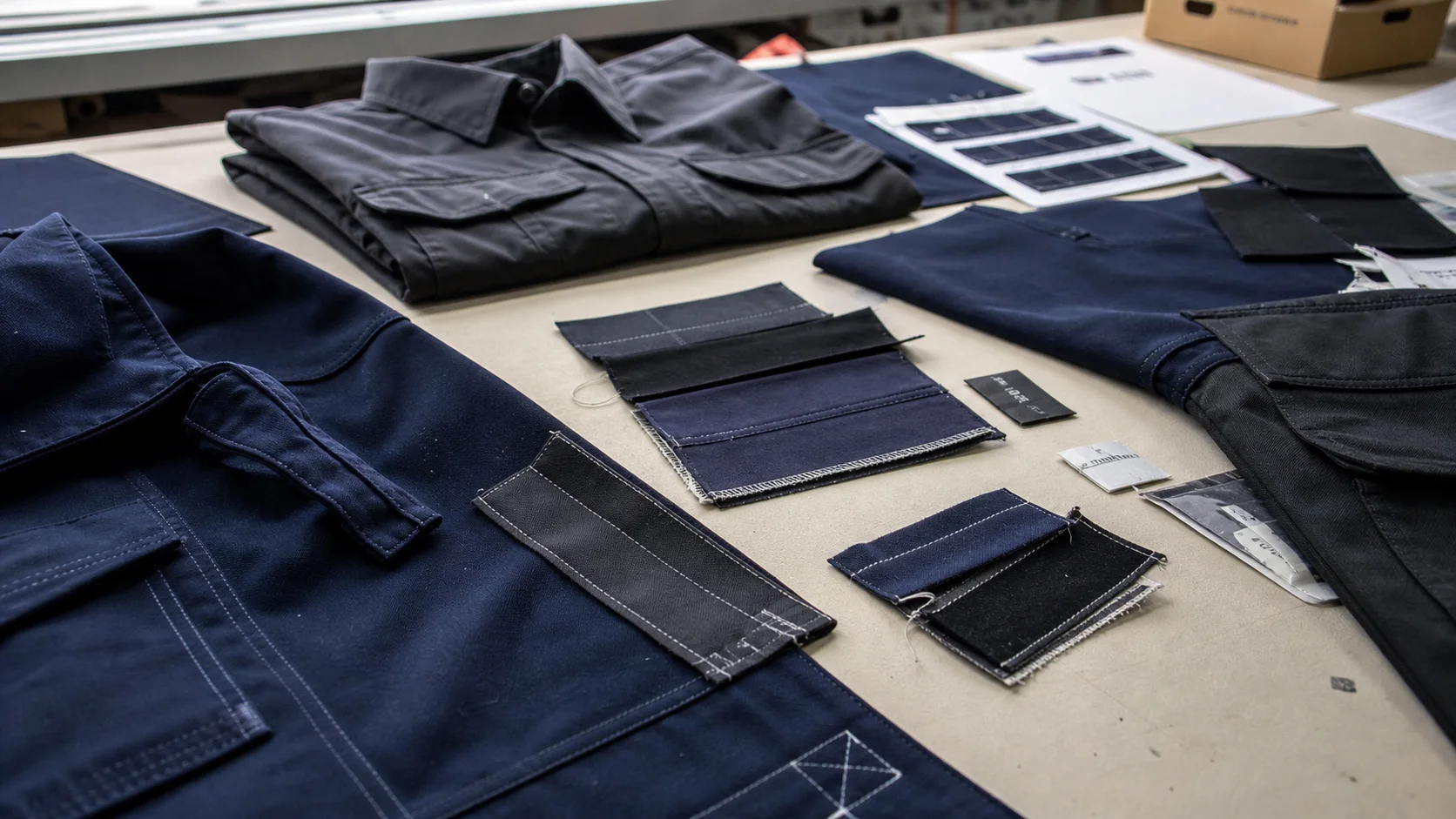
A construction sample or pre-production sample should show the approved seam methods. Turn the garment inside out. Check seam allowance, stitch consistency, loose threads, skipped stitches, seam puckering, bartacks, pocket attachment, waistband finish, and lining attachment if applicable.
Buyers should not approve a sample only from front-view photos. Inside construction photos are useful for remote review, but physical samples give better information. For large orders, the cost of couriering samples is usually minor compared with the cost of receiving weak production.
Wash testing is particularly important for security uniforms because garments are laundered often. A basic review may include several home-laundry cycles followed by checking shrinkage, seam twisting, thread breakage, color change, reflective tape condition, and logo durability. For industrial laundry, the supplier should know the washing conditions because heat, chemicals, and mechanical action change performance requirements.
Even a small wear trial can reveal issues that a desk review misses. Pockets may sag. Waistbands may roll. Side seams may twist. Reflective tape may feel too stiff. A shirt that looks correct may restrict arm movement once worn with equipment.
The final approved sample should be kept as the production reference. This is often called a sealed sample. It should match the approved fabric, trims, color, logo placement, seam construction, and measurements. Production inspections should compare bulk garments against this reference.
If the order changes after approval, such as switching fabric weight or replacing trims, the buyer should request confirmation that seam performance is still acceptable. Small substitutions can create large quality differences.
MOQ affects price, customization, fabric access, and quality consistency. For security contractors, the challenge is usually size spread and reorder frequency. A contractor may need a wide size range but not huge quantities in every size.
Typical MOQ ranges vary by product, fabric availability, customization level, and supplier setup. Basic stock polos with embroidery may be available from low quantities, sometimes 50-100 pieces depending on supplier policy. Custom woven shirts or trousers may start around 300-500 pieces per style or color. Fully custom outerwear may require 300-1,000 pieces, especially when fabric is dyed or laminated specifically for the order. These are practical ranges, not guarantees.
Product Type Typical MOQ Range Main MOQ Driver Buyer Tradeoff Stock polo with logo 50-100+ pieces Decoration setup and stock availability Lower MOQ, less control over fabric and seams Custom woven shirt 300-500+ pieces Fabric sourcing, cutting, sewing setup Better brand control, higher approval workload Custom security trouser 300-600+ pieces Pattern, grading, fabric, trims Improved fit and durability, size planning needed Softshell jacket 300-1,000+ pieces Fabric, lamination, zippers, color Higher unit cost, stronger site consistency High-visibility outerwear 500-1,000+ pieces Certified materials and tape application Compliance needs may limit low-cost optionsLow MOQ is attractive when a contractor is testing a new client site, onboarding a small team, or managing uncertain staffing. The tradeoff is reduced control. Stock garments may not have the seam strength required for active patrol, and the supplier may not alter construction for small runs.
Higher MOQ can support custom fabric, stronger construction, better size grading, and consistent branding. The risk is inventory exposure. Security contractors should forecast by site, role, gender fit requirements, climate, and turnover rate. A reorder buffer is often necessary, especially for core sizes.
For buyers planning a new security uniform program, it may help to separate garments into core and optional items. Core trousers, shirts, and polos justify more detailed seam review. Optional caps, ties, or occasional-use layers may not need the same inspection intensity unless they affect brand presentation or safety.
Suppliers that support structured uniform programs can usually explain the path from MOQ to sampling, approvals, and reorders. For a broader view of sourcing support, see Fabrikn services.
Stronger seams cost more when they require extra operations, better thread, more skilled handling, stronger trims, additional testing, or slower sewing. The increase may be modest on a simple garment and more noticeable on complex trousers or jackets.
Buyers should ask where the price difference comes from. A supplier may quote more for double-needle stitching, bartacks, reinforced pocket bags, better zippers, seam sealing, or additional inspection. Those are real cost drivers. A higher quote without a clearer specification is harder to justify.
Every extra seam operation adds time. Bartacks, topstitching, reinforced pocket corners, and flat-felled seams slow production. In high-volume manufacturing, minutes matter. A buyer looking only for the lowest unit price may unintentionally remove the operations that make the garment suitable for security use.
Some seam types need specific machines or attachments. If the factory is set up for simple casualwear, it may struggle with structured workwear details. A supplier’s capability matters more than a promise in the quotation.
Heavy twill, stretch woven fabric, coated outerwear fabric, and reflective tape all require different handling. Poor handling can create puckering, uneven seams, needle damage, or twisted panels. A stronger fabric does not automatically produce a stronger garment.
Formal lab testing may be needed for some programs, especially if safety, compliance, or industrial laundry is involved. For many security orders, practical inspection and wash checks may be enough, but the buyer should decide this before production. Testing after shipment is too late to protect the order.
Purchasing judgment: when comparing two quotes, ask whether they include the same seam types, bartacks, thread, pocket bags, trims, inspection level, and sample process. A cheaper quote may simply be a weaker garment with the same exterior appearance.
Lead time for security uniform orders depends on more than sewing capacity. Fabric availability, lab dips, trim sourcing, sample revisions, logo approvals, size grading, production queue, inspection timing, and shipping method all affect the schedule.
A basic decorated stock order may move quickly if inventory is available. A custom security uniform program commonly needs several stages: design confirmation, fabric sourcing, first sample, fit comments, revised sample if needed, pre-production sample, bulk production, inspection, packing, and shipping. Each revision adds time.
Typical custom production timelines may range from 6-12 weeks after final sample approval, depending on order size and material readiness. Outerwear, dyed-to-match fabric, certified reflective materials, and complex trim packages can extend that timeline. Peak season and public holidays can also affect scheduling.
Buyers should avoid approving weak samples simply to protect a launch date. It is usually better to use a temporary stock garment for a short bridge period than to accept thousands of uniforms with known seam risks.
Inspection should verify both appearance and construction. Security uniforms often look acceptable when folded, but seam problems show up when garments are opened, turned inside out, measured, and lightly stressed.
Inspection sampling should be agreed in advance. Many apparel inspections use AQL-style sampling, but the buyer and supplier must agree on defect classifications. For example, a missing bartack at a cargo pocket corner may be a major defect for security trousers, even if it looks minor in a general apparel inspection.
The inspection should include size assortment checks. A shipment with strong medium samples but poor construction in extended sizes can still fail in the field. If a contractor has many larger sizes, those sizes should be represented in inspection sampling.
One blind spot is focusing only on the approved sample size. Another is checking only exterior appearance. A third is ignoring pocket function. Security uniforms often carry objects, so pocket seam strength deserves more attention than it would in fashion apparel.
Logo and badge areas are another risk. Heavy embroidery on lightweight fabric can distort the panel or create weak points around the stitched area. Heat transfers may crack if the fabric stretches or if washing conditions are harsher than expected.
Packaging can also create operational problems. If uniforms are not packed by size or site as required, distribution becomes slower and errors increase. This does not directly affect seam strength, but it affects the real cost of the order.
Good supplier communication reduces confusion before production. Buyers should ask direct questions and require written confirmation. Vague approval language creates avoidable disputes later.
The final question is important. A capable supplier should be able to explain practical tradeoffs. For example, upgrading pocket bags may matter more than adding decorative topstitching. Strengthening belt loops may be more valuable than choosing a heavier fabric. Reducing style complexity may improve consistency and lead time.
Security contractors should also decide which features are truly needed by role. A concierge-style guard may need a sharp woven shirt and tailored trouser. A mobile patrol officer may need stretch, reinforced pockets, and weather-resistant outerwear. Event security may require breathable polos and fast replenishment. A single uniform design rarely serves every environment equally well.
If your team is preparing a new uniform brief or reviewing supplier options, the Fabrikn about page gives context on sourcing and manufacturing support. For order-specific questions, buyers can also use the contact page to start a discussion.
A clear checklist helps keep the approval process grounded. It also gives procurement, operations, and supplier teams the same reference point.
Review Area What to Confirm Why It Matters Fabric Composition, weight, shrinkage, colorfastness, stretch recovery Fabric behavior affects seam stress and garment life Thread Type, color match, strength, suitability for stretch if needed Weak or mismatched thread can cause early failures Critical seams Crotch, seat, armhole, shoulder, inseam, outseam, side seam These areas experience the most movement and strain Reinforcement Bartacks, pocket corners, belt loops, zipper ends, vents Small reinforcements prevent common field complaints Fit Movement comfort across size range Poor fit increases seam stress even in well-made garments Wash performance Shrinkage, twisting, seam puckering, logo durability Uniforms must survive repeated cleaning Inspection Defect standards, sampling, size checks, sealed sample comparison Bulk production must match the approved constructionThis checklist should be attached to the order file or supplier brief. It does not need to be complicated, but it should be specific enough to prevent assumptions. “Good quality stitching” is not a specification. “Bartacks at pocket corners and belt loop ends, double-needle seat seam, approved stitch density on crotch seam” gives the supplier a clearer target.
The best security uniform is not always the strongest possible garment. It is the garment that fits the role, budget, brand standard, and replenishment model. A highly reinforced tactical-style trouser may be too heavy or too casual for a corporate lobby. A slim tailored trouser may look sharp but fail quickly in mobile patrol work. The order review should match construction to use.
For contracts with public-facing guards, appearance may carry more weight. Clean seams, smooth pressing, color consistency, and neat logo placement are critical. Strength still matters, but reinforcements should be discreet. For patrol or industrial-site security, buyers may accept a more rugged look in exchange for stronger pockets, better mobility, and heavier-duty seams.
There is also a replenishment tradeoff. If a contractor can reorder quickly from a reliable stock program, a moderate-durability garment may be acceptable. If the uniform is fully custom with a long lead time, stronger construction and inventory planning become more important. Running out of replacement trousers can disrupt onboarding and site consistency.
Cost should be judged over the expected service life. A garment that costs less but needs replacing twice as often may not be cheaper. Replacement administration, shipping, wearer downtime, and inconsistent site appearance all add hidden cost.
For security contractors, seam strength review should happen before bulk production, not after complaints arrive. The most important areas are trousers, pockets, belt loops, armholes, shoulders, and any attachment points for badges, reflective tape, or equipment-related features.
Buyers should request clear specifications, approve physical samples where possible, test movement and washing, and define inspection standards before production starts. MOQ decisions should be made with size spread, reorder needs, and customization level in mind. Low MOQ may reduce inventory risk, but it can limit construction control. Higher MOQ can support better durability, but it requires stronger forecasting.
The practical goal is not to over-engineer every seam. The goal is to put strength where the garment will actually be stressed. That is where security uniform orders either hold up in the field or become a recurring replacement problem.
Get a free quote from Fabrikn — your trusted B2B clothing manufacturer with 10+ years of experience. MOQ as low as 200 pieces.
Get a Free Quote →The highest-risk areas are usually trouser crotch seams, seat seams, inseams, belt loops, pocket corners, shirt armholes, shoulder seams, and jacket zipper or pocket openings. These areas face movement, pulling, sitting pressure, and repeated use.
Typical MOQs vary by garment and supplier. Stock polos with decoration may start around 50-100 pieces. Custom shirts and trousers often start around 300-600 pieces per style or color. Custom jackets may require 300-1,000 pieces or more, especially when fabric or trims are specially sourced.
Double-needle seams can improve strength and appearance in many areas, but they are not automatically the best choice for every seam. Fabric type, fit, thread, seam allowance, and stress point reinforcement all matter. Buyers should specify the critical areas where stronger stitching is needed.
Buyers should review the specification sheet, inspect physical samples, turn garments inside out, check bartacks and stitch consistency, conduct movement tests, and perform wash checks. For larger orders, a sealed pre-production sample should be approved before bulk manufacturing.
Not always. Heavier fabric may improve durability, but poor seam construction can still fail. In some cases, a medium-weight fabric with better seam allowance, correct thread, and reinforced stress points performs better than a heavier fabric sewn cheaply.
Common causes include tight fit, poor size grading, low stitch density, weak thread, insufficient seam allowance, limited fabric recovery, and lack of reinforcement. Movement testing during sample approval is one of the best ways to identify this risk.
Yes. Security uniforms are usually washed often, so buyers should check shrinkage, seam twisting, thread breakage, puckering, fading, reflective tape condition, and logo durability. Industrial laundry conditions should be discussed with the supplier before production.
Focus on the real failure points: trousers, pockets, belt loops, armholes, and attachment areas. Approve samples carefully, specify reinforcements clearly, plan size inventory, and inspect bulk production against a sealed sample. The cheapest unit price is not always the lowest total cost.