
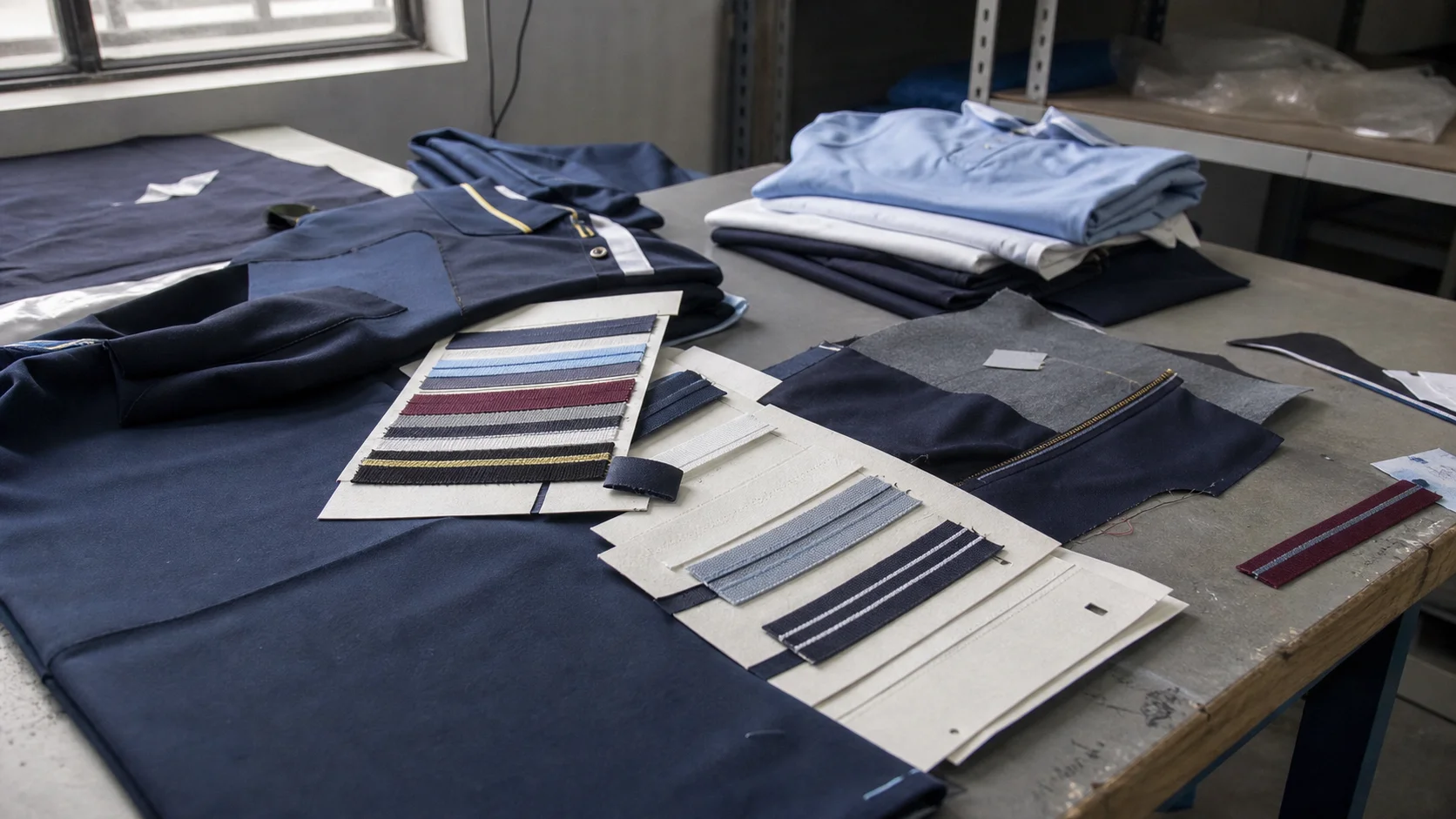
A practical SEO outline for outdoor school buyers auditing woven origin tab suppliers, with a focus on colorfastness, labeling durability, wash exposure,...
Woven Origin Tab Audit for Outdoor School Buyers - Decoration & Printing manufacturing guide
Outdoor school apparel has a harder job than standard classroom uniform items. Jackets, fleece layers, rain shells, field-trip vests, camp shirts, and activity packs are exposed to wet grass, mud, sunscreen, sweat, repeated laundering, and strong daylight. A small woven origin tab may look like a minor decoration item, but it carries brand identity, country-of-origin information, size or care references, and sometimes school program credibility. If the tab bleeds, fades, curls, frays, or transfers dye onto a pale shell fabric, the problem becomes visible very quickly.
For buyers sourcing woven origin tabs, the colorfastness audit should not be treated as a generic label check. It needs to be connected to the final garment, the end-use environment, the laundering instructions, the decoration method, and the way children will actually wear the product. A tab that passes on a dry tabletop can still fail when attached to a waterproof jacket cuff, a backpack strap, or a brushed fleece hem.
This guide is written for outdoor school buyers, uniform program managers, sourcing teams, and apparel brands that purchase woven tabs through label suppliers, trim vendors, or cut-and-sew factories. It focuses on practical audit points: fiber content, yarn dyeing, colorfastness testing, MOQ realities, sample approval, lead-time dependencies, and inspection risks.
A woven origin tab is often small, but it sits at the intersection of compliance, branding, and durability. In outdoor school programs, the tab may show country of origin, school branding, collection name, sustainability wording, or a supplier identity code. Buyers usually place it on a side seam, hem, sleeve edge, chest pocket, bag strap, or zipper guard.
The problem is that these placements are high-contact areas. Children rub cuffs against desks and rocks. Backpacks abrade shoulder zones. Rainwear tabs get wet, dry, and wet again. Fleece tabs can trap lint and detergent. If the tab color is unstable, it can stain surrounding fabric or lose legibility before the garment reaches the end of the school year.
Outdoor school buyers should view the woven tab as a functional trim, not just a decorative add-on. It must survive the same care and use conditions as the garment. This is especially important when sourcing for institutions, school districts, camps, outdoor education providers, or retailers that expect repeat orders with consistent appearance.
For broader apparel production planning, buyers can compare trim decisions with full-package development support through Fabrikn’s services. Trim sourcing should be aligned with garment engineering, decoration placement, washing requirements, and production timing, not handled as a last-minute accessory purchase.
A woven origin tab supplier colorfastness audit should confirm whether the tab is suitable for the exact garment and end use. A basic visual approval is not enough. The audit should cover yarn quality, dye process, construction, finishing, dimensional stability, rubbing performance, washing performance, perspiration exposure, light exposure, and compatibility with adjacent fabrics.
The scope should include both supplier-side documents and buyer-side verification. A supplier may provide a test report, but the buyer still needs to confirm whether the test reflects the ordered tab color, fiber content, weave density, backing, edge finish, and final application.
The audit should also identify who owns each risk. The woven tab supplier controls yarn and weaving quality. The garment factory controls attachment method, stitch tension, and placement. The buyer controls the approved specification, testing requirements, and inspection standard. Weakness in any one area can cause a finished-product failure.
Most woven origin tabs used in school and outdoor apparel are made from polyester yarns because polyester offers good dimensional stability, reasonable colorfastness, and competitive pricing. Nylon may be used for certain technical looks or softer hand feel, but it can create more concerns around dye migration and heat sensitivity depending on the finishing route. Cotton woven tabs can support a natural look, but they are less common for wet outdoor use because they may shrink, fade, or absorb moisture more readily.
Damask polyester is a common choice for small origin tabs because it can hold fine text better than lower-density woven constructions. Taffeta woven labels may be cheaper, but they may not deliver the sharpness needed for small country-of-origin wording or school crests. Satin woven tabs can look premium, but shine and snagging risk should be reviewed for outdoor garments.
For school outdoor apparel, the safest default is usually a high-density polyester woven tab with stable dyed yarn, a heat-sealed edge, and enough seam allowance to avoid text distortion. That does not mean it is always the cheapest option. It means it is less likely to create quality claims across repeated washing and outdoor use.
Colorfastness is not one single property. A tab may resist washing but still fail rubbing. It may resist dry rubbing but bleed when wet. It may look stable after laundering but fade under sunlight. Buyers need to match test priorities to the garment’s real exposure.
Outdoor school garments are washed frequently, especially after field trips, sports days, camping activities, and wet-weather use. Dark woven tabs attached to light fleece, yellow rainwear, pale blue shirts, or white linings need careful washing fastness review.
Typical buyer expectation is no obvious staining on adjacent fabrics and no major shade change after the stated wash cycle. For schoolwear, the care label often calls for machine wash at 30°C or 40°C. If parents are likely to use warmer washing, the buyer may choose to test at a stricter condition than the care label. That decision increases confidence but may also exclude lower-cost suppliers.
Rubbing fastness matters because tabs touch desks, backpack straps, seat belts, sleeves, and hands. Wet rubbing is usually more difficult than dry rubbing. A navy, red, black, or forest green tab may pass dry rubbing but transfer under wet rubbing if dye fixation is weak.
This risk is higher on external tabs and loop tabs. An interior side-seam origin label has less abrasion exposure, while a sleeve tab or bag strap tab faces constant friction. Buyers should specify both dry and wet rubbing tests for visible external tabs.
Children perspire during outdoor activities, and sweat chemistry varies. Perspiration fastness is relevant for tabs near the neck, chest, underarm, waistband, or backpack contact zones. Acidic and alkaline perspiration testing can reveal dye instability that ordinary washing tests miss.
If the tab is attached to base layers, active polo shirts, softshell jackets, or pack straps, perspiration fastness should be included in the audit. This is not overengineering. It is a practical safeguard when the tab is placed close to skin or high-sweat areas.
Rainwear and outdoor jackets create a specific challenge. Water may sit between the tab and the shell fabric, especially under folded seams or flaps. If the tab dye bleeds, staining can appear around the stitch line or under the folded edge.
Water fastness testing should be reviewed for dark tabs on light or bright shell fabrics. Buyers should also request a wet sandwich test using the actual tab and actual garment fabric, especially for white, cream, yellow, light grey, pastel, or neon materials.
Outdoor school programs expose apparel to sunlight during field activities, sports, playground use, and camps. Light fastness is easy to overlook because the tab is small, but faded tabs can make a garment look old before the main fabric fails.
Light fastness matters most for visible tabs, school branding tabs, and tabs using red, orange, yellow, or fluorescent colors. If the tab carries required origin wording, fading can also reduce legibility. A buyer should be cautious when using bright custom colors unless the supplier can demonstrate acceptable light performance.
Dye migration can occur when dark or disperse-dyed yarns interact with synthetic garment fabrics, coatings, adhesives, heat, or storage conditions. This risk is especially relevant when tabs are attached to polyester shells, laminated fabrics, waterproof coatings, or heat-pressed decorated panels.
Heat used in garment production can aggravate the issue. If the finished product includes heat transfers, seam sealing, bonding, or high-temperature pressing, the woven tab should be tested under comparable heat exposure. Buyers should ask the garment factory whether tabs are attached before or after any heat process.
Purchasing judgment: a dark tab on a light waterproof shell may look sharp in a product photo, but it carries higher staining risk than a tonal or medium-shade tab. If the order is for school distribution and returns are difficult to manage, choose stability over contrast.
A strong specification sheet is the buyer’s main control tool. It reduces interpretation by the supplier and gives inspection teams a clear standard. Vague wording such as “good quality woven tab” is not enough for outdoor school products.
For origin tabs, legibility is not optional. If the tab states “Made in,” “Origin,” or a country name, the text must remain readable after sewing and washing. Buyers should check artwork at actual size, not only as a digital enlarged proof. Small letters can close up in weaving, especially on low-density labels.
Tab dimensions should account for sewing. If the visible tab is intended to be 20 mm by 15 mm, the supplier needs to know the total unfolded size and seam allowance. Text should not sit too close to a stitch line. A safe margin is usually needed on all sides, particularly for folded tabs.
Color approval should be based on physical references. Pantone numbers are useful, but woven yarns do not always match paper or screen colors exactly. Buyers should approve a physical yarn card, lab dip, or woven strike-off before bulk production.
For school programs, color consistency across repeat orders is important. If a school uses a specific navy, burgundy, green, or gold, the buyer should maintain an approved trim standard. A small shade shift can be obvious when students wear garments from different production lots together.
A woven origin tab colorfastness audit should combine document review, lab testing, and practical garment-level checks. The best approach depends on order size, risk level, and budget. For low-risk internal tabs on dark garments, a simpler audit may be enough. For high-volume outdoor school jackets with visible tabs, a stricter process is justified.
Buyers may refer to ISO, AATCC, or equivalent testing methods depending on market and customer requirements. The important point is consistency. The purchase order should state the required method, grade, and testing condition. “Pass colorfastness” is too vague to enforce.
Many buyers set acceptable colorfastness grades around 3-4 or 4 depending on the test and risk level, but requirements vary by product, customer, and market. Stricter grades may increase supplier screening time and cost. Lower grades may be acceptable for internal tabs on dark garments, but they are risky for external tabs on light outdoor shells.
The pre-production sample stage is where many problems become clear. A tab can look acceptable alone but curl after being sewn into a thick fleece seam. It can pass shade review but stain a pale lining after a wash. It can look legible on a flat desk but become unreadable when folded into a side seam.
For buyers building a new outdoor school product line, early supplier coordination is worth the time. Teams can use Fabrikn’s contact page to discuss how trim specifications, decoration planning, and garment production timelines should be aligned before bulk orders are placed.
MOQ and lead time vary by supplier, yarn availability, weaving complexity, color count, and whether the tab uses stock colors or custom-dyed yarn. Buyers should treat quoted MOQ as a negotiation point, but not assume very low MOQ will support stable quality.
These ranges are typical market expectations, not fixed rules. Some suppliers accept lower MOQs with surcharge. Others require higher MOQs during peak season or for custom-dyed yarn. Buyers should compare the full landed cost, not just the unit price. A cheap tab with unstable colorfastness can create returns that exceed the savings.
Lead time depends heavily on approval discipline. Delays often come from unclear artwork, missing color references, late origin wording changes, or buyers approving digital proofs without checking actual size. A country-of-origin change after bulk weaving starts can make the entire tab lot unusable.
Outdoor school buyers should lock origin wording before sample approval. If the final garment production country is not confirmed, do not release bulk origin tabs. A label that says the wrong country is not a quality defect that can be repaired with better sewing.
Inspection should happen before the tabs are sewn and again after the finished garment is made. Once thousands of tabs are stitched into jackets, the cost of correction rises sharply. Trim inspection is cheaper than garment rework.
AQL inspection can be used for bulk trim, but buyers should define major and minor defects clearly. Wrong origin wording, heavy color bleeding, illegible text, and incorrect size should be treated as major or critical depending on the product. A loose thread may be minor if it can be trimmed, but repeated fraying across a lot indicates a production problem.
Inspection risk rises when the garment factory receives mixed lots of tabs. If two lots are close but not identical, the difference may appear across garments in the same school order. Buyers should require lot segregation and should avoid mixing trim lots within one purchase order unless the shade match is approved.
A good supplier should be able to answer practical questions without overpromising. The goal is not to demand unrealistic guarantees. The goal is to identify whether the supplier understands outdoor apparel requirements and can control bulk consistency.
Buyers should be careful with suppliers who answer every question with “no problem” but cannot provide a written specification, physical strike-off, or relevant test data. A low price is useful only if the supplier can repeat the approved quality in bulk.
It is also worth asking whether the supplier has experience with outdoor apparel trims, not just fashion labels. Outdoor school garments face a different risk profile from casual tees or indoor uniforms. Moisture, abrasion, and sunlight exposure make the specification more demanding.
Every sourcing decision has a tradeoff. A buyer can choose a cheaper tab, a sharper tab, a softer tab, a faster tab, or a more colorfast tab. The right choice depends on the garment, the distribution channel, and the cost of failure.
In these cases, a higher-density polyester woven tab with verified colorfastness is usually the safer buying decision. The unit cost may be slightly higher, but the claim risk is lower.
A lower-cost tab is not automatically poor quality. It can be the right choice for simple school apparel if the risk is low and the supplier is consistent. The mistake is using a low-cost tab in a high-risk placement without testing.
For many outdoor school buyers, the best compromise is a simple two-color polyester damask tab using approved stock yarns. Keep the artwork clean, avoid very small text, avoid heavy dark contrast on pale shells, and confirm wash and rubbing performance before bulk sewing. This approach controls cost while reducing the most common quality problems.
If the tab is part of a broader apparel identity system, buyers should align it with neck labels, care labels, hangtags, heat transfers, embroidery, and packaging. Consistency matters. You can review more about the company background and production approach at Fabrikn’s about page.
Documentation is not just paperwork. It protects repeat orders and supports claims if the supplier ships nonconforming trim. A buyer should keep an approved physical tab standard, signed artwork, test reports, purchase order specifications, bulk lot references, inspection records, and wash test results.
For repeat school programs, the approved standard should be stored carefully and replaced when it becomes worn or discolored. Digital files are useful, but physical trim standards are still essential because woven yarn color and texture cannot be judged accurately from a screen.
Traceability becomes especially important if a school reports staining or fading after delivery. Without lot records, the buyer may not know whether the issue came from one trim batch, one garment factory line, one wash process, or one storage condition.
Outdoor school buyers should not approve woven origin tabs by appearance alone. The right audit checks whether the tab can survive wet use, laundering, rubbing, perspiration, sunlight, and garment production processes. The highest-risk combinations are dark tabs on light fabrics, visible tabs on rainwear, tabs placed in abrasion zones, and small origin wording woven at low density.
The most reliable sourcing route is to define the tab specification early, approve a physical woven strike-off, test the tab with the actual garment fabric, and inspect bulk trim before sewing. If the garment is part of a school program with repeat orders, keep physical standards and lot records. This is a small step in the sourcing calendar, but it prevents expensive garment-level claims later.
Practical purchasing rule: if the tab is visible, dark, or attached to a light outdoor garment, pay for testing before bulk sewing. If the supplier cannot support that step, the price advantage is not strong enough.
Get a free quote from Fabrikn — your trusted B2B clothing manufacturer with 10+ years of experience. MOQ as low as 200 pieces.
Get a Free Quote →A woven origin tab is a small textile label or folded tab that shows origin information, branding, or product identification. It is often sewn into a side seam, hem, pocket, sleeve, or strap.
Outdoor school apparel is exposed to rain, sweat, mud, washing, sunlight, and abrasion. Poor colorfastness can cause fading, dye transfer, staining, and loss of legibility.
Polyester is commonly used because it offers good durability, stable weaving, and reasonable colorfastness. The final choice should still be tested against the garment fabric and care instructions.
Typical MOQ ranges from 1,000 to 5,000 pieces for standard custom woven logo tabs. More complex constructions or custom-dyed yarns may require 5,000 to 20,000 pieces.
A woven strike-off often takes 5 to 10 working days after artwork approval. Lab testing may add 3 to 7 working days, and bulk production often takes 7 to 20 working days after final approval.
For outdoor school garments, buyers should prioritize washing, wet and dry rubbing, perspiration, water, and light fastness. Heat migration testing may be needed if the garment uses pressing, bonding, or seam sealing.
It can support initial screening, but it should match the same yarn type, color depth, construction, and finish. For high-risk orders, testing the actual tab is safer.
The biggest risk is approving bulk trim too late, after sewing has started. Buyers should inspect tab shade, size, wording, edge finish, and colorfastness before release to production.
Dark tabs are not a problem if the yarn is stable and tested. They become risky when attached to light fabrics, waterproof shells, high-rub areas, or garments exposed to wet use.
Define the specification early, approve physical samples, test the tab on actual garment fabric, inspect incoming trim, and keep lot records. These steps reduce avoidable failures before finished garments ship.