
A 2500-word SEO outline for outdoor school buyers auditing woven origin tabs, covering label legality, fiber content, durability testing, sew-in placement,...
Woven Origin Tab Compliance Checklist for Schools - Fabrikn production reference
For outdoor school buyers, a woven origin tab looks like a small trim item. In practice, it can carry legal, operational, and brand risk. A missing country-of-origin detail, an unreadable weave, a weak fold, or a tab that bleeds color during rain exposure can create problems across uniform jackets, fleece pullovers, rain shells, backpacks, camp shirts, and field-trip apparel.
Schools and outdoor education programs often buy through a mix of distributors, decorators, uniform suppliers, and direct manufacturers. That creates a common weak point: the garment may be compliant, but the small label or tab added for branding or origin identification may not be controlled with the same discipline as the main care label. Buyers should not treat the origin tab as only a decorative accessory. It needs a compliance checklist that connects artwork, material, factory capability, testing, sewing placement, and final inspection.
The safest purchasing position is simple: require the woven origin tab factory to prove that the tab is legible, durable, colorfast, correctly worded, and compatible with the garment’s intended use. That proof does not need to be excessive for every small order, but it should be structured. Outdoor school products face washing, rain, mud, abrasion from backpacks, repeated handling by students, and sometimes long storage before seasonal distribution. The trim must survive that use without becoming a compliance or appearance issue.
A woven origin tab should be approved as a controlled component, not as a loose decoration. Buyers who lock the wording, yarn colors, fold type, and inspection criteria early usually avoid the most expensive rework later.
This checklist is written for school procurement teams, outdoor uniform buyers, decoration and printing coordinators, and apparel sourcing staff who need practical control before placing bulk trim orders. It is not legal advice. Origin labeling rules vary by market, product type, fiber content, and sales channel, so buyers should confirm final wording with their compliance team or regulatory adviser before production.
A woven origin tab is a small fabric label or folded tab produced on a loom using yarns rather than ink. It may show a country of origin, brand mark, school name, program icon, size indicator, or other short compliance detail. In outdoor school apparel, it may be sewn into a side seam, hem, sleeve edge, neck seam, pocket seam, bag seam, or flap edge.
The term “origin” can be misunderstood. Buyers should clarify whether the tab identifies the origin of the garment, the origin of the brand, the origin of a program, or the origin of the tab itself. In regulated sales channels, the country-of-origin statement normally relates to the finished article, not merely the label. A decorative woven tab that says “Made in...” must match the correct finished product origin and must not conflict with other sewn labels, hangtags, invoices, packaging, or online product pages.
For school programs, the tab is often used because it is durable, subtle, and more premium than a printed satin label. It can also support easy product recognition during distribution. The tradeoff is that woven tabs have size and detail limits. Tiny letters may fill in, long country names may lose sharpness, and high-contrast designs can become bulky if the yarn density is too high. Buyers should keep the design simple when the tab carries compliance information.
Outdoor school buyers cover a broad range of products. A single program may source waterproof jackets, softshells, fleece layers, caps, backpacks, staff vests, student ID pouches, sports warmups, and event apparel. Some products are sold to families; others are issued by the school and retained as institutional property. The level of documentation may differ, but the sourcing logic should remain consistent.
School buyers should pay closer attention when products are used by children, sold across regions, supplied through public procurement, or purchased under a licensed school identity. In these cases, a trim error can cause shipment delays, relabeling cost, reputational complaints, or inconsistent product records. A woven origin tab that is not approved at the same time as the garment sample can become a last-minute bottleneck.
The category also matters. Decoration and printing teams may manage embroidery, screen printing, heat transfer, patches, and woven labels together, but woven origin tabs are not inspected like a logo print. A print can often be checked by color, placement, and wash durability. A woven tab also needs yarn control, cut-edge control, folding accuracy, seam allowance, fray resistance, and readability at small scale.
Buyers who need broader trim, decoration, and product development support can review apparel service options at fabrikn.com/services/. The key point is to define the woven origin tab early, before production artwork and garment sewing instructions are locked.
The following checklist can be used when qualifying a woven origin tab factory or confirming a trim supplier through a garment factory. Not every school order requires a full formal audit, but every order needs enough evidence to support the claim being woven into the product.
Traceability is often overlooked for small trims. That is a mistake. If a school reorders the same jacket next term and the origin tab changes shade, wording, or fold size, the buyer needs a way to determine whether the factory used the same construction and artwork file.
A woven label factory can weave what is ordered, but it should not be expected to determine legal origin for the finished garment. That responsibility belongs upstream with the buyer, brand owner, importer, or party controlling the product claim. The purchasing judgment here is direct: do not approve bulk production from a screenshot or chat message if the tab includes origin wording.
Factory capability should match the artwork. A small tab with dense letters may require a finer yarn, higher-density weave, or larger finished size. The buyer should accept that some designs must be simplified. A sharper, readable tab is better than a crowded tab that looks premium in a PDF and poor in bulk.
Small trim suppliers may not have the same audit profile as major garment factories. That does not automatically disqualify them, but school buyers should know where the work is performed and whether subcontracting is hidden. For public or institutional buyers, undisclosed subcontracting is a procurement risk.
Artwork control is the core of woven origin tab compliance. Once a tab is woven, errors are expensive to correct. Unlike a printed hangtag, a woven tab usually cannot be overwritten or stickered without looking improper. If the tab is already sewn into finished apparel, the repair cost can exceed the trim cost many times over.
Some buyers try to combine too much information on a small tab. That often creates readability and compliance problems. If the product requires full fiber content, care symbols, manufacturer or importer identification, and country of origin, a separate main label may be more appropriate. A side seam woven origin tab can support recognition, but it should not be forced to carry information it cannot display clearly.
Buyers should review a woven proof, not only a digital rendering. Digital artwork can show clean lettering that the loom cannot reproduce at production scale. The practical rule is to judge the sample with the same distance and lighting that a parent, student, inspector, or customs reviewer would use. If the country name cannot be read quickly, the design needs revision.
Material specification turns a general label request into a controlled trim purchase. A factory may offer damask woven, satin woven, taffeta woven, cotton woven, recycled polyester woven, or high-density woven labels. Each option affects clarity, hand feel, durability, cost, and lead time.
For outdoor school products, polyester damask is often the safest starting point because it balances durability, clarity, and availability. If the school requires a natural aesthetic, cotton or cotton-blend tabs may be considered, but the buyer should ask for wash and shrinkage evidence. A rustic tab that shrinks or curls after laundering is not a good tradeoff for school uniforms.
Sharp or scratchy edges matter more in school apparel because garments are worn for long periods and often by younger users. A tab placed at the neck, cuff, or side seam can irritate skin if the edge is stiff. For outdoor jackets, the tab may sit under a backpack strap or harness area, increasing abrasion. Buyers should test the exact placement, not just the loose tab.
Most small woven tabs do not need adhesive backing if they will be sewn into seams. Heat-seal backing may help positioning in some applications, but it can add stiffness and may not be suitable for all fabrics. If the tab is attached to waterproof outerwear, buyers should confirm whether sewing through the tab affects seam sealing, water resistance, or seam tape placement.
For bags and outdoor accessories, heavier tabs may be acceptable. For base layers, fleece, or student uniforms worn next to the skin, soft hand feel is more important. A buyer should not use the same tab specification across every item without testing placement and wear comfort.
Woven origin tab orders should move through controlled approval steps. The process does not need to be slow, but it needs gates. Skipping sample approval saves a few days at the beginning and can cost weeks if the origin wording, fold, color, or readability is wrong.
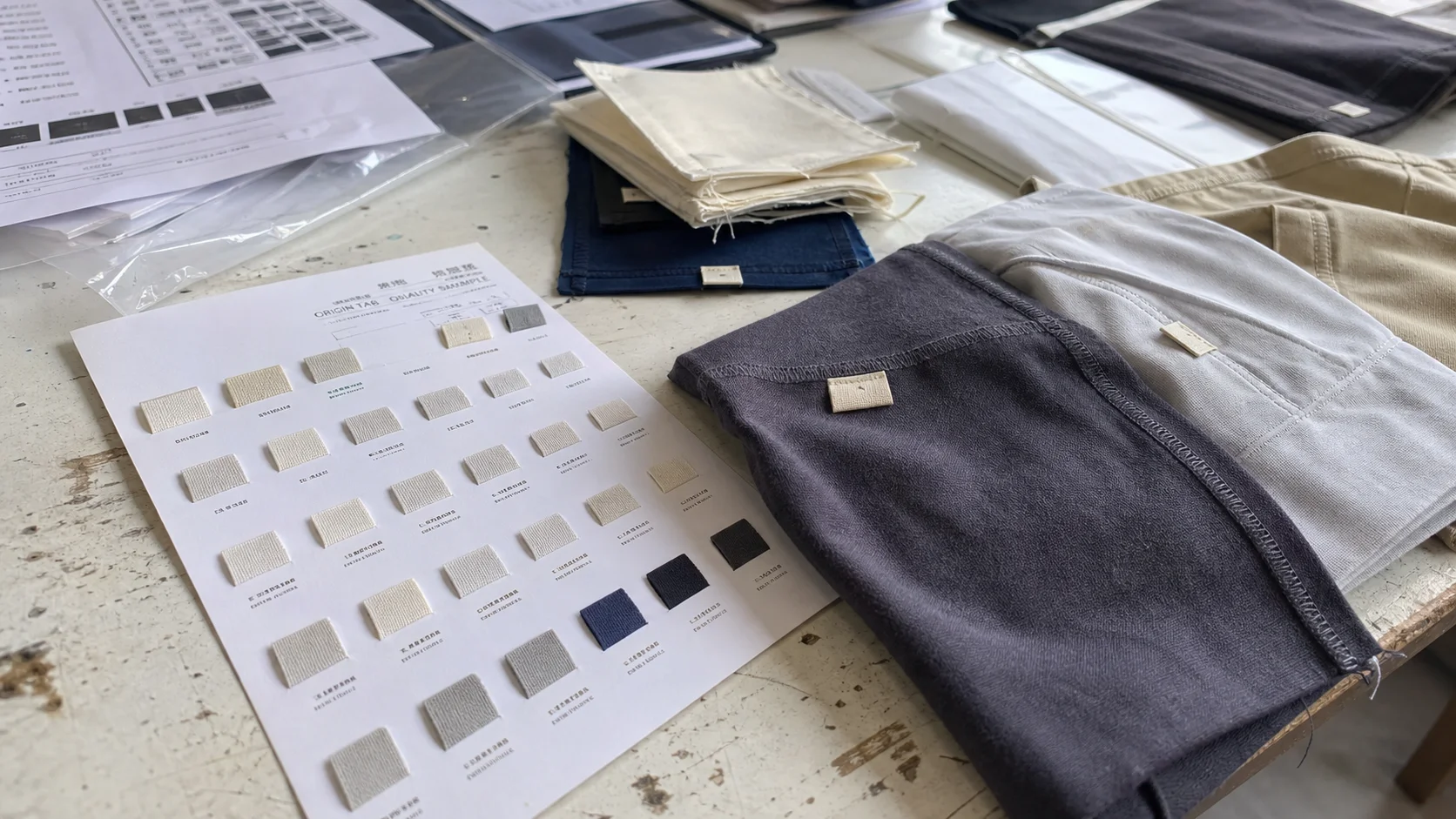
The physical sample is the critical control point. A woven origin tab can change noticeably from screen to loom. Buyers should inspect sample tabs under normal light, after handling, and after at least basic laundering or wet rubbing when the item is intended for outdoor use.
MOQ varies by factory, loom setup, label size, yarn count, color count, fold type, and packaging requirement. For planning purposes, many woven label factories work in approximate ranges such as 500 to 1,000 pieces for basic reorderable labels, 1,000 to 3,000 pieces for custom woven tabs, and 5,000 pieces or more for lower unit pricing or special yarn programs. Small trial orders may be possible, but the unit cost and setup charge will usually be higher.
School buyers should compare MOQ against actual program needs. If the school needs only 300 jackets, ordering 3,000 origin tabs may appear wasteful. Yet if the program repeats every year and the origin wording remains stable, a larger trim buy may reduce cost and support consistent appearance. The risk is obsolete inventory if the garment origin changes, the school logo is updated, or the supplier changes production country. Do not stockpile origin tabs unless the wording is unlikely to change.
Factories may charge for sample weaving, artwork conversion, loom setup, color matching, or courier delivery. These charges are normal, especially for low-volume school programs. A buyer should not choose a supplier only because sampling is free. A poor sample process often indicates weak production control. Paying a reasonable strike-off charge can be cheaper than accepting unverified bulk labels.
When discussing sourcing support or trim development, buyers can contact Fabrik at fabrikn.com/contact-us/ to start with product requirements, quantity expectations, and application details.
Lead time for woven origin tabs is usually shorter than garment production, but it can still delay shipment if started late. A simple woven tab reorder may be produced in about 7 to 15 days after approval, while a new custom tab may require 10 to 25 days depending on sample rounds, yarn availability, production queue, and shipping method. Complex labels, recycled yarn verification, special finishes, or low-volume scheduling can extend the timeline.
Outdoor school programs often work around academic calendars, camp seasons, field-trip dates, and weather windows. The tab schedule should be built backward from garment sewing, not from final shipment. If the garment factory needs tabs before side seams or hem operations, late trim delivery can stop a production line. If the tab is attached after garment completion, late delivery may still cause rework, extra handling, or inconsistent placement.
The purchasing tradeoff is between speed and control. Air shipping a late tab order may rescue a delivery date, but it does not fix wrong wording or poor weaving. Buyers should prioritize artwork and sample approval before chasing cheaper freight.
Inspection should cover loose tabs and sewn application. Many trim defects are not obvious until the tab is attached to the product. A tab that looks acceptable loose may be partly hidden in a seam, rotated after sewing, puckered by the fabric, or too stiff on a lightweight garment.
Inspection sampling should be agreed before production. For small school orders, a practical approach is to inspect all pre-production samples and then apply a reasonable random inspection at bulk stage. For larger institutional orders, buyers may use an AQL-based inspection plan. Critical defects should include wrong origin, illegible origin, missing tab where required, or conflicting label information. These should not be treated as minor cosmetic issues.
Buyers should build defect definitions into the purchase order or trim specification. If the factory only knows “make the tab like the artwork,” it may not understand which failures are shipment-stopping issues. Correct origin wording, readability, and placement should be non-negotiable.
Outdoor school products face rougher use than classroom apparel. Students may wear jackets over wet layers, stuff garments into lockers, drag backpacks across seams, and wash items inconsistently. Staff uniforms may need to look professional through repeated field use. The woven origin tab needs to fit this environment.
Rain, sweat, detergent, and mud can expose weak colorfastness. A dark woven tab on a white or light gray jacket should be checked carefully. Wet rubbing and wash testing are useful even when formal lab testing is not required. If a tab bleeds onto a school-branded rain shell, the complaint will be directed at the product supplier, not the trim factory.
Tabs placed near shoulder seams, side seams, hem edges, pocket openings, or bag straps can experience repeated rubbing. A proud or stiff tab may abrade faster than the garment fabric. For high-abrasion zones, consider a lower-profile tab, softer yarn, reinforced stitching, or a different placement.
Small trims should not create sharp edges, loose loops, or irritating contact points. If the product is for younger students, avoid long free-hanging tabs that can catch or tear. A small folded woven tab sewn securely into a seam is usually safer than a dangling decorative label.
School programs often reorder across semesters or years. A color shift in the origin tab may be acceptable for a hidden label but obvious on a visible side tab. Buyers should keep approved physical standards and require the factory to match them for reorders. If the garment origin changes, the old tab stock should be quarantined or destroyed to prevent accidental use.
Company background and sourcing context can be reviewed at fabrikn.com/about-us/ when buyers need to understand service positioning before opening a trim or apparel discussion.
A good supplier conversation should be specific. Broad questions such as “Can you make woven labels?” do not reveal enough. The buyer should ask questions that connect compliance, production, and use conditions.
The buyer should listen for practical answers. A strong factory will discuss feasibility, tolerances, and sample approval. A risky supplier may promise perfect results immediately without asking about size, yarn, fold, placement, or application. Fast agreement is not always a good sign.
The table below can help school buyers choose the right level of control. The goal is not to overcomplicate every order. The goal is to match compliance effort with risk.
Buying Situation Recommended Control Level Practical Decision Small staff apparel order with non-visible internal origin tab Basic artwork approval and physical sample Keep process lean, but do not skip wording confirmation. Student outerwear sold to families Physical sample, sewn sample, wash check, bulk inspection Use stronger controls because complaints and relabeling are costly. Licensed school logo plus origin wording Artwork authorization, origin approval, retained standard Protect both compliance and brand usage. Multi-country garment sourcing Separate tab versions, strict inventory control, carton labeling Avoid mixing origin tabs across production lots. Waterproof jackets or coated bags Placement test, seam impact review, durability check Do not allow the tab to compromise water resistance or comfort. Annual reorder program Retained sample, artwork version control, origin reconfirmation Reorder only after confirming origin and design are unchanged.A purchase order for woven origin tabs should include more than quantity and price. At minimum, it should specify final artwork version, finished size, fold type, material, yarn colors, edge finish, packaging, inspection criteria, and delivery date. If the tab includes origin wording, the PO should state that no substitution or wording change is allowed without written approval.
Useful PO language may include the following requirements: produce only from approved artwork file; submit physical sample before bulk; maintain finished size tolerance; ensure origin wording is readable; pack by artwork version; identify cartons with PO number; do not mix country versions; retain production sample; notify buyer of any material or process change. Buyers should adapt these points to their own contracts and compliance process.
Price should not be the only deciding factor. Woven tabs are low-cost components, but the cost of failure is high when they carry origin information. A cheaper quote may still be acceptable if the factory can provide sample control and version discipline. A slightly higher quote is often justified when the supplier gives clearer documentation, better weave quality, and reliable packing.
The best sourcing decision is to treat the woven origin tab as a compliance-bearing trim with decoration standards. It must be accurate enough for regulatory review, durable enough for outdoor school use, and clean enough to represent the school identity. Buyers who control the tab early protect the whole garment program from avoidable rework.
Get a free quote from Fabrikn — your trusted B2B clothing manufacturer with 10+ years of experience. MOQ as low as 200 pieces.
Get a Free Quote →A woven origin tab is a small fabric label or folded tab made with woven yarns that may show a country-of-origin statement, brand mark, school identity, or short product detail. When it includes origin wording, the statement should match the finished product’s approved country of origin.
Usually, a small woven tab should not replace a full care and content label unless it is specifically designed, sized, and approved for that regulatory purpose. Most woven origin tabs are best used as supplementary identification or visible trim.
Typical custom woven tab MOQs often fall around 1,000 to 3,000 pieces, with some basic orders starting near 500 to 1,000 pieces and better pricing often appearing at 5,000 pieces or more. Actual MOQ depends on the factory, yarn, size, fold, and complexity.
A simple repeat order may take about 7 to 15 days after approval. A new custom tab may take about 10 to 25 days or longer when physical sampling, color matching, testing, or international shipping is required.
The biggest risk is incorrect or conflicting origin wording. A tab that says one country while the main label, invoice, or packaging shows another can create serious compliance and shipment problems.
Basic checks are strongly recommended. Buyers should review readability, edge comfort, wash behavior, wet rubbing, fray resistance, and sewn placement, especially for jackets, fleece, bags, and products used in rain or field conditions.
Damask polyester is often a practical choice for small woven origin tabs because it supports finer detail and good durability. The final choice should be confirmed through a physical sample, not only a digital proof.
Use artwork version numbers, separate carton labels, retained samples, and clear purchase order references. If products are made in different countries, each origin version should be packed, stored, and issued separately.
The buyer, importer, brand owner, or compliance adviser responsible for the finished product should approve the wording. The woven label factory should produce to approved artwork, but it should not be expected to determine the legal origin of the finished garment.
Approve it before garment bulk production begins. The safest process is to approve the loose woven sample first, then approve the tab sewn into the actual garment or accessory before bulk sewing.