
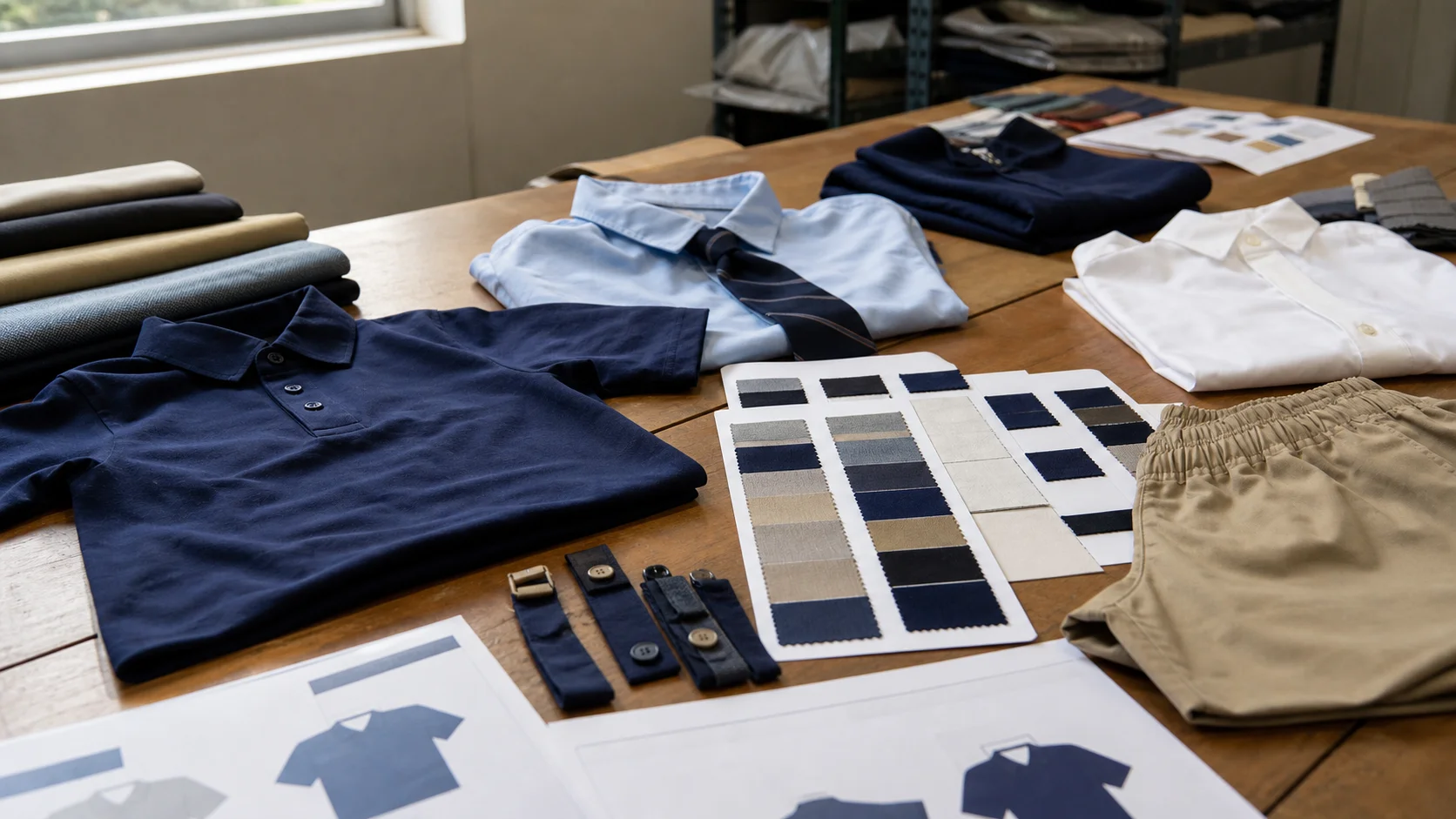
A focused review of woven origin tabs for school operations teams, covering MOQ thresholds, pricing drivers, label construction, and production tradeoffs...
School operations teams rarely buy a woven origin tab as a stand-alone decoration decision. It sits inside a broader compliance, uniform consistency, and budget-control problem. A small woven tab may look like a minor trim item, but the sourcing logic behind it affects artwork approval, color matching, carton control, replacement planning, and the true landed cost of a uniform program. For school operations, that makes MOQ pricing more than a supplier quote exercise. It becomes a practical review of risk, timing, and repeatability.
This article looks at woven origin tab MOQ pricing from the perspective of school operations teams managing uniforms, spirit wear, team kits, or branded apparel programs. The focus is on what actually moves price, where minimum order quantities become flexible or inflexible, and which details should be locked before purchase orders are released. The goal is simple: reduce surprise charges, avoid rework, and keep decoration quality stable across replenishment cycles.
Woven Origin Tab MOQ Pricing Review for School Ops - Decoration & Printing manufacturing guide
A woven origin tab is a small textile label or trim element used to identify origin, brand, program line, or school identity on garments and accessories. In many school programs, it is attached to neck seams, side seams, pockets, sleeve hems, or exterior trim points. The design may be simple, such as a school name or origin mark, or more specific, such as a limited colorway identifier used across a seasonal uniform set.
From a sourcing standpoint, the tab is not only decorative. It is a controlled production component with its own material spec, weave density, edge finishing method, color count, fold style, attachment method, and packaging expectations. A low-cost tab can become expensive if the approval path is loose or if the supplier has to re-run weaving due to artwork changes. That is why operations teams should review it alongside the garment order, not after the garment order is approved.
A woven origin tab is a trim item, but the buying decision behaves like a mini production program. Price is driven by setup, weaving complexity, and the risk of repeat approval cycles.
School operations teams usually manage one of three buying patterns. The first is a single annual bulk buy for an entire student group. The second is staggered seasonal buying for sports, clubs, or activity wear. The third is replenishment for replacements, late enrollment, or size exchanges. Woven origin tab pricing behaves differently across all three.
MOQ pricing matters because the unit cost is often tied to loom setup and production efficiency. A supplier may quote a low per-piece price at 5,000 pieces, then the cost rises sharply at 300 or 500 pieces because the setup cost is spread over a smaller run. If a school needs only a modest quantity for a pilot, the price may still be acceptable, but the buyer should expect a different cost structure than a large retail-style program.
The second issue is consistency. School programs tend to repeat styles across terms and years. If a supplier’s MOQ is too high, the school may overbuy to secure the price, then carry dead stock. If MOQ is too low, the supplier may be using a more manual or less efficient production process, which can introduce variation in weave sharpness, color consistency, or finish quality. Both scenarios have a cost.
For broader sourcing context, school teams often compare trim buying against other program categories and service routes. If you need a reference point for scope or commercial contact routing, the supplier pages at fabrikn.com/services/, fabrikn.com/contact-us/, and fabrikn.com/about-us/ are useful starting points.
MOQ varies by supplier, construction, and decoration complexity. For a woven origin tab, a practical market range often falls into one of these bands:
Program Type Typical MOQ What Usually Happens on Price Simple woven tab, 1 to 2 colors 300 to 1,000 pieces Lowest setup burden, lower unit cost at higher quantities Multi-color woven tab, cut and fold finish 500 to 2,000 pieces Higher weaving complexity and more QC attention Custom shape, specialty yarn, or premium edge finish 1,000 to 5,000 pieces Setup and wastage costs rise, pricing depends heavily on artwork Very small replenishment or pilot order 100 to 300 pieces, if accepted Unit cost is usually high and may include sample or short-run surchargesThese ranges are not fixed rules. They are a practical planning reference. Some mills or trim suppliers will accept lower minimums if the tab is a repeat design, if the buyer accepts a higher price, or if the design can be nested with another production order. Other suppliers will hold a firm MOQ because their loom changeover and post-weave finishing cost cannot be reduced meaningfully below a threshold.
School buyers should also expect pricing to move with total artwork complexity. A one-color origin tab with a clean edge and standard fold can be materially cheaper than a four-color version with micro text. If the artwork includes fine lines, tiny lettering, or a dense logo mark, the supplier may need a higher weave density or a wider tab to maintain legibility. That increases cost even if the tab size stays small.
Most woven origin tab pricing can be traced back to a short list of variables. If the buyer understands these drivers early, quote comparison becomes much cleaner.
Every additional color adds loom setup work and can reduce weaving speed. Fine detail adds risk. A school logo that looks acceptable in vector form may not read well when reduced to label size. If the supplier recommends simplifying text or enlarging the mark, that is usually a sign the artwork is too dense for the target dimensions.
Small tabs are not always cheaper. If the logo needs enough space for clarity, the supplier may increase the dimensions, which can affect material usage and cut time. Folded tabs also change the quote. Center-fold, end-fold, and loop-fold constructions add different finishing steps.
Polyester is common for woven labels because it is durable and stable. Cotton can be used in some apparel programs, but it may behave differently in wash tests and can cost more depending on the finish standard. Heat-cut edges, stitched edges, adhesive backing, and sew-on applications all change production effort.
Standard thread colors are easier to price than custom-dyed colors. If the school needs a specific match to a uniform Pantone reference, the supplier may need special yarn preparation or may propose the closest stock color instead. That tradeoff should be priced and documented before sample approval.
Bulk packed tabs are cheaper than individually packed or pre-sorted labels. If the school wants tabs separated by house, grade, sport, or campus, the supplier may charge sorting labor. That is often overlooked in the initial quote.
If the tab is delivered as a loose trim item, pricing stays simpler. If it must be sewn onto garments at the factory, the labor cost becomes part of the quote. That distinction matters because a low trim price can become a higher total garment price once application labor is included.
School ops teams get better pricing when the spec is tight. A vague request for a woven origin tab invites quote volatility and sample delays. The following points should be confirmed before sending artwork for pricing.
A precise spec also helps operations teams control future replenishment. If the school changes suppliers later, a detailed spec sheet reduces the chance that a replacement tab arrives with a different edge finish or an altered logo proportion. That is especially important when programs run over several years and the original buyer is no longer managing the account.
Even though the tab is small, the trim should be reviewed against the garment fabric. A stiff tab on a soft polo can feel intrusive. A thick woven edge on lightweight performance wear may cause a visible bump or discomfort at the neck. If the garment is intended for children, comfort and wash durability should be weighed together. School programs are sensitive to complaints about scratchiness, curling, and edge fray after repeated laundering.
Sample approval should not be treated as a formality. A woven origin tab usually goes through at least one visual sample round, and often two if the artwork is detailed or the finish is custom. The development path typically looks like this:
School buyers should use the sample stage to test readability, color contrast, fold quality, and hand feel. A logo that appears crisp in a digital proof may blur when woven too small. If the sample is not legible at normal viewing distance, the supplier should be asked to enlarge the logo or simplify the artwork before bulk approval. Accepting a weak sample because the price is attractive usually creates trouble later in the program.
Samples also reveal whether the supplier understands the school’s use case. A supplier that provides only a loose label mockup may not have considered how the tab will sit against the garment or whether the end fold will remain flat after laundering. That is a useful signal for risk review. A better supplier will specify how the sample will translate into bulk production and what tolerance to expect.
A clean sample is not the same as a safe bulk run. The sample proves visual intent; the bulk order proves process control.
Lead time for woven origin tabs depends on both the supplier’s queue and the amount of development work required. A straightforward repeat order may move quickly. A new artwork set with custom colors, special folding, and garment attachment can take materially longer.
Typical lead-time components include artwork correction, weaving or loom setup, sample production, approval turnaround, bulk production, finishing, packing, and shipping. Any delay in approval can push the entire program back. In school operations, that timing matters because uniforms often must arrive before a term start, sports season, or parent distribution date.
Buyers should assume that the fastest quote is not necessarily the safest timeline. Lead time gets longer when any of the following are present:
A practical school sourcing rule is to treat the tab as a front-loaded item. If the trim is not approved early, the garment order may still be delayed even if the rest of the order is ready. For that reason, trim approvals should be scheduled as soon as the seasonal design is locked.
Inspection risk is often underestimated because a woven origin tab is small. Small components create large program problems when they are wrong at scale. The most common issues are easy to identify if the buyer knows what to look for.
For school programs, the biggest commercial risk is not always defect percentage. It is distribution inconsistency. If the same tab looks slightly different from carton to carton, the issue becomes visible across an entire student population. That can trigger complaints, rework, or replacement requests. Uniform programs need consistency more than novelty.
Inspection should therefore be written into the purchase process. Buyers should ask for photo approval before mass shipment, carton-level labeling, and clear lot traceability if the order is split across production runs. If the item is being sewn onto garments, the buyer should also specify the acceptable stitch pattern, seam tension, and alignment tolerance. A trim item that is technically correct but poorly attached still counts as a failure in the end user’s eyes.
The best buying strategy is usually not the cheapest unit price. It is the lowest-risk total program cost. That means balancing MOQ, repeatability, and the cost of holding inventory. School operations teams should consider three practical sourcing approaches.
If the school has stable enrollment and predictable replenishment needs, it may be smarter to buy enough origin tabs for the full term or season. This can unlock a better unit price and reduce repeat setup charges. The tradeoff is inventory risk if student numbers or branding requirements change.
For new programs, a pilot order allows the team to validate look and feel before committing to a larger MOQ. This is useful when the artwork is not fully proven or when different age groups may respond differently to the garment. The downside is that short-run pricing can be higher and may create a second setup cost later.
When the same woven origin tab can be used across polos, hoodies, jackets, and bags, volume improves and the supplier can usually price more efficiently. Standardization also helps with replenishment. The key is making sure the tab is neutral enough to work across categories without looking out of place.
School ops teams should also separate the trim discussion from the garment discussion during vendor comparison. Some suppliers quote a very attractive garment price and then recover margin through the decoration item. Others do the opposite. A clean apples-to-apples comparison should include the cost of the origin tab, attachment labor if relevant, packaging, and any added approval fee. That is the real purchasing picture.
A useful supplier for school operations is not simply the one with the lowest quote. The better fit is the one that can explain MOQ, approval timing, and production constraints without hand-waving. A supplier should be able to state what changes the price, what a proof will show, what the lead-time dependencies are, and what happens if the artwork needs revision.
If you are comparing vendors or building a trimmed uniform program from the ground up, supplier communication quality matters as much as price. Clear specs, realistic timelines, and documented approval steps reduce the chance of churn later. If you need a broader starting point for sourcing support, service scope, or company background, use the pages at fabrikn.com/services/, fabrikn.com/contact-us/, and fabrikn.com/about-us/ as reference points for next-step outreach.
For school operations teams, the sourcing question should always be framed as: what is the cleanest path from approved artwork to repeatable bulk delivery? If the supplier cannot answer that clearly, the quoted MOQ pricing is probably not the full story.
Get a free quote from Fabrikn — your trusted B2B clothing manufacturer with 10+ years of experience. MOQ as low as 200 pieces.
Get a Free Quote →A realistic MOQ often starts around 300 to 1,000 pieces for simple designs, then rises to 1,000 to 5,000 pieces for more complex constructions. Some suppliers will accept lower quantities, but the unit price usually increases and the approval path may be less efficient.
The main reason is setup cost. Loom preparation, artwork translation, and finishing labor do not scale down as easily as material cost. On a small run, those fixed costs are spread across fewer pieces, which pushes the unit price higher.
One sample round is common for simple labels. Two rounds are normal when the artwork is detailed, the color match is strict, or the school wants to confirm fold, size, and feel before bulk production. Tight artwork often needs more than a digital proof.
Late artwork changes, custom yarn colors, unclear attachment instructions, and slow approval responses are the most common delay points. Seasonal factory congestion can also extend lead time, especially if the order is placed close to a school term start.
Check logo sharpness, exact dimensions, fold direction, color match, edge finish, and attachment method. If the origin tab will be sewn onto garments, confirm placement tolerance and stitching expectations as well. A clean approval process prevents problems across the whole bulk run.
Yes, if the size and look are neutral enough to fit different garments and accessories. Standardizing one tab across several product lines can improve pricing and simplify replenishment, but it should still be tested for comfort and appearance on each fabric type.
For school operations teams, the practical view is this: woven origin tab pricing is not only a trim quote, it is a small production program with its own MOQ, approval logic, and quality risks. The better the spec, the cleaner the sample approval, and the more disciplined the vendor comparison, the more predictable the final cost will be.