
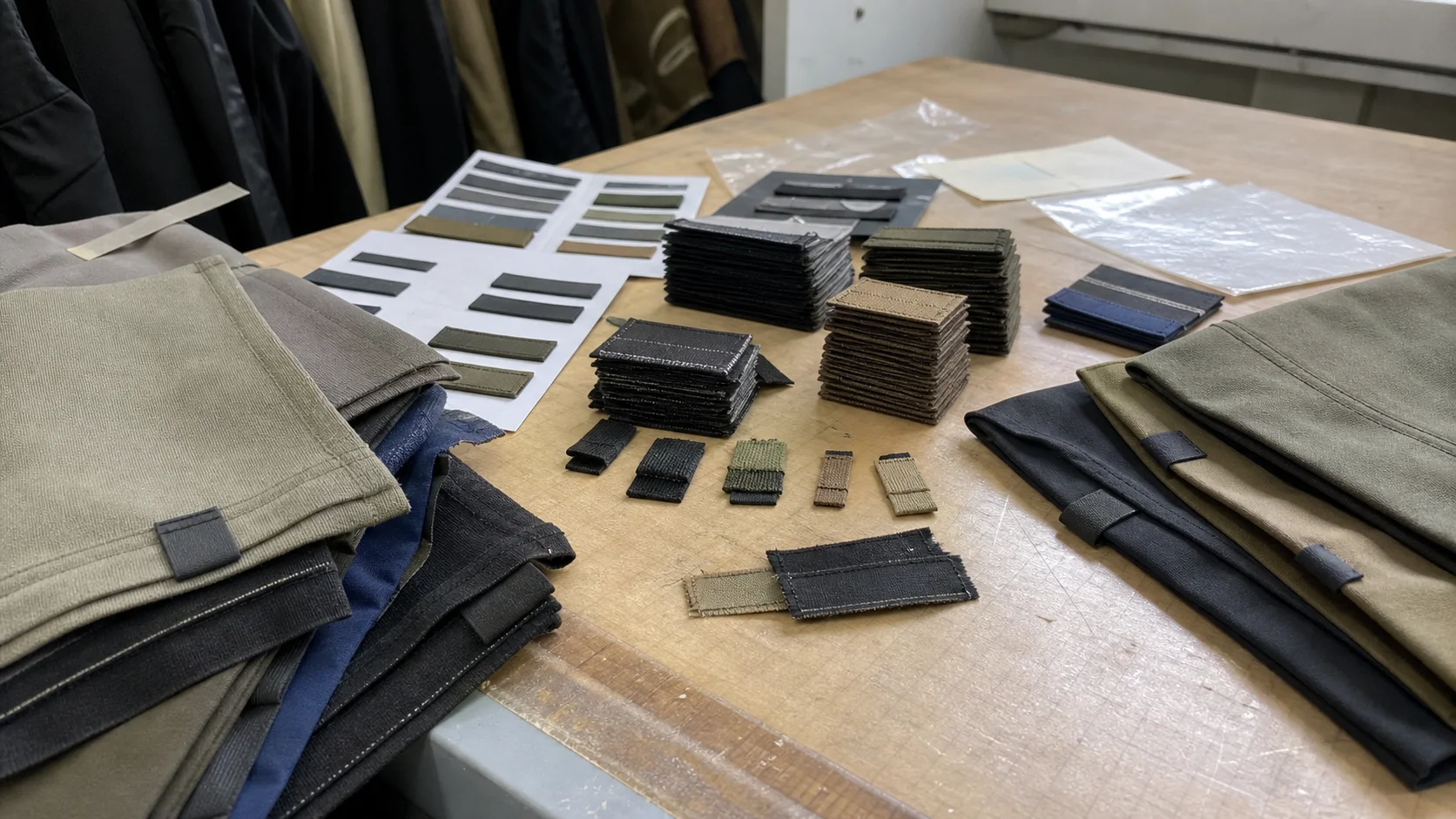
A focused SEO outline for evaluating woven origin tab factory pricing, MOQ, and production details for security contractor uniform programs, with emphasis...
Woven Origin Tab Pricing for Security Contractor Orders - Fabrikn production reference
Security contractor programs usually look simple on paper: a woven origin tab, a clear brand mark, a clean edge finish, and a price that fits the uniform budget. In practice, the order is shaped by a set of small decisions that affect cost more than many buyers expect. A woven origin tab factory quote is rarely just “per piece.” It is a mix of construction, thread count, size, color changes, backing, fold style, and how the factory handles inspection and packing.
For contractors sourcing woven origin tabs for uniforms, tactical outerwear, or workwear programs, the key question is not only “what is the price?” It is “what price buys consistent color, stable sizing, clean cutting, and reliable repeat production?” That distinction matters because a low unit cost can become expensive once rework, late delivery, or rejected lots enter the picture.
This review looks at woven origin tab factory MOQ pricing from a practical purchasing angle. It is aimed at security contractor orders where durability, repeatability, and replenishment matter more than one-off decoration. The strongest buying approach is usually not the cheapest quote. It is the quote with the lowest total risk.
A woven origin tab is a small label or decoration panel that typically carries brand identity, origin marking, division name, or compliance-related text. In security contractor apparel, it often appears on chest seams, sleeve areas, hem points, bags, outerwear, or tactical accessories. Buyers sometimes treat it as a minor trim item, but it can influence the entire look of the garment.
Woven construction is often chosen because it gives sharper detail than basic printed fabric labels and tends to hold up better under frequent wear and washing. A well-made woven tab also supports a cleaner uniform presentation, which matters in security work where garments need to look disciplined and consistent across a team.
From a sourcing perspective, the origin tab should be evaluated as a functional trim, not just decoration. It must survive handling, laundering, abrasion from belts or gear, and repeated replacement orders. If the factory cannot hold the same yarn shade and edge quality from batch to batch, the tab will look mismatched even if the logo is technically correct.
Factory pricing for woven origin tabs is usually shaped by a handful of predictable variables. The first is size. A small tab uses less yarn and usually costs less, but not always in a straight line. Very small labels can require tighter loom setup and more careful cutting, which can reduce the savings.
The second is color count. A one-color woven tab is usually cheaper than a multicolor design because it reduces loom complexity and yarn changeover. Strong contrast logos, edge borders, and small text can add cost fast. If the artwork includes multiple shades, the factory may need more setup time and tighter QC to keep the design readable.
The third is backing and finish. Heat seal, sew-on, adhesive, merrow border, laser cut, folded edge, and center fold each carry a different cost profile. Security contractor buyers should pay attention to where the tab will be applied. Outerwear and tactical items often need stronger sewing or heat seal support than lightweight shirts.
Thread type and yarn density also affect price. Higher-density weaving creates cleaner detail, but it can increase factory time and reduce throughput. Low-density weaving may save a little on cost, but the text can blur, especially on small origin marks or narrow logo lines. In many cases, a moderate density is the better purchasing choice because it preserves legibility without pushing the quote too high.
Packaging adds more variation than buyers expect. Bulk packing is usually cheaper than individual polybagging or custom carding. If the contractor needs kitted deliveries by size, department, or site, the factory may charge extra labor. That cost can be justified if it reduces warehouse handling on the buyer’s side.
Pricing Driver Typical Effect on Quote Buyer Note Tab size Small to moderate impact Very small tabs can still cost more if setup is difficult Color count Moderate to high impact Each added color can increase weaving complexity Backing or finish Moderate impact Match finish to garment use and wash performance MOQ level High impact Lower quantities usually mean higher unit pricing Packaging spec Low to moderate impact Custom packing helps receiving, but it costs moreOne practical judgment: quote comparisons should normalize the same spec. A cheap quote for a looser weave, simpler backing, and bulk-only packing is not the same product as a more expensive quote with denser weave, cleaner edge finish, and sorted packing. Contractors should request the same artwork file review, same size, same thread color standard, and same packing method before judging price.
MOQ is where woven origin tab pricing becomes especially relevant. For many factories, a typical minimum order quantity for a simple woven tab may fall in the range of 500 to 3,000 pieces per design, though the exact number depends on the factory, construction, and number of colors. Some suppliers will accept lower quantities for sampling or repeat customers, but the unit price usually rises quickly at the low end.
Security contractor orders often involve small initial rollouts followed by replenishment. That makes MOQ planning important. If the first lot is too small, the contractor may pay an inefficient price and still need a second run soon after. If the lot is too large, the buyer risks holding unused inventory if the uniform program changes, artwork is revised, or site requirements shift.
A sensible approach is to forecast by team size, replacement rate, and expected uniform life. If the tab will be used on items that are ordered in seasonal waves, it may be better to place a larger initial order and hold a controlled reserve. If the design is still being finalized, a smaller pilot run can be the safer choice even if the price is not ideal.
Factories may quote lower prices at higher MOQs because setup cost is spread over more units. Buyers should still test whether the supplier can repeat the same shade and weave quality on a second run. Low price is useful only if the replenishment lot matches the first shipment.
Sample approval should be treated as a control point, not a formality. For woven origin tab orders, the normal path is artwork submission, digitization or weaving file preparation, first sample or strike-off, buyer review, correction if needed, and pre-production approval. Some factories can move faster if the artwork is simple, but the buyer should not compress the review step just to save a few days.
The sample should be checked for legibility, border sharpness, color match, and actual size. Small woven items often look acceptable on screen and disappointing in hand. Text can collapse, thin lines can disappear, and edge detail can shift during cutting or folding. A practical buyer verifies how the tab reads at normal viewing distance and under warehouse lighting, not just in a photo.
Security contractor orders also need functional approval. If the tab will be sewn onto a heavyweight uniform or jacket, test the actual attachment method. Heat-seal films may fail on certain fabric surfaces. Sew-on tabs may pucker if seam allowances are too small. Adhesive-backed trims can save labor but may not withstand repeated laundering or heavy field use.
Before release to production, the buyer should confirm artwork version, Pantone or yarn reference, finished dimensions, placement method, and packaging count per bag or carton. Most avoidable disputes come from assumptions that were never written down.
Woven origin tab pricing should always be tied to a clear technical spec. Without it, quotes are hard to compare and factory substitutions become more likely. The most useful specs are the finished size, fold style, weave density, yarn composition, backing, and tolerance range.
For material, polyester is common because it offers good color stability, durability, and cost control. Some orders may call for cotton blends or specialty yarns, but these are less common in security contractor programs unless a specific handfeel or brand standard is required. Buyers should ask how the material responds to washing, heat, and abrasion if the tab will be used on workwear or outerwear.
Size should be set with care. A tab that is too large can distract from the garment, while one that is too small can lose readability. A common approach is to match the tab to the scale of the uniform panel it sits on. Tighter tolerances are worth paying for when the tab must align with other branded components across a multi-garment program.
Edge finish matters more than many buyers expect. Merrowed edges give a classic patch-like look, while laser or hot cut edges can create a cleaner modern look. Folded edges are useful when sewing allowance needs to be hidden. Each finish affects not only appearance but also production speed and risk of fraying. If the item will see rough use, the buyer should prioritize durability over cosmetic neatness alone.
Useful spec checklist:
Lead time for woven origin tab factory orders depends on more than the factory’s stated production window. Artwork approval speed is often the biggest variable. If the artwork is unclear, missing file details, or changes after the sample stage, the schedule can slip even when the factory is ready to run.
For many standard woven tabs, production may take around 7 to 20 days after approval, but this range can stretch with busy factory schedules, higher color counts, or special finishes. Sampling may add several days before production even starts. Rush orders are possible in some cases, but rushed work often narrows QC margins and may increase price.
Lead time also depends on input availability. If a tab requires specific yarn colors, custom backing materials, or special packaging, the factory may need extra time to source those components. Buyers should ask early whether the quoted timeline assumes all materials are in stock. That question prevents a common delay where weaving is ready but finishing materials are not.
For security contractor rollouts with fixed deployment dates, a safer procurement timeline is to approve the sample early, keep artwork frozen, and build a small buffer into the schedule. Tight dates and custom decoration are a risky combination.
Inspection risk is where many woven tab orders become expensive. The most common defects are color shift, misaligned text, loose edges, inconsistent sizing, and poor cut quality. On small tabs, even a minor weave error can make a logo look amateurish.
Buyers should specify acceptable tolerance levels. If the factory is allowed to vary size too much, the tab may not sit properly on the garment. If color matching is loose, a re-order may not blend with the first shipment. If border definition is not controlled, the trim may look uneven in a line-up of uniforms.
Pre-shipment inspection should focus on a few practical checks: quantity, dimensions, weave readability, edge integrity, and packing accuracy. For contractor orders, it is also wise to check whether cartons are labeled clearly by style, color, and size. Mixed packs can slow receiving and create downstream distribution issues.
One tradeoff is whether to inspect only the finished goods or to request in-process checks. Full inspection can catch issues earlier, but it costs time and may raise supplier friction. For recurring programs, a lighter in-process check plus a solid pre-shipment inspection is often a reasonable middle ground. For first-time orders, the buyer should lean more conservative.
A low unit price is not a win if the contractor cannot reorder the same tab six months later without visible mismatch.
Security contractor buyers should think in terms of program continuity. The real cost of a woven origin tab is not only the invoice price. It includes setup effort, sample cycles, replacement risk, storage, distribution, and the damage caused by inconsistent branding across a team.
When comparing factories, the best quote is usually the one that proves control. Look for clear itemized specs, willingness to sign off on a sample, consistent responses on yarn and finish details, and an honest explanation of MOQ. A supplier that gives an unrealistically low quote without asking about artwork density, attachment method, or packing method is usually not giving a meaningful comparison.
Contractors should also decide whether the origin tab is being treated as a decoration element or a controlled identity marker. If it is part of a uniform standard, then matching matters more than saving a few cents. In that case, higher-quality weaving and stricter approval steps are justified. If it is a temporary project label, then cost may take priority and the spec can be simplified.
For buyers building a broader sourcing relationship, it is often useful to review the supplier’s service structure and company background before sending a PO. Fabric and decoration vendors that can handle repeat orders, controlled sampling, and communication discipline are usually more valuable than one-time low-cost sellers. See services for a closer look at typical production support, and about us for supplier background context.
The best supplier relationship for woven origin tab orders is a practical one. It should be easy to ask for a revised spec, get a clear quote, and confirm what is included. A contractor buyer should expect details on MOQ, sampling, production lead time, finish options, and inspection handling before making a commitment.
When the order is for a security team, responsiveness matters almost as much as price. Replacement tabs may be needed on short notice. That means the buyer benefits from a supplier who keeps artwork records, understands repeat-order timing, and can quote refresh runs without rebuilding the job from zero.
If you are preparing a new request for pricing, the most useful next step is to share your artwork, target quantity, attachment method, and required packing format. A structured inquiry produces a more accurate quote and reduces back-and-forth. For direct contact, use contact us to send the spec and ask for a factory review.
Get a free quote from Fabrikn — your trusted B2B clothing manufacturer with 10+ years of experience. MOQ as low as 200 pieces.
Get a Free Quote →Typical MOQ is often around 500 to 3,000 pieces per design, depending on weave complexity, color count, finish, and the supplier’s production setup. Lower quantities are sometimes possible, but unit pricing usually rises.
One quote may include a denser weave, tighter tolerances, better backing, or more careful packing. Another may be priced on a looser spec. Always compare the same finished size, same artwork, same finish, and same pack method.
Many orders run in about 7 to 20 days after sample approval, but lead time changes with artwork revisions, material sourcing, factory workload, and packing requirements. Sampling adds extra time before production starts.
Check size, readability, color match, border finish, and how the tab performs with the actual garment attachment method. A sample should be judged in real lighting and on the intended fabric, not only in photos.
Common risks include color shift, blurred text, uneven edges, incorrect dimensions, and packing mistakes. Clear specs and a sample approval step reduce those risks, but they do not remove them completely.
Not for contractor programs. The lowest quote can be a poor value if it creates rework, delays, or mismatch in repeat orders. A controlled supplier with reliable repeatability is usually the safer buy.