
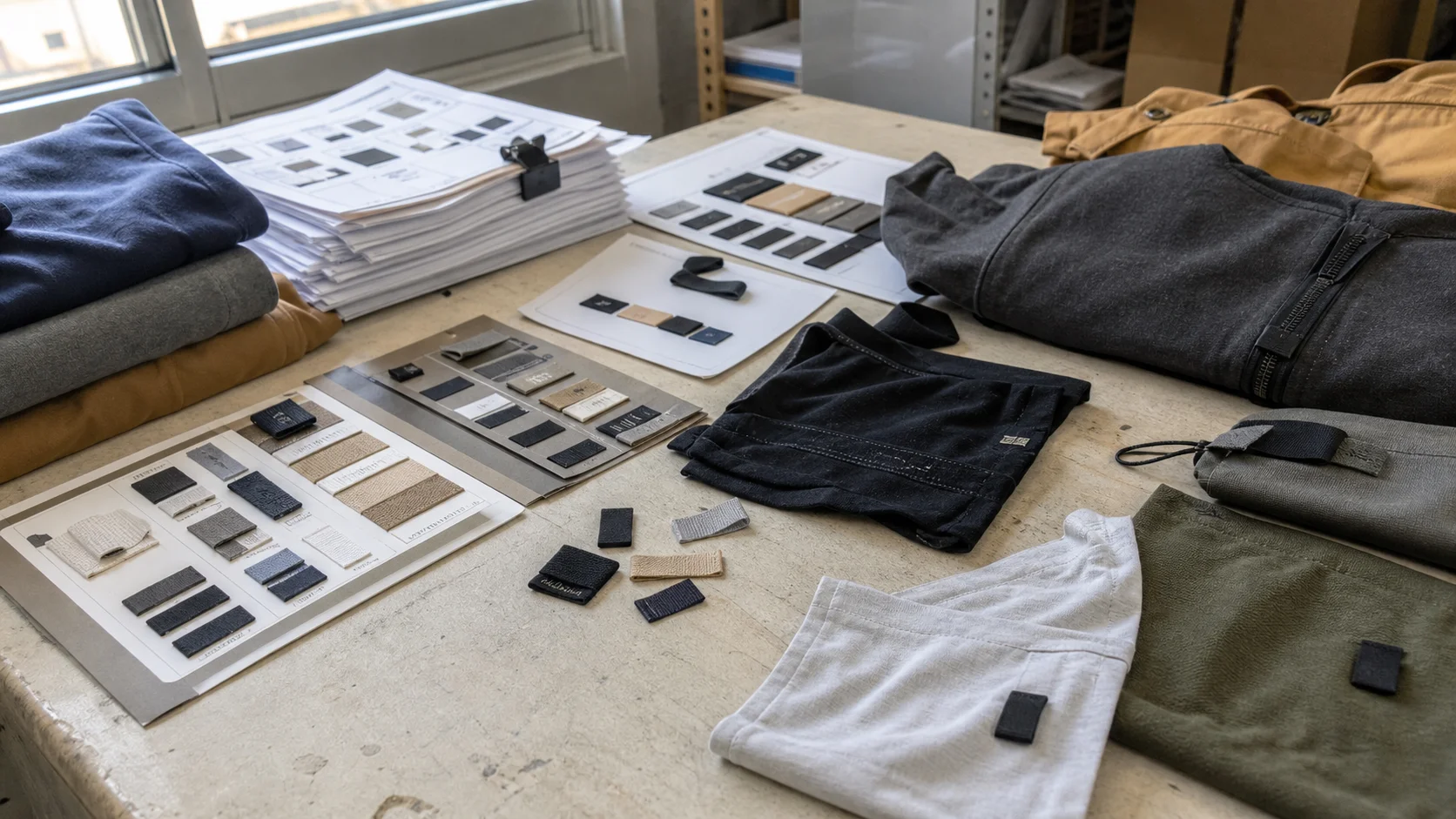
A 2500-word SEO outline for school operations teams evaluating bulk woven origin tab suppliers, with criteria for compliance, weave quality, attachment...
Woven Origin Tab Supplier Scorecard for Schools - Fabrikn production reference
For school operations teams, a woven origin tab is a small item with a large compliance footprint. It may sit on a uniform hem, inside a jacket, on a sportswear seam, or beside a branded patch. The tab can identify the garment’s country of origin, school program, house color, size system, sustainability claim, or approved supplier code. When ordered in bulk, it becomes part of a wider uniform control process: procurement, decoration, garment production, inspection, and distribution.
A strong supplier scorecard helps schools avoid the common problems: inconsistent tab color, unreadable woven text, late delivery to the garment factory, unclear origin wording, weak fold accuracy, and tabs that fail after washing. The point is not to make purchasing complicated. The point is to create a simple, repeatable way to compare woven tab suppliers before a full uniform rollout.
This guide is written for school operations teams, procurement managers, uniform coordinators, and decoration buyers who need a practical way to evaluate bulk woven origin tab suppliers for school apparel programs.
School uniforms are bought differently from fashion retail. A school may need the same polo, blazer, PE short, fleece, skirt, or tracksuit pant to remain consistent across multiple terms and intake years. Families expect the garment to match the approved uniform guide. Operations teams expect the supplier to deliver on time. Distributors and school shops need stock that is easy to identify and reorder.
Woven origin tabs support that system when they are planned correctly. They can carry country-of-origin wording, approved program codes, school identity colors, garment line references, or internal supplier identifiers. For schools managing several garment vendors, a tab can make stock sorting easier. For uniform programs with strict decoration rules, it can reduce off-spec substitutions.
The risk is that woven tabs are often treated as a minor trim. That creates avoidable problems. A poorly woven tab may look acceptable in a digital proof but fail once sewn into a seam. Small letters can blur. Metallic yarn can scratch. Dense edges can curl. Folded tabs can shift during sewing. In bulk, those small problems become visible across thousands of garments.
A woven origin tab should be scored as a production trim, not as a casual branding extra. It affects compliance, appearance, sewing efficiency, and uniform consistency.
Schools working with apparel production partners can also review broader decoration and manufacturing support through Fabrikn services, especially when trims, labels, printing, embroidery, and garment finishing need to be coordinated under one sourcing plan.
A supplier scorecard should be short enough to use, but detailed enough to catch real production issues. For woven origin tabs, the most useful categories are product capability, compliance control, sampling discipline, bulk consistency, lead time, pricing transparency, and communication.
School operations teams should avoid scoring only on unit price. A low tab price can become expensive if production misses the garment sewing window or if the tab is rejected because the wording is unreadable. The better approach is to score each supplier on the areas that affect the whole uniform program.
Use weighted scoring if the school program is large or time-sensitive. For example, a small reorder may place more weight on speed and MOQ. A new full-school rollout should place more weight on sampling, compliance wording, and bulk consistency.
The table below can be adapted for RFQs, vendor reviews, and annual supplier evaluations. A simple 1 to 5 score is usually enough. Score 1 for poor or unverified performance, 3 for acceptable performance with some risk, and 5 for strong documented capability.
Scorecard Area What to Check Why It Matters for Schools Suggested Weight Artwork and Text Clarity Minimum readable letter height, logo detail, border sharpness, contrast Origin wording and school identifiers must remain legible after weaving and washing 15% Yarn and Color Control Polyester yarn type, color matching method, approved shade standard Uniform programs need consistent school colors across repeated bulk orders 12% Fold, Cut, and Edge Finish End fold, center fold, straight cut, ultrasonic cut, heat-sealed edge Poor edges cause fraying, bulk at seams, sewing delays, and visible defects 10% Compliance and Origin Wording Approved text, country wording, care-label coordination, record keeping Wrong wording can trigger rework, garment rejection, or distribution delays 15% Sampling Process Digital proof, physical strike-off, revised sample, approval file Physical samples reveal weaving limitations that digital artwork may hide 12% Bulk Production Consistency Lot-to-lot shade, woven density, length tolerance, fold accuracy Schools often reorder the same trim over several terms or years 12% MOQ and Reorder Flexibility Minimum order by design, color, size, fold type, and reorder quantity Not every school program needs the same volume at the same time 8% Lead Time and Delivery Control Sample lead time, bulk lead time, shipping method, production queue Tabs must arrive before the garment sewing stage, not after decoration 10% Packing and Inspection Support Bundle count, polybag labeling, batch number, QC report availability Incoming inspection is faster when tabs are clearly packed and traceable 6%A supplier scoring above 80% is usually suitable for controlled bulk production, assuming pricing and delivery align with the school calendar. A score between 65% and 80% may be workable for low-risk tabs with simple wording. Anything below 65% deserves caution, especially if the program involves strict branding, multiple garment factories, or a fixed back-to-school deadline.
Clear specifications prevent most woven tab disputes. Schools should issue a written trim spec, even for a simple origin tab. The spec does not need to be complicated, but it must include enough detail for a supplier to quote accurately and produce repeatably.
Text size is one of the most common failure points. Very small country-of-origin wording may look sharp on a PDF but become fuzzy when woven. If the wording must be readable, the supplier should confirm the minimum recommended letter height for the chosen weave. A practical buyer will not approve a tab based only on enlarged artwork.
Woven origin tabs often sit within a larger decoration package. A school garment may also include embroidery, heat transfer, screen print, woven badge, care label, barcode sticker, or retail packaging. The tab’s color and placement should not conflict with those elements.
For teams coordinating multiple decoration methods, it is useful to treat the tab as part of the complete branding bill of materials. Fabrikn’s apparel services page is a relevant starting point for understanding how decoration, trims, and garment production can be managed together.
Typical MOQs for woven origin tabs vary by supplier, design complexity, yarn color, and production location. For many bulk school uniform programs, buyers may see MOQs from around 1,000 to 5,000 pieces per design for standard woven tabs. More flexible suppliers may support lower trial quantities, while larger production setups may prefer 10,000 pieces or more for best pricing.
MOQs can also apply by colorway, fold type, or artwork version. If one school needs the same tab in four house colors, the supplier may treat each color as a separate SKU. That matters for budgeting and stock planning.
The lowest unit price is not automatically the best value. If a tab is going into 20,000 garments, a small quality failure can create inspection delays, sewing disruption, or replacement costs. Paying slightly more for better text clarity, controlled folding, and reliable packing is often justified when the school calendar is fixed.
At the same time, over-specification can waste money. A basic inside-origin tab does not always need a luxury woven finish. If the tab is not visible during wear and carries only simple country text, a standard polyester woven option may be sufficient. The purchasing decision should match the tab’s visibility, compliance role, and risk level.
Sampling should be structured. Informal approval by email can lead to confusion when the bulk shipment arrives. A better process creates a short approval trail that the school, garment factory, and trim supplier can all follow.
Schools should be careful with late artwork changes. A single change to origin wording, font weight, or tab size can require a new sample. If the garment sewing schedule is already booked, a late trim revision can cause more damage than most teams expect.
Lead time depends on artwork readiness, sample approval speed, supplier capacity, order size, shipping route, and public holiday schedules. Typical physical sample timing may range from several days to two weeks after artwork confirmation. Bulk production may often take around two to four weeks for standard woven tabs, with longer timelines for complex designs, large quantities, or peak-season queues.
The most important point is that the tab lead time must be planned against the garment factory’s sewing schedule. If the tab is sewn into a side seam, neck seam, pocket, hem, or waistband, it must arrive before that operation begins. A trim that arrives before final shipment but after sewing is still late.
A practical safety buffer is essential. For a school uniform launch, ordering tabs only when garment production starts is risky. The safer approach is to approve and produce trims before bulk garment sewing begins, then inspect and release them to production with the rest of the bill of materials.
Woven origin tabs should be inspected before sewing. Once sewn into garments, replacement is slow and expensive. The inspection can be simple, but it needs to be consistent.
Inspection risk rises when a supplier packs multiple designs together without clear labels. That is common in school programs with house colors, year-group variations, or multiple campuses. Each tab version should have a unique code, and cartons should be marked clearly. The cost of better labeling is small compared with the cost of sorting trims on a sewing floor.
A good RFQ does not need to be long, but it should force the supplier to answer the details that affect school operations. Vague quotes are a warning sign. If the supplier cannot confirm the weave type, MOQ, sample timing, packing method, and remake policy, the buyer has limited control once bulk production starts.
For schools still building a uniform sourcing plan, it can be useful to speak with a manufacturing partner before issuing the RFQ. The Fabrikn contact page is an appropriate route for teams that need to discuss trim, decoration, or production requirements before committing to a supplier specification.
The right woven origin tab supplier is not always the cheapest or the most premium. The right supplier is the one whose capability matches the risk of the program.
Pay more when the tab is visible, carries small text, uses school colors, supports compliance wording, or must match reorders over several years. Also pay more when the delivery date is fixed and the supplier has a better record of sampling control, packing accuracy, and production communication. In those cases, the tab is not just decoration. It is part of operational continuity.
Simplify when the tab is internal, the wording is basic, the quantity is small, or the garment program is still being tested. A standard woven polyester tab with clear black-and-white contrast may be more sensible than a multi-color design with tight artwork and higher MOQ. Simple trims are easier to reorder and less likely to fail inspection.
School uniform supply is sensitive to timing. Parents need garments before term starts. School shops need correct stock by size. Operations teams need predictable delivery. A woven origin tab scorecard gives the buyer a practical control tool before problems reach the sewing line.
When issuing an RFQ, include the scorecard as part of the supplier response pack. Ask each supplier to provide a quote, sample schedule, technical recommendation, and packing plan. Then score responses before requesting samples. This prevents teams from spending time on suppliers that cannot meet basic operational requirements.
The RFQ should include expected annual volume, first bulk order quantity, reorder pattern, number of designs, artwork files, target delivery date, and destination. If the school uses a garment manufacturer, decorator, or distributor, list where the tabs must be delivered. A supplier cannot plan correctly without that information.
It is also worth keeping supplier background in proportion. Buyers can review general company information, service scope, and sourcing approach through pages such as Fabrikn about us, but the final decision should still be based on sample quality, documented specifications, commercial terms, and delivery performance.
For most school operations teams, a 100-point system is enough. Assign each category a weight, score the supplier from 1 to 5, then convert that score according to the weight. Keep notes beside each score. The notes matter because two suppliers may receive the same score for different reasons.
Final Score Supplier Status Recommended Action 85 to 100 Preferred Proceed to sample approval and negotiate bulk terms 75 to 84 Conditionally Approved Use for standard designs; monitor sampling and first bulk order closely 65 to 74 Limited Use Consider only for simple tabs, small reorders, or non-critical programs Below 65 High Risk Avoid for fixed-deadline school uniform programs unless risks are resolvedDo not let a strong price compensate for weak compliance control. Wrong origin wording, poor legibility, or late delivery can create costs beyond the trim invoice. A fair scorecard makes that tradeoff visible before purchase orders are placed.
A bulk woven origin tab supplier scorecard gives school operations teams a practical way to compare suppliers beyond price. The best scorecards focus on what actually affects uniform delivery: readable woven text, correct origin wording, stable yarn color, reliable folding, realistic MOQ, controlled sampling, and delivery before garment sewing.
For a low-risk internal tab, keep the design simple and the supplier requirements clear. For visible tabs, compliance-sensitive wording, or large back-to-school production runs, use a stricter scorecard and approve physical samples before bulk production. That judgment protects the uniform program, the sewing schedule, and the families waiting for finished garments.
Get a free quote from Fabrikn — your trusted B2B clothing manufacturer with 10+ years of experience. MOQ as low as 200 pieces.
Get a Free Quote →A woven origin tab is a small woven trim used on or inside a garment to show country-of-origin wording, school program identification, supplier coding, or related information. It may be sewn into a seam, hem, waistband, neck area, or visible branding position.
Typical MOQs often range from about 1,000 to 5,000 pieces per design for standard woven tabs, although this varies by supplier, artwork, color count, fold type, and production setup. Larger orders may receive better unit pricing, while small custom runs may carry higher costs.
Yes. A digital proof is useful for checking layout and spelling, but a physical woven sample is needed to confirm text clarity, color, fold accuracy, edge finish, and actual hand feel. This is especially important for small origin wording.
Sample production may take several days to two weeks after artwork confirmation. Bulk production for standard woven tabs may often take around two to four weeks after sample approval. Timelines depend on supplier capacity, design complexity, quantity, shipping route, and seasonal demand.
The main risks are unreadable text, incorrect origin wording, color mismatch, frayed edges, poor fold alignment, inaccurate counts, and late delivery to the garment factory. These risks are easier to manage when tabs are inspected before sewing.
Woven tabs are durable and suitable for repeated laundering, but they can struggle with very small or detailed text. Printed labels can carry more fine information, but may wear differently depending on print method and fabric. The best choice depends on placement, wash requirements, text length, and compliance needs.
Yes, if the wording, size, color, and placement work across the garment range. Using one master tab can reduce MOQ pressure and simplify stock control. The tradeoff is that the design must be generic enough to suit all approved garments.
A useful scorecard should include artwork clarity, yarn color control, origin wording accuracy, sample process, bulk consistency, MOQ flexibility, lead time, packing quality, inspection support, and commercial transparency. Weight the categories according to the risk of the school uniform program.