
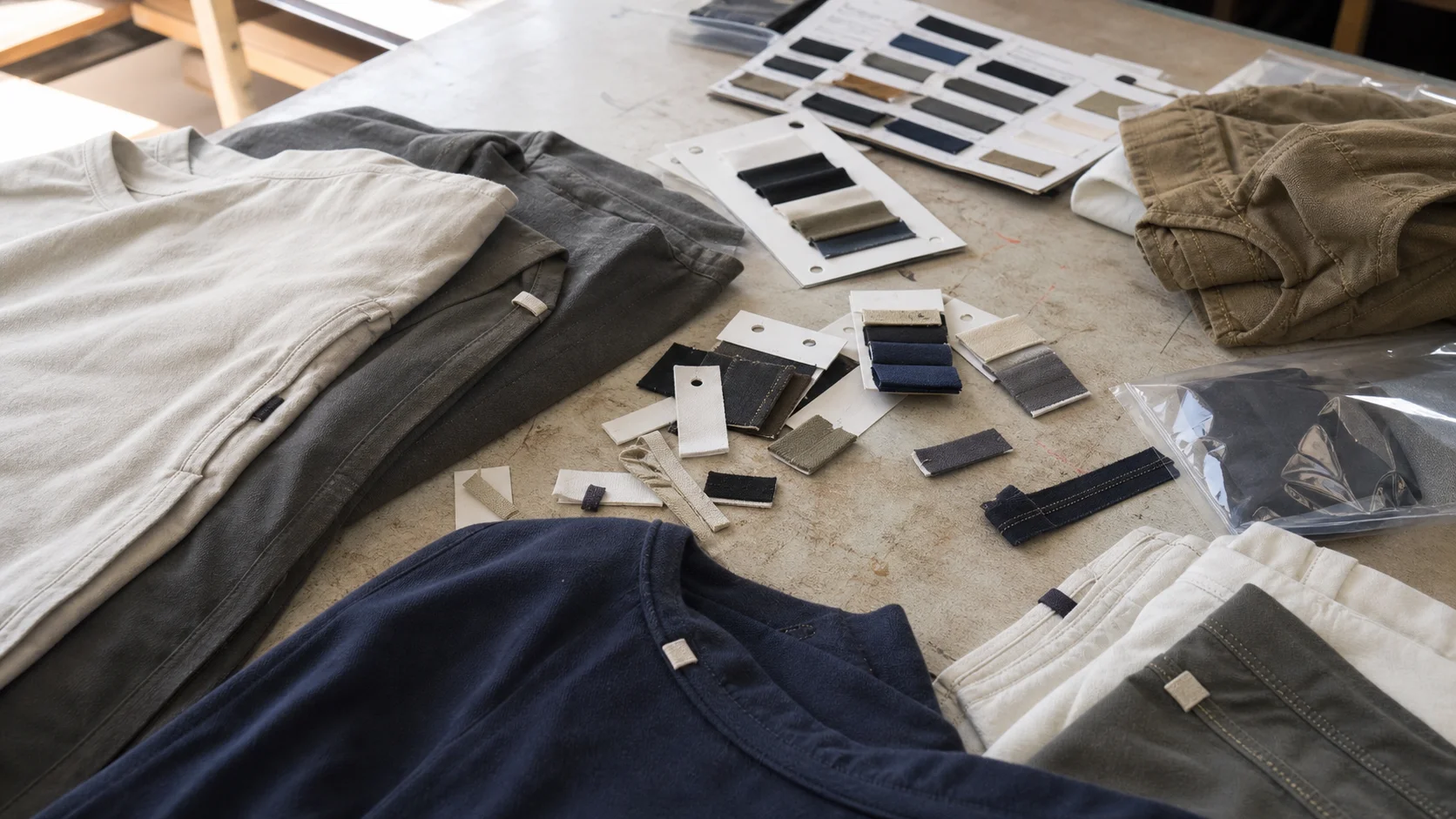
A distributor-focused outline for reviewing wholesale woven origin tab pricing, MOQ breaks, artwork variables, compliance details, and landed-cost risks...
Woven Origin Tabs: MOQ Pricing Review for Buyers - Fabrikn production reference
Category: Decoration & Printing
Woven origin tabs are small brand, country-of-origin, or compliance labels sewn into apparel, accessories, uniforms, home textiles, and promotional products. They are often used to show “Made in,” size, brand identity, collection naming, fabric origin, or distributor-specific labeling. In sourcing terms, they sit between decoration and trim: decorative enough to influence product presentation, but functional enough to affect compliance, packaging, and final inspection.
For wholesale buyers, the main issue is not whether a woven tab can be made. Most label suppliers can produce basic origin tabs. The bigger question is whether the supplier can hold consistent color, legibility, fold accuracy, edge finish, and packing discipline across repeat orders. A small tab can create a large receiving problem if the wording is wrong, the fold is off, or the label frays during sewing.
Origin tabs are usually woven from polyester yarn because polyester is stable, relatively colorfast, and suitable for high-volume production. Cotton-look yarns, recycled polyester yarns, metallic threads, and softer satin-style options are also available, but each choice changes cost, feel, lead time, and minimum order quantity. Buyers should treat the tab as a technical trim, not a last-minute graphic item.
Distributor buyers often source these tabs in bulk to support private-label apparel programs, uniform contracts, promotional merchandise, retail replenishment, or multi-style production. The tab may be small, but it touches many commercial points: branding, legal labeling, product differentiation, inventory planning, and factory sewing efficiency.
Distributor buyers typically need woven origin tabs for three reasons: standardization, margin control, and speed. A distributor may supply garments from several factories, yet still need the same origin tab across every shipment. Centralized trim sourcing helps keep branding consistent and reduces the risk of each garment supplier using a slightly different label quality.
In private-label programs, woven tabs can make a basic product look more controlled. A clean woven tab at the hem, side seam, collar, cuff, or waistband adds perceived value without changing the garment pattern. This is useful for distributors selling to retailers, workwear accounts, schools, teams, hospitality groups, or corporate buyers.
Margin is another reason. If each cut-and-sew factory sources tabs independently, the distributor may pay hidden markups on a low-cost trim. Direct wholesale purchasing can reduce unit cost, especially when the same artwork is used across multiple garment styles. The tradeoff is inventory responsibility. A distributor that buys tabs directly must forecast usage, manage leftovers, and coordinate shipments to production sites.
Speed also matters. When tabs are pre-approved and stocked, garment factories can move faster once fabric and trims are ready. A tab that is still pending artwork approval can hold up bulk sewing, packing, or final inspection. The risk is especially high when the tab carries country-of-origin wording or care-related claims. Those details need to match the actual product and destination-market rules.
Purchasing judgment: woven origin tabs are worth centralizing when the same label is used repeatedly across programs. For one short promotional run, the savings from direct sourcing may not justify the artwork, sampling, freight, and inventory management effort.
For buyers building a broader apparel program, it is sensible to align tab sourcing with other development work. Fabrikn’s apparel production support can be reviewed through its services page, especially when woven labels, trims, and finished-garment execution need to be coordinated under one sourcing workflow.
MOQ for wholesale woven origin tabs depends on supplier type, loom setup, yarn count, color count, fold type, backing, and whether the supplier already runs similar specifications. Buyers often see quoted minimums from 500 pieces to 10,000 pieces per design. In practical distributor sourcing, the most common working range is 1,000 to 5,000 pieces per artwork, colorway, and size variant.
Order Type Typical MOQ Range Buyer Notes Basic woven origin tab 1,000–3,000 pcs Common for simple text, one fold, standard polyester yarns. Fine-detail logo tab 2,000–5,000 pcs Higher-density weaving may be needed for small letters or icons. Multiple colorways 1,000–3,000 pcs per colorway Each colorway is usually treated as a separate production setup. Recycled yarn or special thread 3,000–10,000 pcs MOQ may rise if yarn must be purchased specially. Heat-cut or ultrasonic-cut tabs 1,000–5,000 pcs Cut method affects edge finish, fraying risk, and cost.A low MOQ can be useful for testing, but it rarely gives the best unit price. A supplier accepting 300 or 500 pieces may charge a setup fee, artwork fee, sample fee, or higher unit cost to cover loom preparation. That can still be reasonable for a pilot order. It is usually not the right benchmark for distributor-level pricing.
At 1,000 pieces, buyers can often get a workable opening order for a single artwork. At 3,000 to 5,000 pieces, pricing usually becomes more competitive because setup cost is spread across more units. At 10,000 pieces and above, the buyer may gain stronger leverage, but only if the artwork is stable and the program has dependable sell-through.
MOQ should be reviewed per SKU, not only per total order. If a buyer orders 10,000 tabs split across five designs, the supplier may still price each design as a 2,000-piece run. The setup cost does not disappear because the purchase order total looks large. Artwork changes, text changes, color changes, and fold changes all affect production efficiency.
Distributor buyers should also watch size variants. A label reading “Made in Portugal” and a label reading “Made in Vietnam” are not the same artwork. A label in black ground with white letters and another in white ground with black letters are separate colorways. A center-fold tab and an end-fold tab require different finishing. Each variation can trigger a separate MOQ.
Purchasing judgment: if the supplier offers an unusually low MOQ with no setup fee and a very low unit price, check whether the label is truly woven, whether the yarn colors are custom-matched, and whether the quote includes folding, cutting, packing, and pre-production sample approval.
Woven origin tab pricing is usually driven by setup cost, weaving time, yarn consumption, finishing labor, and packing. The tab itself may look simple, but small changes can shift the cost. A buyer comparing quotes should not look only at the final unit price. The specification behind that price matters more.
Typical wholesale pricing for standard woven tabs may range from a fraction of a cent to several cents per piece, depending on order size, complexity, country of production, and finishing requirements. Small test runs can cost noticeably more per unit. Large recurring orders with stable artwork usually price better. Freight, duties, sampling, and bank charges can outweigh the tab cost if the order is very small.
Artwork preparation may be quoted separately. Some suppliers include basic artwork conversion in the unit price, while others charge for digitizing or woven layout development. Buyers should clarify whether the quote includes a woven proof, physical sample, or only a digital mockup.
Color matching is another cost and risk factor. Woven yarn colors do not always match Pantone references exactly. A close commercial match may be acceptable for origin wording, but brand-sensitive tabs may need lab dips or yarn cards. If a buyer demands exact color matching on a low-volume tab, cost and lead time can rise quickly.
The cheapest quote is not always the lowest-cost choice. Poorly cut tabs can slow sewing lines. Stiff tabs can irritate the wearer. Weak contrast can make origin wording unreadable. Incorrect folding can create visible misalignment after sewing. These issues create rework costs that are larger than the savings on the label itself.
A clear specification sheet is the best way to control woven origin tab quality. The spec does not need to be complicated, but it should remove avoidable interpretation. A supplier cannot quote accurately if the buyer provides only a logo file and a general size.
Damask woven labels are common when small text needs to remain legible. Satin labels can give a smoother look, but they may not suit every garment type. Taffeta is often more economical and can work for basic origin tabs where detail is not demanding. High-density weaving is useful for compact logos, but buyers should check whether the tab becomes too stiff for lightweight garments.
Fold allowance is often underestimated. If the tab is sewn into a side seam or hem, part of the label disappears into the seam allowance. The visible area must be designed with that in mind. A tab that looks balanced on the artwork can look cramped after sewing if the fold and stitch margin were not considered.
Country-of-origin wording must be handled carefully. The wording should match the actual manufacturing origin and destination-market requirements. If production moves from one country to another, the tab artwork may need to change. Distributor buyers should avoid ordering excessive inventory of origin-specific tabs unless the production base is stable.
For garment programs that require broader coordination between trim specs and production planning, buyers can review Fabrikn’s company background through the about us page before deciding whether to consolidate development support.
Sampling is where most avoidable label problems should be caught. A digital mockup is useful, but it is not enough for final approval. Woven labels are physical items. Yarn, density, cut, fold, and hand feel must be checked in real form.
The sewing test is important. A tab that looks acceptable loose on a table can twist, curl, or disappear once sewn into a garment. Lightweight jerseys, fleece, woven shirts, caps, tote bags, and outerwear all behave differently. The tab stiffness and fold thickness must suit the product.
Buyers should approve against a physical standard whenever possible. The approved sample should be retained by the buyer, supplier, and sewing factory. Photos help, but photos do not capture hand feel, thickness, or edge sharpness. If the order is repeated, the original approved sample gives all parties a reference point.
Sampling charges vary. Some suppliers waive sample fees for larger confirmed orders. Others charge for strike-offs and refund the fee after bulk order placement. Freight for samples can be disproportionate to the item value, so buyers should plan sample timing carefully. Combining tab samples with other trims can reduce shipment waste.
Purchasing judgment: do not approve bulk production from a screen proof if the tab carries legal origin wording, a small logo, or a tight fold tolerance. The cost of one physical sample is low compared with the cost of replacing mislabeled garments.
Standard woven origin tab production can often be completed in about 7 to 20 business days after approval, depending on supplier capacity, order size, yarn availability, and finishing requirements. This is only a general range. Sampling, artwork revision, holiday periods, freight, customs clearance, and factory receiving time can extend the total calendar timeline.
Buyers should separate sampling lead time from bulk lead time. A supplier may quote 10 days for production, but that may start only after artwork approval, sample approval, deposit, and final order confirmation. If the tab is needed for garment production, the relevant deadline is not the ship date from the label supplier. The relevant deadline is the date the sewing factory must receive usable trims.
Peak production seasons can affect lead times. Label suppliers serving apparel factories may become busier before major retail delivery windows. National holidays in production countries can also create bottlenecks. Distributor buyers should not assume that a repeat order will move at the same speed if it is placed during a holiday buildup.
Origin wording can also create delays if the garment production country changes after tab approval. A buyer may approve “Made in China” labels, then shift production to another country because of garment capacity or duty considerations. That change requires new artwork and a new tab order. The safest approach is to confirm origin after the garment supplier is locked, not before.
Rush orders are possible in some cases, but they reduce room for quality control. A rushed woven tab order may skip proper strike-off review or rely on limited yarn options. If the tab is purely decorative, that may be an acceptable risk for some buyers. If it carries compliance wording, rush production is not a good place to save time.
Woven origin tabs should be inspected before they reach sewing lines, not after they are attached to finished garments. Once a wrong or defective label is sewn in, the cost of correction rises sharply. Distributors should define inspection points for incoming trims and finished goods.
A practical inspection should check wording, dimensions, color, fold accuracy, edge finish, weave defects, count, and packing labels. For distributor orders, carton labels should identify artwork code, colorway, quantity, purchase order number, and production batch. This makes it easier to trace problems if a factory reports a defect.
Testing may be needed for certain programs. Wash durability, colorfastness, abrasion resistance, and needle damage can matter if the tab is used on workwear, children’s apparel, uniforms, or products subject to repeated laundering. For basic decorative tabs, full lab testing may not be commercially necessary, but buyers should still run a simple wash and wear check when the garment use case is demanding.
Inspection risk rises when the tab is supplied to multiple garment factories. One factory may sew the tab correctly while another places it too close to the seam edge. The tab supplier may have produced acceptable trims, but the finished product still fails appearance review. Placement instructions and sewing diagrams should be shared with every factory using the tab.
Purchasing judgment: if the tab is brand-visible, inspect both loose trims and sewn samples. If the tab is compliance-related, check every artwork version against the final production origin before bulk cutting or sewing starts.
A good woven origin tab buying strategy balances MOQ savings against inventory risk. The lowest unit price usually comes from larger orders, but overbuying origin-specific labels can create dead stock. Distributors should calculate expected usage by garment style, size range, production location, and reorder probability.
For a new program, a staged order is often safer. A buyer might approve artwork and order 1,000 to 3,000 pieces for the first production run. Once garment sell-through and factory origin are stable, the buyer can move to 5,000 or 10,000 pieces for better pricing. This avoids locking cash into labels that may become obsolete after a brand update or production shift.
For established replenishment programs, larger MOQ commitments can make sense. If the same origin tab is used across multiple seasons and factories, the buyer can negotiate better pricing, reserved yarn, repeat-order sampling rules, and consistent packing standards. Repeat business also makes it easier to push for priority production when deadlines tighten.
Distributors should avoid too many artwork variations. Every design, country, color, size, and fold version adds complexity. If a buyer can standardize label size and fold across several garment styles, purchasing becomes cleaner. Standardization also helps factories set up sewing operations more efficiently.
Supplier selection should reflect the buyer’s program type. A small promotional order may prioritize speed and low MOQ. A private-label retail program should prioritize repeatability, inspection discipline, and clear documentation. A uniform or workwear program may need stronger durability checks and stable replenishment planning.
Payment terms also affect the real purchase cost. Small custom trim orders are often paid upfront or with a deposit before production. Larger repeat buyers may negotiate better terms over time, but suppliers are unlikely to extend credit on custom artwork without order history. Buyers should include payment timing in cash-flow planning, especially when trims are ordered before garments are invoiced.
When buyers need help aligning trims, decoration, and apparel production, the most efficient next step is usually a specification review before placing bulk orders. Fabrikn can be contacted through its contact page for project discussions where label requirements need to match broader garment sourcing decisions.
Clear supplier questions reduce pricing surprises and production disputes. A short, direct checklist is better than a vague request for “best price.” The supplier should quote against a complete specification and confirm what is included.
Buyers should also ask how repeat orders are handled. Some suppliers keep artwork files and loom settings, but that does not guarantee identical output if yarn lots change or the supplier changes production equipment. Repeat orders should reference the approved sample, previous purchase order, batch number, and any accepted tolerances.
For distributor buyers, a strong quote should be easy to compare. It should show MOQ, unit price, sample fee, setup fee, lead time, Incoterms or freight basis, packing method, and payment terms. If these points are missing, the buyer is not ready to compare suppliers fairly.
Woven origin tabs are small trims with outsized operational impact. They influence brand presentation, compliance accuracy, sewing efficiency, and final inspection results. Distributor buyers should treat them as controlled production components, not generic accessories.
The practical MOQ range for wholesale woven origin tabs is often 1,000 to 5,000 pieces per design, with better pricing at higher quantities and higher MOQs for special yarns, fine details, recycled materials, or multiple colorways. Low MOQ offers can be useful for testing, but they should be reviewed carefully for hidden setup charges, limited quality control, or missing finishing services.
The best purchasing decision depends on program stability. For a new garment program, start with a controlled MOQ and prove the artwork, origin wording, sewing placement, and demand. For a stable distributor program, consolidate designs, negotiate price breaks, hold approved samples, and manage trim inventory with the same discipline used for fabric and packaging.
A clean woven origin tab does not need to be expensive. It does need to be specified correctly, sampled physically, inspected before sewing, and ordered in quantities that match real production demand. That is where buyers protect both margin and delivery reliability.
Get a free quote from Fabrikn — your trusted B2B clothing manufacturer with 10+ years of experience. MOQ as low as 200 pieces.
Get a Free Quote →Typical MOQ is often 1,000 to 5,000 pieces per artwork, colorway, and fold type. Some suppliers accept 500-piece trial runs, but the unit price may be higher and setup fees may apply.
Each country-of-origin wording is usually treated as a separate artwork. “Made in China” and “Made in Vietnam” require different woven layouts, so each version may have its own MOQ and setup cost.
Woven tabs can be more expensive than simple printed labels, especially at low quantities. They often offer a more durable and premium appearance, so the choice depends on garment positioning, wash requirements, and budget.
Bulk production commonly takes about 7 to 20 business days after final approval. Sampling, artwork revisions, yarn availability, holidays, and shipping can extend the total timeline.
Yes, a physical woven sample is strongly recommended. It allows the buyer to check legibility, color, hand feel, edge finish, fold accuracy, and sewing performance before committing to bulk production.
The specification should include finished size, fold style, material, weave type, yarn colors, exact wording, edge finish, backing if needed, packing method, and placement on the garment.
Yes, recycled polyester options are available from some suppliers. MOQ and pricing may be higher if certified yarns, special documentation, or separate production handling are required.
The biggest risk is incorrect wording or poor legibility, especially when the tab carries origin or compliance information. Fraying, wrong fold size, color mismatch, and quantity shortages are also common inspection issues.
Buyers can reduce cost by consolidating artwork, limiting colorways, ordering at higher price-break quantities, using standard yarn colors, avoiding unnecessary backing, and keeping fold styles consistent across programs.
Order them after the garment production country, artwork, and placement are confirmed, but early enough for sampling, approval, bulk production, shipping, and factory receiving before sewing begins.