
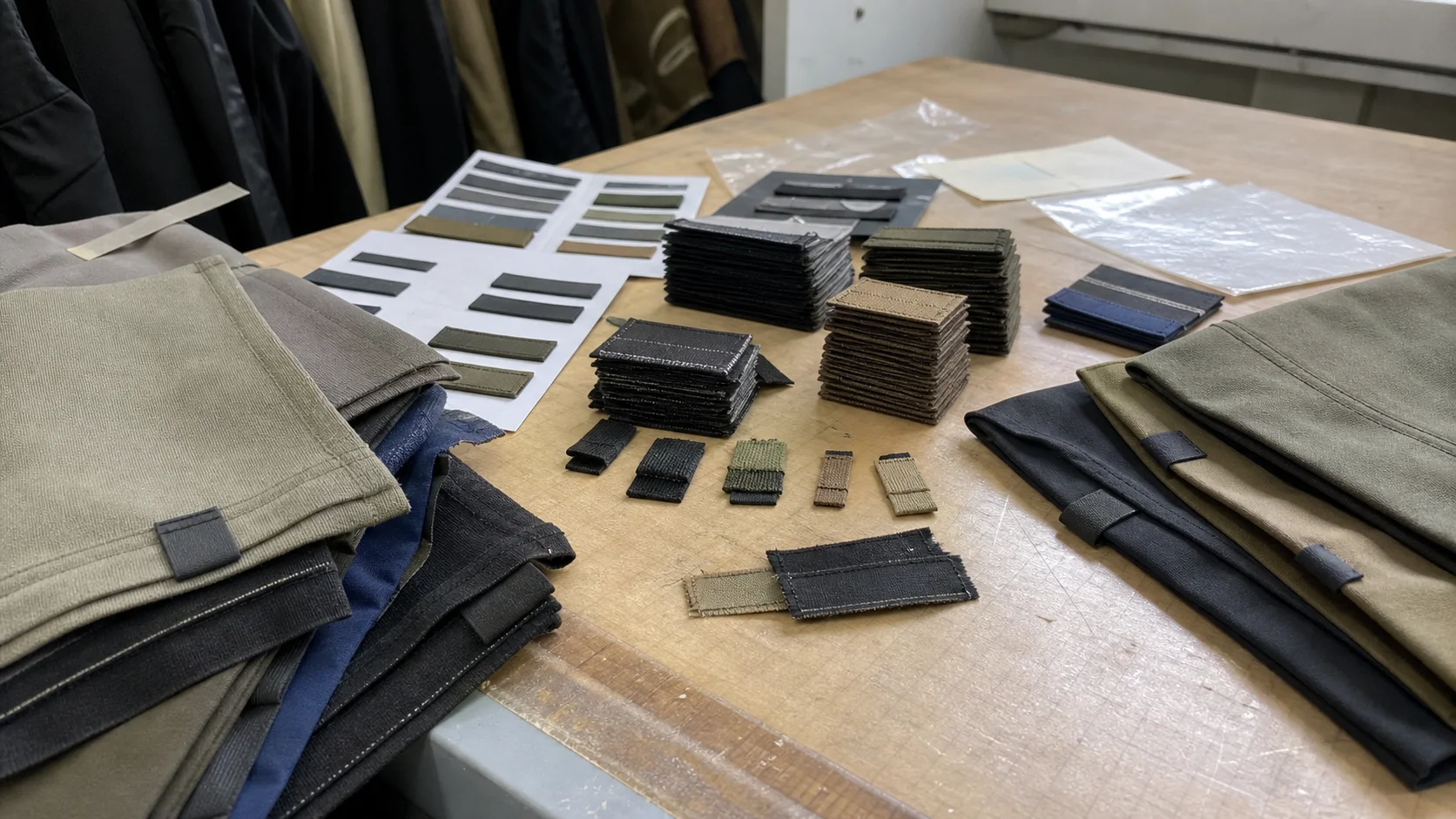
A production control brief for woven origin tabs on security contractor uniforms and gear, covering construction specs, placement, approvals, and QC...
Woven origin tabs are a small component, but they carry more weight than their size suggests in security contractor apparel and gear programs. They identify where a garment, accessory, or uniform line came from, support brand control, and help procurement teams keep production aligned across repeat orders. In a category where consistency matters, the origin tab is part decoration, part documentation, and part risk control.
This brief focuses on woven origin tab order production control for security contractors. It is written for sourcing teams, merchandisers, and buyers who need a practical view of specs, approvals, lead times, and inspection risks. The emphasis is not on marketing language. It is on what needs to be controlled before a purchase order is released.
For broader production support, see services, and if you need to discuss a specific order, use the contact page. Company background is available on the about page.
Woven Origin Tabs for Security Contractor Orders - Fabrikn production reference
A woven origin tab is a small woven label used to indicate country of origin, product line identity, or program affiliation. In security contractor orders, origin tabs are often attached to uniforms, tactical shirts, outerwear, duty bags, pouches, caps, or other controlled items where consistent identification matters. The label may sit at a side seam, hem, back neck area, pocket edge, or on an accessory attachment point depending on the garment structure and the compliance approach.
“Origin tab” is not always a strict legal term. In practice, buyers may use it to describe a tab that identifies origin, a small woven flag label, or a custom side tab carrying the brand and manufacturing identity. That distinction matters. If the tab is intended to satisfy a compliance requirement, the wording, placement, and permanence must be confirmed before production. If it is purely decorative or brand-identifying, the controls are different, but the label still needs to survive wash, abrasion, and field use.
Security contractor programs tend to be stricter than general promotional apparel because the clothing often moves through multiple user groups, contract changes, and replenishment cycles. A loose label standard creates confusion fast. The sourcing brief needs to specify exactly what the tab is supposed to do.
Security contractor uniforms and gear usually need a clean, repeatable identity. Woven origin tabs can support that in several ways:
That last point is often overlooked. In controlled programs, the label is part of the anti-substitution system. If the supplier changes fold size, yarn quality, backing method, or attachment method without approval, the part may pass visually but fail in use or compliance review. Buyers should treat the origin tab as a controlled component, not an afterthought.
For security contractors, the bigger issue is consistency under repeat ordering. A tab that looks correct in a one-off sample can drift over time if the woven density, border finish, or trim color is not locked. A good production control brief prevents that drift.
A useful production control brief for woven origin tabs should be short enough for the factory to execute, but complete enough to prevent interpretation. The goal is to remove ambiguity before sampling starts. A brief that is vague on size or backing type can cause avoidable revisions later, and revisions are expensive when orders are time-sensitive.
At minimum, the brief should define the following:
When the buyer is handling multiple SKUs, the brief should also define whether the tab is shared across styles or unique to each item. Shared components reduce variation and improve reorder efficiency. Unique tabs can be useful when programs need differentiated identification, but they increase inventory complexity.
A practical brief also states what is not allowed. That can include no color substitutions, no alternate backing without approval, no scale reduction of the logo, no extra text, and no unapproved border finish. Small restrictions prevent larger disputes later.
Woven tabs appear simple, but the specifications affect both appearance and performance. Buyers should not assume the factory will standardize these details without direction.
For origin tabs on apparel, common finished widths may fall in the 15 mm to 50 mm range, with heights varying according to the design. The correct size depends on placement and visibility. Smaller tabs may work on caps, cuffs, and slim accessory edges. Larger tabs may suit outerwear, tactical bags, or visible side branding. A tab that is too large can distort the garment line. A tab that is too small can lose legibility and create rejection at inspection.
Two general choices matter most: standard woven and high-density woven. Standard woven labels are suitable for simple text or basic shapes. High-density woven construction gives better edge control and cleaner fine detail, but it may cost more and require tighter loom settings. If the design includes small letters, thin lines, or narrow symbols, high-density weaving is usually the safer choice.
Edge finish is not cosmetic only. A merrow border can protect the edge on some patches, but it may add bulk. Heat-cut or laser-cut edges can stay slimmer and more modern-looking, but the factory must control fraying and heat marks. Folded edges are often better when the tab is sewn into a seam or binding. The right choice depends on garment construction and user environment.
Security contractor orders often require restrained color palettes. Black, navy, olive, grey, tan, and white are common. Buyers should confirm both yarn color and perceived contrast in actual light, not just on screen. A label that passes a digital mock-up can look too bright or too dull in production thread. If the program needs exact matching, physical swatches are safer than digital references alone.
Attachment should be chosen with the end use in mind. Sew-in tabs are durable and low risk for uniforms. Heat-applied versions can work when sewing access is limited, but adhesion must be tested after laundering and abrasion. Hook-and-loop tabs are useful for removable identity markers, though they introduce their own wear and replacement issues. The buyer should specify whether the tab must remain permanently attached or be removable for operational reasons.
Control Item Recommended Buyer Action Typical Risk If Not Controlled Finished size Approve with tolerance range Placement issues, visual inconsistency Weave density Match to artwork detail Blurred text, poor logo edges Color standard Use physical swatch or approved sample Shade variation, contract non-compliance Backing or edge finish Confirm with garment construction Fraying, stiffness, poor wear comfort Attachment method Test on final material Peeling, seam distortion, failure in washSampling is where most problems are prevented, provided the approvals are treated seriously. A woven origin tab order should not move into bulk production after a loose digital proof alone. The relevant sample stages depend on complexity, but a disciplined process usually includes at least one physical review before approval.
A common sequence looks like this:
For security contractor orders, revision control needs extra discipline because stakeholders may include procurement, operations, and compliance. Each round of feedback should be consolidated. Split instructions from multiple reviewers often create contradictory corrections. The buyer should nominate one final approver and one retained reference sample.
A useful practice is to require the factory to mark the sample with version number, date, and order reference. That helps prevent an old approval from being reused on a new order. It also reduces disputes when repeat orders are placed months later.
If the tab is part of a controlled uniform program, the approved sample should define size, color, attachment, and artwork as a single package. Partial approval is where later problems begin.
MOQ for woven origin tabs varies by supplier, artwork complexity, and whether the order is part of a larger garment run or a standalone trim order. A typical MOQ may start around 500 to 1,000 pieces per design for simple woven tabs, with higher thresholds for multi-color, fine-detail, or custom-cut constructions. Some suppliers can support lower test runs, but unit cost usually rises and lead-time flexibility can narrow.
Lead time depends on more than just weaving. Buyers should account for artwork approval, loom scheduling, sample revision, trim sourcing, sewing capacity, packing requirements, and inspection. A simple repeat tab may be turned faster than a new design, but only if the factory has the yarn colors and technical setup already in place.
As a general sourcing reference, a practical order sequence may require:
These are not fixed promises. Yarn availability, seasonal factory loading, and quality requirements can extend the schedule. If the security contractor program is tied to a go-live date, the buyer should buffer time for approval delays. Tight lead times are possible, but only when the specification is already stable and the supplier is not waiting on color decisions.
Woven origin tabs tend to fail in predictable ways. Buyers who know the failure modes can catch them early.
Color drift is one of the most common issues. A label may be “close” on paper but different in production yarn. This matters when tabs are part of a contractor uniform standard or when replacement lots must match existing stock. The safest control is an approved physical sample under expected lighting.
Small text can collapse if the weave density is too low or the artwork is too detailed for the label size. Buyers should test legibility at actual viewing distance. If a word or code is essential, reduce the amount of text rather than forcing a compressed layout.
Cut edges, poor heat sealing, and loose threads can cause fraying. In field use, this becomes a wear issue and a presentation issue. It can also create concern during final inspection if the buyer specified a clean edge and the tab does not hold shape.
Any sewn or bonded attachment can fail if the wrong needle, stitch density, adhesive, or heat setting is used. On uniforms and gear exposed to repeated laundering or abrasion, the buyer should require a wash and wear test on the final substrate. Testing on the tab alone is not enough.
A woven tab that looks right on a blank sample may not sit correctly on the real garment. Pocket thickness, seam allowance, shell texture, and lining structure can all affect how the tab lies once attached. The factory should test the label on final material before bulk runs are released.
Inspection should include the following checks:
For contract orders, buyers may also want carton-level traceability. That does not need to be complicated. A simple lot number, order reference, and production date code can be enough to isolate issues if one batch shows a problem.
Packing is often overlooked because the component is small. That is a mistake. Woven origin tabs can bend, crease, or pick up contamination if packed loosely. When tabs are sewn into finished garments at a later stage, damaged trim causes avoidable rework. When they are packed as separate components, each bundle should be counted and protected.
Recommended packing controls include:
Traceability matters because repeat orders are common in security contractor programs. If a tab was revised mid-season, the buyer needs to know which version is in stock and which version belongs to which batch. A good supplier should be able to support that level of control without making the process unnecessarily heavy.
Good sourcing is usually about tradeoffs, not perfect specs. Woven origin tabs are no different. Buyers need to decide where to spend complexity and where to simplify.
If the program is highly visible and brand-sensitive, pay for better weave detail, tighter color control, and a more durable finish. If the tab is hidden or secondary, simplify the artwork and reduce the number of color changes. The cost difference may be small on paper but meaningful across large annual volumes.
If the order is time-sensitive, reducing custom complexity often beats chasing a premium construction. A simpler tab with strong approval discipline is usually better than a complex tab that risks delay. That is especially true when the buyer is managing a security contractor launch, uniform refresh, or replacement cycle.
If the contract expects repeated replenishment, lock the specification as early as possible. The cheapest order is not always the best order. A slightly higher unit cost can be justified if it prevents later shade variation, rework, or mismatched reorders. Procurement teams should judge the component by lifecycle value, not only by first cost.
Get a free quote from Fabrikn — your trusted B2B clothing manufacturer with 10+ years of experience. MOQ as low as 200 pieces.
Get a Free Quote →It is a small woven label or tab used to identify origin, brand, or program association on uniforms and gear. In security contractor programs, it often serves both appearance and control functions.
Typical MOQ often starts around 500 to 1,000 pieces per design, though the exact figure depends on artwork complexity, color count, construction, and supplier policy. Lower test quantities may be possible at a higher unit cost.
Use a physical strike-off or sample, review all artwork and size details, approve one final reference sample, and keep that sample linked to the order version. A digital mock-up alone is not enough for controlled programs.
That depends on the garment or accessory. Sew-in is usually the most durable for uniforms. Heat-applied methods can work, but they should be tested on the final substrate. Hook-and-loop is useful for removable identification, but it adds wear considerations.
The main issues are color drift, poor text legibility, fraying edges, weak attachment, and mismatch between the sample and bulk production. Most of these are preventable with better technical control before bulk release.
For a straightforward order, allow time for artwork confirmation, sampling, revisions, and bulk production. In practice, lead time often ranges from a few weeks to longer if the design is complex or the factory is already loaded.
It can be both. If it is only decorative, the spec is simpler. If it carries origin or program identification requirements, the buyer should treat it as a controlled component with approved artwork, placement, and traceability.
Size, placement, woven construction, colors, edge finish, attachment method, artwork version, quantity per SKU, approval stage, packing method, and any restrictions on substitution should all be included.
For buyers building a new program or revising an existing one, the practical starting point is to define the origin tab as a controlled part of the uniform system, not a decorative extra. That approach reduces rework, supports repeat orders, and gives the supplier a clear technical target. If you need support on a production brief or broader trim sourcing, review the available services and use the contact page to begin the order discussion.