
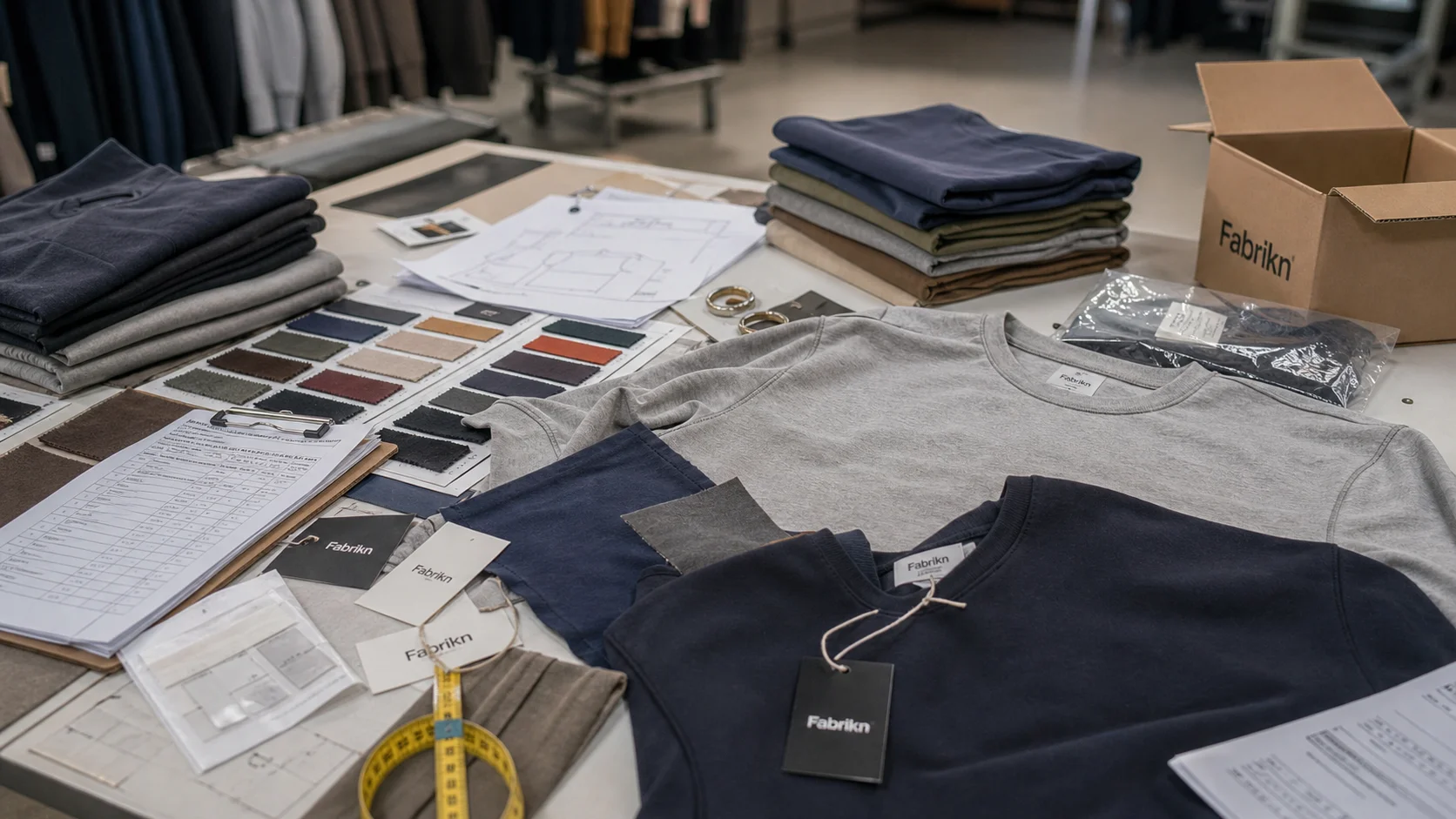
Wrap Certification for Garment Factories Buyer Review with checks for samples, fit, MOQ, QC evidence, pricing terms, and delivery risk.
Fast answer: Wrap Certification for Garment Factories Buyer Review: Samples, Cost Lines, QC, and Delivery Risk should be judged by production evidence, not by a generic sourcing promise. The buyer needs sample proof, cost breakdowns, QC checkpoints, and delivery buffers in writing.
Ask for recent sample photos, measurement tolerances, fabric or print test assumptions, decoration test notes, packing examples, and a named inspection checkpoint. These details show whether the team can repeat an approved sample at bulk volume.
Separate garment cost, decoration, labels, packaging, sampling, testing, freight, and rush charges. When every cost line is visible, it becomes easier to reduce colorways, adjust size depth, or reserve more time for sampling.
WRAP certification is one of the most recognized compliance standards for garment factories and apparel manufacturing facilities worldwide. WRAP stands for Worldwide Responsible Accredited Production, an independent, non-profit organization focused on promoting lawful, humane, and ethical manufacturing practices.
For garment factories, WRAP certification demonstrates that a facility operates in line with international workplace standards covering labor practices, health and safety, environmental responsibility, and legal compliance. It is especially important for factories that supply brands, retailers, and wholesalers in global markets where transparency and responsible sourcing are becoming non-negotiable.
In simple terms, WRAP certification helps prove that a garment factory is not only producing quality apparel but doing so in a responsible way. This can be a major advantage when competing for contracts with brands that require audited and compliant manufacturing partners.
The garment industry has long faced scrutiny over labor conditions, safety issues, and environmental impact. Brands and consumers increasingly demand proof that production is ethical and sustainable. WRAP certification gives factories a credible framework to show they are meeting these expectations.
For garment manufacturers, WRAP certification matters because it supports:
Today, many buyers do not just ask whether a factory can meet production capacity and quality standards. They also ask whether the factory can pass social compliance audits. WRAP certification can therefore become a key differentiator in winning new business and maintaining long-term partnerships.
If your company is exploring compliance support or private-label production, you may want to learn more about our manufacturing capabilities on Fabrikn services.
WRAP certification is based on 12 core principles. These principles define the minimum standards a garment factory must meet to qualify for certification. They cover a broad range of issues related to labor, health and safety, environmental practices, and ethical business conduct.
Factories must comply with all applicable local, national, and international laws, including labor, environmental, and commercial regulations.
No form of forced, bonded, prison, or trafficked labor is allowed.
Factories must not employ workers below the legal minimum age or otherwise violate child labor laws.
Workers must be treated with dignity and respect. Physical punishment, threats, abuse, or harassment are strictly prohibited.
Employees must receive wages, overtime pay, and benefits that meet or exceed legal requirements.
Working hours must comply with legal limits and not create unsafe fatigue or exploitative conditions.
Factories must provide equal opportunity and treat workers fairly regardless of gender, race, religion, age, nationality, or other protected characteristics.
Facilities must maintain safe working environments, including proper fire protection, emergency exits, ventilation, machine safety, and protective equipment.
Workers must be free to join associations or unions and participate in collective bargaining, where legally permitted.
Factories should manage environmental impact responsibly, including waste handling, chemical storage, and pollution control.
Factories must comply with customs laws and accurate import-export practices.
Facilities must maintain workplace security and protect both workers and goods without creating unsafe conditions.
These principles form the backbone of WRAP certification. A factory that understands and implements them is better positioned to pass audits and sustain compliance over time.
The WRAP certification process is designed to assess whether a factory meets the organization’s 12 principles. While the exact process may vary depending on factory size, location, and readiness, the general steps are similar.
The factory begins by reviewing current policies, labor records, safety procedures, and environmental controls. This internal assessment helps identify gaps before an external audit takes place.
The facility submits an application to WRAP or an authorized certification body. At this stage, the factory provides basic information about operations, workforce, and production scope.
An independent auditor is assigned to inspect the factory. The audit may be announced or semi-announced depending on the certification program and circumstances.
The auditor evaluates working conditions, employee records, safety systems, wage documentation, facility cleanliness, environmental practices, and compliance procedures. Workers may also be interviewed.
If issues are found, the factory may be required to implement corrective actions within a set timeframe. This can include updating records, improving safety measures, or revising policy documents.
After reviewing the audit findings and corrective actions, WRAP determines whether the facility qualifies for certification. If approved, the factory receives its WRAP status, which may be Gold, Silver, or Platinum depending on compliance level and history.
WRAP certification is not a one-time event. Factories must maintain standards and undergo renewal audits to remain certified. Continuous improvement is essential.
WRAP certification offers both operational and commercial advantages for garment factories. It is not only about passing an audit; it is about building a stronger, more resilient manufacturing business.
Many global buyers prefer or require WRAP-certified suppliers. Having certification can open doors to new clients, including fashion brands, promotional apparel companies, and retail chains.
Certification signals to buyers that a factory values ethical production. This can help strengthen trust and credibility in a competitive market.
Factories that follow WRAP standards are more likely to avoid issues related to labor violations, safety incidents, customs problems, or reputational damage.
Preparing for WRAP certification often leads to better documentation, clearer responsibilities, safer workplaces, and improved management systems.
As sustainability becomes more important in apparel sourcing, WRAP certification helps factories align with responsible supply chain expectations and ESG priorities.
For buyers interested in responsible manufacturing partnerships, you can also explore our company background on about us and reach out through our contact page.
WRAP is often compared with other social compliance and ethical manufacturing certifications such as SA8000, BSCI, and SEDEX-related audits. While each certification has its own focus, WRAP stands out for its accessibility, global recognition, and direct relevance to apparel manufacturing.
SA8000 is a broader social accountability standard based on international labor norms. It is highly respected but may be more complex and less industry-specific than WRAP.
BSCI, now part of amfori, is widely used by European buyers. It focuses on supply chain social compliance. WRAP is often preferred in apparel because it is tailored to manufacturing facilities and garment production environments.
SEDEX is a platform for ethical supply chain data, and SMETA is a popular audit methodology. These are highly useful but not the same as a factory certification. WRAP provides a standalone certification that can be easier for factories to communicate to buyers.
For many garment factories, the best strategy is not choosing one system in isolation, but understanding which certification aligns with target customers and market goals.
Preparation is one of the most important parts of the certification journey. Even factories with strong day-to-day practices can fail audits if records are incomplete or policies are inconsistent.
Make sure employee files, payroll records, timecards, contracts, and age verification documents are complete and up to date.
Check that wages and overtime comply with local law. Ensure workers are not exceeding legal or company-defined limits on working hours.
Inspect fire extinguishers, alarms, emergency exits, first aid kits, machine guards, ventilation systems, and chemical storage. Address any hazards immediately.
Front-line managers should understand anti-harassment policies, timekeeping rules, emergency procedures, and worker communication standards.
Factories should have clear written policies covering forced labor, child labor, discrimination, discipline, harassment, safety, and environmental management.
Before the official audit, run your own compliance review. This helps identify weak spots and gives the factory time to fix them.
Good documentation is essential. If a policy exists but there is no evidence of implementation, auditors may consider it ineffective.
Workers should understand their rights, complaint channels, safety procedures, and company expectations. Communication in the local language is important.
If you need support in developing compliant garment production systems, our team at Fabrikn can help guide sourcing and manufacturing discussions through our services.
Many garment factories struggle with WRAP preparation because compliance affects every part of the operation. Some challenges are structural, while others are administrative.
A factory may follow ethical practices but fail to document them properly. The solution is to establish standardized recordkeeping for payroll, attendance, training, and safety inspections.
Seasonal demand and tight production deadlines can push working hours beyond legal or safe limits. Factories should improve production planning, staffing, and line efficiency to reduce dependency on excessive overtime.
Fire systems, exits, machine guards, and PPE may be inadequate. Regular safety inspections and maintenance schedules are critical.
Compliance can break down when supervisors are not properly trained. Continuous training and refresher sessions help ensure rules are followed consistently.
Unapproved subcontracting can create major compliance issues. Factories should maintain visibility over all production stages and ensure subcontractors follow the same standards.
Sustainable fashion is often associated with recycled fabrics, low-impact dyes, and circular design, but ethical manufacturing is just as important. A garment cannot truly be sustainable if it is produced in unsafe or exploitative conditions.
WRAP certification supports sustainable fashion by reinforcing the social dimension of sustainability. It helps ensure that apparel is made responsibly, with respect for workers, legal standards, and environmental practices.
Brands that prioritize sustainability increasingly look for factories that can support their broader ESG goals. WRAP-certified facilities are often better equipped to participate in long-term responsible sourcing relationships because they already have systems in place for compliance, audit readiness, and continuous improvement.
For garment factories, this creates a business opportunity. Sustainability is no longer a niche demand; it is becoming a baseline expectation. Factories that invest in WRAP certification today may be better positioned for the future of global apparel manufacturing.
At Fabrikn, we understand that modern apparel production requires more than stitching garments together. Brands need manufacturing partners that can support quality, reliability, and responsible production practices.
Whether you are developing a new fashion line, scaling private-label apparel, or sourcing compliant garment manufacturing, our team can help you move with confidence. Learn more about how we work on our about us page or get in touch through contact us.
As a B2B clothing manufacturer, Fabrikn values ethical supply chains and sustainable production standards that align with buyer expectations in today’s market.
Get a free quote from Fabrikn — your trusted B2B clothing manufacturer with 10+ years of experience. MOQ as low as 200 pieces.
Get a Free Quote →WRAP stands for Worldwide Responsible Accredited Production. It is a global certification focused on lawful, humane, and ethical manufacturing.
No, WRAP certification is not legally mandatory. However, many buyers prefer or require it as part of their supplier compliance standards.
WRAP certification is typically valid for a limited period and must be renewed through follow-up audits and continued compliance.
The main requirements are based on 12 principles covering legal compliance, labor rights, safety, wages, working hours, environment, customs, and security.
Yes. WRAP certification is available to factories of different sizes, provided they meet the required standards and documentation practices.
Yes. WRAP certification can make a factory more attractive to international buyers who prioritize ethical sourcing and compliance assurance.
WRAP certification is an important part of sustainable manufacturing, especially on the social compliance side. However, full sustainability also involves environmental, material, and supply chain practices.
Fabrikn supports B2B apparel manufacturing needs and can help brands connect with reliable production solutions. Visit our services page or contact us for more information.