
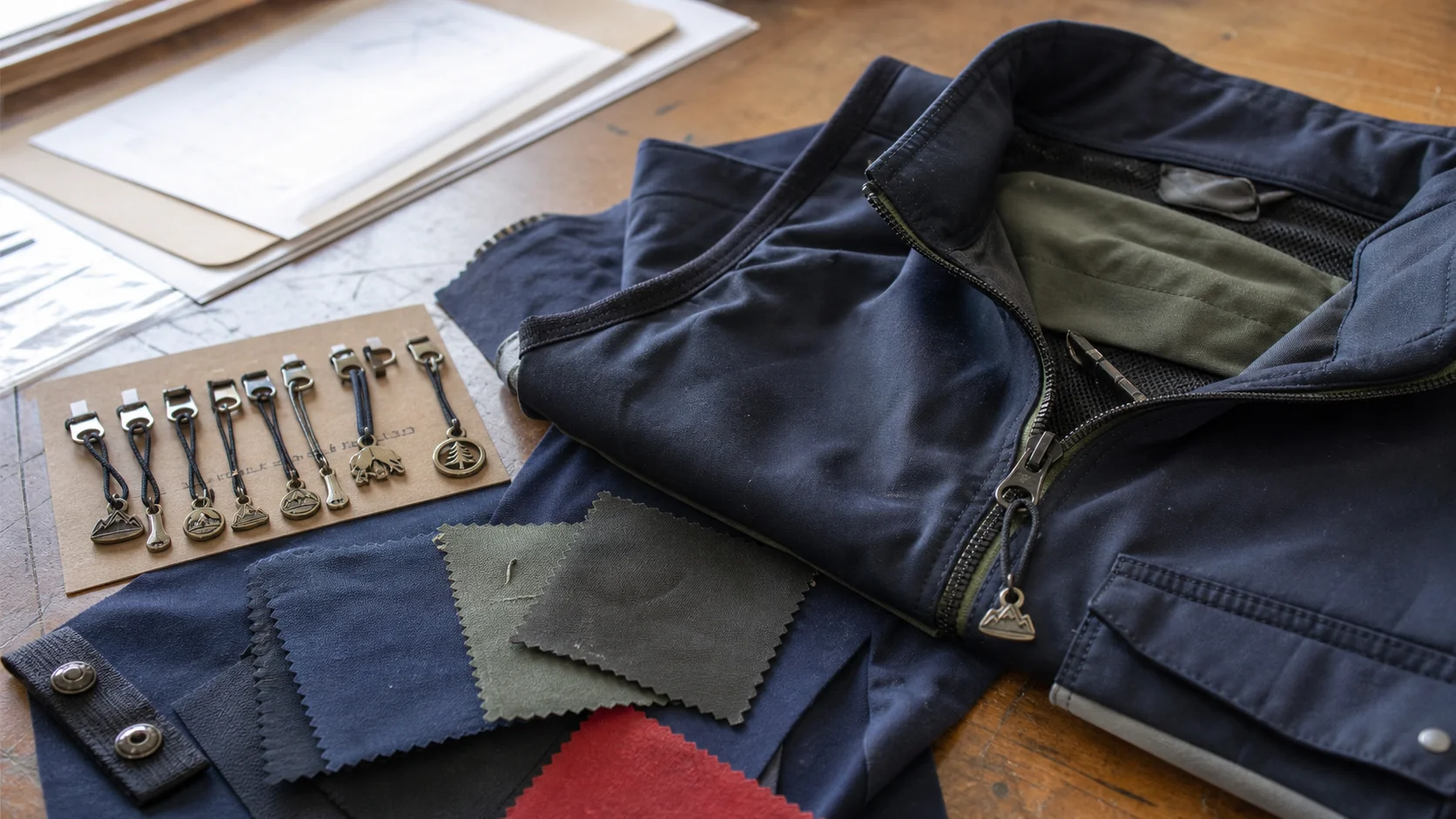
A practical testing guide for outdoor school buyers evaluating zip puller charms, attachment fabrics, coatings, and durability before bulk production.
Zip Puller Charm Tests for Outdoor School Buyers - Decoration & Printing manufacturing guide
Zip puller charms look like small decoration details, but they create a surprisingly high level of sourcing risk for outdoor school buyers. They sit at a stress point on jackets, fleece layers, rainwear, school bags, PE kit sacks, and outdoor education uniforms. They are touched daily, pulled with force, exposed to rain, mud, sunscreen, detergent, freezing air, and rough handling by children. A weak charm can break before the garment fails. A sharp edge can create a safety issue. A poorly printed logo can make a schoolwear program look cheap after only a few wears.
This zip puller charm fabric testing guide for outdoor school buyers focuses on practical purchasing decisions: what to specify, what to test, what to approve, and what to reject before bulk production. The goal is not to over-engineer a small trim. The goal is to avoid preventable failures that lead to complaints, returns, delayed launches, or rework at the packing stage.
In the Decoration & Printing category, zip puller charms are often treated as branding accessories. That is only half correct. A charm is both a decoration item and a functional grip. Buyers should evaluate it like a trim that carries a logo, not like a loose promotional item. The correct tests depend on the charm material, the attachment method, the fabric around the zipper, the age group, the climate, and the expected wear cycle.
Purchasing judgment: if the zip puller charm is used on outdoor school garments, test it as a stress-bearing trim first and a branding decoration second.
Outdoor school apparel faces harsher use than standard casualwear. Children pull zippers quickly, often while wearing gloves. Bags and jackets may be dragged, stuffed into lockers, washed frequently, or exposed to wet grass and grit. A zip puller charm that works on a fashion hoodie may not be suitable for a school waterproof jacket or expedition fleece.
The main sourcing risks are usually predictable. The charm detaches from the cord. The cord slips out of the zipper slider. The molded end cracks in cold weather. The printed logo peels after washing. Metal charms corrode or discolor nearby fabric. Rubber charms transfer color onto light fabric. Fabric pullers fray or wick water. PVC or silicone charms may pass visual approval but fail tensile strength or color fastness checks.
Age group matters. For younger pupils, detachable small parts create a higher safety concern. For older pupils, strength and appearance retention may be more important because garments are worn longer and branding expectations are higher. For outdoor school programs, buyers should be especially cautious with novelty shapes, long dangling charms, hard metal attachments, and charms with corners that can snag on desks, bag straps, playground equipment, or branches.
Buyers also need to consider school procurement cycles. Uniform and outdoor kit orders often have fixed launch windows before term starts. A failed trim test close to shipment can disrupt the whole program. Replacing charms after garment production is possible, but it adds labor, sorting risk, shade variation, and packing delays. It is cheaper to test and lock the trim before bulk cutting begins.
Testing only becomes useful when the product definition is clear. A vague purchase order that says “custom zip puller with logo” leaves too much room for interpretation. Buyers should define the charm type, base material, attachment system, logo method, dimensions, color, surface finish, and intended garment use before requesting samples.
Common zip puller charm formats include molded rubber charms, silicone charms, PVC charms, woven fabric tabs, grosgrain tabs, TPU tabs, leather-look synthetic tabs, metal charms, paracord pullers, and cord pullers with molded ends. Each type has different strengths. Silicone and PVC can show bold color and 3D logo effects, but they need checks for tearing, migration, and print adhesion. Woven or grosgrain tabs are softer and lighter, but they may fray, curl, or absorb water. Metal charms can look premium, but they increase weight and may corrode, scratch paint, or feel cold in winter.
The zipper itself should also be defined. A charm attached to a reverse-coil zipper on a lightweight softshell jacket has different risk than one attached to a chunky molded zipper on a padded winter coat. Buyers should confirm zipper gauge, slider hole size, pull tab shape, tape color, and whether the charm is attached directly to the slider or through an intermediate cord, ring, loop, or plastic connector.
Factories can source trims faster when the specification is complete. They can also quote more accurately. If the buyer changes the logo method or material after sampling, the cost and lead time may shift. For coordinated development support, buyers can review broader production options through Fabrikn’s apparel manufacturing services before locking decoration and trim requirements.
A zip puller charm does not work in isolation. It interacts with the garment fabric, zipper tape, lining, pocket construction, and washing method. Outdoor school buyers should review charm testing together with the main fabric specification.
For waterproof jackets, the main risk is water exposure and abrasion. A charm may rub against coated fabric, laminated panels, reflective print, or seam tape. Hard charms can scratch PU coatings. Dyed cords can bleed onto pale zipper tape. Heavy charms can pull the slider down if the zipper has weak retention. For fleece jackets, pile contamination and pilling around pocket zippers may be a concern. For softshell garments, stretch and surface abrasion need attention. For bags, repeated high-force pulling is more likely than on garments.
Fabric weight also affects trim suitability. A thick molded puller can look balanced on a padded jacket but oversized on a lightweight rain shell. A narrow woven tab may suit a midlayer but feel too weak on a school backpack. The buyer should assess proportion, hand feel, and function, not just logo visibility.
Buyers should also define acceptable tolerances. For example, a molded charm may need a thickness tolerance of plus or minus 0.5 mm, while a woven tab may need length tolerance within plus or minus 2 mm. Color tolerance should be realistic because molded trims, zipper tapes, printed logos, and garment fabric rarely match perfectly across different materials. A practical standard is to define a master approved sample and require bulk production to match within an agreed shade range under consistent lighting.
The right test package depends on the market, garment type, school age range, and buyer risk tolerance. Outdoor school buyers should not assume one universal lab test covers everything. A sensible approach combines lab testing, in-house pull checks, wash testing, visual assessment, and pre-shipment inspection.
Tensile testing checks whether the charm, cord, connector, or attachment can withstand pulling force. This is one of the most important tests for school outerwear and bags. The test should measure the weakest point: cord breakage, knot slipping, molded end tearing, split ring opening, or slider deformation.
Buyers should specify the target pull force based on garment use. A lightweight pocket puller may need a lower requirement than a center-front jacket puller or backpack puller. Many buyers set different internal standards for children’s apparel and bags. If the supplier cannot provide a formal lab report, the buyer should at least require controlled in-house pull testing on pre-production samples and bulk production samples. A hand-pull check alone is not reliable enough for larger programs.
For younger children, small parts risk should be reviewed carefully. If a charm detaches and fits within a small parts cylinder, it may become a safety issue depending on destination market regulations and age grading. Buyers should consult the applicable legal requirements for the selling market rather than relying only on factory advice.
Design choices can reduce risk. Shorter pullers, integrated molded loops, soft fabric tabs, and stronger attachment points are usually safer than tiny decorative add-ons connected by weak rings. Charms shaped like toys, animals, initials, or novelty icons may look appealing, but they can increase attention from children who twist, chew, or remove them.
Metal charms, embossed badges, hard plastic pieces, and split rings should be checked for sharp edges and burrs. This is especially important when charms are die-cast, laser cut, stamped, or attached with metal findings. A small burr may scratch skin, damage zipper tape, or catch on knitted gloves.
Factories should remove burrs before assembly, but inspection should still include touch checks and visual checks under good lighting. Any charm that can scratch fabric during normal use needs redesign or rejection. For outdoor school apparel, smooth edges and rounded corners are better purchasing choices than aggressive logo shapes.
School garments are washed repeatedly. Zip puller charms should be tested through the garment’s expected care method, not only dipped in water. Wash testing should check detachment, print loss, color bleeding, deformation, cracking, shrinkage, and surface dullness. If the garment is tumble-dried, that condition should be included because heat can affect PVC, TPU, adhesives, cords, and printed inks.
A practical approval route is to wash the full garment sample with attached charm for several cycles before final approval. Lab wash standards can be used for formal validation, while buyer-side wash checks can reveal everyday problems. The charm should be inspected before wash, after wash, and after drying.
Color migration is a serious risk when dark charms are placed against light fabric, white zipper tape, pale linings, or reflective trims. Silicone, PVC, dyed cord, coated synthetic leather, and printed logos can transfer color under heat, moisture, pressure, or storage conditions. Packed garments may sit compressed in cartons for weeks, which can increase migration risk.
Buyers should request color fastness to rubbing, washing, water, perspiration, and heat where relevant. For high-risk combinations, a storage migration test is useful: place the charm in contact with the actual fabric under pressure and elevated temperature, then check staining. This is particularly important for navy, black, red, fluorescent, and high-saturation colors on pale garments.
Outdoor school garments may be worn in cold, wet, and windy conditions. Some molded materials become stiff or brittle in low temperatures. Cold flex testing helps check whether the charm cracks when bent or pulled after exposure to cold conditions. This matters for winter coats, ski-trip kit, field-trip outerwear, and uniforms used in colder regions.
UV exposure can also affect color and surface condition. A charm that fades faster than the garment creates an uneven appearance. UV testing may not be necessary for every schoolwear program, but it is worth considering for high-volume outdoor jackets, caps, bags, and garments sold for multi-season use.
Zip puller charms rub against fabric, desk edges, bag straps, and other garments. Abrasion testing should check whether the charm damages nearby fabric and whether the charm surface wears away. Snagging checks are useful for shaped charms, metal rings, woven tabs, and split-ring attachments.
A charm can pass tensile testing but still fail in the field because it snags easily. Long pullers are easier to grip but more likely to catch. Short pullers are neater but may be difficult for children wearing gloves. Buyers need to choose the right compromise for the garment’s use.
Because zip puller charms often carry school crests, house colors, activity branding, or supplier logos, decoration quality matters. The logo must stay legible after wear and washing. The test method depends on the decoration type.
Screen-printed or pad-printed logos should be checked for adhesion, cracking, rubbing, and wash resistance. Heat-transfer logos need peel resistance and heat stability checks. Embossed and debossed logos are generally more durable than surface printing, but fine crest details may lose clarity on small charm sizes. Molded multi-color logos can be durable, though tooling cost and color separation limits must be reviewed early.
Woven pull tabs have their own limitations. Small text may not weave clearly. Curved crest details may blur. Dense woven designs can make the tab stiff. Printed woven tabs may show better detail but need ink adhesion and wash tests. Reflective print on a zip puller can improve visibility, yet it may crack or wear if placed at a high-rub point.
For school buyers, the most practical logo is usually a simple, durable mark. A full crest with tiny text may be suitable for a chest badge but not for a 20 mm zip puller. Redrawing the artwork for trim use is often better than shrinking the main logo file. Buyers should approve both artwork layout and physical strike-off before bulk production.
A disciplined sample process reduces late-stage trim failures. Buyers should avoid jumping from digital artwork approval straight into bulk production. Zip puller charms need physical approval because hand feel, weight, edge finish, color, and function cannot be judged accurately on screen.
The pre-production sample is the most important checkpoint. It should use the actual bulk fabric, bulk zipper, bulk charm material, and final attachment method. Substitute trims should not be accepted unless the buyer understands and approves the change. A charm made from sample-room material may perform differently from the bulk trim.
Buyers should also confirm whether tooling is required. Molded charms often need a mold, especially for embossed or 3D designs. Tooling adds time and cost. Once tooling is made, changes to size or logo relief may require rework. Artwork should be locked before tooling begins.
If a buyer needs help coordinating apparel decoration decisions with production planning, an early conversation through Fabrikn’s contact page can help clarify what needs to be tested before quotation and sampling.
MOQ and lead time vary by charm type, customization level, factory workload, and material availability. Buyers should treat the following as typical sourcing ranges, not guaranteed figures. Final numbers depend on the supplier, design complexity, and production season.
Charm Type Typical MOQ Range Typical Sampling Time Typical Bulk Lead Time After Approval Plain cord puller with molded end 500 to 2,000 pieces 5 to 10 days 10 to 20 days Custom silicone or PVC charm 1,000 to 5,000 pieces 10 to 20 days, longer if tooling is needed 20 to 35 days Woven or grosgrain branded tab 1,000 to 3,000 pieces 7 to 14 days 15 to 25 days Metal charm or engraved puller 500 to 2,000 pieces 12 to 25 days 25 to 45 days Reflective or specialty printed puller 1,000 to 5,000 pieces 10 to 20 days 20 to 35 daysSmall schoolwear programs often struggle with MOQ. A custom molded charm may look attractive, but it may not be economical for a short run of 300 jackets. In that case, a standard cord puller in school color with a woven tab or simple printed grip may be more practical. Larger programs can justify tooling because the unit cost drops across volume and the branding looks more consistent.
Lead time is not just trim production time. It includes artwork confirmation, sample shipping, testing, buyer review, mold changes, color correction, bulk trim production, inbound trim delivery to the garment factory, garment sewing, final inspection, packing, and shipment. A late charm approval can hold up the full garment line.
Cost tradeoffs should be judged against return risk. The cheapest charm may save a few cents per garment but cause failures that cost far more in replacement handling. On the other hand, a premium metal charm may add unnecessary cost and safety checks to a basic junior rain jacket. The best choice is the lowest-risk trim that meets the branding and performance requirement.
Final inspection should include the zip puller charm as a specific checkpoint. Many inspection reports focus on garment measurements, stitching, labels, and packing while treating trims as general appearance items. That is not enough for outdoor school apparel.
Inspectors should check the approved master sample against bulk production. They should confirm color, logo position, size, attachment strength, edge finish, and quantity. Puller defects should be classified according to severity. A missing charm on a visible center-front zipper may be a major defect. A slight shade difference within approved tolerance may be minor. A sharp metal burr or easily detachable small part may be critical, especially for young children’s products.
Inspection sampling should reflect the order size and buyer risk tolerance. High-volume schoolwear orders normally need a formal AQL inspection. For small orders, a tighter 100% check on visible decorative trims may still be worthwhile if the charm is custom-branded and hard to replace later.
Buyers should ask the factory how replacement trims will be handled if defects are found. Loose spare charms may be useful, but they do not solve a weak attachment method. If the charm needs special tools, heat sealing, rivets, or bar tacks, repair at the destination warehouse may be slow and inconsistent.
The best time to challenge a supplier is before purchase order placement. Buyers should request clear answers about material, testing, production controls, and replacement policy. A supplier that cannot explain the attachment method or testing route may still be able to produce the trim, but the buyer carries more risk.
A good supplier should be able to provide realistic tolerances. They should not promise perfect color matching across different materials without qualification. They should also be clear about what tests are included in the quote and what requires third-party lab testing at extra cost.
For buyers comparing apparel suppliers, it can also help to understand the manufacturing partner’s broader quality approach. Background information about sourcing structure and production focus is available on Fabrikn’s about page.
Several failure patterns appear repeatedly in outdoor school garment development. They are not complicated, but they are easy to miss when attention is focused on fabric, fit, and price.
The first is charm detachment after washing. This often happens when a cord knot is poorly secured, a molded end is too shallow, or the connector material softens under heat. Prevention requires pull testing before and after wash. If the attachment weakens after laundering, the design should be changed before bulk production.
The second is logo loss. Surface-printed logos can look clean on a strike-off but rub away after repeated use. Buyers should run rub and wash checks on the actual color and finish. A more durable emboss, deboss, or molded logo may cost more at setup stage but reduce complaints over time.
The third is color staining. Dark rubber-like charms, dyed cords, and coated synthetic tabs can stain light fabrics during storage or washing. Prevention requires migration testing against the actual fabric and zipper tape. This is especially important when garments are packed tightly or shipped through warm climates.
The fourth is poor usability. A charm can pass tests but still be too small, too slippery, too stiff, or too bulky for pupils. Outdoor garments may be used with gloves, wet hands, or cold fingers. Buyers should physically test the puller on the garment, not approve it as a loose trim only.
The fifth is late substitution. A supplier may replace a cord, connector, ink, or molding compound if the original material is unavailable. Even small substitutions can change test performance. Purchase orders should state that no trim substitution is allowed without written approval and new sample confirmation.
Not every project needs the most expensive laboratory program. Buyers should build a test package that matches order volume, risk, and end use. A premium outdoor school jacket for younger children needs more scrutiny than a simple older-student fleece with a standard cord puller. Still, every custom zip puller charm should go through basic checks.
Buyers should decide test responsibilities early. The trim supplier may test the charm, while the garment factory may test the finished garment. A third-party lab may be needed for formal reports. Clear ownership avoids the common problem where each party assumes someone else checked the trim.
Documentation is useful when disputes arise. It also helps with reorders. Outdoor school buyers should keep approved artwork, master trim samples, lab reports, wash results, pull test records, inspection reports, and approved pre-production garment samples. If the program repeats every season, these records reduce confusion and speed up future approvals.
Purchase orders should reference the approved sample date and version. If a supplier updates material, mold, ink, cord, or connector, the buyer should request a new approval sample. Reorder consistency is not automatic, especially when trims are sourced from different batches or subcontracted trim vendors.
Photographs can support documentation, but physical samples remain important. Color, texture, thickness, and grip are hard to judge from images. A signed or sealed master sample is still one of the most useful tools in trim quality control.
Zip puller charms are small, but they deserve a proper testing plan when used on outdoor school apparel. The safest buying approach is to define the trim clearly, test the attachment and decoration, approve the charm on the actual garment, and inspect bulk production against a physical standard.
Buyers should not choose a charm only because it looks good in a digital mock-up. They should ask whether it can survive pulling, washing, cold weather, abrasion, storage, and daily pupil handling. They should also ask whether the design is safe for the intended age group and practical for the garment type.
A well-specified puller improves both function and branding. A poorly tested charm becomes a weak point on an otherwise good product. For outdoor school buyers, that tradeoff is clear: spend time on trim testing before bulk production, or spend more time later managing avoidable complaints.
Get a free quote from Fabrikn — your trusted B2B clothing manufacturer with 10+ years of experience. MOQ as low as 200 pieces.
Get a Free Quote →Tensile strength is usually the first priority because the charm is pulled repeatedly during wear. Buyers should test the charm, cord, connector, and attachment point, preferably before and after washing.
Not always. Lower-risk orders may use in-house checks and buyer wash tests. Higher-risk children’s garments, large programs, molded trims, metal trims, and products for regulated markets often justify third-party testing.
Typical MOQs range from about 500 to 5,000 pieces depending on material and customization. Custom silicone or PVC charms often require 1,000 to 5,000 pieces, while some plain cord pullers or metal charms may start lower.
Sampling often takes 5 to 25 days depending on the design. Molded, engraved, reflective, or multi-color trims may take longer, especially if tooling or artwork corrections are required.
Embossed, debossed, molded, or woven branding is often more durable than surface printing. Surface print can still work, but buyers should test rub resistance, wash durability, and adhesion before approval.
Yes. Dark molded charms, dyed cords, printed inks, and coated synthetic materials can migrate onto light fabric or zipper tape. Buyers should test color transfer under moisture, heat, and pressure where risk is high.
They can be used, but they need extra checks for sharp edges, corrosion, weight, noise, and detachment risk. Softer puller options are often more practical for younger pupils.
Both checks are useful. Separate trim testing helps evaluate the charm itself, while finished garment testing confirms zipper function, snagging, proportion, washing performance, and fabric interaction.