
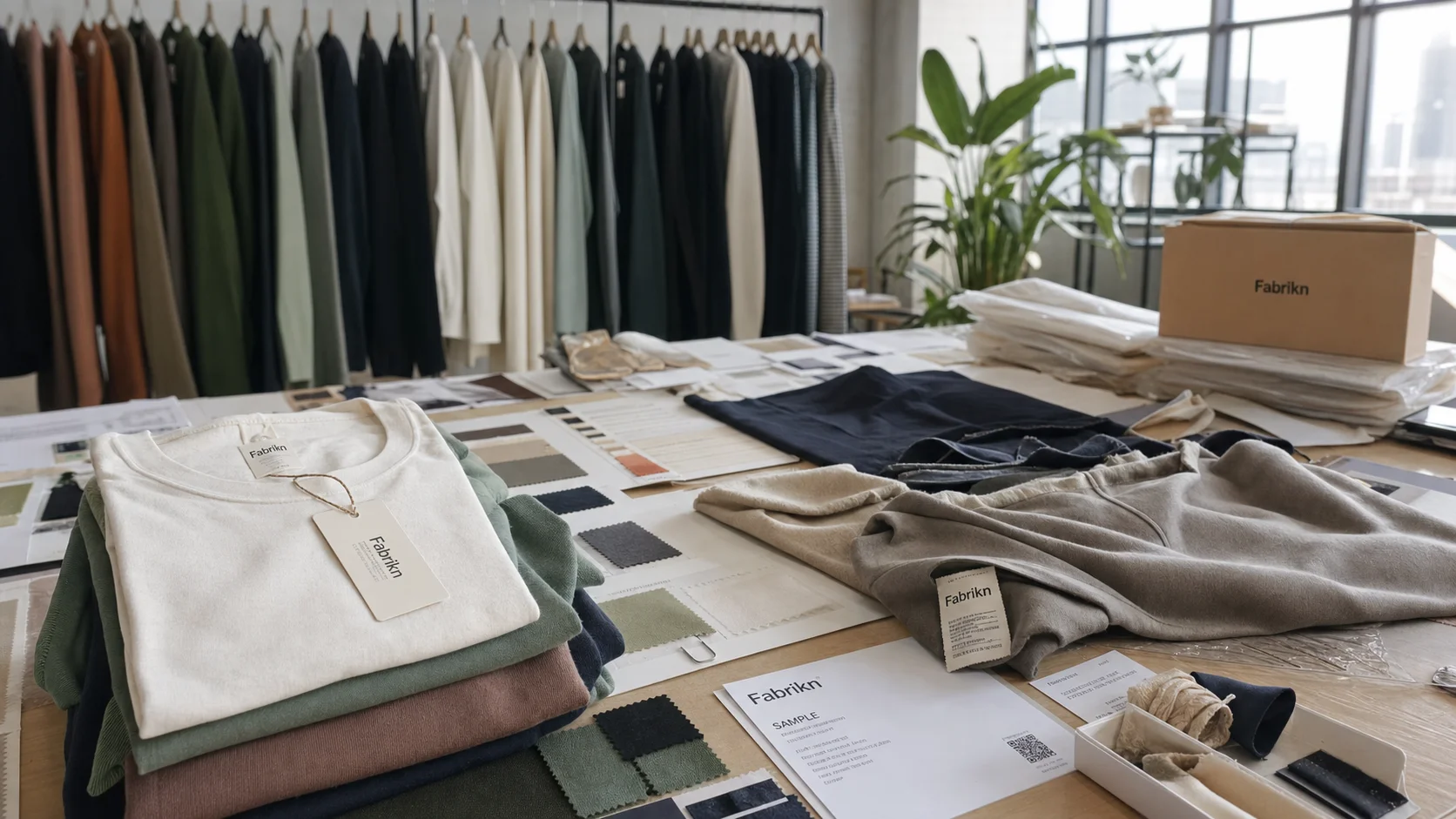
Luxury Clothing Packaging Selection with checks for samples, fit, MOQ, QC evidence, pricing terms, and delivery risk.
Fast answer: Luxury Clothing Packaging Selection: Box Strength, Inserts, Finish, and Cost should be judged by production evidence, not by a generic sourcing promise. The buyer needs sample proof, cost breakdowns, QC checkpoints, and delivery buffers in writing.
Ask for recent sample photos, measurement tolerances, fabric or print test assumptions, decoration test notes, packing examples, and a named inspection checkpoint. These details show whether the team can repeat an approved sample at bulk volume.
Separate garment cost, decoration, labels, packaging, sampling, testing, freight, and rush charges. When every cost line is visible, it becomes easier to reduce colorways, adjust size depth, or reserve more time for sampling.
The best packaging for luxury clothing brands starts with a blunt retail truth: buyers decide in seconds whether the box feels worthy of the garment inside. Weight. Structure. Print sharpness. Lid action. Tissue fold. Those cues land before the fabric ever touches skin.
After reviewing more than 200 factories across 8 countries, the pattern is maddeningly clear. A $2 rigid box can beat a $12 mailer if the board keeps its shape, the corners stay square, and the coating shrugs off scuffs. A flimsy mailer can wipe out the perceived value of a late delivery that would otherwise be forgiven. Customers spot crushed corners faster than they notice a two-day shipping delay. Milan showed me a 1200 GSM board with crisp 1.5 mm wrap that looked immaculate; Shenzhen answered with a cheaper board rescued by strong die-cut control and tighter glue-line discipline.
Packaging often outperforms product photography because it is physical proof. A campaign image promises aspiration. A box proves follow-through. In Portugal, a supplier used soft-touch lamination, blind embossing, and 1-color offset printing to lift a modest knitwear shipment without blowing the budget. Vietnam delivered excellent consistency on 5,000-unit runs, but only after tolerance checks were written down and signed off. China offered a wider finish range: excellent for a brand with a real spec sheet, uneven for one that sent a vague mood board and hoped for magic. The best packaging for luxury clothing brands is rarely the most expensive. It is the one that matches promise to execution.
Cheapness that looks accidental? No chance. A matte white box with clean typography and a folded tissue insert can feel more premium than a busy printed carton stuffed with unnecessary extras. I have seen that especially in DTC launches, where the first tactile moment does more brand work than $20,000 of ad spend. Think in touchpoints, not decoration. If you are comparing a manufacturer, a factory, or a supplier, ask how their production process controls board density, coating, and glue-line quality before you talk about finishes.
Luxury packaging has four jobs: protect the garment, preserve the brand image, reduce damage, and justify price. The format shifts by product. Tailoring usually belongs in a rigid box or a structured garment bag. Knitwear can travel well in a premium mailer or folding carton. Outerwear needs space, strength, and less compression. Accessories and occasionwear tolerate more ceremony, especially when the buyer expects a giftable presentation.
Rigid boxes still dominate high-ticket apparel because they signal permanence. A 2-piece setup box with a 1200-1400 GSM board, soft-touch lamination, and a wrapped lid can hold its shape through storage, retail handling, and parcel transit. Garment bags work better for suits, coats, and occasion dresses because they protect drape and reduce wrinkling. Mailers make sense for lighter categories when the brand wants lower freight and less storage burden. Wraps and tissue are the finishing layer, not the hero.
Tactile cues matter more than logos. Embossing adds depth. Foil stamping adds glare, which can help or hurt depending on the brand code. Edge painting can sharpen a box, but only if the supplier controls color consistency from the first 500 units to the 5,000th. Ribbon, tissue, and dust bags can elevate presentation, yet they become waste if they are only there to cover weak structure. I have seen brands spend $3.40 per order on ribbons and still ship products in sagging cartons. Backwards.
The sweet spot is packaging that signals price integrity without looking like a prop. A $150 silk blouse can do fine with a clean folding carton, tissue, and a dust bag. A $2,000 tailored coat can justify a rigid box, a gusseted garment cover, and controlled inserts. For a brand building clothing packaging solutions, the best packaging for luxury clothing brands is the one that fits the category’s handling reality, not the founder’s Pinterest board. That is especially true when custom packaging has to work at wholesale and bulk volumes without sacrificing quality or pushing MOQ beyond what the launch can support.
At $150 retail, packaging has to look premium without eating margin alive. I’d expect a folding carton, premium tissue, and one branded insert, with packaging cost landing around 2% to 4% of retail. At $500, the box can become more substantial: rigid construction, better print, maybe a dust bag, and a more deliberate opening sequence. Here packaging might run 3% to 6% of retail. At $2,000 and above, buyers accept more ceremony, but only if the garment earns it. When the coat is extraordinary and the box feels like afterthought cardboard, the price gap shows instantly.
Regional cost differences are real, and they are not just labor math. In Italy, finishing quality is often excellent, but labor and sourcing push unit costs up fast. A premium rigid box that might run $4.50 in Asia can land closer to $7.50 to $10 in parts of Europe once print, wrap, and assembly are included. Portugal has strong consistency on mid-volume runs, especially 2,000 to 10,000 units, with tighter communication and fewer language gaps. North America has board quality, but decorative finishing gets expensive quickly, especially foil, magnet closures, and small-batch die work. China gives the broadest range, from $1.60 mailers to elaborate boxes over $8, depending on spec, QC, and freight.
Vietnam catches first-time buyers off guard. Tooling is not always the cheapest, yet once a supplier understands the spec, repeatability can be excellent. I saw a factory in Binh Duong produce 10,000 identical cartons with color drift under a Delta E of 2.0, which is strong for packaging. In Italy, a similar run used richer paper stock but moved slower at 5-7 weeks. Near Dongguan, a Chinese factory matched the finish only after the brand sent physical samples and a 12-point sign-off sheet.
No one likes hearing this: cheaper markets can produce premium-looking work if spec control is tight, while expensive regions can still disappoint if the brief is vague. I’ve watched brands overspend in Paris and under-spec in Guangzhou. Both mistakes cost money. Both look bad in a customer’s hands. If you want the best packaging for luxury clothing brands, the question is not simply where to buy; it is which production partner can repeat the same quality at the target MOQ with the lowest defect rate.
Paperboard is still the backbone of premium apparel packaging. FSC-certified board gives brands a cleaner story, but certification alone does not make the box good. Recycled board can look refined if the surface is smooth and the print is controlled. A 1.2 mm to 2.0 mm rigid board is common for luxury, while folding cartons usually sit in the 300-450 GSM range. Corrugate belongs behind the scenes for shipping strength, not for showroom glamour.
Molded pulp has improved sharply. I have seen it used for inserts, shoe holders, and accessory trays with far better results than a few years ago. Cotton twill bags and brushed garment covers work well for coats, knitwear, and delicate dresses, especially when buyers want long-term storage. Magnetic closures feel premium, but they add weight and complicate recycling. If the closure is hidden inside a reusable box, fine. If it exists only to make the unboxing feel “luxurious,” I question the spend.
Inks and coatings are where environmental credibility can slip. Heavy lamination, UV coatings, and mixed-material wraps can make recycling harder. Water-based coatings and soy-based inks often make more sense, especially for brands claiming lower-impact packaging. Adhesives matter too. Too much glue can interfere with repulping, and sloppy application creates visible ripples that look cheap. For brands aligning with textileexchange.org guidance on responsible materials or OEKO-TEX certified trims and components, packaging choices should support the same sustainability story.
Durability has to be judged twice: once in transit, once in store. A garment cover that survives storage but tears on a courier route is not premium. A rigid box that photographs beautifully but dents when stacked under 8 kg of freight is a liability. Choose the lightest structure that survives the journey, then finish it well enough to hold attention on a shelf for 30 seconds and in a parcel for 30 seconds more. Trade rules and import clarity from trade.gov can also help teams plan sourcing and landed cost before they scale.
For a standard folding carton, I have seen unit prices from $0.65 to $1.80 at MOQs of 5,000 to 10,000 pieces, depending on board, print, and finishing. Rigid boxes usually start around $1.80 to $3.50 in Asia for simple builds and can rise to $6 to $12 once lamination, foil, magnets, and hand assembly enter the picture. Branded tissue often costs $0.04 to $0.18 per sheet, while a dust bag may land at $0.60 to $2.20 depending on fabric and drawcord quality. A premium mailer can range from $0.45 to $1.50. These are not theoretical numbers. They are live sourcing quotes.
MOQ changes the math fast. A box quoted at $2.20 for 3,000 units may drop to $1.55 at 10,000 units, but the brand has tied up cash in inventory and warehouse space. Tooling also bites. Dies, plates, embossing tools, and custom inserts can add $300 to $2,500 before the first production run ships. Lead times matter just as much. Stock packaging may arrive in 2-3 weeks. Semi-custom often takes 4-6 weeks. Fully custom packaging can stretch to 6-10 weeks, and a missed approval round can add another 7-10 days.
Freight and damage rates quietly inflate total spend. A box that saves $0.20 per unit but increases crush damage by 3% is not a saving. Warehousing can be equally unforgiving. A rigid box occupies more cubic volume than a folding carton, and that difference gets expensive when a brand holds 20,000 units in a third-party warehouse. I have seen packaging budgets overshoot by 15% because the team ignored storage density.
For custom bra manufacturing, where product weight is low and presentation matters, even a small packaging cost can feel oversized. The same goes for lingerie, silk, and giftable accessories. Luxury is not about spending the most per box. It is about spending in the right places and proving it with a defect rate under 2%, not with a glossy render. In other words, the best packaging for luxury clothing brands balances unit cost, wholesale readiness, and measurable quality instead of chasing a bigger box.
Give suppliers facts, not vibes. They need exterior dimensions, board grade, GSM, flute type if corrugate is involved, print file format, finish samples, tolerance ranges, and shipping method. A box that works for air freight may fail under sea freight if humidity warps it. I ask brands to specify dimensions to the millimeter, board tolerance within ±1 mm, and print approval against a physical master sample.
For tailoring, use structured boxes or garment covers with enough depth to prevent crease pressure. For knitwear, a folding carton with tissue can work well. For babywear, a lighter box or mailer may be enough, and I have found that brands building custom baby clothing manufacturing programs often need softer edges, simpler closure systems, and faster pack-out. For heavier coats, insist on reinforced corners and double-wall shipping protection if the box will travel direct to consumer.
Do not overbuild. Every extra gram increases freight and emissions. Every hidden insert adds labor. I check three QC points on factory floors: warped panels, glue-line consistency, and color drift across the print run. If a supplier cannot keep a lid square on the sample table, they will not keep it square after 8 hours of packing. Brands that need broader category control through private label clothing services should treat packaging as part of the product spec, not as a last-minute marketing accessory. That is why the best packaging for luxury clothing brands is usually the one with the clearest spec sheet, the most disciplined factory, and the fewest unnecessary parts.
Start with a shortlist of 3 suppliers: one nearshore, one Asia-based, one fallback option. Request quotes on the same dieline, same board, same finish, same MOQ. Then order samples and test them against four conditions: drop resistance from 1 meter, scuffing after 20 rub passes, color consistency under daylight, and unboxing feel with the actual garment inside. I prefer a pilot run of 200 to 500 units before full production, because that is enough to reveal glue failures and handling problems without trapping cash.
Approve only after a damage audit. Count crushed corners, warped lids, print defects, and closure failures. Compare suppliers on defect rate, response time, sample accuracy, and whether they can repeat the same result in week 1 and week 4. Data from ISO and ASTM standards is useful here, especially for testing consistency and material performance, but I still trust a physical pilot more than a polished PDF.
If you want the best packaging for luxury clothing brands, do not chase spectacle. Source for structure, specify for consistency, and test for transit. That protects the garment and the margin. For teams launching across regions, a disciplined supplier review in China, Vietnam, Portugal, or Italy will usually outperform a beautiful concept with no production discipline.
The best packaging for luxury clothing brands depends on the garment and the selling channel, but rigid boxes, premium folding cartons, and high-quality garment bags are the main formats. For most luxury apparel, a structured box with tissue and a branded insert gives the strongest balance of protection and presentation.
Typical costs range from $0.65 to $1.80 for folding cartons, $1.80 to $3.50 for simple rigid boxes in Asia, and $6 to $12 for more complex rigid builds. Dust bags can add $0.60 to $2.20, depending on fabric and construction.
Stock packaging can ship in 2-3 weeks, semi-custom packaging usually takes 4-6 weeks, and fully custom packaging can take 6-10 weeks. Add 7-10 days if you need a second sample round or artwork correction.
Yes. Use the lightest structure that protects the garment, then spend on print, finish, and closure quality only where the buyer can feel it. A 1200 GSM rigid box with clean tissue often beats a heavier box overloaded with inserts.
China and Vietnam often offer the widest cost range, while Portugal and Italy can be stronger for tighter communication and higher-touch finishing. The key is spec control: a precise brief can deliver premium results even in lower-cost regions.