
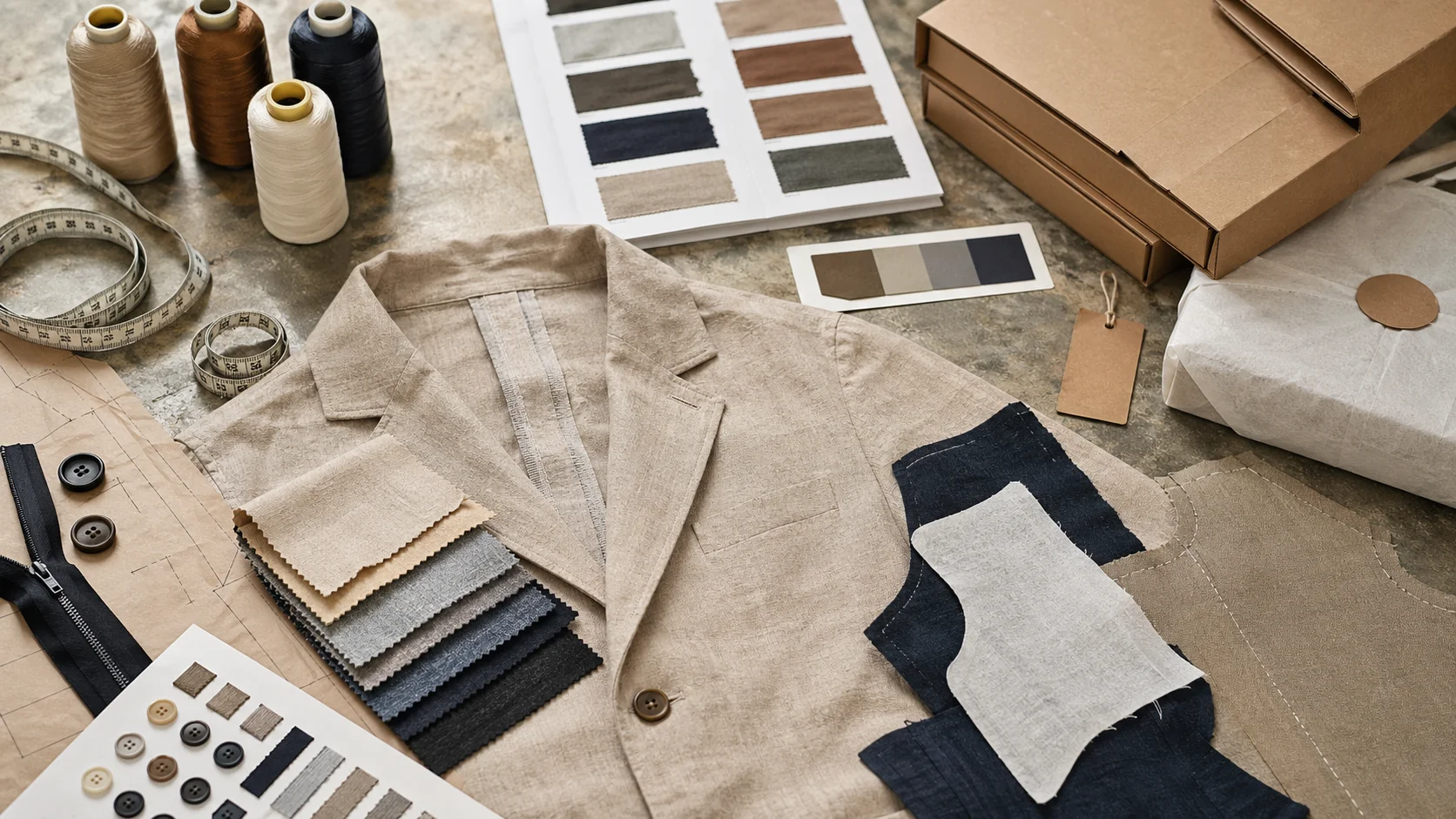
Luxury Fashion Clothing Packaging with checks for samples, fit, MOQ, QC evidence, pricing terms, and delivery risk.
Fast answer: Luxury Fashion Clothing Packaging: Box Strength, Tissue, Inserts, and Finish should be judged by production evidence, not by a generic sourcing promise. The buyer needs sample proof, cost breakdowns, QC checkpoints, and delivery buffers in writing.
Ask for recent sample photos, measurement tolerances, fabric or print test assumptions, decoration test notes, packing examples, and a named inspection checkpoint. These details show whether the team can repeat an approved sample at bulk volume.
Separate garment cost, decoration, labels, packaging, sampling, testing, freight, and rush charges. When every cost line is visible, it becomes easier to reduce colorways, adjust size depth, or reserve more time for sampling.
The box gets judged before the garment does, which is why clothing packaging for luxury fashion brands has become part of the product, not a finishing touch. I have watched buyers run a hand over a lid, weigh the closure in silence, and decide—sometimes in seconds—whether the brand feels worthy of the price tag. The package is the first quality test, the first pricing signal, and often the first clue that the maker understands detail.
At $600 jacket appointments, buyers notice the edge of a carton before they ever touch the fabric. Weight matters. So does the sound of the closure, the resistance of a magnetic flap, and whether the lid returns square after being opened a dozen times. Luxury shoppers rarely narrate these things, but they read them instantly. A soft-touch carton with a clean, low-noise click signals precision. A warped lid says cost cutting.
Across channels, the pressure changes shape. In DTC, the package has to carry the brand story on its own after two to five days in transit. Department store buyers expect consistency with existing luxury codes and little tolerance for dented corners. Boutiques are harsher in a different way: they compare you against neighboring labels at $250, $800, and $2,000 price points, then decide whether your presentation belongs on the table or in the back room.
During factory visits in Guangdong and northern Italy, one truth kept repeating itself. A flawless $18 rigid box with tight corner wraps, exact Pantone registration, and clean foil can outrank a $4 box built from heavier board if the structure shifts by 2 mm and the print looks muddy. Luxury packaging is architectural. It protects a silk blouse, survives three or four handoffs, and still looks intentional after shipping.
That is why I treat clothing packaging for luxury fashion brands as part of brand architecture, not decoration. It frames margin, shapes expectation, and tells buyers whether the company understands detail at a level that justifies its price. If the box is sloppy, the garment starts at a discount before the hanger even comes off the rail.
Luxury buyers want restraint with evidence. They expect soft-touch lamination that feels matte, not plastic. They expect crisp edges, accurate Pantone matching within a narrow delta, and closures that open with quiet confidence instead of rattling like office supplies. I have handled packages where the paper cost $1.20 a unit and still looked expensive because the structure was disciplined. I have also opened packages where the board cost $3.80 and looked tired because the printing was off by half a shade.
Regional expectations differ more than brands admit. In Europe, especially France and Italy, paper weight and finishing discipline matter more than visual noise. A 350 gsm wrap with embossing and sharp die-cut tolerance can read as couture-adjacent even without foil. In North America, buyers often respond to a stronger unboxing narrative, but they still reject clutter. In Asia, especially Japan and South Korea, gifting culture puts pressure on presentation, so ribbon tension, fold symmetry, and immaculate insert placement are scrutinized with near forensic care.
The best luxury packaging works because it looks intentional in every market. A minimal box can signal scarcity through board thickness, a narrow emboss, and a ribbon tied with consistent tension, not through layers of ornament. I have seen brands spend $2.70 extra per unit on metallic foil, then lose the advantage because the foil chipped during the first transit cycle. Expensive materials do not rescue poor assembly. In fact, they often expose it faster.
Here’s what most people miss: buyers often judge packaging from the outside in. If the logo sits 1 mm too high, the flap does not align, or the insert rattles when shaken, they assume the same lack of discipline touches production, sourcing, and quality control. That assumption is costly. It affects repeat purchase intent, wholesale confidence, and the margin for premium extensions such as gift wrap or seasonal capsules.
Luxury does not mean maximal branding. It does not mean every surface must shout. It does not mean foil on foil on foil. Over-branding often makes a package look promotional rather than premium. A restrained box, a strong material hand, and one precise signature detail usually carry more authority than a crowded surface covered in fragile embellishment.
Rigid boxes, folding cartons, and premium mailers each earn their place, but they solve different problems. For silk shirts, scarves, and delicate tops, a rigid box with a fitted insert protects shape and raises perceived value. Knitwear and heavyweight basics can live in folding cartons or reinforced mailers if the dimensions are exact. Leather accessories and limited editions usually justify rigid construction because the package must survive storage, gifting, and shelf display without collapsing.
Material choice changes everything. FSC board is a strong starting point, especially at 1200 to 1800 gsm for rigid structures. Recycled pulp inserts work well for folded apparel and can be die-cut to hold items snugly, reducing movement by 30% to 40% in transit tests. Water-based inks cut odor and improve compliance. Mono-material closures, when designed carefully, make recycling simpler. For some categories, I have seen brands use fabric wraps, especially cotton or linen sleeves, to signal tactility without relying on mixed plastics.
Finishes deserve scrutiny because they can make or break both the look and the life cycle. Embossing and debossing are durable and elegant. Soft-touch coatings feel rich, but low-quality versions scuff fast and can complicate recyclability depending on the substrate. Spot UV adds contrast, though it can look busy if overused. Foil works when it is sparse and precise; it looks cheap when registration drifts or the art team treats it like confetti. Every finish adds cost, and every finish adds a failure point.
Structural design matters as much as visual design. A package that saves 8% in board weight but crushes under freight pressure is not efficient. I have seen freight rates rise by 12% to 18% when a box is oversized by just 1.5 cm in each direction, because pallet efficiency collapses. For shelf presence, the lid height, corner reinforcement, and insert depth control whether the product presents as scarce or merely boxed. That is why I always ask for transit testing, stacking tests, and close-up photography from at least three sample runs.
For adjacent categories such as intimate apparel, custom bra manufacturing taught me a useful lesson: small, delicate products demand packaging that prevents deformation first and visual drama second. The same logic applies to luxury apparel, just at a higher price point and with more scrutiny.
Packaging cost depends on more than board grade. For a premium mailer, I typically see unit pricing around $0.90 to $2.50 at 5,000 to 10,000 units, depending on print complexity and inserts. A rigid gift box often lands between $2.80 and $8.50 at 1,000 to 3,000 units. Fully customized heirloom-style boxes with magnets, ribbon pulls, layered inserts, and multiple finish passes can reach $9.00 to $18.00 or more at small volume. MOQ 500 pieces is possible, but the unit cost rises sharply because setup is spread across fewer units.
Material grade drives part of the bill, but decoration can quietly double it. A single-color print on 157 gsm art paper wrapped over grey board is economical. Add foil stamping, embossing, internal print, and a custom insert, and the carton moves quickly from $3.40 to $6.20. I have watched brands approve a design that looked beautiful in renderings, then get surprised when the sample quote arrived 38% above target. The quote was not inflated. The spec was.
Hidden costs matter. Tooling for dies and emboss plates can run $150 to $900 per design. Sampling may take two to four rounds. Freight can add another 8% to 22% depending on route and box weight. Storage becomes real when a seasonal program lands eight weeks early and takes up cubic meters you did not budget. QC rejects usually sit at 2% to 5% for disciplined suppliers, but poor vendors can burn through 10% of a run before anyone notices.
If you need a simple planning rule, allocate packaging at 3% to 7% of retail for true luxury apparel, and closer to 1.5% to 3% for entry-luxury. That ratio protects margin while keeping the package credible. I have seen brands try to squeeze packaging under 1% and end up with weak board, bent corners, and rework costs that eat the savings. Packaging economics reward realism, not wishful thinking.
For comparison, I often build a three-line cost view: basic premium mailer at $1.20 to $2.20, rigid gift box at $3.50 to $7.00, and an elevated presentation box at $8.00 to $15.00. That frame helps buyers compare vendors apples-to-apples instead of falling in love with one sample that hides expensive extras.
Brochures rarely tell the real story. Factory capability shows up in machine maintenance, glue control, hand-finishing skill, and how a team handles a bad print batch at 7 p.m. I have walked through plants where the sales deck promised precision but the corner wraps varied by 3 mm and the die-cut edges frayed. In luxury packaging, setup discipline is the product.
Regional differences are real, though they are not stereotypes. In Italy, lead times often sit around four to six weeks for smaller bespoke programs, and hand-finishing is excellent when the factory is well run. China can move faster, especially at two to four weeks for repeat work, and it offers broad material access, but quality varies widely by tier. Vietnam brings strong value on simpler structures, though decorative complexity can slow things down. Turkey is often strong for proximity to Europe and for short-run flexibility, especially when transit time matters.
Color calibration is one of the easiest places to see competence. Good factories maintain consistent lighting booths, check Pantone targets against calibrated samples, and catch drift before mass production. Glue control matters too. Too much adhesive warps board and leaves marks; too little creates separation at the corners after 50 to 100 openings. Batch consistency should be visible across 20 units, not just the first perfect sample.
Warning signs are usually practical. Oversized tolerances. Weak sampling discipline. Poor traceability on paper batches or board lots. If a supplier cannot explain where the board came from, which press run handled your job, or how rejects are logged, I walk away. Luxury brands should audit suppliers with the same seriousness they use for garment factories. A package that looks elegant on day one but fails after shipping can damage brand equity faster than a mediocre garment.
When I source clothing packaging for luxury fashion brands across multiple categories, I often compare the same factory’s output across adjacent products. A supplier that handles custom baby clothing manufacturing well often understands softness, safety, and presentation discipline, which can translate into better folding standards for luxury apparel cartons.
Sustainable packaging can look expensive if it is designed with restraint. Recycled board, recycled pulp inserts, and FSC-certified substrates now deliver feel and structure that would have been hard to source consistently five years ago. The key is not to announce sustainability with visual clutter. It is to make the package feel calm, intelligent, and durable. According to Textile Exchange, material sourcing and traceability are central to credible environmental claims, and that principle applies to clothing packaging for luxury fashion brands just as much as it does to textiles.
I compare carbon, water, and waste impact in three ways. First, board grade: recycled content generally lowers virgin fiber demand. Second, coatings: water-based or dispersion coatings tend to be easier to manage than heavily plasticized films. Third, inserts: molded pulp often outperforms foam because it is easier to recycle and can reduce end-of-life waste. The trade-off is visual control. Some recycled boards have more fiber fleck or a less uniform tone, which can be gorgeous in the right design and sloppy in the wrong one.
Buyers should request FSC or SFI certification, recycled content proof, and restricted-substance declarations before approval. I also ask for migration or compliance documentation where needed, plus confirmation that inks and adhesives meet regional requirements. Data from OEKO-TEX and related standards frameworks has made one point clear across categories: material claims need evidence, not adjectives. If a supplier cannot document the source and composition of a paper wrap, the sustainability story is not ready for market.
The mistakes that make green claims sound hollow are obvious in person. Oversized empty boxes that waste space. Mixed-material builds that glue paper to plastic so tightly they cannot be separated. Excess ribbon, foam, or magnets with no reuse value. I have seen brands place a recycled logo on a box that took twice the shipping volume it needed. That is not stewardship. That is theater.
Some premium labels get it right through restraint. A single-color recycled carton, a neatly die-cut insert, and a small deboss can feel more luxurious than a glitter-heavy package. I have seen that strategy work for private label clothing services too, where consistency across hundreds of SKUs matters more than one dramatic hero box.
Start with a packaging brief, not a quote request. Define brand codes, dimensions, product weights, shipping methods, finish targets, and sustainability requirements. Set tolerances. If your garment folds to 280 x 220 x 40 mm, say so. If you ship by air 30% of the time and ocean 70% of the time, say that too. Then ask vendors for mockups, not just renders, and test drop resistance, corner crush, and color drift across at least two sample rounds.
To compare quotes properly, standardize the variables. Same board grade. Same print count. Same insert type. Same delivery term. Otherwise you are comparing a $2.40 spec against a $5.90 one and pretending it is apples-to-apples. I have watched brands save 12% on paper cost and lose 18% in damage, rework, and freight. That is a bad trade.
Run a pilot before seasonal rollout. A batch of 300 to 500 units can expose scuffing, misalignment, and tolerance issues that a 10-piece sample hides. If you need a starting point, use clothing packaging solutions as a benchmark, then build your own spec from there. Clothing packaging for luxury fashion brands is not the last step in product development. It is the last proof that the brand understands what it is charging for.
When you move into production, choose a manufacturer with clear quality controls, a reliable factory workflow, and a supplier team that can support custom and wholesale orders in bulk. The best partners can explain MOQs, sampling, and lead times without hiding the real production constraints, especially when sourcing from China or another export hub. That clarity saves time and reduces costly revisions.
For sourcing outside your core market, it also helps to review basic trade guidance from trade.gov before finalizing import plans. Duties, compliance steps, and landed-cost assumptions can change the economics of a packaging program more than the box design itself.
Premium mailers usually cost $0.90 to $2.50 per unit, rigid gift boxes often run $2.80 to $8.50, and highly customized presentation boxes can reach $9.00 to $18.00 or more. MOQ, finish level, and insert complexity drive most of the spread. Sampling, tooling, and freight sit outside unit price and should be budgeted separately.
FSC board, high-density rigid board, recycled pulp inserts, water-based inks, and mono-material closures are strong options. For luxury apparel, 1200 to 1800 gsm rigid structures perform well, while folding cartons suit lighter garments and accessories. The best choice depends on shipping method, product weight, and how much structural protection the item needs.
Typical lead times are two to four weeks for repeat work in faster factories and four to six weeks for more bespoke production. Add one to two weeks for sampling if the design is new or uses complex finishes. Freight can extend delivery by another 7 to 30 days depending on origin and destination.
Yes. Recycled board, molded pulp, and water-based coatings can still look premium if the design is disciplined. Keep the layout restrained, use precise embossing or debossing, and avoid mixed materials that cannot be recycled easily. Oversized boxes and excessive ribbon are usually what make sustainability look weak, not the recycled content itself.
Ask for board specs, Pantone targets, certification documents, sampling timelines, defect tolerances, and transit test results. Request photos from previous production runs, not just samples, and confirm how the factory tracks paper lots and rejects. A good supplier should be able to explain its QC process in under 10 minutes.