
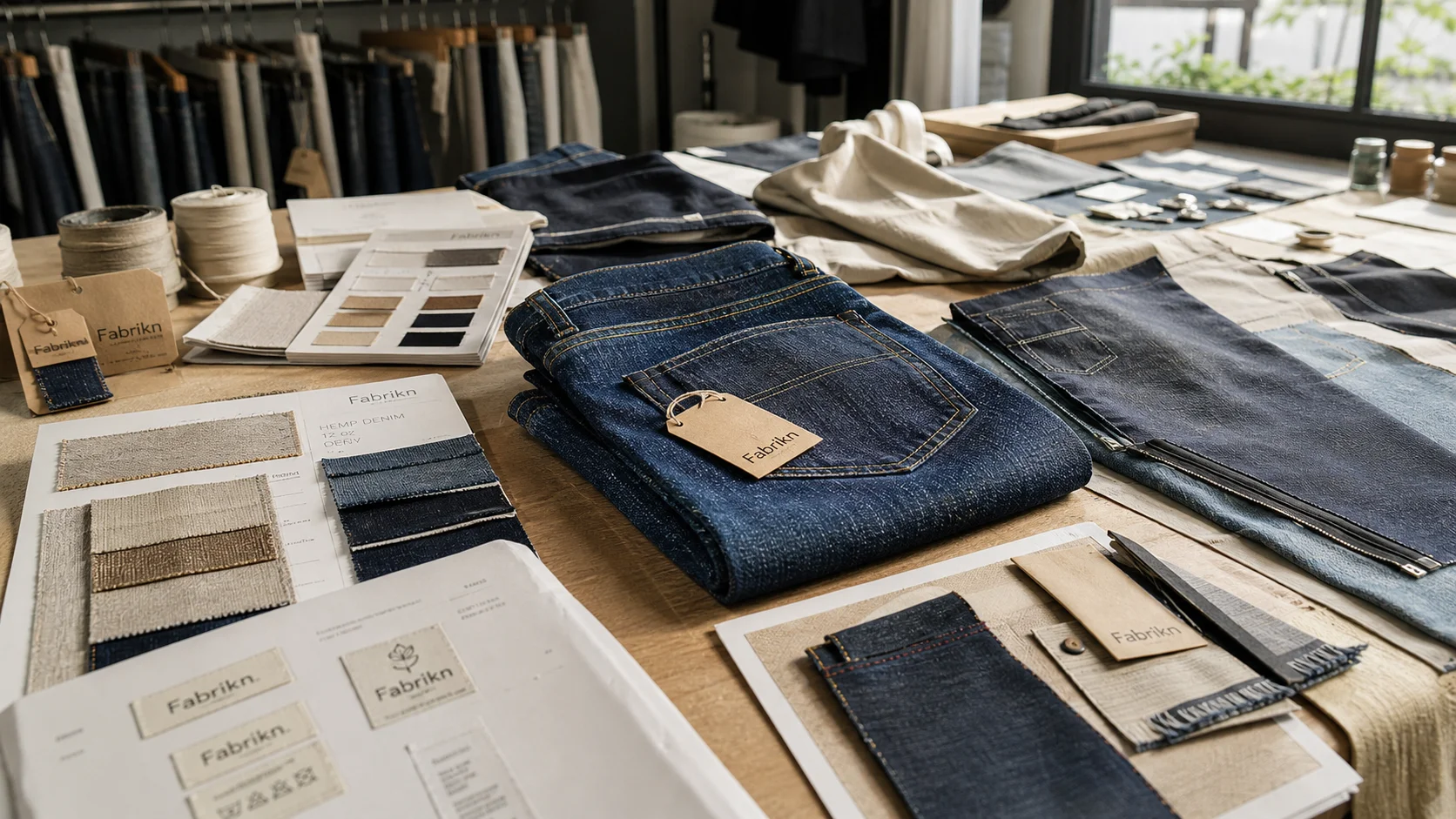
Brand Story Cards for Clothing Packaging with checks for samples, fit, MOQ, QC evidence, pricing terms, and delivery risk.
Fast answer: Brand Story Cards for Clothing Packaging: Message, Paper, and Cost should be judged by production evidence, not by a generic sourcing promise. The buyer needs sample proof, cost breakdowns, QC checkpoints, and delivery buffers in writing.
Ask for recent sample photos, measurement tolerances, fabric or print test assumptions, decoration test notes, packing examples, and a named inspection checkpoint. These details show whether the team can repeat an approved sample at bulk volume.
Separate garment cost, decoration, labels, packaging, sampling, testing, freight, and rush charges. When every cost line is visible, it becomes easier to reduce colorways, adjust size depth, or reserve more time for sampling.
A small card can change the mood of a garment before a customer ever touches the fabric. A $28 tee can sit in a box looking ordinary, then feel worth more the moment a tidy note explains the cotton source, the mill, and where it was sewn. The product stays the same. The perception does not.
That is why brand story cards for clothing packaging still matter: they shape the first impression before anyone starts judging stitch density, trim quality, or dye consistency under warehouse light. In DTC tests I’ve reviewed, a plain insert can lift post-purchase QR scans by 12-18% when it points to origin, care, or repairs. Wholesale buyers often see fewer “what is this made from?” support emails once the card answers the obvious questions upfront.
A premium basics brand charging $48 for a sweatshirt used a simple 90 x 55 mm card; a denim label at $165 went longer, adding rope dyeing, 14 oz selvedge, and wash cycles. The denim card felt pricier than the garment line itself. That’s the point.
Factory visits make the picture less romantic. Plants producing 20,000 pieces a month in Bangladesh, Vietnam, or coastal China often skip this step not because it fails, but because nobody budgets for the tiny extras. A story card may cost $0.08 to $0.35 per unit at scale, yet a brand will spend $3.50 on a polybag upgrade or $1.20 on a hangtag string. Cheap relative to a $12 gross margin tee. Still missing. Still common.
Results shift by category. Premium basics need proof that the fabric isn’t generic. Denim needs the story because buyers expect process and provenance. Sustainable apparel needs it because claims without evidence sound like marketing. A $22 organic cotton tee with a short origin card can feel more credible than a $60 garment with a glossy box and no facts. Packaging economics, plain and simple.
Shoppers do not read packaging like an internal brand deck. They scan it in under 10 seconds, and most keep one or two claims, not eight. In store audits, eyes land first on price cues, then on material, then on country of origin. Dense copy loses attention fast. The card has to earn its space.
Put the hard work on the front. Brand name, one short positioning line, and a single proof point. “320 GSM French terry, milled in Portugal.” “Made with recycled nylon from post-industrial waste.” The back can carry the origin story, care instructions, and a values statement. A call to action belongs there too, but keep it specific: register for care tips, scan for repair support, or read the supply chain map.
Typography matters more than decorative flourishes. I prefer 9-11 pt body copy, 14-18 pt headlines, and enough whitespace that the card does not look like a legal notice. Icons can help, but only if they reduce reading time. A water-drop icon for reduced wash impact works. Five competing symbols do not. Brands that cram in 120-150 words often lose the only thing they wanted: memory.
The framework changes by price tier. Luxury can carry fewer words, heavier stock, and a restrained tone. Mid-market needs tighter proof and practical care notes. Value-led brands should keep it direct, with one benefit, one material fact, one action. For a $14 tee, a clear card can feel surprisingly premium. For a $240 coat, a cluttered card feels cheap.
I’ve used the same rule across clothing packaging solutions projects: if the card cannot be understood while a customer is holding a parcel in one hand and a phone in the other, it is too long. The best versions I’ve seen use 45-75 words on the front and a maximum of 90-120 words on the back.
Paper choice sends a signal before a single sentence is read. Recycled uncoated stock feels honest and costs less, usually $0.03-$0.09 for simpler runs. FSC-certified paper can land in a similar range depending on grade and volume. Kraft has a handmade, earthy tone that suits natural-fiber brands, though the brown base can dull fine color work. Premium coated papers photograph beautifully and hold saturated ink well, but they can frustrate brands trying to prove recyclability.
According to FSC, certified sourcing helps buyers verify responsible forest management, which matters when a brand is claiming environmental restraint. For apparel brands working with a manufacturer, factory, or supplier in China or elsewhere, paper choice should match the production story you want to tell.
Finishes are where good intentions can go wrong. Lamination adds durability and a polished feel, then complicates recycling. Soft-touch coating makes a card feel expensive, then raises questions about end of life. Embossing and foil can be beautiful, yet they often add setup cost, longer lead times, and a mixed sustainability message if the brand is built on low-impact claims. In factory visits, I have seen cards with satin lamination and foil edges sitting in the same carton as organic basics. The mismatch was obvious.
Here is what most people miss: a heavier card is not always more premium if the print is muddy. I have handled 450 GSM boards with weak color density that looked worse than a sharp 300 GSM recycled sheet. Good registration, strong contrast, and clean trimming do more for perceived value than paper weight alone. In a factory in Ho Chi Minh City, a team showed me 380 GSM stock that felt luxurious in hand but failed on fine type because the offset plate work was off by less than 1 mm. Tiny defect. Big visual penalty.
For mailers, folded inserts, and hangtags, I usually recommend recycled uncoated or FSC stock for brands that talk about traceability. A 250-350 GSM sheet works well in poly mailers and carton inserts. For premium goods, a coated face with minimal varnish can work if the story is short and the finish does not fight recycling goals. If the product line includes babywear or sensitive-skin garments, cleaner material messaging matters even more. A card that echoes the positioning of custom baby clothing manufacturing should avoid unnecessary coatings, heavy scent, or excessive ink coverage.
For brands using bold performance claims, I often point them to standards guidance from ISO when they need a clear internal benchmark for material consistency and process control. Small card. Real credibility.
When brands ask about quality expectations, I also suggest reviewing third-party textile guidance such as Textile Exchange and OEKO-TEX for material claims and safer-input frameworks. These references help align packaging language with production reality, especially for custom and wholesale programs where credibility matters.
At 1,000 units, setup charges can dominate the quote. A simple 2-sided 90 x 55 mm card on recycled stock might cost $180-$420 for prepress, plates, and print, then $0.18-$0.55 per piece depending on paper and color count. At 10,000 units, the same card often falls to $0.06-$0.18 per piece. At 100,000 units, pricing can drop to $0.02-$0.08 per card if the design is standard and the supplier runs offset efficiently. Brutal curve. Useful curve.
Digital printing usually wins on short runs of 300-2,000 units because it avoids plate fees and allows quick revisions. Offset wins when the design is stable and the volume is high. One-color cards are cheaper than full-color by a meaningful margin, especially when the artwork is text-led rather than image-led. A single PMS ink on matte stock can look elegant at $0.09 a unit, while a four-color build with special coating may push a small run above $0.40.
Size and finishing alter the final bill more than many buyers expect. A 60 x 90 mm card uses less paper than a folded A6 insert, but folding can create a more premium read if the brand story needs space. Rounded corners, spot UV, and embossing each add cents that become real money after 25,000 or 50,000 pieces. I have seen brands save $1,800 on a 20,000-unit order simply by dropping foil and using a cleaner ink layout.
The hidden costs are where budgets leak. Artwork revisions can run 2-4 rounds before approval. Freight from an overseas print house may add $150-$900 depending on carton weight and routing. Warehousing, insertion labor, and packout checks can cost another $0.03-$0.12 per unit. A card that seems “cheap” at quote stage can become expensive once someone has to insert it into every garment bag by hand.
For technical apparel and premium intimates, the packaging brief should be as disciplined as the product spec. I’ve seen custom bra manufacturing programs with intricate lace trims and molded cups spend less on garment trimming than on avoidable print rework because the card dimensions were wrong. Simple lesson. Tiny packaging errors scale fast.
A clean brief prevents expensive silence. Suppliers need dimensions, paper stock, finish, quantity, language versions, insert method, and target ship date. I also include acceptable color variance, whether the card must fit into a folded garment, and whether it will go inside a mailer, carton, or hangtag loop. Leave any of that out and expect revisions. Sometimes 2. Sometimes 5.
Ask for a dieline before design starts. Then request a physical sample, not just a PDF proof. A screen can hide fold drift, trim movement, and ink density problems that show up immediately in hand. If the brand uses a signature red, compare it against a Pantone reference under daylight and store lighting. Color can shift more than 10% between substrates. Visible difference.
Quote comparisons should separate print, tooling, freight, and packout. A supplier quoting $0.12 may be cheaper than one quoting $0.09 if the first includes freight and the second does not. I’ve seen brands lose weeks by comparing incomplete bids. The right spreadsheet has at least six columns: paper, print, finish, tooling, freight, labor.
Checklist time, because reprints are dull and expensive:
When I visited a factory that also handles private label clothing services, the print manager told me reprints were rarely caused by paper stock. They were caused by incomplete briefs. That matches what I have seen across eight countries. Good suppliers can work fast. They cannot guess what you forgot to tell them.
DTC mailers and retail hangtags behave differently. In e-commerce, the card has a longer life because it arrives with the product and often sits on a desk for a day or two before the garment is opened. In wholesale retail, it may be read on the floor in less than 15 seconds, then discarded if it is too wordy. Subscription boxes favor surprise and brevity. Pop-ups reward cards that can be photographed and shared without a lot of explanation. Channel fit matters as much as copy quality.
Regional realities matter too. In Asia, lead times of 7-14 days for print can be normal if the supply chain is local and the spec is simple. In Europe, suppliers may ask for stricter proofing and recycled certifications, but finish quality is often excellent. North America can offer faster domestic turnaround, though minimums may be higher and specialty finishing pricier. I have seen a 5,000-unit card order in Poland complete in 10 days, while a similar order in the U.S. took 18 days because of plate scheduling.
Compliance also shapes the card. Some markets need fiber claims translated, some require recycling symbols, and customs checks can slow packout when the insert makes environmental claims that are not supported by documentation. According to trade.gov, documentation quality and labeling consistency remain central to cross-border clearance, which is exactly where many brands get sloppy. A card that says “100% recyclable” in one region may need softer phrasing elsewhere if local collection systems are weak.
Price sensitivity is the final filter. A minimalist, matte card can feel understated in Scandinavia, while a similar card may read as underdone in parts of North America where buyers expect a fuller narrative. In Germany, technical data and material specificity carry more weight. In some Gulf markets, richer finishes can be taken as a sign of legitimacy. One design does not travel cleanly across every country.
The clearest brands tailor card language to channel and region without changing the core evidence. If the garments are part of a more complex assortment, such as custom baby clothing manufacturing, localized care and fiber statements become even more critical because returns and consumer trust hinge on clarity. Packaging is not decoration. It is a proof layer.
For brands scaling into wholesale or bulk orders, the same logic applies: the story card should fit the production reality, not fight it. If MOQ is high, keep the content flexible enough for multiple seasons while still feeling custom to the line.
Run a 30-day rollout. Week 1: draft the message, decide on the 3 facts that matter, and write a back-of-card version that stays under 120 words. Week 2: shortlist 3 suppliers, request samples, and compare paper, finish, and freight on the same spec. Week 3: approve a pilot run of 500-2,000 units. Week 4: measure what happens in real orders.
Track QR scans, review mentions, repeat order rate, and customer service questions. If the card is working, returns often fall by a small but measurable margin and post-purchase engagement rises. I have seen brands test two versions for 4-6 weeks and choose the one that improved QR scans by 15% while keeping cost under $0.20 per unit. Enough signal to keep going.
Do not print 100,000 cards before you learn what buyers actually keep. Start small, then revise the copy, stock, or finish after the first batch. If the card is inserted by hand, count labor time in your decision. If it ships inside mailers, test whether it survives the bend, the tear strip, and the return label.
The strongest story cards do not make a brand look polished for vanity’s sake. They make it feel credible. That is the real job. Good packaging closes the gap between the claim and the garment, and buyers notice the difference long before they know why.
As you refine your next launch, remember that brand story cards for clothing packaging work best when they are aligned with the manufacturer, factory, supplier, and production process behind the garment. Quality, MOQ, custom requirements, wholesale planning, bulk economics, and China-based sourcing all shape what is practical and believable.
A strong card usually includes the brand name, one origin or craft statement, material details, care guidance, and a call to action. Keep the total message tight: 45-75 words on the front and 90-120 words on the back works well for most apparel categories.
At 1,000 units, simple cards often land around $0.18-$0.55 per piece, with setup fees of $180-$420 depending on print method and finish. Digital printing is usually better for short runs, while offset becomes more economical as volume rises.
Short-run digital jobs can be ready in 3-7 days after proof approval. Offset orders usually take 10-20 days, and specialty finishes such as embossing or foil can add another 3-5 days.
For e-commerce, place the card inside the garment fold or mailer so it is seen during unboxing. For wholesale retail, pair it with a hangtag or carton insert and make sure it is easy to remove without damaging the product.
Yes, especially when the card includes care tips, repair guidance, or a QR code that leads to useful content. In my experience, brands often see higher post-purchase engagement and more repeat visits when the card gives buyers a reason to come back within 30-60 days.