
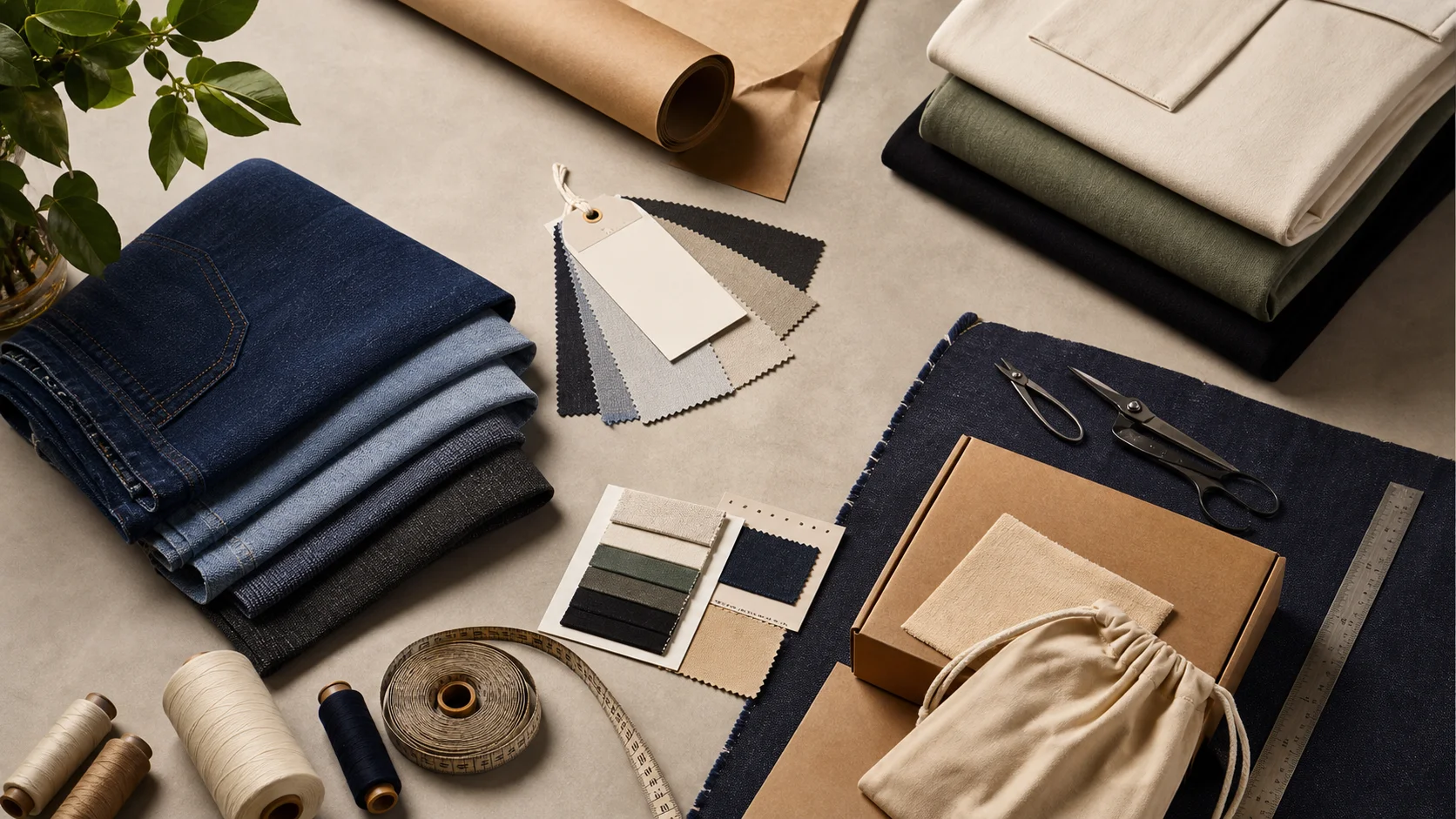
Branded Garment Mailers Decision compared by sample evidence, fabric or trim specs, MOQ, AQL terms, cost lines, delivery timing, and rework responsibility.
Fast answer: Branded Garment Mailers Decision: Material, Print, MOQ, and QC Terms should be judged by production evidence, not by a generic sourcing promise. The buyer needs sample proof, cost breakdowns, QC checkpoints, and delivery buffers in writing.
Ask for recent sample photos, measurement tolerances, fabric or print test assumptions, decoration test notes, packing examples, and a named inspection checkpoint. These details show whether the team can repeat an approved sample at bulk volume.
Separate garment cost, decoration, labels, packaging, sampling, testing, freight, and rush charges. Clear cost lines make it easier to reduce colorways, adjust size depth, or reserve more time for sampling.
The first quote is rarely the real story. When buyers compare branded apparel mailer bags wholesale China options with local sourcing, the winning number usually shows up in the landed cost, not the headline price. Print setup, cartons, inland trucking, and freight can reshape the bill fast. I’ve watched that pattern repeat across Guangdong, Zhejiang, and other export-heavy regions, which is why China stays competitive even when the opening quote looks merely average.
At 1,000 units, local suppliers in the US or UK often sit around $0.42-$0.78 per bag for a basic printed mailer. China quotes can land near $0.18-$0.35 before freight. At 5,000 units, the gap widens: local often sits around $0.28-$0.55, China around $0.12-$0.24. At 20,000 units, I’ve seen China factories quote $0.08-$0.16 for standard LDPE or co-extruded PE bags, while domestic production may still hover at $0.20-$0.38 depending on print and thickness. Currency, resin cost, and compliance rules move the numbers around, but the spread stays real.
Why do buyers still ship across the Pacific? Three reasons. First, unit cost drops harder at scale. Second, China offers a wider range of film structures, from 70-120 micron co-extruded PE to recycled-content blends with 30% to 80% PCR. Third, print registration tends to stay tighter once the run reaches 5,000 pieces or more, which matters for logos, QR codes, and barcode placement on apparel shipments. I’ve compared branded apparel mailer bags wholesale china quotes against local sourcing for brands doing 2,000 to 50,000 monthly parcels. Bigger runs absorb tooling and freight across volume.
The thing nobody tells you: the cheapest bag often fails QC more often, which pushes its true cost above a mid-tier spec. I saw a 55-micron bag quote $0.01 cheaper than a 75-micron alternative, yet its seal failures ran 4.8% versus 0.7% on the thicker version. Once replacements, customer complaints, and chargebacks were counted, the “cheap” bag cost more. That’s the math I trust after 200-plus factory visits, not showroom promises. If your apparel line also needs consistent sizing or intimate-apparel packaging, the same logic applies to custom bra manufacturing and the tolerances that sit behind it.
Guangzhou’s huge apparel packaging corridor, centred around the Nansha Free Trade Port Zone, keeps that math humming: dozens of companies share the same Bruckner 6-layer blown film lines, Corona treatment stacks, and Windmoeller & Hoelscher flexo presses, letting them dial in repeatable film performance before they ship full containers to Long Beach or Felixstowe. When I compare that capability to regional hubs like Dhaka, Ho Chi Minh City, or even Istanbul, the base material costs may look similar, but the combination of flexible capacity, fast tooling turnover, and the dense logistics ecosystem near Guangzhou keeps the landed per-unit price lower for most fashion brands.
Film gauge tells only half the story. A 60-micron LDPE bag can outperform a 70-micron bag if the resin blend is cleaner, the seal bars are calibrated, and the dart fold is consistent. I ask factories to show me three things on the floor: film thickness tolerance, seal strength, and puncture resistance. For thickness, I want a tolerance window of about ±5% on a run of 10,000 units, not a vague “within standard” answer. For seals, I look for a simple peel test and a drop test from 1.2 meters, repeated 10 times on filled samples. Tear propagation matters too. If a perforation starts cleanly but runs across the whole flap after one snag, the bag is wrong for garments with metal trims or bulky knitwear.
Material choice changes performance fast. LDPE is cheap and flexible. Co-extruded PE gives stronger barrier control and better print surfaces. Compostable blends often sound attractive, but they can be stiffer, moisture-sensitive, and less forgiving in hot warehouses. Recycled content reduces virgin plastic use, though color can shift and the film may carry more odor if the feedstock is poorly sorted. I’ve seen some factories use 30% PCR content with decent performance, but they must prove consistency with batch-by-batch melt flow data, not just one golden sample. If sustainability claims matter to your brand, verify them with independent guidance from Textile Exchange and packaging standards that back up the marketing.
For branding, logo alignment and Pantone matching decide whether the bag reads “premium” or “mass discount.” A 2 mm shift on a centered logo looks minor in a proof and obvious on a pallet. Opaque films protect product privacy and make returns feel cleaner for premium apparel, while transparent or frosted films work better for basics and size-variant packing. Tear strip placement sounds trivial. It is not. If the strip sits 8 mm too close to the seal, the customer tears the top edge instead of opening the bag neatly.
Red flags show up fast in factories: inconsistent resin batches, rushed regrind use mixed in without disclosure, and inspection reports that only check appearance while ignoring seal failure, barcode scanability, or print rub resistance. Data from ISO standards on quality systems is useful here, but the factory floor tells the real story. If a manufacturer cannot explain how they track batch-to-batch variation across 3 shifts and 2 resin lots, I keep moving. For apparel brands that also build sewn product programs, the same discipline matters in private label clothing and packaging alike.
Machines matter. Observe the slitting set-up—Autoland or MKT winders should keep roll tension consistent to avoid telescoping. The film should pass through corona treatment racks before receiving solvent-free adhesives, especially when using BOPP lamination for metallic or matte finishes. Ask to see the printers calibrating UV flexo heads for Pantone 186 C and cool gray 8 C; if they still rely on viscous solvent inks instead of low-migration water-based formulations for security, that’s a risk for GOTS-certified labels and OEKO-TEX Standard 100 claims downstream.
Gloss, matte, frosted, and recycled finishes each signal something different, and the wrong choice can quietly drag down perceived value. Premium fashion labels often choose matte white or frosted black because the surface hides scuffs and photographs well under store lighting, while basics brands lean toward plain white or light grey to keep freight-efficient runs simple. Subscription apparel boxes often prefer a soft-touch matte feel, though that finish can show oily fingerprints if the coating is too heavy. Discount retail returns usually need a tougher, cheaper surface that survives multiple handling cycles and 2 or 3 shipping labels.
I’ve watched a 2-ounce silk blouse sit inside a glossy mailer that felt cheaper than the garment itself. I’ve also seen a 320 GSM French terry hoodie shipped in a matte recycled bag that made the whole parcel look more considered. Finish affects more than appearance. Gloss often resists scuffing better in transit, while matte hides scratches and fingerprints but may show fold marks. Frosted film splits the difference: clean, semi-transparent, and often more expensive because scrap rates can run 6% to 9% higher on some lines.
Printing method changes both cost and color fidelity. Flexographic printing works well for 1 to 3 colors and higher MOQs, with plate costs that can start around $40-$120 per color depending on size. Gravure gives richer ink laydown and sharp gradients, but setup can be costly, so it makes sense when orders move past 20,000 pieces or designs stay stable across seasons. Digital print suits short runs, sample packs, and fast seasonal tests, though per-unit cost can jump 15% to 40% versus flexo at scale. A brand that refreshes artwork every 4 weeks may value digital flexibility more than a 3-cent savings on flexo.
Here’s the part many buyers miss: a recycled-content bag can cost more than virgin film when the order is small or color-critical. A 5,000-piece run with recycled resin may need extra sorting, color correction, and more rejects, pushing cost above a cleaner virgin equivalent by 8% to 20%. That has nothing to do with brand virtue signaling and everything to do with material discipline. I’ve seen more than one sustainable launch blow its budget because the team assumed “recycled” automatically meant “cheaper.” It often does not. For independent verification of chemical and textile safety claims, buyers can also review OEKO-TEX testing reports, WRAP compliance certificates, and GRS documentation, especially if the bag contains woven labels or recycled poly films.
Detailing adhesives, die cuts, and tape can elevate perceived value. Solvent-free hot-melt adhesives, applied with a Nordson dual-head system, keep tear strips intact while allowing smooth resealing. Laser-perforated gussets or zipper channels often require a Komori die station, and the backing paper for peel-and-seal tapes should match the bag’s release force. Brands that demand GOTS-certified cotton drawstrings or OEKO-TEX Standard 100 printed tags will appreciate a supplier that can show how the adhesive and ink families interact without compromising those certifications.
The cheapest advertised price usually omits tooling, film treatment, and finishing. For example, a 6x9 delivery-type mailer made from 70-micron co-extruded PE with two-color flexo printing, 100% PCR film, and peel-and-seal tape typically lands between $2.50-4.00 per unit at a 500 MOQ if the design needs metallic inks and spot varnish. Raise the MOQ to 5,000 and that same structure dips toward $0.90-$1.15. If you add woven hang-tag loops and a matching soft-touch coating using an inline Meyer Bar, you can tack on another $0.20-$0.35 to the per-unit cost.
Breakdown of the $2.50-4.00 figure includes $0.65-$1.05 for film extrusion (cast or blown), $0.40 for the flexo print run with a 1-color plate, $0.18 for adhesive application (Nordson hot-melt and peel strip), $0.35 for die cutting and film trimming on an automatic turret, and $0.60-$1.10 for internal QC, packaging, and palletization. Cartons, plastic caps, and strapping are another $0.05-$0.12 per piece. That leaves a small margin for the factory and trading office, but the real variable is freight—ocean freight from Guangzhou to Los Angeles at current rates adds roughly $0.25-$0.35 per parcel.
Beware freight comparisons with Dhaka, Ho Chi Minh City, or Istanbul. While those regions can undercut Guangzhou on labor cost alone, their export infrastructure often ties them to longer lead times or extra transloading layers. A container leaving Dhaka may hit Chattogram and then backhaul to Singapore before crossing the Pacific, adding $0.05-$0.07 to the per-unit land cost. Istanbul offers low-cost Euro pallet shipments but still needs stronger documentation when you claim GRS or WRAP compliance for recycled films.
Sampling, approvals, and production take time—even in Guangzhou. Expect 5-7 business days for a digital proof, 10-12 business days for a physical sample produced on a Windmoeller & Hoelscher flexo line, and 3-5 business days for revisions if you demand Pantone exactness or a high-density varnish. Once the final sample is signed, a standard run of 10,000 pieces typically requires 18-22 business days to extrude, print, seal, and inspect, assuming the film supplier already has resin on hand and the production schedule is stable.
Shipment adds another 18-22 business days for ocean transit from Guangzhou to West Coast ports at current service levels. When brands insist on air freight for faster replenishment, expect 4-6 business days plus customs clearance. Some factories will keep 1-2 rolling months of raw material inventory, especially for UV inks and solvent-free adhesives, so the 18-22 business day window only slips when resin surges, typhoons, or Chinese holidays coincide with your deadline.
For seasonal drops, plan sampling 6 weeks ahead of store launches. Send tech packs with finalized logos, barcode placements, and resin blend targets to the QA team in Guangzhou, and have them confirm GRS or GOTS compliance before the first roll is produced. If your brand also sources hang-tags or tissue from Ho Chi Minh City, factor in that crossing; those items may arrive within 7-10 business days of the bag production, but you must coordinate bundling on the export floor.
Requests for certifications separate serious partners from opportunists. Secure copies of the factory’s WRAP and BSCI certificates, ensure their film suppliers carry GRS registration for recycled PP or PE, and verify that any natural-fiber drawstrings or cotton carry handles tie to a GOTS license so you can advertise compliance to resale platforms. Check that their OEKO-TEX Standard 100 reports cover inks, adhesives, and barrier coatings for your specific SKU—not just a generic film grade.
Inspect the machine room. A clear photo of the Bruckner 6-layer line with the correct die stack and thermostat settings is fine, but a live video of the controls adjusting film thickness to ±3 microns shows the operator actually understands the specs. Ask for SPC data from their CPK charts, review seal strength distribution, and request tear-strip pull tests captured on a testing press. If they can’t supply those, move on.
Audit their processes. Do they run 100% camera inspection after print with a Keyence line-scan? Do they log adhesives batch numbers (Nordson adhesives systems should print that onto the backer paper automatically)? Do they keep ISO 9001 and ISO 14001 oversight in-house? A thorough vet includes audits of their chemical warehouse, their resin cooler, and the condition of their shipping cartons. Given the environmental scrutiny on packaging today, this is the time to ask for their latest carbon footprint shadowing from Guangzhou, not after the order ships.
Start with a detailed specification sheet. Spell out the bag size, film gauge, PMI (print management index) for each color, tear-strip placement, and any lamination or soft-touch finishing required. Share a sample of your apparel SKU so the supplier can assess abrasion risk and recommend the right film blend. Have the supplier run a short burst on their gravure or flexo presses, then document the UV curing settings, the adhesive temperature, and the seal dwell time.
Ask for a “pilot run” of 300-500 pieces on the actual equipment you plan to use. That gives you a chance to test adhesion, scuff resistance, barcode legibility, and transit heat performance. Ask your freight forwarder to build the final supply chain—they can book the container from Guangzhou or, if you prefer, compare a second supplier near Ho Chi Minh City or Istanbul to see how the costing and delivery curves shift.
Finally, integrate the packaging supplier into your compliance team. Let them know which certifications the finished mailer must meet, whether that’s GOTS, OEKO-TEX, WRAP, BSCI, or GRS. Coordinate third-party QC inspections before shipping, and have them upload certificates to platforms like IMDS or Source Intelligence, which your procurement team may require.
Q: What is a realistic MOQ for a fully printed, recycled-content mailer?
A: Most Guangzhou suppliers can run 1,000-2,000 units for a flexo job, but expect the lowest realistic cost break at 5,000 units. Samples of 200-300 pieces on a digital press still give you proof of concept.
Q: Can a factory in Guangzhou meet GOTS and OEKO-TEX demands for packaging?
A: Yes, if they document resin origin, ink chemistry, and adhesive systems. The supplier must coordinate with their resin vendor to prove GOTS or OEKO-TEX Standard 100 coverage extends to the film. WRAP and BSCI audits should back their employment and process controls.
Q: How long does it take to ship from Guangzhou to the US?
A: Ocean transit typically takes 18-22 business days. Add another 3-5 days for customs clearance and inland trucking. Air freight can cut this to 4-6 business days but at a higher cost.
Q: Should I compare Guangzhou suppliers to Dhaka or Istanbul?
A: Absolutely. While Guangzhou still leads on scale and QC maturity, factories in Dhaka, Ho Chi Minh City, and Istanbul can offer attractive lead-time or labor cost advantages. Just ensure their logistics and certification story—especially GRS or WRAP—align with your program requirements.