
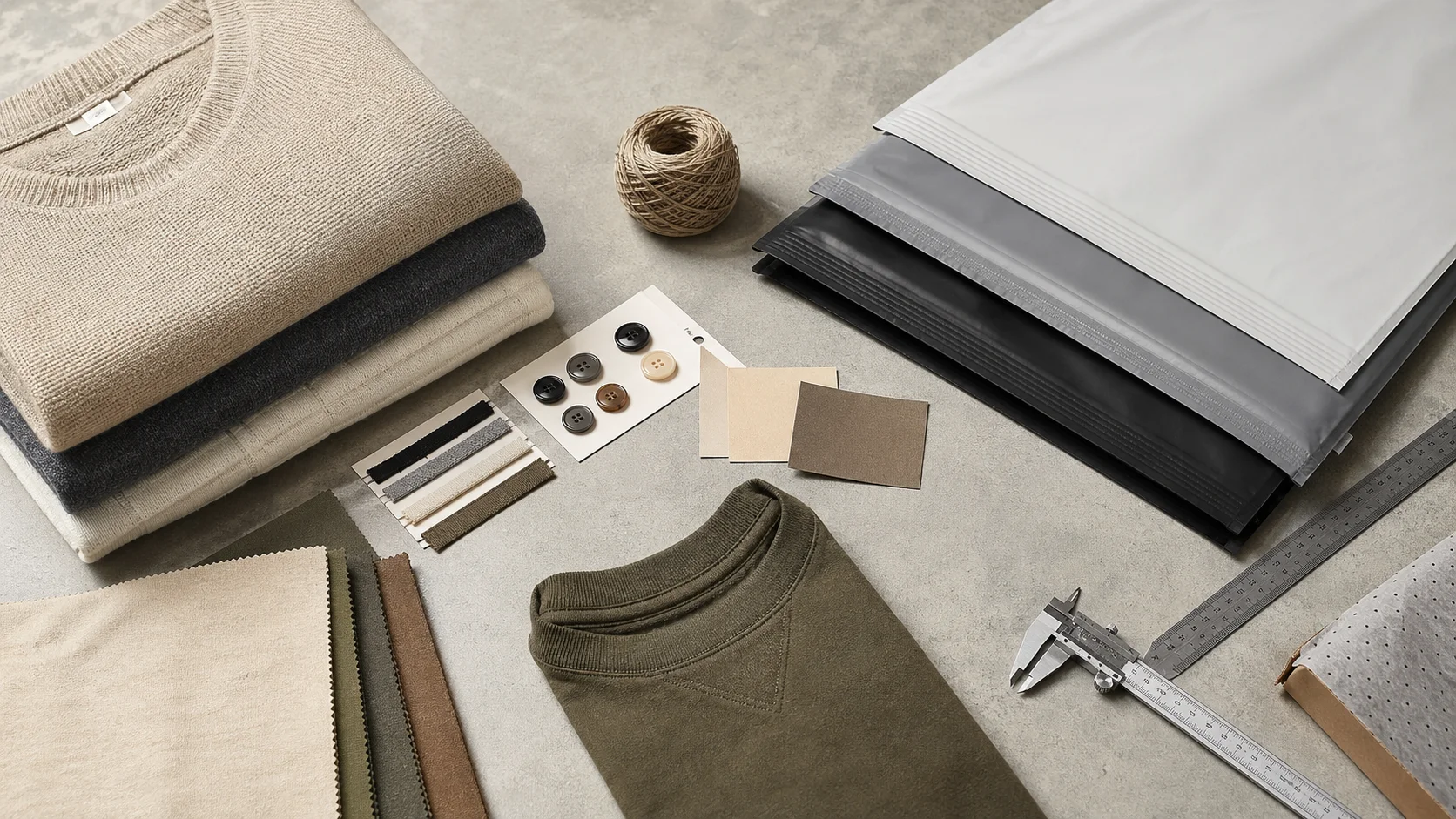
Custom Clothing Mailer Bags Wholesale China compared by sample evidence, fabric or trim specs, MOQ, AQL terms, cost lines, delivery timing, and rework...
Fast answer: Custom Clothing Mailer Bags Wholesale China: Material, Print, MOQ, and QC Terms should be judged by production evidence, not by a generic sourcing promise. The buyer needs sample proof, cost breakdowns, QC checkpoints, and delivery buffers in writing.
Ask for recent sample photos, measurement tolerances, fabric or print test assumptions, decoration test notes, packing examples, and a named inspection checkpoint. These details show whether the team can repeat an approved sample at bulk volume.
Separate garment cost, decoration, labels, packaging, sampling, testing, freight, and rush charges. Clear cost lines make it easier to reduce colorways, adjust size depth, or reserve more time for sampling.
Cheap packaging has a habit of turning expensive the moment it reaches a warehouse floor. In factory audits across Guangzhou, Zhejiang, Ho Chi Minh City, and Izmir, one number kept repeating: apparel brands can cut mailer costs by 20% to 45% versus domestic suppliers. Warehouse teams hate surprises. And freight, duty, and reject rates can still wreck the win in a single season. So custom clothing mailer bags wholesale China still dominate apparel shipping.
Five thousand bags one week. Five hundred thousand the next. China’s advantage showed up fast: tighter print consistency, broader film choices, quicker line changeovers on KAMMANN flexo lines, and integrated corona treatment so adhesives stick every time. Vietnam impressed me with nimble labor and smaller-batch flexibility on Ballyflex digital print presses. Turkey had the Europe angle and shorter transit. But China kept the deepest bench of co-extruded film suppliers, color-matching technicians, and packaging engineers who could switch from matte white to opaque black without losing registration on a 4-color print.
The lowest quote usually hides a tax. I have seen bags called out at 40 microns when they should have been 60 microns. I have also seen seams sealed just well enough to pass a glance and fail a warehouse drop test. Those orders looked cheap until the chargebacks hit. A 2% defect rate on a 50,000-piece run can cost more than paying a sturdier factory another 8% upfront. And returns, re-shipping, customer service time — all of it stacks.
Packaging is not an afterthought for apparel brands. It shapes conversion, repeat purchase behavior, and brand perception the same way fit and fabric do. Some labels obsess over French terry at 320 GSM and approve a weak mailer in ten minutes. Bad move. And if the order arrives scuffed, damp, or crushed, customers do not separate “garment” from “packaging.” They read the whole thing as one experience.
Material choice drives more than sustainability messaging. It changes puncture resistance, shelf appearance, and freight weight. No such thing as a magic bullet here. Virgin LDPE still wins when a brand wants strength, clarity, and a clean seal. Recycled PE can support lower-impact claims, but the resin blend needs checking because color variation and haze show up fast in white or pastel mailers. Co-extruded film sits in the middle: one layer for toughness, another for printability, with a surface that can take shipping abuse without turning brittle. Paper mailers work well for premium positioning, though they are not automatically greener if they trigger damage and replacement shipments.
Printing method changes the economics just as much. Flexographic printing fits large runs such as 30,000 to 300,000 pieces because plate costs spread out and repeatability stays strong. Gravure gives sharper image quality and richer solids, but the cylinder investment pushes it toward higher-volume programs. And digital print works for short runs, seasonal drops, and frequent artwork updates, especially when a brand tests 2 or 3 designs before scaling. I’ve seen labels save money with digital on a 5,000-piece pilot, then switch to flexo once the artwork stopped changing.
Thickness is where many buyers get misled. A 60-micron bag may cost more than a 40-micron version, but it can cut split seams, punctures, and handling complaints. In one factory visit near Dongguan, the supplier quoted a bag 11% cheaper at the thinner spec. Their test samples tore during a 1-meter drop test with folded denim inside. But that bargain gone.
Color and finish are not cosmetic details. Black opaque bags hide contents well and often feel premium, but they can show scuffs more clearly under bright retail lighting. And lighter colors improve presentation and usually reduce ink coverage, which matters on large-format mailers measured at 35 x 45 cm or bigger. Matte finishes hide fingerprints better than glossy ones. Soft-touch coatings feel expensive in hand, yet they can add 5% to 12% to the base quote.
Factories love a low base price, then tack on charges for zippers, tear strips, adhesive quality, vent holes, and special inks. I have seen an order jump from $0.18 to $0.27 per unit because every “optional” upgrade became necessary after the sample stage. Specify everything before you ask for a quote. And that matters even more if the order sits beside other programs like custom baby clothing manufacturing or a wider private label launch. Packaging is part of the product system, not a bolt-on expense.
Direct factories usually give tighter control over resin, print, and sealing, plus better pricing on runs above 10,000 units. Traders still earn their keep for small launches, mixed product lines, or buyers who need 3 packaging categories at once. I lean toward factories when the order is specific and repeatable. But traders make more sense when the brand wants speed, bundling, and one point of contact for mailers, hangtags, and insert cards.
Ask for the business license, export records, and an ISO 9001 certificate. If the supplier claims social compliance, request a current BSCI audit, WRAP certificate, and check that it matches the actual facility. For premium apparel, documented material compliance matters too. And if the bags will sit against finished garments for 30 days in storage, odor and ink migration stop being paperwork and start being product risk. Verify GOTS, OEKO-TEX Standard 100, or GRS labels on the film when required.
Samples tell you more than a glossy quotation ever will. I check seam strength, adhesive tack, odor, print registration, and scuff resistance first. And then comes the drop test, usually 1 meter, with folded knits or denim inside. If the film creases badly, the seal splits, or the artwork shifts more than 1 mm, production will probably magnify the problem. Factories that send spec sheets, tolerance ranges, and test results without being asked tend to run cleaner lines.
Location matters too. Coastal hubs such as Shenzhen, Dongguan, and Ningbo usually move export paperwork faster and get cartons to port with fewer handoffs. But inland plants in places like Anhui or Henan may quote 6% to 10% lower ex-factory pricing, and inland freight and the extra 2 to 4 days can swallow the savings. Same logic shows up in packaging vendors sitting beside a garment line — the specs travel with the product, defects get caught before cartons close, and the whole job runs cleaner. I have seen that work well in cut and sew manufacturing.
Price starts with MOQ, then moves through size, thickness, print colors, finish, and shipping terms. A simple white mailer with one-color print and a standard seal sits near the value end of the market. Add 60-micron film, 2-side printing, matte lamination, and tear strips, and the quote climbs fast. I have seen the same size bag priced at $0.12 per unit, only to watch it jump once zippers, adhesives, and inland miles got folded in.
A strong brief makes the supplier's job narrower and the quote more reliable. For custom clothing mailer bags wholesale china, include the target customer, sales channel, expected order quantity, size range, decoration needs, packaging requirements, and delivery market. Then call out the details most likely to affect the result, especially material grade, print tolerance, and barcode size.
The brief should also explain what cannot change. Some brands care most about hand feel, some about price, some about launch timing, and some about retail compliance. When those priorities are not written down, suppliers tend to optimize for whatever is easiest to quote. Clear priorities help the factory make better tradeoffs before the first sample is cut or printed.
Ask the supplier to respond with assumptions, not just a price. A useful reply states MOQ, sample route, production capacity, inspection plan, packing method, and freight handoff. If the answer is vague, the project may still work, but it needs a tighter pre-production stage before money and calendar pressure build up.
The best time to catch problems is before the pre-production sample is approved. Check measurements, color, placement, material behavior, shrinkage, construction, labels, and packaging in the same review instead of approving each item in isolation. Many bulk issues are not caused by one dramatic mistake; they come from several small unchecked assumptions.
For custom clothing mailer bags wholesale china, pay special attention to folding method, pack-out sequence, and retail compliance. These details often look minor in an email but become expensive once cutting, printing, sewing, packing, or shipping begins. A simple checklist with owner, due date, and approval status keeps the brand team and factory aligned.
Bulk production should not start until the supplier can explain how the approved sample becomes a repeatable production standard. That means reference sample storage, line instructions, inline checks, final inspection, and defect handling. A factory that can describe this process clearly is usually safer than one that only promises speed.
Price differences are useful only when the quotes cover the same work. Compare sample cost, material source, trims, decoration, packaging, testing, inspection, and freight assumptions. A low unit price can become expensive if it excludes items the brand needs before launch.
Timeline promises deserve the same scrutiny. Ask what happens if the first sample needs revision, whether materials are in stock, when the production slot is reserved, and how export packing is handled. The most reliable supplier is often the one that gives a realistic calendar instead of the fastest optimistic answer.
Before making the final decision, write down the specification, approval owner, delivery expectation, and the one or two risks that would cause the most trouble if missed. For custom clothing mailer bags wholesale china, this usually means checking material grade, print tolerance, barcode size, and the support process after the order is placed.
This last review does not need to be complicated. It simply makes the decision easier to repeat, easier to explain, and easier to verify when the finished product or jewelry arrives.
One useful way to pressure-test the decision is to ask what would happen if the order had to be repeated in six months. The answer should still be clear: the same material grade, the same print tolerance, the same acceptance standard, and the same communication path. If a second order would depend on memory or guesswork, the first order is not documented well enough yet.
Another useful check is to separate preference from requirement. Preference is the look, wording, or finish the brand likes. Requirement is the measurement, tolerance, certificate, material, or delivery condition that cannot fail. Good buying decisions keep both visible, so the final choice is not pushed around by the last email, the cheapest quote, or the prettiest sample photo.
Finally, ask who owns each approval. A project with one accountable owner for sample review, one owner for final content or artwork, and one owner for delivery sign-off usually moves faster than a project where every decision is shared loosely across a team. Clear ownership reduces delays and makes the finished result easier to judge.
The finished result should be judged against the approved standard, not against a vague idea of what looked good at the start. Compare the delivered item with the approved sample, written specification, photos, and any measurement or certification notes. If the result meets those points, the project is easier to reorder and easier to improve later.
If something is off, record it in practical terms: where the issue appears, how often it appears, whether it affects use, and what change would prevent it next time. That turns a complaint into a useful production note and helps the next order become more consistent.