
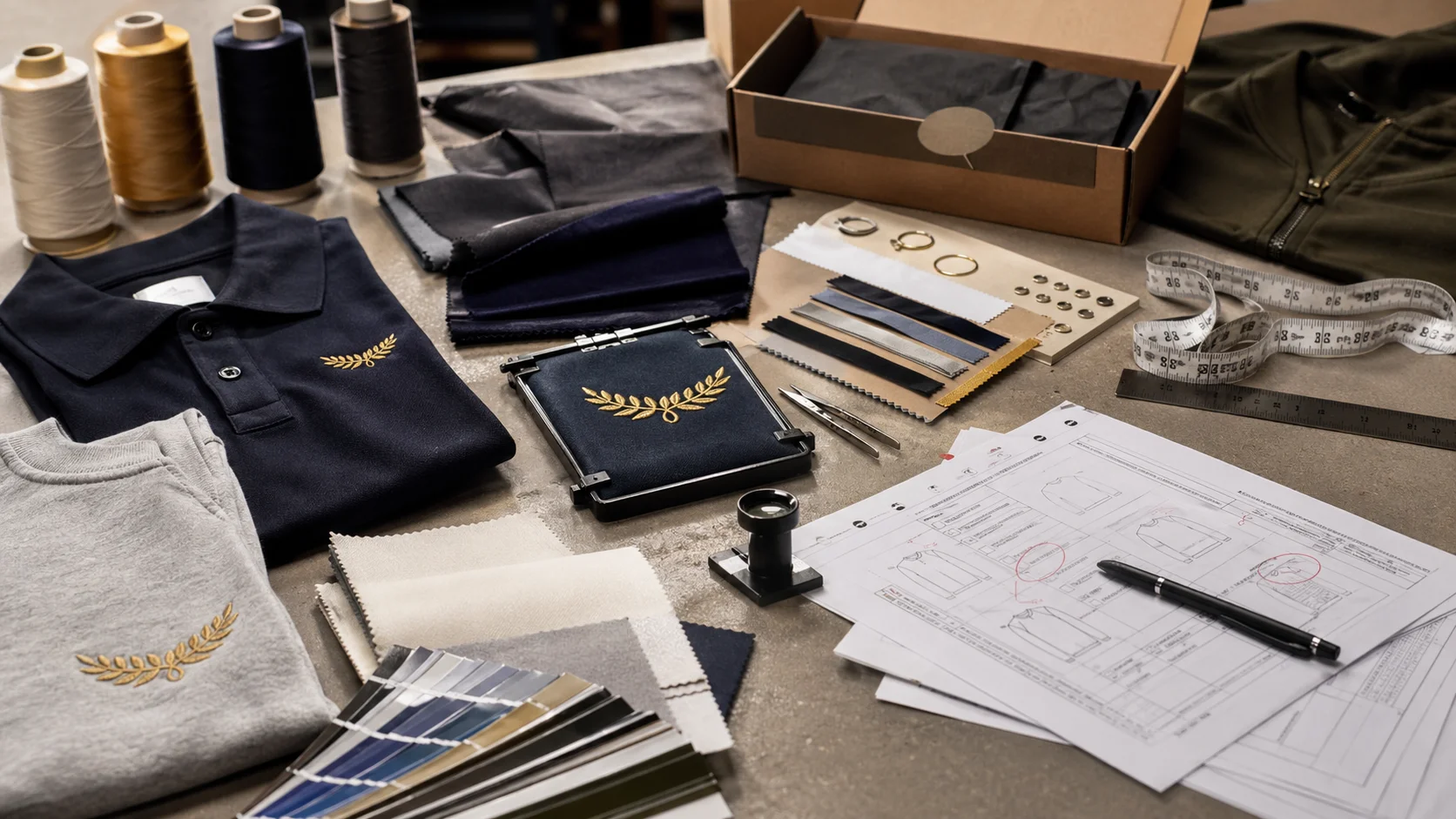
Ecommerce Clothing Box Packaging with checks for samples, fit, MOQ, QC evidence, pricing terms, and delivery risk.
Fast answer: Ecommerce Clothing Box Packaging: Board, Print, Inserts, and Freight should be judged by production evidence, not by a generic sourcing promise. The buyer needs sample proof, cost breakdowns, QC checkpoints, and delivery buffers in writing.
Ask for recent sample photos, measurement tolerances, fabric or print test assumptions, decoration test notes, packing examples, and a named inspection checkpoint. These details show whether the team can repeat an approved sample at bulk volume.
Separate garment cost, decoration, labels, packaging, sampling, testing, freight, and rush charges. When every cost line is visible, it becomes easier to reduce colorways, adjust size depth, or reserve more time for sampling.
I once watched a $38 T-shirt borrow the confidence of a $68 brand before anyone touched the fabric. Crisp box. Square edges. Real branding. Inside? Just ordinary cotton jersey. That is what branded clothing box packaging for ecommerce does. Quietly, but fast. The box lands first, and the shopper starts judging the brand before they ever judge the hem, the dye, or the fit.
Across price points, the pattern repeats. A $24 basics brand and a $240 premium knitwear label both got a lift from better presentation, just not in the same way. The low-price brand used packaging to justify a higher perceived quality. The premium brand used it to reduce buyer doubt, which matters because apparel returns often hover around 20% to 30% in online channels, depending on category and fit risk. Better presentation will not erase sizing issues, but when the product is close, not perfect, customers tend to be more forgiving.
Why does the first three seconds matter? Because shoppers decide almost instantly whether to keep the box, open it carefully, or toss it aside. When I visited fulfillment lines in Portugal, Vietnam, and Los Angeles, I timed this with warehouse teams. Intentional-looking boxes were opened more slowly, with more inspection and fewer immediate complaints. Plain mailers got treated like waste. A branded box read like a gift, even when the buyer paid for it themselves.
Clothing has more packaging flexibility than beauty or electronics. A lipstick tube can crack. A phone has compliance and protection demands. A shirt can survive a simpler structure if the board is stiff enough and the fold is accurate. That gives apparel brands room to shape emotion without paying for unnecessary protective hardware. I have seen brands spend $0.18 more per unit on a better box and save on customer service tickets, re-shipment costs, and negative reviews. That trade is not theoretical. It shows up in repeat orders, higher gift purchase rates, and fewer “arrived damaged” complaints.
Last year I worked with a brand that sold linen shirts at $79 and rugby polos at $112. After they switched from a plain poly mailer to branded outer packaging, repeat purchase rate rose by 11% over two quarters, while return reasons tied to “item feels cheap” fell by 14%. The garment did not change. The story around it did.
Before you ask for foil, embossing, or a magnetic closure, measure the box like a shipping object. I start with three things: internal dimensions, board grade, and compression performance. A folded knit top may fit in a 250 x 180 x 40 mm box. A hoodie in French terry 320 GSM usually needs something closer to 320 x 260 x 70 mm, depending on fold style and whether tissue is included. Fit matters because over-boxing inflates volumetric freight charges and creates void fill waste that customers notice immediately.
Ask suppliers for the board specification in plain language. For folding cartons, that might be 300-400 GSM SBS or kraft-lined board. For mailer-style apparel boxes, double-wall or reinforced E-flute is common when parcels face more abuse. Closure style matters too. Tuck-in lids are cheaper, often by $0.08 to $0.22 per unit. Magnetic closures can add $0.60 to $1.80, which is hard to justify unless the box gets reused or the product price supports it. Inserts matter only when movement creates creasing, snagging, or brand damage during transit.
Brand cues have to survive the journey, not just the mockup. A raised logo that scuffs in distribution is poor design, not premium design. Same story with dark solid colors on uncoated stock if your fulfillment center uses rough conveyor handling. When I visited a parcel hub in Germany, I saw black laminated boxes show corner wear after just two sortation cycles, while lightly textured kraft held up better despite a lower print budget.
Buyers should request these specs from every supplier:
For brands with more complex assortments, such as lingerie, layered basics, or bundled sets, I often point teams toward custom clothing packaging solutions from a manufacturer that can adapt one structure across multiple SKUs without redesigning the whole system. One box size can save weeks of sourcing, provided the fold is consistent and the product range is disciplined.
Material choice shapes both perception and unit economics. Kraft board is usually the leanest option, white SBS sits in the middle for print clarity, and rigid board leads on perceived value. In my factory visits across Spain, China, and Turkey, I saw kraft boxes produced by a manufacturer for $0.45 to $0.90 each at 3,000 units, white SBS cartons for $0.70 to $1.35, and rigid boxes from $1.80 to $4.50 depending on structure, lining, and finish. Those are broad bands, but they are realistic for apparel brands ordering in modest volume.
Kraft has an honest look. It works well for heritage labels, outdoor apparel, and sustainability-led brands. White SBS gives sharper color control and cleaner photography on pack, which matters if your logo uses pale tones or fine typography. Rigid board feels expensive in hand, but it also adds cubic weight and shipping cost. If the customer discards the box after opening, that premium can become waste with a logo on it.
Finishes are where budgets often go sideways. Matte lamination adds scuff resistance and a more muted feel, usually $0.06 to $0.18 per unit. Soft-touch lamination can add $0.15 to $0.40. Foil stamping often adds $0.10 to $0.35, embossing $0.08 to $0.22, and spot UV $0.07 to $0.20. Each of these can look beautiful, but each also creates extra setup, more spoilage risk, and more chance of inconsistency across runs of 5,000 or 10,000 units.
The thing nobody tells you: cheaper finishes can still look premium if print discipline is strong. I have held a $0.72 carton with one-color black ink, a tight grid, and a well-controlled matte varnish that looked more expensive than a $2.90 box overloaded with foil, soft-touch, and gloss spot coating. The difference was not the decoration budget. It was registration, ink density, and restraint. A weak logo on a rich substrate still looks weak.
Here is how I would compare price tiers:
If your assortment includes intimate apparel, fit-sensitive basics, or family ranges, the packaging brief changes fast. A supplier experienced in custom bra manufacturing understands delicate structures, shape retention, and presentation details that ordinary garment boxes often ignore. That matters more than a flashy finish, especially for product lines where perceived softness and care influence repeat purchase behavior.
Lead time is not a vague promise. It is a sequence of events that can slip at each handoff. Domestic production in the US or EU often runs 10 to 20 days for standard cartons, while offshore production commonly runs 25 to 45 days before sea freight. Air freight can compress transit to 3 to 7 days, but at a cost that can double or triple landed pricing on light but bulky packaging.
Sampling is where many launches stall. A structural sample can take 3 to 7 days. Print proofing may add 2 to 5 days. If you request foil, embossing, or a custom insert, tooling can add 5 to 12 more days. Then there is freight. Ocean transit from Asia to the US West Coast often adds 18 to 28 days, plus customs and inland transfer. That means a 30-day project can easily become 60 days if artwork changes late.
MOQ is another trap. I have seen small brands get priced into a box they do not need because the supplier only offers 5,000-unit runs for the preferred size. A smaller brand may only need 1,000 or 1,500 units to test conversion. Paying 20% more per box can still be wiser than holding three extra months of inventory tied to a packaging gamble. Packaging should support launch velocity, not freeze it.
From brief to delivery, a realistic timeline looks like this:
Brands with multi-category assortments should think ahead. A label building a family basics line may need one box system for adults and another for children, especially if it also sells through marketplaces. I have seen teams pair apparel packaging with custom baby clothing manufacturing workflows so newborn sets and adult bundles can share color logic while keeping sizes separate and efficient.
Recycled content is useful only when the box can still perform. According to Textile Exchange, buyers are paying more attention to verified fiber and material claims than ever, and packaging is no exception. In carton sourcing, I want to see post-consumer recycled content percentages stated clearly, along with FSC certification where applicable. A claim that says “eco-friendly” without a percentage or certificate is marketing, not evidence.
In practice, 30% to 100% recycled fiber options exist, but higher recycled content can reduce stiffness and whiteness. That is fine if the brand design accepts a natural look. Water-based inks usually improve recyclability compared with heavy UV coatings, and soy or vegetable-based inks can be useful for some print processes. Adhesives matter too. Hot-melt glues, lamination films, and plastic windows can complicate recycling even when the board itself is recyclable.
Extra coatings can undo good intentions. A box made from recycled board but wrapped in plastic laminate may be less useful in regions with weak recycling systems. I have seen well-meaning brands specify soft-touch film on a “sustainable” box, then ship into markets where consumers cannot easily separate layers. In the UK and parts of the EU, paper recycling is relatively familiar. In some US cities, collection rules vary by municipality. In parts of Southeast Asia, informal recycling networks may recover corrugated better than coated cartons.
Data from trade.gov trade reporting also shows how packaging materials move globally in large volumes, which is one reason claims should be precise. If the carton crosses two or three borders before it reaches the customer, every extra finish complicates both cost and disclosure. For brands that want a cleaner setup, recycled kraft, soy-based inks, and minimal lamination usually create the best balance of carbon, waste, and end-of-life clarity.
I advise teams to ask suppliers for proof of chain-of-custody documents, not just a logo. That means certificates, mill references, and ink specifications. Sustainability sells only when it is measurable.
Luxury is often a matter of control, not decoration. A fold that sits straight. A lid that closes with a clean click. A tissue sheet that does not wrinkle into a mess. Those details change the emotional reading of a parcel more than an extra coating ever will. I have opened boxes where the insert was perfect, but the typography was badly kerned, and trust dropped instantly.
Keep the system consistent across DTC and marketplace orders. A shopper who receives the same palette, logo scale, and insert message on a branded site order and a marketplace order learns that the brand is disciplined. If your navy drifts from one batch to another, or your logo changes size across cartons, the customer notices. Print variance of even 5% in color density can make a box look off-brand under retail lighting or kitchen light.
One of the easiest wins is a simple sleeve or belly band over a standard box. It adds presence without forcing you into a fully custom rigid structure. Tissue paper, a thank-you card, or a one-line care note can also improve retention, but keep the copy short. Overwriting the pack makes it feel like a brochure, not a product.
Brands serving premium basics or curated bundles often reach for private label clothing services because the packaging has to match the consistency of the garments. A box that says “premium” while the print is misaligned, or the magnet sits crooked, weakens trust faster than a plain box ever could.
Before you place the order, ask for a sample set, a production proof, and a shipping test plan. Do not compare quotes unless the dimensions, board grade, finish, and carton count are identical. I have seen a $0.88 quote beat a $1.10 quote only because one supplier used 280 GSM board and the other used 350 GSM. That is not a fair comparison. It is a trap.
Send these questions to every factory or supplier:
Ask for at least three sample types: white dummy, structural sample, and final printed sample. Then test them with a 1 kg or 2 kg product load, depending on your SKU, and run a drop from 80 cm to 100 cm if your parcel network is rough. Approval should cover artwork, dieline, carton counts, and packing method before production begins. Lock the size, print file, and delivery date in writing.
The best quote is the one with fewer surprises. Good factories will tell you where they can save 10% and where they cannot. Bad suppliers hide the cost until the reorder. If you are sourcing from China, ask for the production schedule, quality checkpoints, and carton-loading photos before final payment.
For standard apparel cartons, expect roughly $0.45 to $1.35 per unit at 3,000 to 5,000 pieces for kraft or SBS board. Rigid boxes with foil, embossing, or inserts usually run $1.80 to $4.50 or more. Freight, sampling, and customs can add another 10% to 30% to landed cost.
Domestic production often takes 10 to 20 days after proof approval. Offshore production usually takes 25 to 45 days before freight, with sea shipping adding 18 to 28 days and air freight adding 3 to 7 days. Sampling can add another 5 to 12 days if you need custom tooling.
For most apparel brands, white SBS works best for sharp print, kraft works best for a natural look, and rigid board works best for premium perception. The right choice depends on product price, shipping method, and whether the box will be kept or discarded after opening. Recyclability is usually better with fewer coatings.
Yes, when the packaging makes the purchase feel intentional and high-quality. In my experience, brands that improve presentation often see better repeat purchase rates and fewer “felt cheap” complaints, especially in the $24 to $120 apparel range. Packaging will not fix sizing problems, but it can soften the customer’s judgment.
Approve the size, artwork, board grade, finish, carton count, and delivery terms before production. Also confirm the sample type, test results for compression or drops, and the exact Incoterms. If any of those change after sign-off, ask for a revised quote and a new proof.